

Hello there! I am the Lead Editor of Daily Hangul.
If you have been studying Korean long enough to reach the advanced (C2) level, you probably already watch Korean news, read editorials, and have deep conversations with your local friends over a pint of beer. But have you ever noticed a recurring theme in Korean society that is rarely covered in traditional language textbooks, yet constantly dominates the news and casual conversations among young adults?
Picture this: You are watching a critically acclaimed K-Drama. The protagonist, exhausted by the fiercely competitive life in Seoul, packs their bags and returns to their quiet, beautiful hometown by the sea. They find peace, romance, and community. It is a beautiful story of healing. But when you turn off the TV and meet your Korean friends from the southern provinces, their reality is quite different. They sigh deeply while saying, “다들 서울로 가려고 난리야” (Dadeul seoul-lo garyeogo nalliya) [Everyone is desperate to go to Seoul].
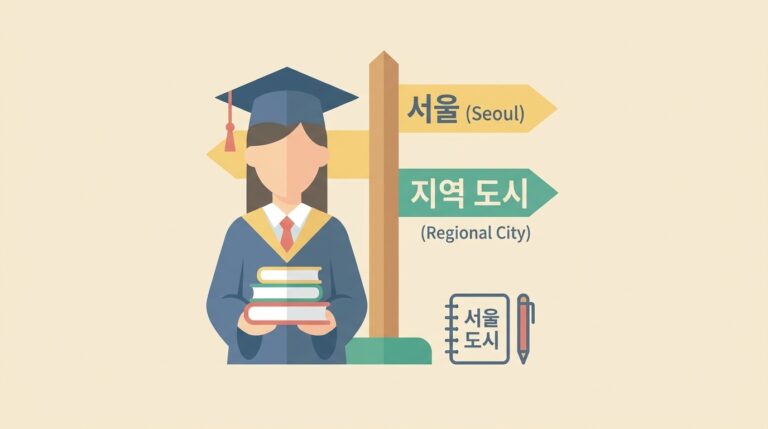
Why does everyone want to flock to Seoul, and what is happening to the rest of the country? Today, we are diving deep into one of the most pressing socio-economic issues in modern Korea: the hyper-centralization of Seoul, the struggle to nurture Regional Flagship National Universities, and the critical mission to prevent the brain drain from rural and local areas.
By mastering the vocabulary and cultural nuances in this unit, you will instantly transition from a ‘foreigner who speaks good Korean’ to an ‘insider who truly understands Korean society.’ Let’s get started!
Phase 2: Deep Dive into Core Expressions
1. 지방 소멸
Pronunciation: jibang somyeol
Meaning: Regional Extinction (Literal) vs. Depopulation and decline of areas outside the capital (Real nuance)
K-Culture Moment: This phrase frequently appears in news broadcasts and documentaries. You will also hear politicians using it during election seasons to emphasize the urgency of regional development.
Editor’s Insight: The word 소멸 (somyeol) sounds very dramatic—it means ‘extinction’ or ‘vanishing.’ When Koreans use this term, they are expressing a genuine fear that entire towns, schools, and local cultures will disappear due to the falling birth rate and youth migration to Seoul.
Situation Spectrum:
친구 사이(Casual): ✅ (Often discussed when visiting a hometown that feels emptier)
직장 동료(Semi-formal): ✅ (Common in social/economic discussions)
직장 상사·어른(Formal): ✅ (Highly appropriate for formal debates)
🤔 Think About It: Why use such a strong word like ‘extinction’? In your home country, how do you describe the phenomenon of rural depopulation? Does it carry the same existential weight as it does in Korea?2. 지거국
Pronunciation: jigeoguk
Meaning: Regional Flagship National University (Literal abbreviation of 지역 거점 국립대학교 – jiyeok geojeom gungnip daehakgyo)
K-Culture Moment: High school seniors and their parents talk about this constantly. In the past, graduating from a 지거국 like Pusan National University or Kyungpook National University guaranteed elite status and a prestigious local job. Today, students agonize over whether to attend a mid-tier university in Seoul or a top-tier 지거국.
Editor’s Insight: This is a classic Korean abbreviation (줄임말). Knowing this term instantly proves your C2 level. It carries a sense of local pride but also an underlying anxiety about the diminishing prestige of regional schools compared to the past.
Situation Spectrum:
친구 사이(Casual): ✅
직장 동료(Semi-formal): ✅
직장 상사·어른(Formal): ⚠️ (In formal writing or speeches, use the full term: 지역 거점 국립대)
🤔 Think About It: Korea has a heavy emphasis on university rankings. How does the centralization of top universities in the capital affect the economic balance of the entire country?3. 인서울
Pronunciation: in-seoul
Meaning: In Seoul (Literal) vs. Getting accepted into a university located within Seoul (Real nuance)
K-Culture Moment: You will hear this in almost every high school K-Drama (like SKY Castle or Black Dog). A teacher might shout, “If you study like this, you can’t even dream of ‘In-Seoul’!”
Editor’s Insight: It is technically a Konglish word, but it has become a powerful social concept. It represents not just education, but the gateway to better infrastructure, cultural events, and high-paying jobs. Failing to go ‘In-Seoul’ is often viewed by society as falling behind, which drives the massive brain drain.
Situation Spectrum:
친구 사이(Casual): ✅
직장 동료(Semi-formal): ✅
직장 상사·어른(Formal): ⚠️
🤔 Think About It: Why did a simple geographic location become an adjective for success? What is the equivalent of ‘In-Seoul’ in your culture?
Phase 3: Textbook vs. Real Korean
Discussing University Choices
* 📖 Textbook Korean: 우수한 학생들이 수도권 대학교로 진학합니다. (usuhan haksaengdeuri sudogwon daehakgyoro jinhakhamnida.) [Excellent students advance to universities in the metropolitan area.]
* 🗣️ Real Korean: 요즘 애들 다 인서울 하려고 난리잖아. 지방대는 미달이고. (yojeum aedeul da in-seoul haryeogo nallijana. jibangdaeneun midarigo.) [Kids these days are going crazy trying to get In-Seoul. Regional universities are under-enrolled.]
* 💡 Why the difference?: Real conversations use vivid expressions like ‘난리’ (chaos/craze) and ‘미달’ (falling short of the quota) to reflect the emotional reality of the demographic crisis.
Discussing Finding Jobs
* 📖 Textbook Korean: 지역 사회의 인재 유출이 심각한 문제입니다. (jiyeok sahoe-ui injae yuchuri simgakan munjeimnida.) [The brain drain of the local community is a serious problem.]
* 🗣️ Real Korean: 지거국 나와도 결국 취업은 다 서울로 가야 돼. (jigeoguk nawado gyeolguk chwieobeun da seoul-lo gaya dwae.) [Even if you graduate from a regional flagship national university, you ultimately have to go to Seoul to get a job.]
* 💡 Why the difference?: The formal version focuses on the systemic issue, while the casual version personalizes the struggle using the practical term ‘취업’ (employment) and the abbreviation ‘지거국’.
Bottom Note: At the C2 level, your goal is to seamlessly transition between the formal analytical language (used in essays and news) and the raw, lived-experience language (used at the pojangmacha with friends).
Phase 4: Cultural Context — K-Culture Deep Dive
4-1. Non-Verbal Elements: The Art of Nunchi in Social Issues
When discussing regional inequality in Korea, the non-verbal cues are just as important as the words. If a friend from a rural area talks about their hometown’s decline or the lack of jobs, do not offer overly simplistic solutions like, “Why don’t you just move back and start a farm?” Listen with a subtle nod, perhaps a soft, empathetic sigh. In Korean culture, 눈치 (Nunchi) dictates that you acknowledge the structural difficulties they face before offering unsolicited optimism.
4-2. K-Culture Connection: Media vs. Reality
K-Drama Tropes and the Romanticization of Rural Life
Think of beloved dramas like Hometown Cha-Cha-Cha or Welcome to Samdal-ri. They portray regional towns as idyllic sanctuaries for Seoulites who have suffered from corporate burnout. The locals are warm, the sea is sparkling, and life is slow.
However, for actual youths living in these areas, the reality is a fierce battle against 인재 유출 (brain drain). While the dramas show professionals happily returning to the countryside, real-life graduates from Regional Flagship National Universities often feel forced to buy a one-way KTX ticket to Seoul because the headquarters of major corporations and cultural infrastructures are heavily concentrated there. Understanding this gap between the romanticized K-Drama countryside and the socio-economic reality will make your discussions in Korean incredibly profound.
Phase 5: Real-Life Roleplay Scenario
Setting: A Friday evening, 8:00 PM. A bustling makgeolli tavern near Pusan National University (one of the top Regional Flagship National Universities). Rain is lightly tapping against the window. You are sitting at a round metal table with your Korean lab mates. Seafood green onion pancake (해물파전) and bowls of makgeolli are on the table.
Characters:
* YOU: A foreign graduate student studying urban sociology in Busan. You love the local culture but understand the struggles of your peers.
* Ji-hoon: (28, a native of Busan, your lab mate. Smart, proud of his city, but currently stressed about job hunting.)
Dialogue:
Ji-hoon: 아, 오늘 교수님 면담했는데 진짜 답답하다. 건배나 하자! 짠!
(a, oneul gyosunim myeondamhaenneunde jinjja dapdaphada. geonbaena haja! jjan!)
[Ah, I had a meeting with the professor today and I’m so frustrated. Let’s just toast! Cheers!]
YOU: 고생했어요. 근데 왜요? 취업 얘기 때문에요?
(gosaenghaesseoyo. geunde waeyo? chwieop yaegi ttaemuneyo?)
[You worked hard. But why? Because of the job hunting talk?]
Ji-hoon: 어. 교수님은 자꾸 부산에 있는 공기업 준비하라고 하시는데… 솔직히 기회가 서울에 훨씬 많잖아.
(eo. gyosunimeun jakku busane inneun gonggieop junbiharago hasineunde… soljikhi gihoega seoure hwolssin manjana.)
[Yeah. The professor keeps telling me to prepare for public enterprises here in Busan… but honestly, there are way more opportunities in Seoul.]
YOU: 하긴, 요즘 뉴스 봐도 ‘인재 유출’ 문제가 심각하다고 매일 나오잖아요.
(hagin, yojeum nyuseu bwado ‘injae yuchul’ munjega simgakhadago maeil naojannayo.)
[True, even watching the news these days, they say the ‘brain drain’ problem is serious every day.]
Ji-hoon: 맞아. 우리 학교가 명색이 ‘지거국’인데, 선배들도 결국 다 서울로 올라가더라고. 인프라가 다 수도권에 몰려있으니 원…
(maja. uri hakgyoga myeongsaegi ‘jigeoguk’inde, seonbaedeuldo gyeolguk da seoul-lo ollagadeorago. inpeuraga da sudogwone mollyeoisseuni won…)
[Right. Our school is a ‘Regional Flagship National University’ in name, but even the seniors end up going up to Seoul. Since all the infrastructure is concentrated in the metropolitan area…]
YOU: 지훈 씨는 그럼 졸업하고 무조건 서울로 갈 생각이에요?
(jihun ssineun geureom joreophago mujogeon seoul-lo gal saenggagieyo?)
[So Ji-hoon, are you planning to absolutely go to Seoul after graduation?]
Ji-hoon: 고민 중이야. 서울공화국에서 버틸 수 있을까 싶기도 하고… 너는? 졸업하면 어떡할 거야? 계속 한국에 남을 거면 너도 서울로 갈래?
(gomin jung-iya. seoulgonghwagugeseo beotil su isseulkka sipgido hago… neoneun? joreophamyeon eotteokhal geoya? gyesok hanguge nameul geomyeon neodo seoul-lo gallae?)
[I’m contemplating. I wonder if I can survive in the ‘Republic of Seoul’… What about you? What will you do after graduation? If you stay in Korea, will you go to Seoul too?]
🔀 Your Turn! How should you respond?
* A) “네! 서울이 최고죠. 부산은 시골이잖아요.”
* B) “저도 고민이에요. 서울 인프라가 탐나긴 하지만, 지역 균형 발전도 중요하니까요.”
* C) “아무데나 돈 많이 주는 곳으로 갈 거예요!”
✅ Best Choice: B — Reason: It shows immense empathy and a high-level understanding of Korean societal issues. You acknowledge the allure of Seoul while intellectually dropping the phrase “지역 균형 발전” (balanced regional development), which will deeply impress a C2 conversational partner.
⚠️ Choice A Analysis: Calling Busan a “시골” (countryside/rural area) is highly offensive to locals. Busan is Korea’s second-largest city. Never diminish regional pride!
Phase 6: 10-Second Shadowing Drill
Let’s practice a high-level, sophisticated sentence you can use when debating this topic. Pay attention to the pausing (/) and intonation.
🤔 진지하게 / jin-ji-ha-ge
지방 소멸을 / 막으려면, / 양질의 일자리가 / 지역으로 내려와야 한다고 / 생각해요.
(jibang somyeoreul / mageuryeomyeon, / yangjirui iljariga / jiyeogeuro naeryeowaya handago / saenggakaeyo.)
[I think that in order to prevent regional extinction, high-quality jobs must come down to the local areas.]
Phase 7: K-Culture Mini Dictionary
1. 서울공화국
* Romanization: seoulgonghwaguk
* English: Republic of Seoul
* Context: A satirical term criticizing the extreme concentration of political, economic, and cultural power in Seoul, treating the rest of the country merely as the periphery.
2. 수도권 집중 현상
* Romanization: sudogwon jipjung hyeonsang
* English: Phenomenon of Metropolitan Concentration
* Context: The academic and journalistic term for everything (population, wealth, education) gathering in Seoul, Incheon, and Gyeonggi-do.
3. 혁신도시
* Romanization: hyeoksindosi
* English: Innovation City
* Context: Planned cities across Korea created by the government. They relocated public institutions (공공기관) from Seoul to these cities specifically to fight brain drain and support regional flagship universities.
4. 대학가
* Romanization: daehakga
* English: University Town / Neighborhood
* Context: The commercial district around a university. Regional flagship universities usually have massive, vibrant 대학가 filled with cheap food, indie culture, and youth energy, serving as the cultural heart of the local city.
Phase 8: Traveler’s Survival Kit
Even if you are just visiting Korea for a short time, you might travel outside Seoul to experience true local charm. The best places to eat cheaply and feel the local youth culture? The 대학가 (University Towns) of Regional Flagship National Universities (like PNU in Busan, KNU in Daegu, or CNU in Gwangju).
🆘 Survival Phrases for the Local University Town
– 🇰🇷 “여기 대학생들 많이 가는 찐 맛집이 어디예요?” (yeogi daehaksaengdeul mani ganeun jjin matjibi eodiyeyo?)
– 🗣️ English translation: Where is the real local restaurant that university students go to around here?
– 📍 Where to use: Asking a guesthouse host or local cafe owner.
– 💡 Pro Tip: Regional university students take immense pride in their local food (like Dwaeji Gukbap in Busan). Ask them for recommendations, and they will treat you like a VIP!📌 Editor’s Travel Note
– Transportation: KTX is great, but SRT is often cheaper and sometimes faster depending on your starting point in Seoul (Suseo Station vs. Seoul Station).
– Regional Dialects (Saturi): Don’t panic if the Korean you hear sounds completely different from your Seoul-based textbooks. Just smile and say, “사투리가 매력적이네요!” (Your dialect is charming!).
Phase 9: Critical Thinking Corner — “One Step Deeper”
🧠 Think Deeper: Media vs. Reality (미디어와 현실의 괴리)
K-Dramas have successfully sold the image of rural Korea as a ‘healing haven’ to the global audience. We see gorgeous coastal cafes, slow-paced living, and tight-knit communities. However, this aestheticized version of rural life often masks the severe socio-economic reality of 지방 소멸 (regional extinction). For many young Koreans, leaving their hometown is not a choice, but a harsh necessity for survival, education, and career advancement. While the media packages the countryside as an escape for the wealthy or exhausted urbanite, the local governments are desperately fighting to keep their youth from leaving for the capital. Understanding this duality adds profound depth to your grasp of Korean culture.💬 Your Turn: Does your home country struggle with a “capital vs. regions” divide? Do your media romanticize rural areas while ignoring the economic struggles? Share your thoughts in the comments below!
Phase 10: FAQ & Avoiding Misunderstandings
Q: Is it okay to use the word “시골” (sigol – countryside) to describe anywhere outside Seoul?
No! This is a huge mistake. Koreans playfully say “Everything outside Seoul is the countryside,” but if a foreigner calls metropolitan cities like Busan, Daegu, or Daejeon “시골,” locals might get offended. Use 지방 (jibang – provinces/regions) or 지역 (jiyeok – local area) instead.
Q: Can I ask a Korean friend why they didn’t go to an “In-Seoul” university?
Maybe, but tread carefully. University prestige is a highly sensitive topic. Unless you are very close, it is better to praise their current university, especially if it is a respected 지거국 (Regional Flagship).
❌ Common Mistake #1: Assuming “지방대” (Regional University) always means a lower-tier school.
✅ Do this instead: Recognize that Regional Flagship National Universities (지거국) like Pusan National or Kyungpook National have incredibly proud histories and produced many of Korea’s top industry leaders.
Phase 11: Summary & Action Items
One-Liner Summary: Understanding terms like 지방 소멸 (Regional Extinction) and 지거국 (Regional Flagship Universities) unlocks the door to the most realistic and urgent conversations about modern Korean society.
Action Mission 3 Steps:
– 🥉 Bronze (Solo): Look up a map of Korea and memorize the locations of at least three Regional Flagship National Universities (e.g., Busan, Daegu, Gwangju).
– 🥈 Silver (Online): Go to a Korean news YouTube channel, search “지방 소멸” or “인재 유출,” and try to catch those exact words in the broadcast.
– 🥇 Gold (Real World): The next time a Korean friend tells you they are from a city outside Seoul, ask them: “오, 거기 지거국 유명하지 않나요?” (Oh, isn’t the regional flagship university famous there?) Watch their eyes light up!
K-Culture Mission: Watch an episode of a K-Drama set outside of Seoul. Look beyond the romance and try to spot the subtle social commentaries—are the young characters struggling to find work? Are they trying to move to Seoul?
Did today’s lesson change your perspective on Korean society? Let me know in the comments! 👇
Phase 12: Quiz — Interactive Challenge
1. Situational Judgment:
You are at a formal symposium about Korean demographics. It is your turn to ask a question to the panel about young people leaving the southern provinces. Which phrase is the most appropriate for this C2-level formal setting?
* A) 다들 인서울 하려고 난리인데 어떡하나요? (What do we do when everyone is crazy about going In-Seoul?)
* B) 우수한 청년들의 인재 유출을 막을 방안이 있습니까? (Are there measures to prevent the brain drain of excellent youths?)
* C) 서울공화국 진짜 너무한 거 아닙니까? (Isn’t the Republic of Seoul really too much?)
👉 Click here for the answer!
Correct Answer: B.
Explanation: In a formal setting, you must use professional terminology. ‘인재 유출’ (Brain Drain) is perfect here. Option A is too casual (‘난리’), and Option C is too aggressive and informal for a symposium.
2. Fill in the Blank:
“I really wanted to stay in my hometown, but to find a job, I guess I have to go to Seoul… The ________ problem is so real.”
* A) 지거국 (jigeoguk)
* B) 혁신도시 (hyeoksindosi)
* C) 수도권 집중 (sudogwon jipjung)
👉 Click here for the answer!
Correct Answer: C.
Explanation: ‘수도권 집중’ means the concentration in the capital area, which forces youth to leave their hometowns for jobs.






