

Phase 1: Empathy & The K-Culture Cold Open
Hello! Daily Hangul Editor here.
Imagine this: You are exploring the steep, winding streets of Bukchon Hanok Village, feeling like the main character in a historical K-Drama. You are busy snapping a photo, you miss a step, and BAM! You twist your ankle.
In a K-Drama, this is the exact moment the handsome male lead or the tough-but-sweet female lead swoops in, offers a piggyback ride, and carries you to safety while romantic OST music plays in the background.
But in reality? There is no OST. You are sitting on the ground, your knee is scraped, and you need to explain to the worried locals gathering around you that you are hurt.
Getting injured in a foreign country is scary. Your mind goes blank. But don’t worry! Knowing just a few basic emergency survival words can turn a stressful situation into a quick trip to the pharmacy. Let’s learn exactly what to say so you can get back to your K-Travel adventures safely!
Phase 2: Core Expressions Deep Dive
- 다쳤어요 (I am hurt / I got injured)
- Pronunciation: dachyeosseoyo [da-chuh-sso-yo]
- Meaning: I got hurt / I injured myself. (Literal: I got injured)
- K-Culture Moment: You will hear this in K-Dramas when a character shows up with a bandaged arm, and their friend gasps, “What happened?!” It is the clearest way to state that an accident occurred.
- Editor’s Insight: Think of this as your “status update.” You use this to explain what happened to you. You don’t even need to say “I” (저는). Just saying “dachyeosseoyo” is enough!
- Situation Spectrum:
- Casual (with friends): ✅ (Just drop the ‘yo’ and say 다쳤어 – dachyeosseo)
- Semi-formal (strangers/staff): ✅
- Formal (boss/elders): ⚠️ (Needs more context, but acceptable in emergencies)
- 🤔 Think About It: In English, we often say “I hurt my arm.” In Korean, the subject “I” is almost always dropped, especially in emergencies. Why do you think Korean language focuses more on the action itself rather than who did it?
- 아파요 (It hurts / I am sick)
- Pronunciation: apayo [ah-pah-yo]
- Meaning: It hurts / I am in pain / I am sick.
- K-Culture Moment: From a tiny paper cut from a K-Pop album photocard to eating way too spicy Tteokbokki and clutching your stomach, “apayo” is the ultimate pain word.
- Editor’s Insight: While “dachyeosseoyo” means an event (an injury) happened, “apayo” describes the feeling of pain. Just point to where it hurts and say “Apayo!”
- Situation Spectrum:
- Casual: ✅ (아파 – apa)
- Semi-formal: ✅
- Formal: ✅
- 🤔 Think About It: Koreans use “apayo” for both “my leg hurts” and “I am sick with a cold.” What does this tell us about how Koreans view physical distress as a single, unified concept?
- 도와주세요 (Please help me)
- Pronunciation: dowajuseyo [doh-wah-joo-seh-yo]
- Meaning: Please help me.
- K-Culture Moment: The classic thriller movie scene. A character is running down a dark alley in Seoul shouting this. But in real life, you can use it politely when you drop your bags on the subway or need someone to call an ambulance.
- Editor’s Insight: The ending “-juseyo” means “please give me.” So you are literally saying “please give me the favor of your help.”
- Situation Spectrum:
- Casual: ✅ (도와줘 – dowajwo)
- Semi-formal: ✅
- Formal: ✅
Phase 3: Textbook vs. Real Korean
Let’s see how real Koreans speak when they are in pain!
Situation 1: You tripped and scraped your knee.
* Textbook Korean: 저는 무릎에 부상을 당했습니다. (I have sustained an injury to my knee.)
* Real Korean: 아! 저기요, 저 다쳤어요. (Ah! Excuse me, I got hurt.)
* Why the difference?: In an emergency, nobody uses formal noun structures. Drop the subject, use the verb directly, and get straight to the point!
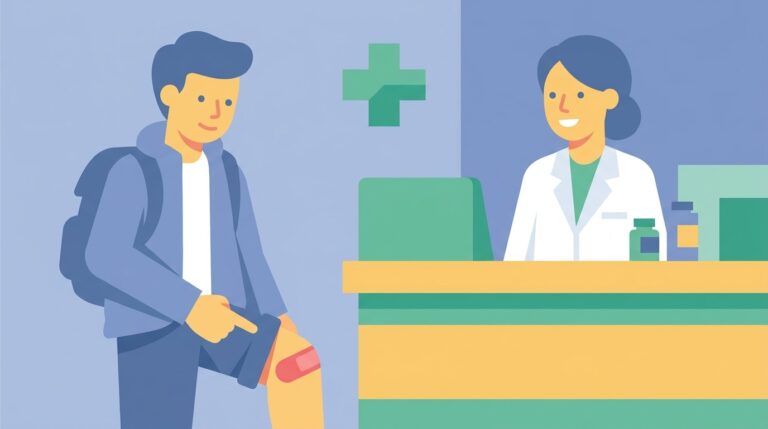
Situation 2: Showing the doctor or pharmacist where it hurts.
* Textbook Korean: 나의 다리에 통증이 있습니다. (There is pain in my leg.)
* Real Korean: 여기 아파요. (Here hurts.)
* Why the difference?: Pointing with your finger and saying “here” (여기 – yeogi) is the most efficient, universally understood survival Korean.
Phase 4: Cultural Context — K-Culture Deep Dive
Non-verbal Communication in Emergencies
When you are hurt, pointing directly at your wound is completely fine. Don’t worry about using two hands or being overly polite when you are bleeding! However, if you walk into a pharmacy (약국 – Yakguk) and you are not in a life-threatening situation, a slight bow of the head as you say “Apayo” will immediately activate the pharmacist’s friendly “Nunchi” (social sense). They will rush to help you.
K-Travel Connection: The Magic of the Korean Pharmacy
If your injury is minor (like a scrape, a blister from walking too much, or an upset stomach from street food), you do not need a hospital. You need a Yakguk! Korean pharmacies are everywhere. Look for a sign with the word 약 (Yak) in bold red or green letters. Korean pharmacists are incredibly helpful. Even if you only know the word “Apayo” and point to your ankle, they will bring you the perfect ointment, a bandage, and perhaps a cooling patch (파스 – Paseu).
Phase 5: Real-Life Roleplay Scenario
Setting: Friday afternoon. You are walking down the crowded shopping streets of Myeongdong. You are looking up at a massive K-Pop billboard, miss a curb, and trip. You scrape your knee badly, and it’s bleeding. A friendly local store owner rushes over.
Characters:
* YOU: A traveler exploring Seoul.
* Ajumma (A middle-aged Korean lady, very warm and concerned).
Dialogue:
Ajumma: 어머! 학생, 괜찮아요?
(Romanization: Eomeo! Haksaeng, gwaenchanayo?)
(English) Oh my! Student, are you okay?
YOU: 아… 아니요. 다쳤어요.
(A… aniyo. Dachyeosseoyo.)
(English) Ah… no. I am hurt.
Ajumma: 아이고, 피 나네! 어디 봐요.
(Aigo, pi nane! Eodi bwayo.)
(English) Oh my, it’s bleeding! Let me see.
(Stage Direction: The Ajumma looks at your knee with a worried face.)
YOU: 무릎이 너무 아파요.
(Mureubi neomu apayo.)
(English) My knee hurts so much.
Ajumma: 병원 갈래요? 아니면 약국?
(Byeongwon gallaeyo? Animyeon yakguk?)
(English) Do you want to go to the hospital? Or the pharmacy?
Your Turn! How should you respond?
* A) “저는 병원에 가고 싶습니다.” (I would like to go to the hospital – Textbook style)
* B) “약국 어디예요?” (Where is the pharmacy? – Practical and fast)
* C) “대박!” (Awesome! – Very inappropriate here)
Best Choice: B — Reason: If it’s just a scrape, a pharmacy is much faster and cheaper. Asking “Where is the pharmacy?” (yakguk eodieyo?) gets you immediate directions.
Choice C Analysis: Never say “Daebak” when you are bleeding, unless you are making a joke and have a very high pain tolerance! People will be very confused.
Ajumma: 저기 사거리 코너에 약국 있어요. 같이 갈까요?
(Jeogi sageori koneo-e yakguk isseoyo. Gachi galkkayo?)
(English) There is a pharmacy at the corner of the intersection over there. Shall we go together?
YOU: 아, 정말 감사합니다. 도와주세요.
(A, jeongmal gamsahamnida. Dowajuseyo.)
(English) Ah, thank you so much. Please help me.
Phase 6: 10-Second Shadowing Drill
Practice these lines out loud. Pay attention to the pauses (/) and the emotion tags!
- 😭 With a pained expression: 아! / 저 다쳤어요. (Ah! / jeo dachyeosseoyo.)
- 🥺 Pointing at your arm: 여기 / 너무 아파요. (Yeogi / neomu apayo.)
- 😰 Urgently: 실례하지만 / 도와주세요! (Sillyehajiman / dowajuseyo!)
Phase 7: K-Culture Mini Dictionary
Here are 4 words you must know for medical emergencies in Korea:
- 약국
* Romanization: Yak-guk
* English: Pharmacy
* Context: They sell over-the-counter medicine. Look for the big ‘약’ sign.
- 병원
* Romanization: Byeong-won
* English: Hospital / Clinic
* Context: In Korea, even small private clinics for minor colds are called “Byeong-won.”
- 파스
* Romanization: Pa-seu
* English: Pain relief patch
* Context: A staple in Korean households. If your muscles ache from hiking or walking around Seoul, put a “Paseu” on it!
- 눈치
* Romanization: Nun-chi
* English: Social sense / reading the room
* Context: If you look lost and in pain, Koreans with quick ‘nunchi’ will approach you to help before you even ask.
Phase 8: Traveler Survival Kit
Top 3 Survival Expressions for Emergencies
- Expression 1: “약국 어디예요?” (Yakguk eodieyo?)
- English Guide: [Yahk-gook uh-dee-yeh-yo?]
- Where to use: Asking anyone on the street for the nearest pharmacy.
- Pro Tip: Show them the word 약국 on your phone if your pronunciation isn’t clear.
-
Expression 2: “119 불러주세요.” (Il-il-gu bulleo-juseyo.)
- English Guide: [Eel-eel-goo bull-uh-joo-seh-yo]
- Where to use: In a severe emergency where you need an ambulance.
-
Pro Tip: 119 is the emergency number in Korea (fire and medical). 112 is for the police.
-
Expression 3: “영어 하세요?” (Yeong-eo haseyo?)
- English Guide: [Young-uh ha-seh-yo?]
- Where to use: At the hospital desk or pharmacy.
Editor’s Travel Note
* Useful Apps: Papago is the best translation app in Korea. You can type your symptoms in English, and it will translate perfectly for the pharmacist.
* Cost: Korean medical care is incredibly affordable, even for tourists without insurance. A simple doctor’s visit or a trip to the pharmacy will usually cost less than a few cups of coffee.
Phase 9: Critical Thinking — “One Step Deeper”
Media vs. Reality: The K-Drama Piggyback Ride
If you watch enough K-Dramas, you might think that every time someone sprains an ankle, a handsome CEO will appear out of nowhere to give them a piggyback ride (어바 – eoba) all the way home. While Korean people are incredibly helpful to strangers in distress, the reality is much more practical!
Instead of piggyback rides, Korea’s “reality” superpower is its world-class medical infrastructure. Pharmacies are on almost every street corner, and you can walk into a small clinic without an appointment and see a doctor within 15 minutes. The media romanticizes the injury, but the reality is a highly efficient system designed to get you healed fast.
Your Turn: What is the medical system like for tourists in your country? Is it easy to find a pharmacy? Share your thoughts in the comments!
Phase 10: FAQ & Avoiding Misunderstandings
- Q: Can I just use casual language (Banmal) if I am in a lot of pain?
- A: Yes and No. If you scream “Apaso 죽겠어!” (It hurts to death!) into the air, it’s fine because it’s an exclamation. But when directly asking a pharmacist or doctor for help, using “-yo” (아파요 – Apayo) is much better. They will help you either way, but maintaining basic politeness is appreciated.
-
Q: Do I need to show my passport at the pharmacy?
- A: No! For simple over-the-counter items like bandages, painkillers, or cold medicine, you just pay like a normal store. No ID required.
Common Mistakes
* Mistake 1: Using the word “Sick” (병 – Byeong) when you mean “Injured” (다쳤어요 – Dachyeosseoyo). If you fall and scrape your knee, you are injured, not diseased!
* Do This Instead: Always use 다쳤어요 (Dachyeosseoyo) for physical accidents like cuts, falls, or sprains.
Phase 11: Summary & Action Items
One-Liner Summary: When you get hurt in Korea, skip the complex grammar, point to the pain, and say “Apayo!” or find the nearest “Yakguk.”
Action Mission 3 Steps:
* Bronze (Solo): Stand in front of the mirror, point to your shoulder, and practice saying “여기 아파요” (Yeogi apayo) with a sad face.
* Silver (Online): Open your favorite map app (like Google Maps or KakaoMap), search for “Seoul”, and type “약국” to see how many pop up!
* Gold (Real Life): Put together a mini travel first-aid kit, and label your bandages with the word “다쳤어요”.
K-Culture Mission:
The next time you watch a K-Drama action scene or a hospital scene, listen closely. I guarantee you will hear someone shout “다쳤어요!” (Dachyeosseoyo!) or “도와주세요!” (Dowajuseyo!).
Engagement: Have you ever gotten hurt or sick while traveling in a foreign country? How did you communicate? Let us know below!
Phase 12: Quiz — Interactive Challenge
- Situational Judgment: You are eating hot K-BBQ and accidentally burn your finger on the grill. What is the most natural thing to say to your Korean friend?
* A) 저는 화상을 입었습니다. (I have sustained a burn.)
* B) 앗! 아파요! 다쳤어요. (Ouch! It hurts! I got hurt.)
* C) 119 불러주세요! (Call 119!)
- Fill in the Blank: You are looking for a pharmacy.
“Excuse me, where is the ________?”
“저기요, ________ 어디예요?” -
True or False – K-Culture Edition: If you get a small scrape in Korea, you must go to a big hospital because pharmacies only sell vitamins. (T/F)
Answers:
1. B is the most natural. A is too formal like a robot. C is too extreme for a small finger burn.
2. 약국 (Yakguk)
3. False! Korean pharmacies (Yakguk) are fully equipped to treat minor injuries with bandages, ointments, and pain relievers.







