Phase 1: Empathy & The Cold Open
Hello! I am the Lead Editor at Daily Hangul, your veteran tutor and local culture navigator.
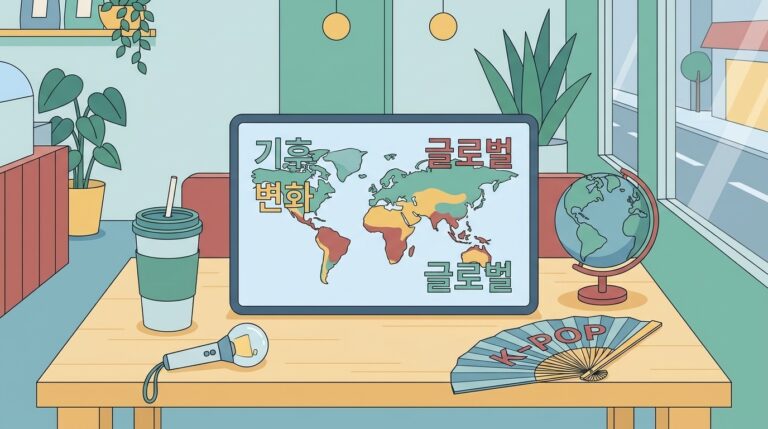
Picture this: You are sitting in a trendy vegan cafe in Seongsu-dong. Suddenly, the sky turns an eerie purple, and a torrential, unseasonal downpour smashes against the window. On the cafe’s large screen, the news anchor looks grave, discussing gihu nanmin (climate refugees) and extreme floods.
At a C1 level, you already know how to say ‘비가 많이 와요’ (It’s raining a lot). But when your Korean friends or colleagues start discussing the global climate crisis, international solidarity, and K-pop fandoms raising funds for climate refugees, you want to jump into the conversation like a true intellectual. If you don’t know the vocabulary of social solidarity in Korea, you might end up just nodding silently. Today, we are going completely beyond textbook weather phrases. We are diving into how modern Koreans discuss the climate crisis and international response.
(Transparency Note: This guide is crafted from real discussions I’ve had with advanced expat learners working in Seoul, navigating the highly socially-aware modern Korean workplace!)
—
Phase 2: Deep Dive into Core Expressions
1. 기후 난민을 위한 국제적 연대가 시급합니다.
- Pronunciation: gihu nanmineul wihan gukjejeok yeondaega sigupamnida. (Sounds like: gee-hoo nan-min-eul wee-han gook-jeh-jeok yuhn-dae-gah shee-geup-ham-nee-dah)
- Meaning: Literal: International solidarity for climate refugees is urgent. / Real nuance: We must globally unite *right now* to support those displaced by the climate crisis.
- K-Culture Moment: You will hear this exact phrasing from K-Pop idols giving speeches at the UN, or in the opening lines of a serious K-Drama featuring a dystopian future (like *Black Knight* or *The Silent Sea*).
- Editor’s Insight: The word **연대 (solidarity)** is incredibly powerful in Korean. It doesn’t mean looking down and ‘helping’ the less fortunate; it implies standing shoulder-to-shoulder horizontally as equals. It’s a heavy, deeply respectful word.
- Situation Spectrum: Casual: ⚠️ | Semi-formal: ✅ | Formal: ✅
- 🤔 Think About It: Why do modern Koreans prefer the word ‘연대’ (solidarity) over ‘원조’ (aid) when discussing international crises? How does your culture phrase global cooperation?
2. 강 건너 불 보듯 할 일이 아닙니다.
- Pronunciation: gang geonneo bul bodeut hal iri animnida. (Sounds like: gahng gun-nuh bool boh-deut hahl ee-ree ah-neem-nee-dah)
- Meaning: Literal: It is not something to look at like a fire across the river. / Real nuance: We cannot remain idle spectators; this affects us too.
- K-Culture Moment: When a passionate colleague at a team dinner (회식) discusses a recent typhoon in a neighboring country, stressing that Korea is next if we don’t act.
- Editor’s Insight: This is a brilliant, high-level idiom. A ‘fire across the river’ looks like a beautiful spectacle because it can’t reach you. Using this shows you deeply understand Korean metaphorical thinking regarding apathy.
- Situation Spectrum: Casual: ✅ (as 강 건너 불 보듯 하면 안 돼) | Semi-formal: ✅ | Formal: ✅
- 🤔 Think About It: Fire across a river implies a false sense of safety. Does your native language have an idiom about ignoring someone else’s disaster?
3. 선한 영향력을 실천하다.
- Pronunciation: seonhan yeonghyangnyeogeul silcheonhada. (Sounds like: sun-hahn yung-hyang-nyug-eul shil-chun-hah-dah)
- Meaning: Literal: To practice a good influence. / Real nuance: To use one’s platform or community power to drive positive global or social change.
- K-Culture Moment: This is the absolute buzzword of the K-Pop industry. When fans donate to climate refugee funds or plant ‘Star Forests’ (스타숲) to combat desertification in the name of their favorite idol, the media praises their ‘선한 영향력’.
- Editor’s Insight: It’s the ultimate compliment for someone driving social action. It shifts the focus from ‘charity’ to ‘influence’.
- Situation Spectrum: Casual: ⚠️ (A bit too grand for small talk) | Semi-formal: ✅ | Formal: ✅
- 🤔 Think About It: How has the concept of ‘fandom’ evolved from simple entertainment to international social activism?
—
Phase 3: Textbook vs. Real Korean
[Discussing Abnormal Weather]
- 📖 Textbook Korean: 최근 기후 변화가 매우 심각합니다. (Recent climate change is very serious.)
- 🗣️ Real Korean: 요즘 날씨 완전 동남아 우기 다 됐어. (Lately, the weather has completely become like a Southeast Asian monsoon.)
- 💡 Why the difference?: Koreans deeply cherish their traditional ‘four distinct seasons’ (뚜렷한 사계절). Comparing Seoul’s new torrential squalls to a tropical monsoon is the most common, visceral way locals express climate anxiety.
[Suggesting Eco-Friendly Action]
- 📖 Textbook Korean: 환경 보호를 위해 일회용품 사용을 줄입시다. (Let’s reduce the use of disposable products to protect the environment.)
- 🗣️ Real Korean: 우리도 **용기내 챌린지** 동참할까요? 텀블러 쓸게요! (Shall we join the ‘Courage/Container Challenge’? I’ll use my tumbler!)
- 💡 Why the difference?: Social media drives action in Korea. ‘용기’ (Yong-gi) is a brilliant pun meaning both ‘Courage’ and ‘Container’. Asking people to bring their own containers is framed as a trendy challenge rather than a boring rule.
(Bottom Note: For C1 learners, using puns like ‘용기내’ or referencing ‘우기’ (monsoon season) instantly elevates your Korean from ‘foreigner studying hard’ to ‘local insider’.)
—
Phase 4: Cultural Context — K-Culture Deep Dive
4-1. Non-Verbal Elements & ‘Nunchi’ in Activism
When discussing heavy topics like climate refugees, the Korean concept of 눈치 (Nunchi) plays a huge role. You do not want to sound preachy or act like you have the moral high ground. The most polite and culturally aligned way to suggest environmental action is to use ‘저희’ (we/our) instead of ‘나’ (I) or ‘당신’ (you). Say 저희가 할 수 있는 작은 일부터 해볼까요? (Shall we start with small things we can do?). It embraces the communal spirit of Korea.
4-2. The K-Pop Connection: Redefining Fandoms
If you think K-Pop is just about catchy dances, you are missing out on one of the most powerful forces in international climate response. Fandoms (팬덤) are highly organized global networks. When a climate disaster displaces communities, K-Pop fans are often the first to mobilize, raising hundreds of thousands of dollars within hours. Entertainment companies are now under immense pressure from fans to produce eco-friendly, biodegradable albums. By using terms like 선한 영향력 (Good influence), you tap right into this modern, progressive side of K-Culture.
—
Phase 5: Real-World Roleplay Scenario
Setting: Friday afternoon, 3 PM. A trendy vegan cafe in Seongsu-dong. Suddenly, a massive, unseasonal ‘squall’ hits the glass windows. You are sitting with Min-su, your Korean coworker.
Characters:
– YOU: An expat working in Seoul. Highly aware of global issues.
– Min-su (32): Your Korean colleague. Eco-conscious and reads a lot of global news.
Min-su: 와, 비 오는 것 좀 봐요. 요즘 한국 날씨 진짜 동남아 우기 같다니까요.
(Wa, bi oneun geot jom bwayo. Yojeum hanguk nalssi jinjja dongnama ugi gatdanikkayo.)
[Wow, look at the rain. The weather in Korea lately really feels like a Southeast Asian monsoon.]
(🎭 Stage Direction: Min-su looks out the window, looking genuinely concerned.)
YOU: 제 말이요. 아까 뉴스 보니까 이웃 나라에는 기후 난민까지 생겼대요.
(Je mariyo. Akka nyuseu bonikka iut naraeneun gihu nanminkkaji saenggyeotdaeyo.)
[Tell me about it. I saw the news earlier, and it said there are even climate refugees in neighboring countries now.]
Min-su: 맞아요. 기후 위기가 이제 남의 일이 아닌 것 같아요.
(Majayo. Gihu wigiga ije namui iri anin geot gatayo.)
[Exactly. It seems the climate crisis is no longer just someone else’s problem.]
YOU: 네, 더 이상 강 건너 불 보듯 할 일이 아니죠.
(Ne, deo isang gang geonneo bul bodeut hal iri anijo.)
[Yes, it’s no longer something we can just watch like a fire across the river.]
Min-su: (눈이 커지며) 와, 한국어 진짜 잘하시네요! 맞아요, 국제 사회의 연대가 시급해요. 우리가 뭘 할 수 있을까요?
(Wa, hangugeo jinjja jalhasineyo! Majayo, gukje sahoeui yeondaega sigupaeyo. Uriga mwol hal su isseulkkayo?)
[(Eyes widening) Wow, your Korean is amazing! You’re right, international solidarity is urgent. What can we do?]
🔀 Your Turn! How will you respond?
A) “글쎄요. 정부가 알아서 하겠죠.” (Well, I guess the government will handle it.)
B) “저희라도 당장 작은 선한 영향력을 실천해 볼까요? 오늘 일회용 컵 말고 머그잔 써요!” (Shall we at least practice a little good influence right now? Let’s use mugs instead of disposable cups today!)
C) “그냥 기도나 해야죠. 너무 무서워요.” (We just have to pray. It’s too scary.)✅ Best Choice: B — Reason: It perfectly incorporates the C1 vocabulary (‘선한 영향력’) and fits the active, communal problem-solving culture in modern Korean workplaces.
⚠️ Choice A Analysis: Very passive. While grammatically correct, it kills the conversation and goes against the Korean culture of ‘we’re in this together’.
Min-su: 오, 좋아요! 저도 마침 텀블러 가져왔어요. 용기내 챌린지 시작이네요!
(O, joayo! Jeodo machim teombeulleo gajyeowasseoyo. Yonginae chaellinji sijagineyo!)
[Oh, I like that! I actually brought my tumbler too. It’s the start of our Yongi-nae challenge!]
—
Phase 6: 10-Second Shadowing Drill
Repeat this sentence to sound like a native Korean news anchor or an impassioned activist!
😤 단호하고 호소력 있게 (Firmly and with an appealing tone):
기후 위기는 / 이제 더 이상 / 강 건너 불 보듯 할 일이 / 아닙니다!
(gihu wigineun / ije deo isang / gang geonneo bul bodeut hal iri / animnida!)
—
Phase 7: K-Culture Mini Dictionary
1. 플로깅 (Plogging)
– Romanization: peulloging
– English: Plogging (Jogging + picking up trash)
– Context: A massive trend among Korean Millennials and Gen Z. It’s even considered a popular, healthy weekend date activity along the Han River!
2. 선한 영향력
– Romanization: seonhan yeonghyangnyeok
– English: Good influence
– Context: The standard term used when celebrities or citizens use their reach to support international causes or climate refugees.
3. 용기내 챌린지
– Romanization: yonginae chaellinji
– English: Courage / Container Challenge
– Context: A viral eco-campaign in Korea encouraging people to bring their own reusable containers (용기) to restaurants. It requires a bit of courage (용기) to ask the restaurant owner to use it!
4. 탄소 중립
– Romanization: tanso jungnip
– English: Carbon neutrality
– Context: You will see this everywhere in Seoul, from government banners to the back of K-Beauty product packaging.
—
Phase 8: Traveler’s Survival Kit
Even if you are just visiting Korea, the climate crisis affects your travel. Korea’s summer monsoons have become intense. Knowing how to navigate extreme weather warnings is crucial.
🆘 Survival Expressions #1: Extreme Weather
– 🇰🇷 “가장 가까운 대피소가 어디인가요?” (gajang gakkaun daepisoga eodiingayo?)
– 🗣️ English: Where is the nearest shelter?
– 📍 Where to use: Subway stations, hotels, asking police officers.
– 💡 Pro Tip: Don’t panic if your phone suddenly blares a terrifying alarm. That is an **안전안내문자 (Emergency Alert Text)**. The government sends these out for heavy rain (호우), heatwaves (폭염), or fine dust (미세먼지). Use Papago to translate the image of the text!
—
Phase 9: Critical Thinking — “One Step Deeper”
🧠 Think Deeper: Korean in the Global Era (글로벌 시대의 한국어)
Not too long ago, words like ‘기후 난민’ (climate refugees) or ‘연대’ (solidarity) belonged exclusively to politicians and news anchors. But the global explosion of K-Pop has fundamentally changed who uses this language. Today, teenage fans from Seoul to Santiago organize global fundraisers, fluent in the vocabulary of international human rights and environmentalism. K-Pop didn’t just export Korean music; it democratized the Korean language of social justice, turning ‘fangirls’ into powerful global citizens practicing ‘선한 영향력’ (good influence). The language of K-Culture is now the language of global response.
💬 Your Turn: How has social media or fandom culture in your home country changed the way people talk about global issues? Let me know in the comments!
—
Phase 10: FAQ & Avoiding Mistakes
Q: Can I use the idiom ‘강 건너 불 보듯 하다’ with my boss?
A: Yes, but with a catch. You can use it when discussing societal issues or third-party problems (like the climate crisis). NEVER use it to describe how your boss is handling a company project. That sounds like you are accusing them of being lazy and apathetic!
❌ **Common Mistake #1:** Using the word ‘원조’ (Aid) instead of ‘지원’ (Support) or ‘연대’ (Solidarity).
✅ **Do this instead:** In modern Korean, ‘원조’ sounds outdated and vertical (a superior country giving pity to an inferior one). When discussing climate refugees, always use **’국제적 연대’** (International Solidarity) or **’인도적 지원’** (Humanitarian Support). It shows deep cultural sensitivity.
—
Phase 11: Summary & Action Items
– One-Liner Summary: Today, you upgraded from basic weather talk to discussing global solidarity, climate refugees, and the ‘good influence’ of K-Culture like a true C1 intellectual.
– Action Mission:
– 🥉 Bronze: Look in the mirror and passionately say, “강 건너 불 보듯 할 일이 아닙니다!” three times.
– 🥈 Silver: Write a post in a Korean language community using the word ‘선한 영향력’.
– 🥇 Gold: Next time you are at a cafe in Korea, bring your tumbler and say, “개인 텀블러에 담아주세요. 용기내 챌린지 중이거든요!” (Please put it in my personal tumbler. I’m doing the Yongi-nae challenge!)
– K-Culture Mission: Go to YouTube and search for “BTS UN Speech” or “Blackpink COP26”. Listen carefully and try to catch the words 기후 변화 (climate change), 연대 (solidarity), and 행동 (action)!
—
Phase 12: Interactive Challenge (Quiz)
1. Situational Judgment: You are talking to a Korean friend about a terrible flood in a neighboring country that displaced thousands. Your friend says it’s sad, but it’s not Korea’s problem. What is the most appropriate C1-level response?
A) 날씨가 덥네요.
B) 남의 일이니까 강 건너 불 보듯 합시다.
C) 기후 위기는 강 건너 불 보듯 할 일이 아니에요. 연대해야죠.
2. True or False — K-Culture Edition:
When K-Pop fans donate money to help climate refugees, the Korean media usually criticizes them for wasting money.
(True / False)
3. Fill in the Blank:
환경을 위해 일회용품 대신 다회용기를 사용하는 캠페인을 ‘____ 챌린지’라고 합니다.
(Hint: It means both container and courage!)
(Answers: 1: C – B is wrong because you are suggesting to ignore it! / 2: False – The media highly praises this as ‘선한 영향력’ / 3: 용기내)
Frequently Asked Questions (FAQ)
Q: What does "눈치" mean in Korean and how do you pronounce it?
A: In Korean, "눈치" is pronounced [Nunchi] and means: plays a huge role. You do not want to sound preachy or act like you have the moral high ground. The most polite and culturally aligned way to suggest environmental action is to use
Q: What does "'저희'" mean in Korean and how do you pronounce it?
A: In Korean, "'저희'" is pronounced [we/our] and means: instead of '나' (I) or '당신' (you). Say 저희가 할 수 있는 작은 일부터 해볼까요? (Shall we start with small things
Q: What does "선한 영향력" mean in Korean and how do you pronounce it?
A: In Korean, "선한 영향력" is pronounced [Good influence] and means: , you tap right into this modern, progressive side of K-Culture.