

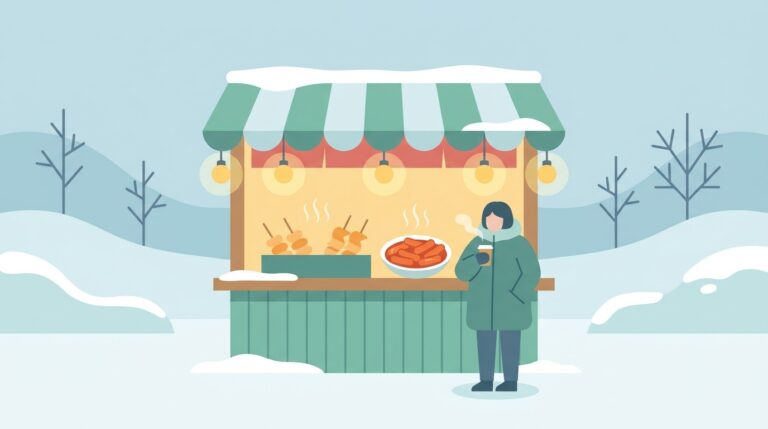
Phase 1: Empathy (Welcome to the Freezing, Delicious Korean Winter)
Hello! I am your Daily Hangul editor.
Picture this: You are at Vivaldi Park or Yongpyong Resort. You have been skiing for three hours. Your fingers are numb, the wind is howling, and your nose is as red as Rudolph’s. Then, you see it. Through the snowy mist, a glowing orange tent or a brightly lit cafeteria (매점) appears. The windows are fogged up with steam. You walk inside, and the smell of hot, savory seafood broth hits you.
In K-Dramas, this is exactly the moment the male lead hands a steaming paper cup of fish cake broth to the female lead, looking deeply into her eyes as they share the warmth. But in reality? You are standing in front of the counter, freezing, desperately wanting that hot soup, but the menu is overwhelming, and everyone is shouting their orders.
If you don’t know how to navigate the ski resort snack bar, you might end up paying for a full meal when all you wanted was a quick warm-up, or worse, missing out on the glorious, free, unlimited hot broth!
Don’t worry. As your local guide who has survived many Korean winters, I am going to teach you exactly what to say to get that piping hot Eomuk (fish cake), warm your soul, and sound like a total local. Let’s dive in!
Phase 2: Core Expressions Deep Dive
1. 어묵 두 꼬치랑 국물 좀 주세요.
- Pronunciation: Eomuk du kkochirang gungmul jom juseyo. [uh-mook doo kkoh-chee-rahng goong-mool johm joo-say-yo]
- Meaning: (Literal) Please give me two skewers of fish cake and some broth. (Real nuance) I’ll take two fish cakes, and don’t forget the hot soup!
- K-Culture Moment: You will hear this constantly at winter street food stalls (Pojangmacha) and ski resorts. The broth (국물 – gungmul) is the main reason people buy Eomuk in winter.
- Editor’s Insight: Notice the word 꼬치 (kkochi). In Korean, we don’t just say two fish cakes, we count them by the skewer. Also, asking for 국물 (broth) is perfectly normal and often free when you buy the skewers!
- Situation Spectrum:
- Friends (Casual): ✅ (Change to: 어묵 두 꼬치랑 국물 좀 줘)
- Shop Owner (Semi-formal/Polite): ✅
- Formal Business: 🚫 (Not a setting for street food)
- 🤔 Think About It: Why is broth such a big deal in Korea? Korean food culture heavily revolves around soups and stews. Sharing a warm soup is seen as sharing affection and comfort. Does your culture have a specific comfort food for freezing weather?
2. 몸 좀 녹이고 가자.
- Pronunciation: Mom jom nogigo gaja. [mohm johm noh-gee-goh gah-jah]
- Meaning: (Literal) Let’s melt our bodies a bit and go. (Real nuance) Let’s warm up for a bit before we head back out.
- K-Culture Moment: This is the ultimate insider phrase! Your Korean friends will say this when they are shivering on the ski slopes and want to drag you into the cafeteria for hot chocolate or cup noodles.
- Editor’s Insight: 녹이다 (to melt/thaw) is used metaphorically here for warming up a freezing body. If you say this to your Korean friends after a long ski run, they will look at you with wide eyes and say, Wow, your Korean is amazing!
- Situation Spectrum:
- Friends (Casual): ✅
- Co-workers (Semi-formal): ⚠️ (Use: 몸 좀 녹이고 가시죠)
- Boss/Elders (Formal): 🚫
- 🤔 Think About It: Koreans love describing physical sensations vividly. Melting the cold away feels much more descriptive than just saying let’s get warm.
3. 여기 단무지 셀프인가요?
- Pronunciation: Yeogi danmuji selpeu-ingayo? [yuh-gee dahn-moo-jee sel-poo-in-gah-yo?]
- Meaning: (Literal) Is the pickled radish self-service here? (Real nuance) Do I get the side dishes myself?
- K-Culture Moment: At busy ski resorts, you rarely get table service. You have to grab your own water, side dishes (like yellow pickled radish), and utensils.
- Editor’s Insight: 셀프 (Self) is a classic Konglish word. You will see 물은 셀프입니다 (Water is self-service) written everywhere in Korea. Asking this saves you from waiting for service that isn’t coming!
- Situation Spectrum:
- Friends (Casual): 🚫 (You ask the staff, not friends)
- Shop Staff (Polite): ✅
Phase 3: Textbook vs Real Korean
[Situation 1: Expressing you are cold and hungry]
* 📖 Textbook Korean: 날씨가 너무 춥습니다. 따뜻한 음식을 먹고 싶습니다. (The weather is too cold. I want to eat warm food.)
* 🗣️ Real Korean: 아, 너무 춥다. 뜨끈한 국물 땡긴다. (Ah, so cold. I’m craving some hot broth.)
* 💡 Why is it different?: 땡긴다 (to be pulled/to crave) is a very common B2-level slang used daily to express a sudden, strong desire for a specific food.
[Situation 2: Asking for a refill of the broth]
* 📖 Textbook Korean: 국물을 조금 더 주실 수 있습니까? (Could you please give me a little more broth?)
* 🗣️ Real Korean: 이모님, 여기 국물 좀 더 주세요~ (Auntie, a bit more broth here please~)
* 💡 Why is it different?: Calling a friendly shop owner 이모님 (Auntie) builds instant rapport, making them happy to give you extra generous portions!
Bottom Note: As a B2 learner, using words like 뜨끈하다 (piping hot, comforting) or 땡긴다 will instantly make your Korean sound more natural and emotionally connected.
Phase 4: Cultural Context — K-Culture Deep Dive
4-1. Non-verbal Element: The Nunchi of Self-Service
When you ask for Eomuk broth, sometimes the owner scoops it for you. But at busy ski resorts, there is usually a large metal dispenser or ladles for you to scoop it yourself. Here, your Nunchi (social awareness) comes into play. Don’t block the broth station! Scoop quickly, step aside, and hold your paper cup carefully with both hands to show you are mindful of the hot liquid in a crowded space.
4-2. Food & Identity: The Magic of Gungmul (Broth)
In Korea, eating dry food in the cold is considered almost sad. Whether you are eating spicy Tteokbokki, Kimbap, or fried snacks at the ski resort, you absolutely need Gungmul to wash it down. Have you ever seen a Korean drink boiling hot soup and let out a satisfied Ahh~ Siwonhada! (Ah, that’s refreshing)? It doesn’t mean the soup is cold; it means the warmth is melting away their fatigue and stress. At the ski resort, that 1,000 KRW paper cup of broth is a shared experience of comfort.
Phase 5: Real-Life Roleplay Scenario
Setting: Saturday afternoon, 2:00 PM at the bustling cafeteria in Yongpyong Ski Resort. You are wearing heavy ski gear. Your boots are clunky, your face is freezing, and the smell of spicy Tteokbokki and savory Eomuk is filling the air.
Characters:
* YOU: A B2 Korean learner who has been snowboarding for 4 hours and is absolutely starving.
* Min-su (30): Your energetic Korean friend who insisted on conquering the hardest slope.
* Staff (50s): The busy but friendly cafeteria worker.
Dialogue:
Min-su: 와, 오늘 바람 진짜 매섭다. 우리 뭐 좀 먹고 갈까?
(Wa, oneul baram jinjja maeseopda. Uri mwo jom meokgo galkka?)
[Translation] Wow, the wind is really fierce today. Should we eat something before we go?
(Stage Direction: Min-su rubs his gloved hands together, shivering.)
YOU: 좋아요. 저 진짜 얼어 죽을 것 같아요.
(Joayo. Jeo jinjja eoreo jugeul geot gatayo.)
[Translation] Sounds good. I feel like I’m literally going to freeze to death.
Min-su: ㅋㅋㅋ 그치? 야, 저기 매점 가서 뜨끈한 어묵 국물 좀 마시자. 몸 좀 녹이게.
(Kkk geuchi? Ya, jeogi maejeom gaseo tteukkeunhan eomuk gungmul jom masija. Mom jom nogige.)
[Translation] Hahaha, right? Hey, let’s go to the snack bar over there and drink some hot fish cake broth. To warm up our bodies.
YOU: 떡볶이도 땡기는데, 같이 먹을래요?
(Tteokbokkido ttaenggineunde, gachi meogeullaeyo?)
[Translation] I’m craving Tteokbokki too, want to eat it together?
Min-su: 콜! 내가 주문할게. 자리 먼저 잡아.
(Kol! Naega jumunhalge. Jari meonjeo jaba.)
[Translation] Deal (Call)! I’ll order. You grab a seat first.
(Stage Direction: You find a small table while Min-su goes to the counter.)
Staff: 네, 주문하시겠어요?
(Ne, jumunhasigesseoyo?)
[Translation] Yes, would you like to order?
Min-su: 이모님, 떡볶이 1인분이랑 어묵 세 꼬치 주세요.
(Imonim, tteokbokki irinbunirang eomuk se kkochi juseyo.)
[Translation] Auntie, 1 serving of Tteokbokki and 3 skewers of fish cake, please.
Staff: 네, 12,000원입니다. 국물은 저기서 셀프로 떠 드시면 돼요.
(Ne, manicheonwonimnida. Gungmureun jeogiseo selpeuro tteo deusemyeon dwaeyo.)
[Translation] Yes, that’s 12,000 won. You can scoop the broth yourself over there.
Min-su: (Walking back to you) 야, 여기 국물은 셀프래. 컵에 좀 떠올게.
(Ya, yeogi gungmureun selpeurae. Keobe jom tteoolge.)
[Translation] Hey, they say the broth here is self-serve. I’ll go scoop some in cups.
🔀 Your Turn! How do you respond to Min-su?
* A) 제가 떠올게요! 민수 씨는 앉아서 쉬세요. (I’ll go scoop it! Min-su, you sit and rest.)
* B) 왜 셀프예요? 서비스가 별로네요. (Why is it self-serve? The service is bad.)
* C) 단무지도 좀 가져다주세요. (Bring me some pickled radish too.)
✅ Best Choice: A — Reason: Min-su paid for the food and ordered. Offering to get the broth and side dishes shows great Nunchi and Korean teamwork!
⚠️ Choice C Analysis: While grammatically correct, telling the person who just bought you food to also fetch the side dishes sounds a bit bossy in Korean culture. It’s better to split the tasks.
Bonus K-Culture Scenario: Dropping your ski pass!
You are eating your Eomuk, and the person next to you drops their ski lift pass.
YOU: 저기요! 리프트권 떨어지셨어요.
(Jeogiyo! Lipeuteugwon tteoreojyeosseoyo.)
[Translation] Excuse me! Your lift pass dropped.
Stranger: 헉, 감사합니다! 이거 잃어버리면 큰일 날 뻔했네요.
(Heok, gamsahamnida! Igeo ireobeorimyeon keunil nal ppeonhaenneyo.)
[Translation] Gasp, thank you! I would have been in big trouble if I lost this.
Phase 6: 10-Second Shadowing Drill
Practice the rhythm and emotion of a freezing, hungry skier!
🥺 애절하게 (Desperately): 아, 너무 춥다. / 뜨끈한 국물 / 땡긴다.
(Ah, neomu chupda. / tteukkeunhan gungmul / ttaengginda.)
😊 밝게 (Cheerfully): 이모님~ / 어묵 세 꼬치랑 / 떡볶이 1인분 / 주세요!
(Imonim~ / eomuk se kkochirang / tteokbokki irinbun / juseyo!)
😌 시원하게 (Relieved): 아~ / 몸 좀 / 녹는다.
(Ah~ / mom jom / nongneunda.)
Phase 7: K-Culture Mini Dictionary
1. 땡기다
* Romanization: ttaenggida
* English: To crave (food), to feel like doing something
* Context: Originally standard Korean 당기다, but everyone pronounces and writes it as 땡기다. Use this when you suddenly really want a specific food!
2. 꼬치
* Romanization: kkochi
* English: Skewer / Counter for skewered food
* Context: Used for Eomuk (fish cake), Dak-kkochi (chicken skewers), or Lamb skewers. Never order one fish cake; order one kkochi!
3. 셀프
* Romanization: selpeu
* English: Self-service
* Context: A crucial Konglish word. From water, side dishes, to returning your tray, if you see the word 셀프, you must do it yourself.
4. 시원하다
* Romanization: siwonhada
* English: Refreshing / Relieving (even for hot things)
* Context: Literally means cool, but older Koreans use it when eating hot soup or stepping into a hot bath. It means the tension is leaving the body.
Phase 8: Traveler Survival Kit
Ski resorts are huge, and finding food or navigating the lines can be tricky.
🆘 Survival Phrases for the Ski Resort Snack Bar
* 🇰🇷 국물은 어디서 떠요? (Gungmureun eodiseo tteoyo?)
* 🗣️ [goong-mool-eun uh-dee-suh ttuh-yo?]
* 📍 Where to use: When you can’t find the self-serve broth station.
- 🇰🇷 빈 그릇은 어디에 놔요? (Bin geureuseun eodie nwayo?)
- 🗣️ [been goo-roo-seun uh-dee-eh nwah-yo?]
- 📍 Where to use: When you finish eating and need to return your tray (Returing trays is mandatory at Korean ski resorts!).
-
🇰🇷 영수증 버려주세요. (Yeongsujeung beoryeojuseyo.)
- 🗣️ [yuhng-soo-joong buh-ryuh-joo-say-yo]
- 📍 Where to use: Please throw away the receipt. Very common to say right after paying by card.
📌 Editor’s Travel Note
* Cash vs Card: Ski resorts are 100% card-friendly, even for a 3,000 KRW snack. You can use Apple Pay or international credit cards easily.
* Trays: Unlike some street food carts, in resort cafeterias, you MUST return your tray to the 퇴식구 (Tray Return area). Leaving it on the table is bad manners!
Phase 9: Critical Thinking Corner — A Step Deeper
🧠 Think Deeper: Food & Identity
Have you noticed how Korean portions at ski resorts or street stalls are often designed for sharing? Tteokbokki comes in a large bowl with multiple forks, and Eomuk skewers are ordered in a bunch for the table. In Korean culture, eating isn’t just about fueling the body; it is the ultimate bonding activity. We share the same plate, we pour broth for each other, and we collectively warm up our bodies. The phrase 몸 좀 녹이고 가자 (Let’s warm our bodies up) isn’t just about temperature; it’s an invitation to pause, share a warm moment, and build 정 (Jeong – affection/connection) before heading back into the cold reality.
💬 Your Turn: In your culture, is street food usually eaten individually, or shared? What is the go-to winter food in your country? Share in the comments!
Phase 10: FAQ & Avoiding Misunderstandings
- Q: Can I just take the Eomuk skewers from the boiling pot myself?
- A: At a traditional street cart (Pojangmacha), yes! You can eat first and count the sticks to pay later. BUT at a ski resort or indoor cafeteria, you must order and pay at the counter first, and the staff will hand them to you on a plate.
- Q: Can I drink the broth from the bowl like a cup?
- A: If it’s served in a small paper cup, definitely drink it directly! If it’s a large bowl of Tteokbokki or Udon, use a spoon.
- Q: Is it rude to ask for a refill of the broth?
- A: Not at all! Broth refills are culturally accepted and encouraged in Korea. Just smile and say 국물 좀 더 주실 수 있나요? (Could I have a bit more broth?).
❌ Common Mistake #1: Ordering Tteokbokki by saying 하나 주세요 (Give me one).
✅ Do this instead: Say 1인분 주세요 (Give me one serving). Tteokbokki is measured in servings (인분), not individual pieces!
Phase 11: Summary & Action Items
One-Liner Summary: When freezing at a Korean ski resort, use 땡긴다 to express your cravings and safely secure your hot Eomuk broth by asking 국물 좀 더 주세요!
Action Mission 3 Steps:
* 🥉 Bronze (Solo): Say 뜨끈한 국물 땡긴다 (I’m craving hot broth) out loud three times while looking in the mirror.
* 🥈 Silver (Online): Go to a Korean language forum and write a post about your favorite winter food using the word 땡긴다.
* 🥇 Gold (Real Life): The next time you go to a Korean restaurant or a ski resort, ask for extra soup by saying 국물 좀 더 주실 수 있나요?
K-Culture Mission:
Search for 한국 스키장 먹방 (Korean ski resort Mukbang) on YouTube and spot how many times people mention the word 국물 (broth) while eating Eomuk!
Phase 12: Quiz — Interactive Challenge
1. Situational Judgment: You are freezing after skiing. You want to suggest going inside to get warm. What is the most natural B2-level phrase?
* A) 우리 몸 좀 녹이고 가자.
* B) 몸이 너무 차갑습니다.
* C) 따뜻한 방이 필요해요.
(Answer: A. It is the most natural, idiomatic way to suggest warming up.)
2. Fill in the Blank:
Staff: 주문하시겠어요?
You: 네, 떡볶이 1____ 이랑 어묵 두 ____ 주세요.
(Answer: 인분 (serving), 꼬치 (skewer))
3. True or False — K-Culture Edition:
At a Korean ski resort cafeteria, it is fine to leave your dirty tray on the table because the staff will clean it up.
(Answer: False! You must return it to the 퇴식구 – Tray Return area. It’s an unspoken rule!)
Stay warm, keep practicing, and enjoy the delicious Korean winter!
Frequently Asked Questions (FAQ)
Q: What does "어묵 두 꼬치랑 국물 좀 주세요." mean in Korean and how do you pronounce it?
A: In Korean, "어묵 두 꼬치랑 국물 좀 주세요." is pronounced [Eomuk du kkochirang gungmul jom juseyo. [uh-mook doo kkoh-chee-rahng goong-mool johm joo-say-yo] and means: (Literal) Please give me two skewers of fish cake and some broth. (Real nuance) I'll take two fish cakes, and don't forget the hot soup!
Q: What does "몸 좀 녹이고 가자." mean in Korean and how do you pronounce it?
A: In Korean, "몸 좀 녹이고 가자." is pronounced [Mom jom nogigo gaja. [mohm johm noh-gee-goh gah-jah] and means: (Literal) Let's melt our bodies a bit and go. (Real nuance) Let's warm up for a bit before we head back out.
Q: What does "여기 단무지 셀프인가요?" mean in Korean and how do you pronounce it?
A: In Korean, "여기 단무지 셀프인가요?" is pronounced [Yeogi danmuji selpeu-ingayo? [yuh-gee dahn-moo-jee sel-poo-in-gah-yo?] and means: (Literal) Is the pickled radish self-service here? (Real nuance) Do I get the side dishes myself?







