

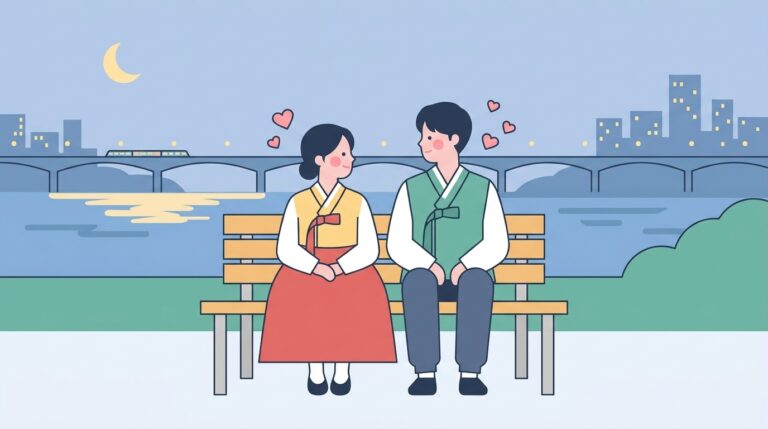
Phase 1: Empathy (Immersive Opening)
Hello! I’m your Daily Hangul Editor.
Imagine this: You are watching a K-Drama. The main characters are walking home. They aren’t holding hands, but their shoulders keep brushing against each other. They stop in front of her house, exchanging awkward but sweet smiles. The subtitle says, “I had a good time today.” But if you listen closely, there’s a tension, a fluttering feeling in the air.
In Korea, we don’t just say we are “dating” or “friends.” We have a very specific, magical, and sometimes frustrating phase called 썸 (Some). It’s the “talking stage,” where you are more than friends but not quite a couple. Your heart flutters (설레다), and you check your phone every five seconds.
If you don’t know the vocabulary for this phase, you might misunderstand a Korean person’s intentions completely! Are they just being nice, or are they flirting? Today, let’s dive into the romantic tension of the K-Drama world and learn the real, insider expressions for navigating the “Some” stage.
Phase 2: Core Expressions Deep Dive
1. 썸 타다 (sseom tada)
- Pronunciation: [sseom tada] + Sounds like “some ta-da!”
- Meaning: (Literal) To ride some / (Real nuance) To be in the talking/flirting stage before officially dating.
- K-Culture Moment: You are out drinking with friends, and someone notices you texting a guy/girl non-stop with a goofy smile. Your friend will point at you and tease, “Oh~ are you guys riding ‘Some’?” (오~ 둘이 썸 타?)
- Editor’s Insight: The word “Some” comes from the English word “Something” (There is something between us). We use the verb 타다 (to ride), similar to “riding a rhythm” or “riding the flow.” It feels like you are surfing on the waves of romance!
- Situation Spectrum:
- Close Friends (Casual): ✅
- Co-workers (Semi-formal): ⚠️ (Only if you are close enough to gossip)
- Boss/Elders (Formal): 🚫
- 🤔 Think About It: Why do Koreans use an English word (“some”) to describe this traditional romantic phase? Does your language have a specific word for the “talking stage”?
2. 설레다 (seolleda)
- Pronunciation: [seol-le-da] + Sounds like “soul-leh-da”
- Meaning: (Literal) To flutter / (Real nuance) My heart is fluttering, I have butterflies in my stomach.
- K-Culture Moment: In a K-Pop song, the chorus drops, and the idol sings about how they can’t sleep because they keep thinking about you. That feeling? That’s “설레다.” It’s the ultimate butterfly feeling when your crush just looks at you.
- Editor’s Insight: This isn’t just for dating! You can use it when you are excited about an upcoming trip or concert. (e.g., “내일 여행 가서 너무 설레요!” – I’m so excited about the trip tomorrow!)
- Situation Spectrum:
- Close Friends (Casual): ✅
- Co-workers (Semi-formal): ✅ (When talking about exciting events)
- Boss/Elders (Formal): ⚠️ (Use polite form: 설렙니다)
- 🤔 Think About It: “설레다” captures a physical feeling (a fluttering heart). Why do you think Korean emotions are often described using physical body reactions?
3. 우리 무슨 사이야? (uri museun saiya?)
- Pronunciation: [oo-ri moo-seun sa-i-ya?] + Sounds like “oo-ri moo-soon sigh-ya?”
- Meaning: (Literal) What relationship are we? / (Real nuance) What are we? Are we officially dating or what?
- K-Culture Moment: The classic K-Drama confrontation. They’ve been on 5 “dates,” texting every night, but no one has made it official. One person finally stops walking, looks the other in the eye, and asks, “What exactly are we?”
- Editor’s Insight: This is a heavy question. It’s the “make it or break it” moment of the Some stage. If you say this, you are demanding clarity.
- Situation Spectrum:
- Close Friends (Casual): ✅ (To the person you are dating)
- Co-workers (Semi-formal): 🚫
- Boss/Elders (Formal): 🚫
- 🤔 Think About It: In Korea, dating usually doesn’t start until someone explicitly “confesses” (고백). Why is this clear boundary so important in Korean society?
Phase 3: Textbook vs. Real Korean
[Expressing you have a crush]
* 📖 Textbook Korean: 저는 당신에게 관심이 있습니다. (I have an interest in you.)
* 🗣️ Real Korean: 나 걔랑 썸 타. (I’m in the Some stage with him/her.)
* 💡 Why the difference?: Textbooks teach formal, written language. “썸 타다” is modern slang born from the internet and pop culture to capture the exact ambiguous tension.
[Telling someone they make you nervous in a good way]
* 📖 Textbook Korean: 기분이 매우 좋습니다. (I feel very good.)
* 🗣️ Real Korean: 아, 심쿵했어. (Ah, my heart skipped a beat.)
* 💡 Why the difference?: “심쿵” (Sim-kung) is a compound slang word: 심장 (Heart) + 쿵 (Thud sound). It perfectly captures the dramatic, sudden feeling of falling for someone.
Bottom Note: For B1 learners, using “썸 타다” and “설레다” perfectly will instantly make you sound like a local who truly understands modern Korean culture!
Phase 4: Cultural Context — K-Culture Deep Dive
4-1. Non-Verbal Cues: The Art of “Nunchi” in Dating
In the Some stage, 눈치 (Nunchi) is everything. You aren’t officially a couple, so you can’t just grab their hand. Instead, Koreans read the room. If you are walking together, do they naturally walk on the outside of the street to protect you from cars? Do they subtly share their side dishes with you at dinner? These silent gestures are the real “I like you” in Korea.
4-2. The K-Drama Umbrella Trope
You’ve definitely seen this. It suddenly rains. Two people, one umbrella. The male lead holds the umbrella, but when they arrive, his entire right shoulder is soaked because he tilted the umbrella towards the girl. This is the ultimate 설레다 (fluttering) moment! In Korean dating culture, showing care through small, unspoken actions (like holding the umbrella or putting a blanket over your lap at a cafe) speaks much louder than saying “I like you” right away.
Phase 5: Real-Life Roleplay Scenario
Scenario A: The Han River “Some” Date
- Setting: Friday night, 9 PM. Yeouido Hangang Park. You are sitting on a picnic mat, the Seoul city lights reflecting on the river. You just finished eating fried chicken and beer.
- Characters:
- YOU: An expat living in Seoul, currently navigating a very confusing relationship with your Korean language exchange partner.
- Minho (28): Your Korean “friend.” He brought you to the river and has been paying for everything today.
Minho: (Hands you a hot coffee) 날씨가 좀 쌀쌀하네. 이거 마셔.
(nalssiga jom ssalssalhane. igeo masyeo.)
[Translation] It’s a bit chilly. Drink this.
(🎭 Stage Direction: He naturally puts his jacket over your shoulders.)
YOU: 고마워. 오늘 치킨도 사주고… 진짜 재밌었어.
(gomawo. oneul chikindo sajugo… jinjja jaemisseosseo.)
[Translation] Thanks. You bought chicken today too… It was really fun.
Minho: 다행이네. 너랑 있으니까 시간 진짜 빨리 간다.
(dahaengine. neorang isseunikka sigan jinjja ppalli ganda.)
[Translation] I’m glad. Time flies so fast when I’m with you.
YOU: 나도. 우리 자주 만나자!
(nado. uri jaju mannaja!)
[Translation] Me too. Let’s meet often!
Minho: (Looking directly at you) 야… 너는 나 안 설레냐? 나는 너 볼 때마다 설레는데.
(ya… neoneun na an seollanya? naneun neo bol ttaemada seolleneunde.)
[Translation] Hey… don’t you get butterflies because of me? Because my heart flutters every time I see you.
🔀 Your Turn! How do you respond?
– A) “어? 우리 그냥 친구 아니었어?” (Wait? Weren’t we just friends?)
– B) “진짜? 나도… 너 땜에 엄청 설레.” (Really? Me too… you make my heart flutter a lot.)
– C) “사랑해요! 결혼합시다!” (I love you! Let’s get married!)✅ Best Choice: B — If you like him back, be honest! Matching his confession with your own “설레다” is the perfect way to graduate from the Some stage.
⚠️ Choice A Analysis: This is the “friendzone” response. If you say this, the Some is officially over!
⚠️ Choice C Analysis: Too fast! In Korea, jumping straight to “I love you” (사랑해) during the talking stage is considered overwhelming. Take it step by step.
Phase 6: 10-Second Shadowing Drill
Practice the rhythm and emotion of today’s expressions!
- 😊 Shyly / 🥺 Looking up:
너랑 / 연락하면 / 너무 / 설레. (neorang / yeollakhamyeon / neomu / seolle.)
(When I text you, my heart flutters so much.) -
😤 Frustrated but serious:
우리 / 도대체 / 무슨 / 사이야? (uri / dodaeche / museun / saiya?)
(What exactly are we?)
Phase 7: K-Culture Mini Dictionary
1. 썸 (Some)
* Romanization: sseom
* English: The talking stage; pre-dating phase.
* Context: The thrilling, ambiguous period where you act like a couple but aren’t official yet.
2. 심쿵 (Simkung)
* Romanization: simkung
* English: Heart skips a beat.
* Context: Used when someone does something incredibly attractive or cute that hits you right in the heart.
3. 밀당 (Mildang)
* Romanization: mildang
* English: Push and pull (playing hard to get).
* Context: Essential dating strategy in Korea. Showing interest (pull) and then acting indifferent (push) to build tension.
4. 고백 (Gobaek)
* Romanization: gobaek
* English: Confession.
* Context: The official step to end the Some stage. In Korea, you must explicitly ask “Will you be my boyfriend/girlfriend?” to start dating.
Phase 8: Traveler’s Survival Kit (Date Edition)
Are you going on a date or hanging out with your Some partner in Korea? Here are crucial survival phrases for cafes and restaurants!
🆘 Survival Phrases #1
– 🇰🇷 “아메리카노 두 잔 주세요.” (amerikano du jan juseyo.)
– 🗣️ English Guide: ah-meh-ri-ka-no doo-jan joo-se-yo.
– 📍 Where to use: At a cafe (Cafes are the #1 spot for Some dates!).
– 💡 Pro Tip: In Korea, couples or people on dates often take turns paying. If they bought dinner, it’s polite for you to say, “제가 커피 살게요!” (I’ll buy the coffee!).📌 Editor’s Travel Note
– Useful Apps for Dates: Naver Map (to find highly-rated aesthetic cafes).
– Dating Etiquette: Splitting the bill exactly 50/50 (더치페이) is common among younger Koreans, but taking turns (I buy food, you buy dessert) is considered much more natural and romantic.
Phase 9: Critical Thinking — “One Step Deeper”
🧠 Think Deeper: Media vs Reality (The “Go-baek” Culture)
In Western cultures, dating is often fluid. You hang out, go on a few dates, and eventually, it’s just understood that you are exclusive. But in Korea, the transition from Some to a real relationship requires a very clear, verbal 고백 (Confession). Why? Korean society values clear boundaries and titles (such as specific job titles or age-based honorifics). This extends to romance. Without a formal title (“my boyfriend/girlfriend”), the relationship feels unstable. The K-Drama confession scenes aren’t just for TV drama; they are a real societal requirement to prove commitment.💬 Your Turn: Does your culture require a formal “confession” to start dating, or does it happen naturally? Share your thoughts in the comments!
Phase 10: FAQ & Avoiding Misunderstandings
Q: Can I hold hands during the “Some” stage?
* Maybe. It depends on the person! Some people think holding hands means you are officially dating. If you hold hands, be prepared for the “우리 무슨 사이야?” (What are we?) question!
Q: Can I use “사랑해요” (I love you) to confess?
* No! “사랑해” is a very heavy word in Korea. For a confession (고백), say “우리 만날래?” (Do you want to date?) or “너 좋아해” (I like you). Saving “I love you” for later makes it much more special.
❌ Common Mistake #1: Calling your Some partner “당신” (You).
✅ Do this instead: “당신” is only used between married couples or when fighting with a stranger. Call them by their name + 씨 (e.g., 민수 씨), or if you are close, just use their name or “오빠/누나”!
Phase 11: Summary & Action Items
One-Liner Summary: To master Korean dating, you must navigate the thrilling, ambiguous Some (썸) stage before making it official!
Action Mission 3-Step:
* 🥉 Bronze (Solo): Look in the mirror and practice saying “너 땜에 설레” (You make my heart flutter) with a shy smile 3 times.
* 🥈 Silver (Online): Comment below this post using the word “심쿵” to describe your favorite K-Pop idol or actor.
* 🥇 Gold (Real Life): Next time you watch a K-Drama, point out the exact moment the characters realize they are in the Some stage!
Special K-Culture Mission: Listen to the famous K-Pop song “Some” by Soyou & Junggigo. Try to catch the lyrics “내꺼인 듯 내꺼 아닌 내꺼 같은 너” (You feel like mine, but you’re not mine, but you seem like mine) – it’s the ultimate anthem for this lesson!
Phase 12: Quiz — Interactive Challenge
1. Situational Judgment:
You’ve been texting a cute Korean friend every night. You went to the movies twice. You want to ask what your relationship status is. What should you say?
* A) 우리 썸 타는 거야?
* B) 우리 결혼할 거야?
* C) 저기요, 얼마예요?
(Answer: A. B is way too fast (marriage), and C means “Excuse me, how much is this?”)
2. True or False: K-Culture Edition
In Korea, it is completely normal to say “사랑해” (I love you) on the first date to show you are interested. (T/F)
(Answer: False. Koreans take “사랑해” very seriously. Saying it on a first date might scare them away! Stick to “관심 있어요” or “좋아해요”.)
3. Fill in the Blank:
When someone does something unexpectedly charming and your heart drops, you can say: “아, 방금 완전
[ ]했어!”
(Answer: 심쿵 – simkung!)
Frequently Asked Questions (FAQ)
Q: What does "썸 타다 (sseom tada)" mean in Korean and how do you pronounce it?
A: In Korean, "썸 타다 (sseom tada)" is pronounced [sseom tada] and means: (Literal) To ride some / (Real nuance) To be in the talking/flirting stage before officially dating.
Q: What does "설레다 (seolleda)" mean in Korean and how do you pronounce it?
A: In Korean, "설레다 (seolleda)" is pronounced [seol-le-da] and means: (Literal) To flutter / (Real nuance) My heart is fluttering, I have butterflies in my stomach.
Q: What does "우리 무슨 사이야? (uri museun saiya?)" mean in Korean and how do you pronounce it?
A: In Korean, "우리 무슨 사이야? (uri museun saiya?)" is pronounced [oo-ri moo-seun sa-i-ya?] and means: (Literal) What relationship are we? / (Real nuance) What are we? Are we officially dating or what?







