

Phase 1: Empathy (Immersion)
Hello! This is your Daily Hangul Editor.
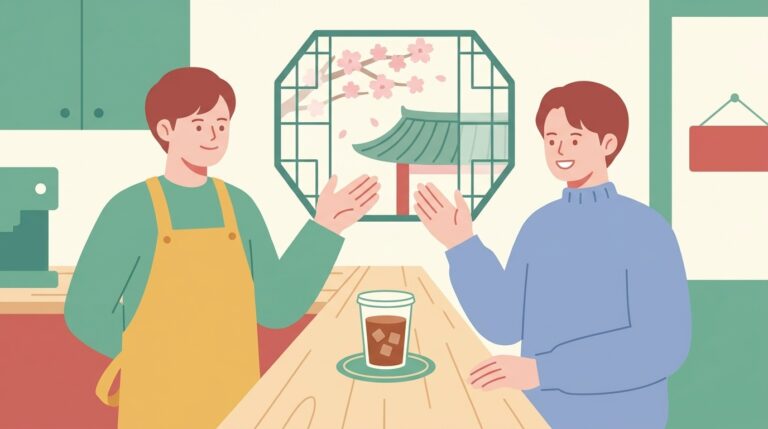
Picture this: You are in a trendy, aesthetic cafe in Hongdae. The interior looks exactly like a scene from your favorite K-Drama. The barista is moving at lightning speed, blending drinks and calling out order numbers. You step up to the counter to order your favorite Iced Mocha. But wait… you hate whipped cream!
The barista quickly asks you something ending in “…juseyo?” and you panic, simply nodding and saying, “Ne…” (Yes). Bam! Your beautiful iced coffee is handed to you with a giant mountain of whipped cream on top.
Sound familiar? In Korea’s fast-paced “Ppali-ppali” (hurry-hurry) culture, ordering at a cafe can feel overwhelming. If you don’t know how to express exactly what you want, you might end up drinking something you didn’t quite order. But don’t worry! Knowing just a few magic words will not only save your drink but also earn you that respected “Insider” nod from the barista. This guide is built from the real panic moments of my beginner students. Let’s dive in!
—
### Phase 2: Core Expressions Deep Dive
> ### 1. 휘핑 빼주세요
> – Pronunciation: Hwi-ping ppae-ju-se-yo. (‘ppae’ sounds like the ‘pe’ in ‘pet’, but with a tight, explosive P sound).
> – Meaning: Literal: Please take out the whipping. / Real nuance: No whipped cream, please.
> – K-Culture Moment: When you order a Frappuccino (often called a ‘Frappé’ in Korea) or a Mocha, the barista will almost always ask rapidly, “휘핑 올려드릴까요?” (Shall I put whipped cream on top?). This phrase is your shield!
> – Editor’s Insight: The verb 빼다 (to take out/remove) is a magic word in Korea. You can use it for almost anything! Don’t like ice? “얼음 빼주세요.” (No ice, please). Don’t like pickles on your burger? “피클 빼주세요.” It feels polite but perfectly direct.
> – Situation Spectrum:
> – Casual (Friends): ✅
> – Semi-formal (Cafe staff): ✅
> – Formal (Boss/Elders): ✅
> – 🤔 Think About It: Notice how Koreans shorten the English word “whipped cream” to just “hwiping”? This reflects Korea’s ppali-ppali efficiency. What long words do you shorten in your native language just to save a few seconds?
> ### 2. 덜 달게 해 주세요
> – Pronunciation: Deol dal-ge hae ju-se-yo. (‘Deol’ sounds a bit like ‘dull’).
> – Meaning: Literal: Please make it less sweet. / Real nuance: Less syrup, please.
> – K-Culture Moment: Koreans love beautiful desserts, but the highest compliment a Korean can give a dessert is actually, “It’s not too sweet!” (너무 달지 않아서 맛있다). If you want to enjoy a cafe drink without the intense sugar rush, this is your go-to phrase.
> – Editor’s Insight: Instead of asking for “one pump of syrup” like in Western cafes, asking them to make it “less sweet” is the most natural, localized way to customize your drink.
> – Situation Spectrum:
> – Casual (Friends): ✅
> – Semi-formal (Cafe staff): ✅
> – Formal (Boss/Elders): ✅
> – 🤔 Think About It: Why is “not too sweet” considered the ultimate praise in Korea? How does your culture view sweetness in desserts?
—
### Phase 3: Textbook vs. Real Korean
[Asking for No Cream]
* 📖 Textbook Korean: 휘핑크림은 넣지 마십시오. (Hwi-ping-keu-rim-eun neot-ji ma-sip-si-o. / Do not insert whipped cream.)
* 🗣️ Real Korean: 휘핑 빼주세요. (Hwi-ping ppae-ju-se-yo. / Whipping take out please.)
* 💡 Why is it different?: Textbooks teach formal imperative forms (-sipsio), which sound like a military command! Real Koreans soften requests using “~juseyo” (please give me/do for me) and abbreviate long English loanwords.
[Ordering For Here or To Go]
* 📖 Textbook Korean: 이 카페 안에서 마시겠습니다. (I i ka-pe an-e-seo ma-si-get-seum-ni-da. / I will drink inside this cafe.)
* 🗣️ Real Korean: 먹고 갈게요 / 테이크아웃이요. (Meok-go gal-ge-yo / Te-i-keu-a-u-si-yo.)
* 💡 Why is it different?: Practicality! “테이크아웃” (Take-out) is universally used in Korea, and “먹고 갈게요” (Literally: I will eat and go) is the most natural way to say “for here.”
> Bottom Note: For an A2 (Beginner) level, stick to phrases ending in ~주세요 (~juseyo). It’s the perfect balance of politeness and natural flow!
—
### Phase 4: Cultural Context — K-Culture Deep Dive
#### 4-1. Non-verbal Cues: The Art of Handing Over Your Card
When you finish ordering and hand your credit card to the barista, don’t just toss it on the counter! In Korea, handing things over with one hand can be seen as slightly disrespectful. Try this: Hand your card over with both hands, OR hold the card in your right hand while lightly touching your right elbow with your left hand. It’s a subtle gesture, but the barista will instantly recognize your cultural respect!
#### 4-2. K-Food Customization Culture
Historically, traditional Korean meals (soups, stews, side dishes) were made in large batches and shared from the center of the table. Customizing a dish just for one person wasn’t very common. However, the modern cafe boom completely changed this! Cafes introduced the idea of highly personalized orders to Korea. Now, customizing your drink (extra shots, oat milk, no ice) is a fun way to express your individual taste. Just remember: customizing a latte is normal, but asking a traditional soup restaurant to change their base recipe might still get you some confused looks!
—
### Phase 5: Real-Life Roleplay Scenario
Setting: It’s 2:00 PM on a sunny Saturday. You are inside a bustling, minimalist cafe in Seongsu-dong (Seoul’s Brooklyn). The scent of roasted coffee beans fills the air. You step up to the register.
Characters:
– YOU: A traveler visiting Korea, craving an Iced Mocha but trying to cut down on dairy.
– BARISTA (NPC): A friendly but fast-paced local in their early 20s, wearing a neat black apron.
Dialogue:
BARISTA: 안녕하세요! 주문 도와드릴까요?
(An-nyeong-ha-se-yo! Ju-mun do-wa-deu-ril-kka-yo?)
(Hello! Can I help you with your order?)
YOU: 네, 아이스 모카 하나 주세요.
(Ne, a-i-seu mo-ka ha-na ju-se-yo.)
(Yes, one iced mocha, please.)
BARISTA: 네, 드시고 가시나요?
(Ne, deu-si-go ga-si-na-yo?)
(Okay, will you be having it here?)
YOU: 아뇨, 테이크아웃 할게요.
(A-nyo, te-i-keu-a-ut hal-ge-yo.)
(No, I’ll take it to go.)
BARISTA: 네, 알겠습니다. 모카에 휘핑 올려드릴까요?
(Ne, al-get-seum-ni-da. Mo-ka-e hwi-ping ol-lyeo-deu-ril-kka-yo?)
(Okay, understood. Shall I put whipped cream on your mocha?)
> 🔀 Your Turn! How do you answer?
> – A) “휘핑크림은 넣지 마십시오!” (Robotic and too commanding)
> – B) “아니요, 휘핑 빼주세요.” (Natural, polite, and clear)
> – C) “휘핑 싫어요!” (A bit too blunt/childish!)
>
> ✅ Best Choice: B — It uses the magic word “빼주세요”. It’s polite but gets straight to the point!
YOU: 아니요, 휘핑은 빼주세요.
(A-ni-yo, hwi-ping-eun ppae-ju-se-yo.)
(No, please leave the whipped cream out.)
BARISTA: 네, 결제 도와드리겠습니다. 카드는 앞에 꽂아주세요.
(Ne, gyeol-je do-wa-deu-ri-get-seum-ni-da. Ka-deu-neun ap-e kko-ja-ju-se-yo.)
(Okay, I’ll help you with the payment. Please insert your card in the front.)
YOU: 네, 여기요.
(Ne, yeo-gi-yo.)
(Yes, here you go.)
BARISTA: 영수증 필요하신가요?
(Yeong-su-jeung pi-ryo-ha-sin-ga-yo?)
(Do you need the receipt?)
YOU: 아뇨, 버려주세요. 감사합니다!
(A-nyo, beo-ryeo-ju-se-yo. Gam-sa-ham-ni-da!)
(No, please throw it away. Thank you!)
(🎭 Stage Direction: The barista smiles and hands you a vibrating buzzer.)
—
### Phase 6: 10-Second Shadowing Drill
Let’s practice the rhythm! Pay attention to the pauses (/) and emotions.
😊 아이스 모카 / 하나 / 주세요!
(a-i-seu mo-ka / ha-na / ju-se-yo!)
Brightly: One iced mocha, please!
🙅♀️ 아, / 휘핑은 / 빼주세요.
(ah, / hwi-ping-eun / ppae-ju-se-yo.)
Politely but firmly: Ah, please remove the whipped cream.
💳 영수증은 / 버려주세요.
(yeong-su-jeung-eun / beo-ryeo-ju-se-yo.)
Lightly: Please throw away the receipt.
—
### Phase 7: K-Culture Mini Dictionary
1. 얼죽아
* Romanization: Eol-juk-a
* English: Iced Americano even if I freeze to death.
* Context: A popular slang reflecting Koreans’ absolute obsession with iced coffee, even in the freezing middle of winter!
2. 진동벨
* Romanization: Jin-dong-bel
* English: Buzzer / Pager
* Context: Instead of shouting your name, Korean cafes give you a small disk that vibrates and flashes when your drink is ready.
3. 아바라
* Romanization: A-ba-ra
* English: Iced Vanilla Latte (Abbreviation)
* Context: Koreans love shortening long menu names. “A-Ba-Ra” (A-i-seu Ba-nil-la Ra-tte) is the most famous example.
4. 1인 1음료
* Romanization: Il-in Il-eum-nyo
* English: One drink per person
* Context: A strict rule in most independent Korean cafes. If two people sit down, you must order at least two drinks. You cannot share one!
—
### Phase 8: Traveler Survival Kit
> 🆘 Survival Phrase #1
> – 🇰🇷 “이거 하나 주세요.” (i-geo ha-na ju-se-yo)
> – 🗣️ English: Please give me one of this.
> – 📍 Where to use: Cafes, restaurants, street food stalls.
> – 💡 Pro Tip: Point at the menu while saying this! It’s perfect if you can’t pronounce the complex Korean name.
> 🆘 Survival Phrase #2
> – 🇰🇷 “화장실 비밀번호가 뭐예요?” (hwa-jang-sil bi-mil-beon-ho-ga mwo-ye-yo?)
> – 🗣️ English: What is the restroom password?
> – 📍 Where to use: Inside cafes.
> – 💡 Pro Tip: Many cafe restrooms are locked. The code is usually printed at the bottom of your receipt!
> 🆘 Survival Phrase #3
> – 🇰🇷 “영수증 버려주세요.” (yeong-su-jeung beo-ryeo-ju-se-yo)
> – 🗣️ English: Please throw away the receipt.
> – 📍 Where to use: The checkout counter.
> – 💡 Pro Tip: Cashiers will almost always ask if you want it. Say this to save your wallet space!
> 📌 Editor’s Travel Note
> – Kiosks are everywhere! Don’t panic if there’s no cashier. Most cafes use digital kiosks. Look for the “English” button usually located in the top right corner of the screen.
> – Card is King: Korea is a cashless society. 99% of cafes prefer credit cards. Some are even “cash-free” zones!
> – No Tipping: Korea has NO tipping culture. If you leave money on the cafe counter, the barista will literally chase you down the street thinking you forgot your change!
—
### Phase 9: Critical Thinking Corner — “A Step Deeper”
🧠 Think Deeper: Food & Identity
Traditional Korean dining is communal. Soups, stews, and side dishes are shared from the center of the table, emphasizing “Jeong” (emotional connection) and the collective “We.” Because of this, asking a chef to customize a traditional dish just for you was historically seen as picky. However, modern cafe culture introduced a highly individualized way of consuming to Korea. Modifying your personal coffee with extra shots, no ice, or no whipped cream is now a symbol of expressing individual taste in a society that is rapidly balancing group harmony with personal identity.
💬 Your Turn: Do you prefer sharing food “family-style,” or do you like having your own highly customized plate? Share your thoughts in the comments!
—
### Phase 10: FAQ & Avoiding Mistakes
Q: “Can I use casual language (Banmal) if the barista looks much younger than me?”
A: NO! Absolutely not. In the service industry, you must always use polite language (~juseyo, ~yo), regardless of age. Speaking casually to service workers is considered very rude and arrogant (a behavior locally called Gapjil).
❌ Common Mistake #1: Leaving your empty tray on the table.
✅ Do This Instead: In Korea, you must bus your own tray! Always return it to the “Return” counter (반납하는 곳) when you leave.
❌ Common Mistake #2: Asking for a “take-out” cup but sitting inside the cafe.
✅ Do This Instead: By Korean environmental law, cafes cannot give you a disposable plastic cup if you are drinking inside. Make sure you say “먹고 갈게요” (For here) if you plan to sit!
—
### Phase 11: Summary & Action Items
One-Liner Summary: Just remember the magic word “빼주세요” (ppae-juseyo) to customize your drink and say no to unwanted whipped cream!
Action Mission 3 Steps:
– 🥉 Bronze (Solo): Practice saying “휘핑 빼주세요” 3 times in front of your bathroom mirror with a polite smile.
– 🥈 Silver (Online): Write down your favorite customized coffee order in Korean and post it in the comments below!
– 🥇 Gold (Real Life): Visit a Korean cafe (or a local K-town cafe) and try ordering your drink without whipped cream in Korean!
K-Culture Mission:
Next time you watch a K-Drama, pay close attention to the cafe scenes. Can you spot the “Jindongbell” (Buzzer) on the table? Did the characters order “Abara”?
—
### Phase 12: Quiz — Interactive Challenge
1. Situational Judgment:
You ordered an Iced Americano to drink while walking around Myeongdong. The barista asks, “드시고 가시나요?” (Are you having it here?). What is the most natural reply?
A) 네, 먹고 갈게요. (Yes, for here.)
B) 아니요, 테이크아웃 할게요. (No, take-out please.)
C) 영수증 버려주세요. (Throw away the receipt.)
▶ Hint: You are walking around outside! (Answer: B)
2. Fill in the Blank:
You want a Green Tea Latte but you want them to remove the ice.
“얼음 _________.”
▶ Hint: Use today’s magic word! (Answer: 빼주세요)
3. True or False — K-Culture Edition:
If the barista gives you incredible service and makes the best coffee you’ve ever had, you should leave a 2,000 won tip in the tip jar. (T/F)
▶ Hint: Watch out for cultural differences! (Answer: False! There is no tipping in Korea. A warm “감사합니다” is the best tip!)
Frequently Asked Questions (FAQ)
Q: What does "~주세요" mean in Korean and how do you pronounce it?
A: In Korean, "~주세요" is pronounced [~juseyo] and means: . It’s the perfect balance of politeness and natural flow!
Q: What does ""빼주세요"" mean in Korean and how do you pronounce it?
A: In Korean, ""빼주세요"" is pronounced [ppae-juseyo] and means: to customize your drink and say no to unwanted whipped cream!







