

Phase 1: Welcome to the Moment of Truth! 🇰🇷
안녕하세요! (Hello!) I am your Lead Editor from Daily Hangul, your personal Korean friend and seasoned tutor.
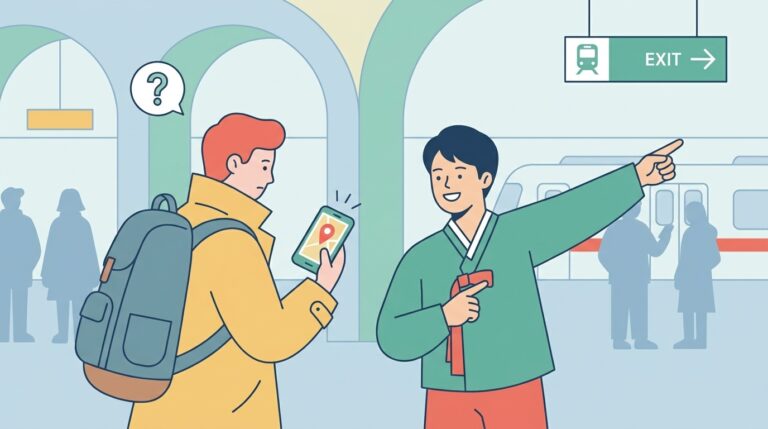
Imagine this: You are standing in the middle of a bustling Seoul street. The neon signs are beautiful, but your map app says “You have arrived” at your guesthouse, and all you see is a 24-hour BBQ restaurant. Your phone is at 2%. You look around, and everyone is walking at the speed of light (Bbali-bbali culture!).
In a K-Drama, this is the exact moment a handsome stranger bumps into you, picks up your dropped bag, and magically knows where you need to go. But in real life? You need to use your words!
Many of my beginner students freeze in this exact situation. They learned “Help me” in textbooks, but they are terrified of sounding rude. Don’t worry! Today, we are going to learn how to ask, “Can you help me?” like a polite, savvy local. By the end of this post, you’ll know exactly how to unlock the famous Korean Jeong (warm-heartedness) without breaking a sweat. Let’s dive in!
Phase 2: Core Expressions — Asking for Help Like a Pro
1. 좀 도와줄 수 있어요?
- Pronunciation: jom dowa-jul su isseoyo? [Sound-alike: jom sounds like “dome” but with a J. dowa-jul = dough-wah-jool]
- Meaning: Literal: “Can you give the ability to help a little?” / Real nuance: “Could you help me out a bit?”
- K-Culture Moment: You are in a modern Korean office (like in the drama Misaeng), struggling with the Korean language on the copy machine. You make eye contact with your friendly coworker and use this phrase.
- Editor’s Insight: The absolute magic word here is “좀” (jom). It literally means “a little.” Even if you need someone to help you move an entire couch, adding “jom” softens the request. It makes you sound considerate, not demanding.
- Situation Spectrum:
- Casual (Friends): ✅ (Just drop the ‘yo’ 👉 좀 도와줄 수 있어?)
- Semi-formal (Coworkers/Strangers): ✅
- Formal (Boss/Elders): ⚠️ (Better to use the honorific: 도와주실 수 있어요?)
- 🤔 Think About It: Why do Koreans almost always add “a little” (좀) when asking for a favor? Does your native language have a similar “softening” word to make requests sound less burdensome?
2. 저기요, 죄송한데요…
- Pronunciation: jeogiyo, joesonghandeyo… [Sound-alike: jeo-ghee-yo, jway-song-han-day-yo]
- Meaning: Literal: “Over there, I am sorry doing this…” / Real nuance: “Excuse me for interrupting, but…”
- K-Culture Moment: You are at a subway station, totally lost. You spot a local listening to K-Pop on their AirPods. You gently wave and say this to get their attention before asking your question.
- Editor’s Insight: Never just walk up to a stranger and yell your question! “저기요” gets their attention politely, and “죄송한데요” shows you respect their time. It’s the ultimate conversation starter for favors.
- Situation Spectrum:
- Casual (Friends): 🚫 (Too formal and awkward!)
- Semi-formal (Strangers on the street): ✅
- Formal (Staff/Elders): ✅
- 🤔 Think About It: In many Western cultures, we say “Excuse me” to start a request. In Korea, we say “I’m sorry.” What does this tell us about the Korean mindset regarding personal space and time?
Phase 3: Textbook vs. Real Korean
[Stopping a stranger on the street]
* 📖 Textbook Korean: 당신의 도움이 필요합니다. (I need your help.)
* 🗣️ Real Korean: 아, 저기요… 혹시… (Ah, excuse me… by any chance…)
* 💡 Why the difference?: The textbook version sounds like a robot or a dramatic police announcement. Real Koreans use filler words like “혹시” (by any chance) as a social cushion to avoid sounding too direct.
[Asking a friend to do something for you]
* 📖 Textbook Korean: 나를 도와주세요. (Please help me.)
* 🗣️ Real Korean: 야, 이것 좀 도와주라~ (Hey, help me out with this~)
* 💡 Why the difference?: Using formal language with close friends creates an awkward, invisible wall. Stretching the end of the sentence (“주라~”) adds a cute, friendly vibe!
Bottom Note: For A1 (Beginner) learners, sticking to sentences ending in “~요 (yo)” is your safest and best bet! It’s polite, natural, and works 95% of the time.
Phase 4: K-Culture Deep Dive
4-1. Non-verbal Cues: The Art of Nunchi
When asking for help in Korea, your body language speaks volumes. Don’t stand tall with your arms crossed! Instead, apply some Nunchi (눈치):
– Slightly bow your head when saying “저기요” (Excuse me).
– Make a slightly hesitant or apologetic facial expression.
– Hold your hands together in front of you. This physical posture shows you are genuinely in need and respectful of their time.
4-2. K-Travel Connection: The Magic of “Jeong”
Finding specific cafes or hidden restaurants in Korea can be tricky because many of them are tucked away on the 3rd floor or in winding alleyways. When you stop a local to ask for directions using “좀 도와줄 수 있어요?”, don’t be surprised if they physically walk you all the way to your destination!
This is the power of 정 (Jeong – warm-heartedness). Even if their English isn’t perfect, they will use hand gestures, map apps, and sheer willpower to make sure you arrive safely as a guest in their country.
Phase 5: Real-Life Roleplay
Scenario A: The Gangnam Station Maze
- Setting: Friday night, 7:30 PM at Gangnam Station. It is incredibly crowded. You need to find Exit 11, but every sign seems to point in a different direction.
- Characters:
- YOU: A traveler on their 3rd day in Seoul, carrying a shopping bag and looking very lost.
- NPC (Minho): A 20-something university student in a trendy oversized coat, looking at his phone.
YOU: 저기요… 죄송한데요.
(jeogiyo… joesonghandeyo.)
[Excuse me… I’m sorry to bother you.]
(🎭 Stage Direction: You slightly bow and wave your hand to get his attention.)
Minho: 네?
(ne?)
[Yes?]
(🎭 Stage Direction: Minho stops and looks up from his phone.)
YOU: 제가 길을 잃었어요… 좀 도와줄 수 있어요?
(jega gireul ileosseoyo… jom dowa-jul su isseoyo?)
[I am lost… could you help me a little?]
Minho: 아, 네! 어디 가세요?
(a, ne! eodi gaseyo?)
[Ah, yes! Where are you going?]
🔀 Your Turn! How do you answer?
– A) “강남역 11번 출구 어떻게 가요?” (How do I go to Gangnam Station Exit 11?)
– B) “도와주세요! 11번 출구!” (Help me! Exit 11!)
– C) “너, 11번 출구 알아?” (You, know Exit 11?)✅ Best Choice: A — It is polite, direct, and perfectly answers his question using the standard “yo” form.
⚠️ Choice B & C Analysis: B sounds too dramatic, like an emergency. C uses casual language (반말) which is extremely rude to a stranger!
Scenario B: Bonus K-Cafe Moment
You are at a trendy cafe in Seongsu-dong, and the Wi-Fi password on the receipt is too faded to read.
YOU: 저기요, 죄송한데요.
(jeogiyo, joesonghandeyo.)
[Excuse me, I’m sorry…]
Barista: 네, 손님!
(ne, sonnim!)
[Yes, customer!]
YOU: 와이파이 비밀번호 좀 알려줄 수 있어요?
(waipai bimilbeonho jom allyeojul su isseoyo?)
[Could you please let me know the Wi-Fi password?]
Barista: 아, 영수증 아래에 있어요. 다시 적어드릴게요!
(a, yeongsujeung arae-e isseoyo. dasi jeogeodeurilgeyo!)
[Ah, it’s at the bottom of the receipt. I’ll write it down for you again!]
Phase 6: 10-Second Shadowing Drill
Practice these sentences out loud. Pay attention to the pauses (/) and the emotion!
- 🥺 Hesitantly: 저기요… / 죄송한데요… (jeogiyo… / joesonghandeyo…)
- 😊 Polite & Bright: 이것 좀 / 도와줄 수 있어요? (igeot jom / dowa-jul su isseoyo?)
- 😥 A little lost: 제가 / 길을 잃었어요. (jega / gireul ileosseoyo.)
Phase 7: K-Culture Mini Dictionary
1. 눈치
* Romanization: nunchi
* English: Social awareness / tact
* Context: The Korean superpower of reading the room. Using “Nunchi” means knowing when someone is too busy to help, or adjusting your tone to be extra polite.
2. 저기요
* Romanization: jeogiyo
* English: Excuse me / Over there
* Context: The universal phrase to get a waiter’s attention in a restaurant, or to stop a stranger on the street politely.
3. 정
* Romanization: jeong
* English: Emotional bond / warm-heartedness
* Context: The invisible cultural force that makes a Korean stranger go out of their way to help you find your hotel.
4. 민폐
* Romanization: minpye
* English: Public nuisance / being a burden
* Context: Koreans highly value not causing minpye. This is why they apologize (“죄송한데요”) before asking for a favor!
Phase 8: Traveler’s Survival Kit
If you only remember three phrases for your trip to Korea, make it these!
🆘 Survival Phrases TOP 3
– 🇰🇷 1. 화장실 어디예요? (hwajangsil eodiyeyo?)
– 🗣️ Meaning: Where is the bathroom?
– 🇰🇷 2. 이거 얼마예요? (igeo eolmayeyo?)
– 🗣️ Meaning: How much is this?
– 🇰🇷 3. 영어 할 수 있어요? (yeongeo hal su isseoyo?)
– 🗣️ Meaning: Can you speak English?📌 Editor’s Travel Note
– Essential Apps: Download Naver Map or KakaoMap. Google Maps does not provide walking directions in South Korea due to security laws!
– Papago over Google Translate: For Korean-to-English translation, the Naver Papago app is incredibly accurate and understands Korean cultural nuances and honorifics much better.
Phase 9: Critical Thinking — “One Step Deeper”
Language & Power (언어와 권력)
In Korean, politeness is built directly into the grammar. When you ask someone “좀 도와줄 수 있어요?” (Can you help me?), you are acknowledging that their time is valuable. By using the “요(yo)” ending and the word “좀(jom/a little)”, you are linguistically lowering yourself to show respect to the person doing the favor. It is a beautiful reflection of a society that values hierarchy, respect, and community harmony over individual demands.
💬 Your Turn: In your culture, how do you express extreme politeness when asking a stranger for a big favor? Let us know in the comments!
Phase 10: FAQ & Mistake Prevention
Q: Can I just shout “도와주세요!” (Help me!) in a store to get a worker’s attention?
A: NO! 🚫 “도와주세요” is used for literal emergencies (like if you are falling off a cliff or someone is stealing your bag). If you just want to find the ramen aisle in a supermarket, use “저기요” (Excuse me) instead. If you shout “도와주세요,” people might call the police!
Q: Can I use “도와줘 (dowa-jwo)” to my favorite K-Pop idol in a fan letter?
A: Maybe! “도와줘” is informal (casual). While fans often use casual language to feel closer to idols, if you are asking for a specific favor (like “Please read this”), it’s safer to use polite forms so you don’t sound bossy.
❌ Common Mistake #1: Asking for help without saying “Excuse me” first.
✅ Do this instead: Always pad your request with “저기요” or “죄송하지만…” (I’m sorry, but…) to show good Nunchi.
Phase 11: Summary & Action Items
- One-Liner Summary: Soften your requests like a true local by using “저기요” to start, and adding “좀” (a little) to your sentence!
Action Mission 3 Steps:
– 🥉 Bronze (Solo): Stand in front of your mirror and practice saying “저기요… 좀 도와줄 수 있어요?” with a polite, slightly apologetic face.
– 🥈 Silver (Online): Go to your favorite K-Pop idol’s music video on YouTube and leave a comment in Korean: “[Idol’s name], 한국어 공부 좀 도와줄 수 있어요? 😊”
– 🥇 Gold (Real Life): Next time you visit a Korean restaurant or grocery store, try saying “저기요” to get the staff’s attention!
K-Culture Mission:
Watch one episode of a K-Drama today. Whenever a character needs a favor, listen closely! Do you hear them say “좀”? Count how many times you hear it!
Phase 12: Quiz — Interactive Challenge
1. Situational Judgment: You are at a busy cafe and dropped your fork. You need to ask the busy staff for a new one. What is the BEST way to start speaking to them?
– A) 도와주세요! (dowa-juseyo!)
– B) 저기요! (jeogiyo!)
– C) 너 일로 와봐. (neo illo wabwa.)
2. True or False — K-Culture Edition:
– It is considered polite to hand your phone to a Korean stranger without saying anything to show them the map.
3. Fill in the Blank:
– “제가 길을 잃었어요. ______ 도와줄 수 있어요?” (I am lost. Can you help me a little?)
Click here to see the answers!
1. Answer: B (A means “emergency help!” and C is incredibly rude, meaning “You, come here.”)
2. Answer: False (Always start with a verbal greeting like “저기요” and explain what you need. Shoving a phone in someone’s face is rude everywhere!)
3. Answer: 좀 (jom) (The magic softening word!)
Frequently Asked Questions (FAQ)
Q: What does "좀 도와줄 수 있어요?" mean in Korean and how do you pronounce it?
A: In Korean, "좀 도와줄 수 있어요?" is pronounced [jom dowa-jul su isseoyo? [Sound-alike: jom sounds like "dome" but with a J. dowa-jul = dough-wah-jool] and means: Literal: "Can you give the ability to help a little?" / Real nuance: "Could you help me out a bit?"
Q: What does "저기요, 죄송한데요..." mean in Korean and how do you pronounce it?
A: In Korean, "저기요, 죄송한데요..." is pronounced [jeogiyo, joesonghandeyo... [Sound-alike: jeo-ghee-yo, jway-song-han-day-yo] and means: Literal: "Over there, I am sorry doing this..." / Real nuance: "Excuse me for interrupting, but..."







