

Phase 1: Empathy (Immersive Opening)
Hello! Daily Hangul Editor here.
Imagine this: You’re sitting at a bustling Pocha (Korean street food tent). The steam from the Tteokbokki is rising, the string lights are glowing, and the local friend you just made asks you, “When did you arrive in Seoul?”
You want to casually sip your Soju and say, “Oh, I got here yesterday!” or “The day before yesterday!” But suddenly, your mind goes blank. You end up pointing behind you, making a swoosh sound, and saying “past time!” We’ve all been there.
Time is the anchor of every conversation. In K-Dramas, whenever a character is interrogating someone or gossiping about a wild night out, the words for “yesterday” and “the day before yesterday” are dropped constantly. Knowing these two simple words will instantly upgrade your Korean from “just smiling and nodding” to actually participating in the story.
Don’t worry! This guide is based on real questions from my absolute beginner (A1) students. By the end of this post, you’ll be throwing these words into your sentences like a true local.
Phase 2: Core Expressions Deep Dive
Let’s break down the most essential words you need to talk about the recent past.
1. 어제 (Yesterday)
- Pronunciation: eo-je [uh-jeh] (The ‘어’ sounds like the ‘uh’ in ‘up’, and ‘제’ sounds like ‘jeh’)
- Meaning: Yesterday
- K-Culture Moment: You’ll hear this in almost every K-Drama office scene. A boss asking, “어제 뭐 했어?” (What did you do yesterday?) or a friend gossiping, “어제 걔 만났어?” (Did you meet them yesterday?).
- Editor’s Insight: This word is your best friend when traveling. Pair it with “왔어요” (came/arrived) to let locals know you’re fresh off the plane!
- Situation Spectrum:
- Casual with friends: ✅
- Semi-formal with coworkers: ✅
- Formal with elders: ✅ (The word itself doesn’t change, just the verb ending!)
- 🤔 Think About It: In English, we say “ON Monday” but just “Yesterday.” In Korean, we use the time particle ‘에’ (at/on) for dates and days, but NEVER attach it to ‘어제’. Why do you think words like ‘today’, ‘tomorrow’, and ‘yesterday’ skip the rules in so many languages?
2. 그저께 (The day before yesterday)
- Pronunciation: geu-jeo-kke [guh-juh-kkeh] (Say it fast, with a strong ‘kk’ sound at the end!)
- Meaning: The day before yesterday
- K-Culture Moment: In K-Pop fandoms, fans love keeping track of idol schedules. “Didn’t they arrive at the airport the day before yesterday?” It implies something happened recently, but the hype has settled a bit.
- Editor’s Insight: English needs five whole words (“the day before yesterday”), but Korean just needs three syllables! It’s so efficient.
- Situation Spectrum:
- Casual with friends: ✅
- Semi-formal with coworkers: ✅
- Formal with elders: ✅
- 🤔 Think About It: Koreans love speed (Ppalli-Ppalli culture). Do you think having a single, short word for “the day before yesterday” helps Korean conversations flow faster?
3. 그제 (The day before yesterday – Short Form)
- Pronunciation: geu-je [guh-jeh]
- Meaning: The day before yesterday (abbreviated)
- K-Culture Moment: If “그저께” is textbook, “그제” is what your cool barista friend says while wiping down the counter.
- Editor’s Insight: It’s literally just “그저께” with the middle chopped out. When you’re typing on KakaoTalk or speaking fast, this is the go-to!
Phase 3: Textbook vs. Real Korean
Let’s see how these words actually live and breathe in Seoul.
[Talking about when you arrived]
* 📖 Textbook Korean: 저는 어제 한국에 왔습니다. (I came to Korea yesterday.)
* 🗣️ Real Korean: 저 어제 왔어요! (I came yesterday!)
* 💡 Why is it different?: Koreans drop the subject (“I”) and destination (“to Korea”) when it’s obvious! It makes you sound much more natural.
[Explaining a recent event]
* 📖 Textbook Korean: 우리는 그저께 만났습니다. (We met the day before yesterday.)
* 🗣️ Real Korean: 우리 그제 만났어. (We met the day before yesterday. – Casual)
* 💡 Why is it different?: Using the shortened form “그제” and dropping formal endings is standard among friends for maximum efficiency.
Bottom Note: For A1 beginners, stick to “어제 왔어요” (I came yesterday). It’s polite, short, and perfectly natural!
Phase 4: Cultural Context — K-Culture Deep Dive
4-1. Non-Verbal Cues: Counting Days
When Koreans talk about “yesterday” or “the day before yesterday,” you might see them using their hands. Instead of pointing fingers outward like in the West, Koreans often start with an open palm and fold their fingers inward toward the palm to count days. Try folding your thumb in while saying “어제”!
4-2. The K-Travel Connection
As a foreigner in Korea, you are going to be asked one question almost every single day: “언제 왔어요?” (When did you come?)
Whether you are checking into a guesthouse in Myeongdong, chatting with a friendly taxi driver, or buying skincare from a chatty salesperson in a K-Beauty shop, locals love knowing how long you’ve been in the country.
Answering with a crisp “어제요!” (Yesterday!) often earns you a warm smile and a “Wow, your Korean is good!” because it shows you aren’t just relying on English. It bridges the gap instantly.
Survival Phrase check: Just add ‘요’ (yo) to the word to make it a polite, complete sentence!
– “어제요.” (Yesterday.)
– “그저께요.” (The day before yesterday.)
Phase 5: Real-Life Roleplay Scenario
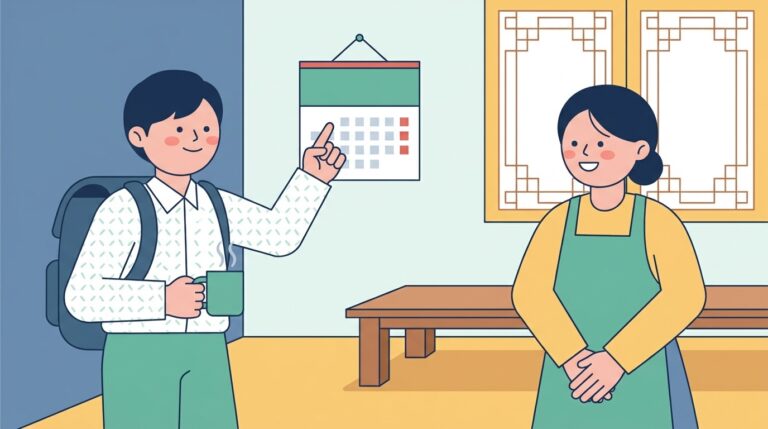
Setting: Saturday morning, 10:00 AM. You are sitting in the cozy, sunlit common area of a Guesthouse in Hongdae. You are drinking instant mixed coffee (맥심 – Maxim). The Guesthouse host, Min-ji, is wiping the tables and strikes up a conversation.
Characters:
– YOU (The Reader): A traveler on your first solo trip to Korea (A1 Level).
– Min-ji (28): The friendly guesthouse manager. She loves chatting with guests.
Dialogue:
Min-ji: 안녕하세요! 커피 맛있어요? ☕
(Annyeong-haseyo! Keopi masisseoyo?)
[Hello! Is the coffee good?]
(🎭 Stage Direction: Min-ji smiles and points at your yellow coffee cup)
YOU: 네! 맛있어요.
(Ne! Masisseoyo.)
[Yes! It’s delicious.]
Min-ji: 한국에 언제 왔어요? 오늘 왔어요?
(Hanguge eonje wasseoyo? Oneul wasseoyo?)
[When did you come to Korea? Did you come today?]
YOU: 아니요, 어제 왔어요.
(Aniyo, eo-je wasseoyo.)
[No, I came yesterday.]
Min-ji: 아, 어제요! 피곤해요?
(Ah, eo-jeyo! Pigonhaeyo?)
[Ah, yesterday! Are you tired?]
YOU: 네, 조금 피곤해요.
(Ne, jogeum pigonhaeyo.)
[Yes, a little tired.]
Min-ji: 어제 뭐 했어요? 홍대 구경했어요?
(Eo-je mwo haesseoyo? Hongdae gugyeong-haesseoyo?)
[What did you do yesterday? Did you look around Hongdae?]
🔀 Your Turn! How should you answer?
– A) 어제 홍대에 갔어요. (I went to Hongdae yesterday.)
– B) 그저께 홍대에 갔어요. (I went to Hongdae the day before yesterday.)
– C) 언제 홍대에 갔어요? (When did you go to Hongdae?)✅ Best Choice: A — Reason: You just said you arrived yesterday, so A makes perfect sense!
⚠️ Choice B & C Analysis: You couldn’t have gone the day before yesterday (B) if you arrived yesterday! Choice C confuses “어제” (yesterday) with “언제” (when), which is a very common beginner mistake!
(Let’s continue with Choice A)
YOU: 네! 어제 홍대에 갔어요.
(Ne! Eo-je Hongdae-e gasseoyo.)
[Yes! I went to Hongdae yesterday.]
Min-ji: 우와, 좋아요. 오늘은 뭐 해요?
(Uwa, joayo. Oneul-eun mwo haeyo?)
[Wow, nice. What are you doing today?]
YOU: 오늘은 쉴 거예요!
(Oneul-eun swil geo-yeyo!)
[Today, I will rest!]
🎬 Bonus K-Culture Roleplay: The Idol Fansign
Imagine you won a ticket to your favorite K-Pop idol’s fan sign event!
– Idol: 안녕하세요! 처음 오셨어요? (Hello! Is it your first time here?)
– YOU: 아니요! 그저께 콘서트에 갔어요! (No! I went to the concert the day before yesterday!)
– Idol: 아, 진짜요? 너무 감사합니다! (Ah, really? Thank you so much!)
Phase 6: 10-Second Shadowing Drill
Read these out loud to get the rhythm right. Focus on the pauses (/) and the emotion tags!
- 😊 밝게 (Brightly): 저 / 어제 / 왔어요! (jeo / eo-je / wasseoyo!) – I arrived yesterday!
- 🥺 아쉽게 (Sadly): 그저께 / 한국을 / 떠났어요. (geu-jeo-kke / hangugeul / tteonasseoyo.) – I left Korea the day before yesterday.
- 😤 단호하게 (Firmly): 그거 / 어제 / 했어요. (geugeo / eo-je / haesseoyo.) – I did that yesterday.
Phase 7: K-Culture Mini Dictionary
Here are some cultural keywords related to our topic:
1. 게하
* Romanization: ge-ha
* English: Guesthouse
* Context: A shortened slang for 게스트하우스 (guesthouse). It’s the ultimate place to make friends and practice saying “어제 왔어요!” (I came yesterday!).
2. 막방
* Romanization: mak-bang
* English: Last broadcast/episode
* Context: Short for 마지막 방송. If your favorite drama ended, you would say “어제 막방 봤어요?” (Did you see the final episode yesterday?).
3. 시차
* Romanization: si-cha
* English: Time difference / Jet lag
* Context: If you arrived “어제” (yesterday), you probably have jet lag! “시차 때문에 피곤해요” (I’m tired because of jet lag) is a great phrase.
4. 빨리빨리
* Romanization: ppalli-ppalli
* English: Hurry up / Fast-paced culture
* Context: Korea’s iconic fast-paced culture. This is why having short words like “그제” instead of a long phrase is so deeply ingrained in the language.
Phase 8: Traveler Survival Kit
Mastering dates and time is crucial for navigating Korea. Here are your top survival phrases:
🆘 Survival Phrase #1: Stating Arrival
– 🇰🇷 “어제 왔어요.” (eo-je wasseoyo.)
– 🗣️ English Guide: [uh-jeh wah-sso-yo]
– 📍 Where to use: Taxi, Immigration, Hotels, chatting with locals.🆘 Survival Phrase #2: Changing Plans
– 🇰🇷 “어제 갔어요.” (eo-je gasseoyo.)
– 🗣️ English Guide: [uh-jeh gah-sso-yo]
– 📍 Where to use: When someone recommends a tourist spot, but you already went there!🆘 Survival Phrase #3: The Short Answer
– 🇰🇷 “그저께요.” (geu-jeo-kkeyo.)
– 🗣️ English Guide: [guh-juh-kkeh-yo]
– 📍 Where to use: When asked when something happened. Just add ‘요’ (yo) to be polite.
📌 Editor’s Travel Note:
– Writing Dates: In Korea, the date format is strictly Year-Month-Day (YYYY-MM-DD). If you are booking a KTX train ticket for “yesterday’s” missed trip or “tomorrow,” pay close attention to this format!
– Time Particles: Remember, NEVER attach ‘에’ (at/on) to 어제, 오늘 (today), or 내일 (tomorrow). It sounds incredibly awkward to locals.
Phase 9: Critical Thinking Corner — “One Step Deeper”
Media vs Reality: The Perception of Time in Korea
🧠 Think Deeper:
If you watch K-Dramas, you might notice how obsessed characters are with when things happened. “Did you call him yesterday?” “We met the day before yesterday!” In Korea’s Ppalli-Ppalli (hurry, hurry) culture, time is a highly valued currency. Everything moves fast—delivery arrives in 20 minutes, trends change overnight. Therefore, knowing exactly whether something happened yesterday versus the day before yesterday isn’t just about grammar; it’s about staying relevant and keeping up with the speed of Korean society.💬 Your Turn: How does your culture view time? Is it relaxed, or is everything fast-paced like in Seoul? Share in the comments!
Phase 10: FAQ & Avoiding Misunderstandings
Q: Can I use “어제” and “그저께” with older people or my boss?
Yes! The words for yesterday and the day before yesterday do not change based on who you are talking to. Just make sure the verb at the end of your sentence is polite (ending in ~요 or ~습니다).
Q: In English, I say “I met him ON yesterday.” Can I say “어제에” in Korean?
No! This is the most common mistake. Words like yesterday (어제), today (오늘), and tomorrow (내일) do not take the time particle ‘에’. Just say “어제 만났어요” (Met yesterday).
Q: Is “그제” slang? Can I write it on a formal test?
It is a standard abbreviation, not slang! However, on a very formal test (like TOPIK), it’s safer to write “그저께”. In speaking, “그제” is perfectly fine and natural.
❌ Common Mistake Alert: Confusing 어제 (Yesterday) with 언제 (When).
– 언제 (eon-je): WHEN did you eat?
– 어제 (eo-je): I ate YESTERDAY.
Tip: They look and sound similar, but mean totally different things! Make sure you don’t ask someone “Yesterday did you arrive?” when you mean “When did you arrive?”
Phase 11: Summary & Action Items
- One-Liner Summary: Talk about the recent past seamlessly by using 어제 (yesterday) and 그저께 (the day before yesterday) without any extra time particles!
-
Action Mission:
- 🥉 Bronze (Solo): Look at your calendar, point to yesterday, and say “어제” out loud 3 times.
- 🥈 Silver (Online): Write a comment below in English mixed with Korean: “I ate pizza 어제!”
- 🥇 Gold (Real World): Next time you enter a Korean restaurant or meet a Korean friend, tell them one thing you did “어제”!
- K-Culture Mission:
Watch 15 minutes of any modern K-Drama today. I guarantee you will hear the word “어제” at least once. When you hear it, shout “I caught it!”
Did you learn something new today? What did you eat 어제 (yesterday)? Let me know in the comments below! 👇
Phase 12: Quiz — Interactive Challenge
1. Situational Judgment:
You want to tell your Korean friend that you arrived in Seoul the day before yesterday. What is the most natural way to say it?
– A) 저는 그저께에 서울에 왔습니다.
– B) 나 그제 왔어!
– C) 나 언제 왔어.
2. Fill in the Blank:
A: 한국에 ( _______ ) 왔어요? (When did you come to Korea?)
B: ( _______ ) 왔어요. (I came yesterday.)
3. True or False – K-Culture Edition:
In Korea, dates are usually written in the order of Day-Month-Year. (T/F)
(Answers)
Click to reveal answers!
1. B is the most natural for a friend! A is wrong because you cannot put ‘에’ after 그저께. C uses the word for ‘when’ instead of ‘yesterday’.
2. 언제 (When) / 어제 (Yesterday). Notice the difference in spelling!
3. False! Korea uses the Year-Month-Day (YYYY-MM-DD) format.
Frequently Asked Questions (FAQ)
Q: What does "어제 (Yesterday)" mean in Korean and how do you pronounce it?
A: In Korean, "어제 (Yesterday)" is pronounced [eo-je [uh-jeh] and means: Yesterday
Q: What does "그저께 (The day before yesterday)" mean in Korean and how do you pronounce it?
A: In Korean, "그저께 (The day before yesterday)" is pronounced [geu-jeo-kke [guh-juh-kkeh] and means: The day before yesterday
Q: What does "그제 (The day before yesterday - Short Form)" mean in Korean and how do you pronounce it?
A: In Korean, "그제 (The day before yesterday - Short Form)" is pronounced [geu-je [guh-jeh] and means: The day before yesterday (abbreviated)







