

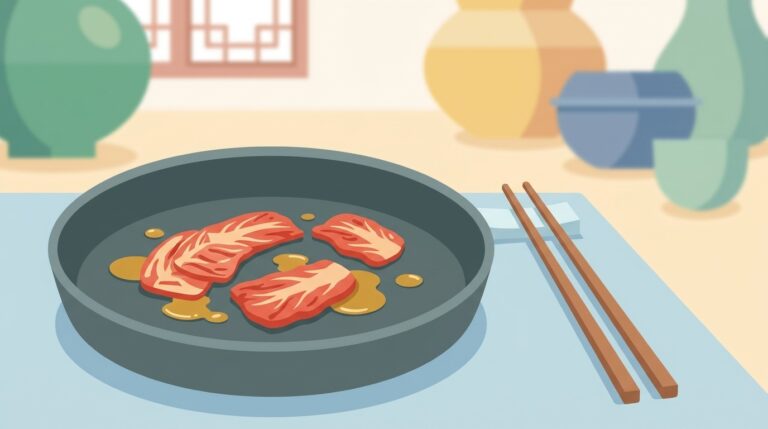
Phase 1: Empathy & K-Culture Open
Hello! I’m your Daily Hangul Editor, your friendly Korean tutor and K-Culture navigator.
Imagine this: You are watching a K-Drama. The main character just had a bad day, so they go into their kitchen, open a container of vibrant red Kimchi, chop it up, and throw it into a hot frying pan. Sizzle! The sound is followed by the nutty, mouth-watering aroma of sesame oil. Or maybe you’re at a loud Korean BBQ restaurant, and the server places a scoop of Kimchi at the bottom of the grill, right where the rich pork juices flow.
Many foreigners ask me, “Wait, isn’t Kimchi a cold side dish? Why do Koreans cook it?” Oh, my friend, cooking Kimchi transforms it from a simple salad into the ultimate K-Food soul food!
But if you try to cook fresh Kimchi, or if you don’t know the secret finishing touch, you might miss out on that authentic taste. Today, based on real questions from my students, we are going to learn how to talk about Stir-frying Kimchi (김치 볶기) like a true local. By the end of this lesson, you’ll be cooking and chatting just like a K-Drama protagonist!
Phase 2: Deep Dive into Core Expressions
Let’s look at the absolute must-know phrases for your K-Food cooking adventure.
1. 김치를 볶아요
- Pronunciation: gimchi-reul bokkayo [gim-chi-reul bo-kka-yo]
- Meaning: I stir-fry the Kimchi / Stir-fry the Kimchi
- K-Culture Moment: This is the core action! When you’re making Kimchi Fried Rice (김치볶음밥) or Tofu with Stir-fried Kimchi (두부김치), this is the first step. The verb
볶다(to stir-fry) is essential in Korean cooking. - Editor’s Insight: The
kksound in볶아요should be sharp and tense. Imagine the quick, sharp sizzle of the hot pan when the Kimchi hits the oil! - Situation Spectrum:
- Casual with friends: ✅ (김치 볶아! – gimchi boka!)
- Semi-formal (coworkers): ✅
- Formal (boss/elders): ✅
- 🤔 Think About It: Korean cuisine has very specific verbs for cooking methods—
볶다(stir-fry),끓이다(boil),굽다(grill). Why do you think knowing the exact cooking verb is so important in Korean culture?
2. 신김치로 하세요
- Pronunciation: sin-gimchi-ro haseyo [sheen-gim-chi-ro ha-se-yo]
- Meaning: Please use sour (aged) Kimchi.
- K-Culture Moment: If you try to stir-fry fresh Kimchi (겉절이), it just gets soggy and tasteless. The golden rule of K-Food is that you must use well-fermented, sour Kimchi (
신김치) for cooking. Korean moms will always proudly announce, “My Kimchi is perfectly aged for frying!” - Editor’s Insight:
신(sin) means sour. When you say this, pucker your lips a little bit, like you’re tasting something tangy! - Situation Spectrum:
- Casual with friends: ✅ (신김치로 해 – sin-gimchi-ro hae)
- Semi-formal: ✅
- Formal: ✅
- 🤔 Think About It: Fermentation takes time and patience. How does the concept of “waiting for the right time” reflect in other parts of Korean life?
3. 참기름을 넣어요
- Pronunciation: chamgireum-eul neoeoyo [cham-gi-reum-eul neo-uh-yo]
- Meaning: Add sesame oil.
- K-Culture Moment: The magic potion of K-Food! In K-Dramas, whenever someone makes a quick meal at night, they always finish it with a generous drizzle of
참기름(sesame oil). It’s the perfume of the Korean kitchen. - Editor’s Insight:
참means ‘true’ or ‘real’, and기름means ‘oil’. It literally translates to “true oil.” Add it at the end of cooking, not the beginning, to keep the aroma alive! - Situation Spectrum:
- Casual with friends: ✅
- Semi-formal: ✅
- Formal: ✅
Phase 3: Textbook vs. Real Korean
Let’s see how textbook Korean differs from what you’ll actually hear in a Korean kitchen or restaurant.
[Situation 1: Adding the cooking oil]
* 📖 Textbook Korean: 식용유를 두르세요. (Add cooking oil.)
* 🗣️ Real Korean: 기름 살짝 두르고~ (Just a little splash of oil~)
* 💡 Why the difference?: Koreans love using rhythmic, soft endings (like ~고~) when cooking to make the process sound smooth and rhythmic, almost like singing a recipe.
[Situation 2: Describing how delicious it is]
* 📖 Textbook Korean: 아주 맛있습니다. (It is very delicious.)
* 🗣️ Real Korean: 완전 밥도둑이에요! (It’s a total rice thief!)
* 💡 Why the difference?: 밥도둑 (Rice thief) is a popular cultural slang. It means the side dish is so salty, savory, and delicious that your bowl of rice magically “disappears” as you eat it.
Bottom Note: For A2 (Beginner) learners,
밥도둑is a fantastic, safe slang word that will make any Korean smile and compliment your Korean skills!
Phase 4: Cultural Context — K-Culture Deep Dive
4-1. Non-verbal Elements: The Sound of Flavor
When Koreans talk about stir-frying Kimchi or grilling meat, we often use sound effects! The most famous one is “치이익” (chi-i-ik). When you tell a friend you cooked Kimchi, make a frying motion with your hands and say, “팬에 김치를 치이익~” (chi-i-ik on the pan~). It instantly makes your story 100 times more delicious.
4-2. K-Food Connection: The Unspoken K-BBQ Rule
If you go to a Korean BBQ restaurant (삼겹살집), you will notice that people don’t just eat Kimchi raw. They place it on the grill. But here is the critical rule: The Kimchi must be placed at the bottom slope of the grill. Why? So that the flavorful pork fat drips down and fries the Kimchi naturally! If you do this without being told, your Korean friends will look at you with deep respect.
Phase 5: Real-life Roleplay Scenario
Setting: It’s 11:00 PM on a Friday. You are at a cozy Airbnb in Seoul. You and your Korean friend, Minji, are hungry after watching a K-Drama. You decide to make midnight Kimchi Fried Rice.
Characters:
* YOU: An enthusiastic Korean learner who loves K-Food.
* Minji (28): Your friendly Korean friend who is an expert at late-night snacks.
Dialogue:
Minji: 배고프다. 우리 김치볶음밥 먹을까?
(baegopeuda. uri gimchibokkeumbap meogeulkka?)
[I’m hungry. Should we eat Kimchi Fried Rice?]
YOU: 좋아요! 제가 김치를 볶을게요. 🍳
(joayo! jaega gimchireul bokkeulgeyo.)
[Sounds good! I will stir-fry the Kimchi.]
Minji: 오~ 요리 좀 하는데? 여기 참기름!
(o~ yori jom haneunde? yeogi chamgireum!)
[Oh~ you know how to cook? Here is the sesame oil!]
YOU: 잠깐만요, 참기름은 마지막에 넣어요.
(jamkkanmanyo, chamgireumeun majimage neoeoyo.)
[Wait a minute, we add sesame oil at the end.]
Minji: (Surprised) 대박! 한국인 다 됐네!
(daebak! hangugin da dwaenne!)
[Awesome! You’ve basically become Korean!]
(🎭 Stage Direction: The fried rice is almost done, smelling amazing)
Minji: 계란 프라이도 하나 올릴까? 어떻게 해줄까?
(gyeran peuraido hana ollilkka? eotteoke haejulkka?)
[Should we put a fried egg on top? How do you want it?]
🔀 Your Turn! How should you answer?
* A) “아니요, 괜찮아요.” (No, I’m okay.)
* B) “반숙으로 해주세요!” (Sunny-side up, please!)
* C) “아무거나 좋아요.” (Anything is fine.)✅ Best Choice: B — In K-Food, breaking the runny yolk of a sunny-side up egg (
반숙ban-suk) over spicy Kimchi Fried Rice is the ultimate aesthetic.
⚠️ Choice C Analysis: It’s polite, but knowing exactly how you want your egg shows you truly understand the K-Food vibe!
Phase 6: 10-Second Shadowing Drill
Read this out loud. Pay attention to the pauses (/) and the emotion!
😊 우와, / 냄새가 / 장~~~난 아니에요!
(u-wa / naem-sae-ga / jang~~~nan a-ni-e-yo!)
Wow, the smell is no joke (incredible)!
Phase 7: K-Culture Mini Dictionary
1. 신김치
* Romanization: sin-gimchi
* English: Sour / Aged Kimchi
* Context: The older the Kimchi, the more sour it gets. It’s the secret weapon for stews (Jjigae) and frying.
2. 참기름
* Romanization: chamgireum
* English: Sesame oil
* Context: Used as a finishing oil in K-Food to add a deep, nutty aroma. Never used for deep frying!
3. 밥도둑
* Romanization: bapdoduk
* English: Rice thief
* Context: A playful term for a side dish that is so delicious and savory that you eat an incredible amount of rice with it.
4. 삼겹살집
* Romanization: samgyeopsal-jip
* English: Pork belly BBQ restaurant
* Context: The social hub of Korean dining, where friends gather to grill meat, drink Soju, and yes, grill Kimchi!
Phase 8: Traveler Survival Kit
If you’re traveling in Korea and find yourself at a Korean BBQ restaurant, use these survival phrases to get the best Kimchi experience!
🆘 Survival Phrase #1
* 🇰🇷 “이거 불판에 구워도 돼요?”
* 🗣️ Pronunciation: [i-geo bul-pan-e gu-wo-do dwae-yo?]
* English: Can I grill this on the pan?
* 📍 Where to use: At a BBQ restaurant, pointing at the Kimchi or garlic.
* 💡 Pro Tip: Most places say yes, but some places with special non-stick grills might ask you not to. Always safe to ask!📌 Editor’s Travel Note
* Spice Level: Cooked Kimchi is usually less spicy than raw Kimchi because the oil mellows out the heat. If it’s still too spicy, eat it with rice!
* Smell: Be careful! Stir-frying Kimchi at your Airbnb might leave a strong garlic smell. Make sure to open the windows (환기 – hwan-gi)!
Phase 9: Critical Thinking — “One Step Deeper”
Food & Identity: The Concept of ‘We’
🧠 Think Deeper:
In Korea, food is rarely an individual experience. When you stir-fry Kimchi or grill meat at a restaurant, you are cooking in the center of the table, sharing the same grill. Fermenting Kimchi (Gimjang) was historically done as a whole village, creating a massive sense of community. The shared process of cooking and eating from the same pan reflects the deep Korean cultural concept of우리(We/Our). We don’t say “My country” or “My house”; we say “Our country” (우리나라) and “Our house” (우리 집).💬 Your Turn: Does your culture have a dish that brings everyone together to cook or eat from a shared pot? Share it in the comments!
Phase 10: FAQ & Avoiding Misunderstandings
- Q: Can I use butter instead of cooking oil to fry Kimchi?
- A: Yes and No! Traditionally, no. But recently, “Kimchi + Butter” has become a trendy fusion flavor. However, to get the authentic Korean mom’s taste, stick to regular cooking oil and finish with sesame oil.
- Q: Do I need to wash the Kimchi before cooking?
- A: No! You want all that red, spicy goodness. However, if Koreans are cooking for small children who can’t handle spice, they will wash the Kimchi in water first. This is called
씻은 김치(washed Kimchi).
- A: No! You want all that red, spicy goodness. However, if Koreans are cooking for small children who can’t handle spice, they will wash the Kimchi in water first. This is called
❌ Common Mistake #1: Trying to make Kimchi Fried Rice with Kimchi you bought from the store on the same day.
✅ Do this instead: Leave it in your fridge for a couple of weeks until it smells quite sour, THEN cook it!
Phase 11: Summary & Action Items
- One-Liner Summary: To make the perfect K-Food dish, remember to stir-fry (
볶아요) sour Kimchi (신김치) and finish it with sesame oil (참기름)!
Action Mission 3 Steps:
* 🥉 Bronze (Solo): Stand in your kitchen, pretend you are tossing a pan, and say “김치를 볶아요!” 3 times.
* 🥈 Silver (Online): Find a K-Food recipe video on YouTube and leave a comment: “완전 밥도둑이에요!” (It’s a total rice thief!)
* 🥇 Gold (Real Life): Next time you visit a K-BBQ restaurant, ask the server, “김치 불판에 구워도 돼요?”
🎬 K-Culture Mission:
Watch an episode of any K-Drama tonight. I guarantee you will see a scene where someone is eating Kimchi. Try to spot if they are eating it raw, or if it’s cooked into a stew or fried rice!
Phase 12: Quiz — Interactive Challenge
1. Fill in the Blank:
To make the best fried Kimchi, you shouldn’t use fresh Kimchi. You must use aged, sour Kimchi, which is called ____.
(A) 새김치 (sae-gimchi)
(B) 신김치 (sin-gimchi)
(C) 단김치 (dan-gimchi)
2. True or False — K-Culture Edition:
At a Korean BBQ restaurant, the best place to put your Kimchi on the grill is at the very top so it doesn’t touch the meat. (T/F)
3. Situational Judgment:
You just tasted your friend’s Kimchi Fried Rice and it is incredibly delicious. You want to use a native slang expression to praise it. What do you say?
(A) 밥도둑이에요! (bapdoduk-ieyo!)
(B) 참기름이에요! (chamgireum-ieyo!)
(C) 식용유예요! (sigyongnyu-yeyo!)
(Answers: 1: B, 2: False – Put it at the bottom to catch the pork fat!, 3: A)
Frequently Asked Questions (FAQ)
Q: What does "김치를 볶아요" mean in Korean and how do you pronounce it?
A: In Korean, "김치를 볶아요" is pronounced [gimchi-reul bokkayo [gim-chi-reul bo-kka-yo] and means: I stir-fry the Kimchi / Stir-fry the Kimchi
Q: What does "신김치로 하세요" mean in Korean and how do you pronounce it?
A: In Korean, "신김치로 하세요" is pronounced [sin-gimchi-ro haseyo [sheen-gim-chi-ro ha-se-yo] and means: Please use sour (aged) Kimchi.
Q: What does "참기름을 넣어요" mean in Korean and how do you pronounce it?
A: In Korean, "참기름을 넣어요" is pronounced [chamgireum-eul neoeoyo [cham-gi-reum-eul neo-uh-yo] and means: Add sesame oil.






