

Phase 1: Empathy & K-Culture Cold Open
Hello! This is your Lead Editor from Daily Hangul.
Picture this K-Drama scene: A wealthy chaebol heir storms into a luxury boutique. Displeased with the service, they scream, throw a designer bag, and force the store clerk to drop to their knees. The clerk, tears streaming down their face, keeps repeating, ‘I am sorry, customer.’
You’ve probably seen a scene like this and thought, ‘Wow, K-Dramas are so dramatic.’ But what if I told you that scenes like this sparked a massive national debate in South Korea, leading to actual legislative change?
Today, we are diving deep into a C2-level socio-cultural topic: The Emotional Labor Worker Protection Act (감정 노동자 보호법). Behind the world-renowned, flawless ‘K-Service’ lies a complex web of social hierarchy, language, and immense emotional toll. If you want to converse with Koreans not just about the weather, but about deep societal issues over a glass of soju, mastering the vocabulary surrounding ‘power dynamics’ and ‘emotional labor’ will instantly elevate you from a language learner to a true cultural insider.
(Note: This guide is crafted from real advanced tutoring sessions where students wanted to decode the social critiques found in Korean news and dramas.)
Phase 2: Deep Dive into Key Expressions
Let’s unpack the most crucial terms that dominate Korean news outlets and everyday venting sessions.
1. 갑질 (Gapjil)
- Pronunciation: [gap-jil] (Sounds like a sharp ‘gap’ followed by a tight, short ‘jeel’)
- Meaning: Power harassment; abusing one’s superior position (Literal: ‘A’ doing ‘A-stuff’)
- K-Culture Moment: You’ll hear this constantly in the news or dramas (like Itaewon Class or The Glory). It originates from contracts where the employer is ‘갑 (Gap – Party A)’ and the employee is ‘을 (Eul – Party B)’. When Party A abuses their power over Party B, it’s Gapjil.
- Editor’s Insight: This isn’t just ‘being mean.’ It inherently implies a structural power imbalance. If your friend is rude, that’s not Gapjil. If a VIP customer forces a barista to apologize on their knees, that’s Gapjil.
- Situation Spectrum:
- Friends (Casual): ✅ (Used playfully, e.g., ‘Stop doing Gapjil over the TV remote!’)
- Co-workers (Semi-formal): ✅ (Commonly discussed regarding clients/bosses)
- Boss/Elders (Formal): 🚫 (Never accuse your boss of this directly unless you are quitting!)
- 🤔 Think About It: Why does Korean society use contract terms (A and B) to describe human relationships? Does your language have a single word that perfectly encapsulates systemic power abuse?
2. 진상 (Jinsang)
- Pronunciation: [jin-sang] (Sounds like ‘jean’ + ‘sang’ sung with a sigh)
- Meaning: An entitled, unreasonable, or rude customer (Literal: A bad appearance/behavior)
- K-Culture Moment: At a Korean BBQ place, a customer screams that the complimentary side dishes (banchan) aren’t being refilled fast enough and demands the meal for free. The owner later shakes their head and mutters, ‘완전 진상이야’ (What an absolute Jinsang).
- Editor’s Insight: If Gapjil is the action of abusing power, Jinsang is the noun for the horrible customer. Every part-time worker in Korea has a ‘Jinsang’ survival story.
- Situation Spectrum:
- Friends (Casual): ✅
- Co-workers (Semi-formal): ⚠️ (Fine to use when venting about clients behind closed doors)
- Boss/Elders (Formal): 🚫
- 🤔 Think About It: In many Western cultures, ‘Karen’ has become slang for an entitled customer. How does ‘Karen’ differ from ‘Jinsang’ in nuance?
3. 감정 노동 (Gamjeong nodong)
- Pronunciation: [gam-jeong no-dong] (gahm-jung no-dong)
- Meaning: Emotional labor (The act of managing one’s emotions to fulfill the emotional requirements of a job)
- K-Culture Moment: When you call a Korean customer service center, before it even rings, you hear an automated voice: ‘The person you are about to speak to is someone’s precious family member…’ This pre-recording was legally mandated to protect workers from verbal abuse.
- Editor’s Insight: Unlike Gapjil or Jinsang, which are slang-turned-mainstream, this is a formal sociological term that has become everyday vocabulary. You can use it in formal essays, news debates, and casual venting.
- Situation Spectrum:
- Universal: ✅ (Appropriate in all settings)
- 🤔 Think About It: Is ‘emotional labor’ recognized as a legitimate hazard in your country’s workforce? How does the law intervene?
Phase 3: Textbook vs. Real Korean
How do Koreans actually talk about workplace stress and bad customers?
[Describing an Unreasonable Customer]
* 📖 Textbook Korean: 까다로운 고객입니다. (Kkada-roun gogeg-imnida – They are a picky customer.)
* 🗣️ Real Korean: 완전 진상 손님이에요. (Wanjeon jinsang sonnim-ieyo – They are a total Jinsang customer.)
* 💡 Why the difference?: ‘Picky’ implies they just have high standards. ‘Jinsang’ implies they are actively crossing social boundaries and making the worker’s life miserable.
[Explaining Unfair Treatment at Work]
* 📖 Textbook Korean: 상사에게 부당한 대우를 받았습니다. (Sangsa-ege budanghan daeu-reul badat-seumnida – I received unfair treatment from my boss.)
* 🗣️ Real Korean: 과장님한테 갑질 당했어요. (Gwajang-nim-hante gapjil danghaes-seoyo – I suffered Gapjil from the manager.)
* 💡 Why the difference?: ‘Gapjil’ instantly conveys the power dynamic and the emotional weight of the abuse in just two syllables.
[Talking About the Strain of Customer Service]
* 📖 Textbook Korean: 서비스업은 정신적으로 피곤합니다. (Seobiseu-eob-eun jeongsin-jeog-euro pigon-hamnida – The service industry is mentally tiring.)
* 🗣️ Real Korean: 감정 노동 장난 아니에요. (Gamjeong nodong jangnan anieyo – The emotional labor is no joke.)
* 💡 Why the difference?: ‘장난 아니다’ (literally: it’s not a joke) is the ultimate native way to emphasize the severity of a situation.
(Bottom Note: As a C2 learner, weaving in terms like ‘감정 노동’ alongside natural phrasing like ‘장난 아니에요’ shows a profound mastery of high-level concepts mixed with native fluency.)
Phase 4: Cultural Context — K-Culture Deep Dive
4-1. The Non-Verbal Culture: The ‘Capitalist Smile’
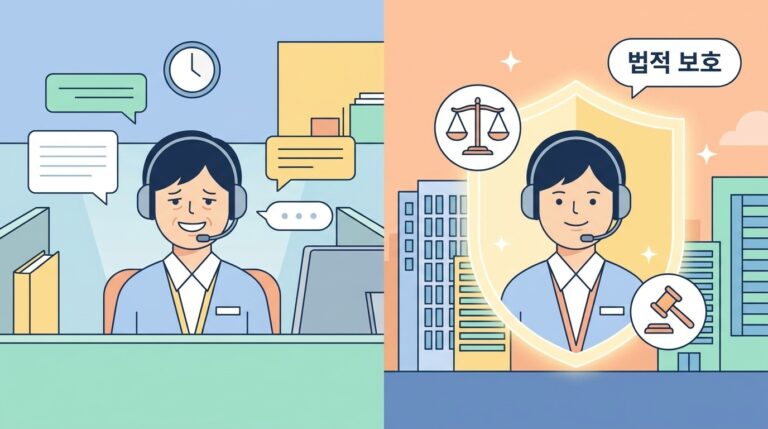
In Korea, there is a funny yet tragic term called 자본주의 미소 (Capitalist Smile). It refers to the bright, energetic, high-pitched smile service workers put on strictly because they are getting paid. To maintain this, workers must constantly use 눈치 (Nunchi)—gauging the customer’s mood to prevent an outburst. The Emotional Labor Law was introduced because workers were developing depression from suppressing their true feelings and forcing this ‘capitalist smile’ even when being verbally abused.
4-2. K-Drama Connection: The Breaking Point
Korean dramas absolutely love the ‘Gapjil’ trope. Think of the iconic scenes: a chaebol throws a glass of water in an employee’s face (a move so famous it has its own name, 물벼락 갑질 – Water-slap Gapjil). In the past, dramas portrayed the employees just crying silently. Today, modern K-Dramas reflect the shift in society: the protagonist often cites the law, films the abuser, and stands up for themselves. Understanding this legal and cultural shift makes watching these K-Dramas 100x more satisfying!
Phase 5: Real-Life Roleplay Scenario
Setting: A bustling, trendy café in Yeonnam-dong. You and your Korean colleague, Min-su, are waiting for your Americanos. Suddenly, a man at the counter starts screaming at the young part-time worker because she didn’t put the ‘exact’ amount of ice he wanted. He throws his receipt at her.
Characters:
– YOU: An expat working in Seoul, highly observant of social issues.
– Min-su (30s): Your Korean coworker. Friendly, but clearly exhausted by witnessing bad behavior.
Dialogue:
Min-su: 와… 저 아저씨 진짜 너무하는 거 아니에요?
(Wa… jeo ajeossi jinjja neomu-haneun geo anieyo?)
[Wow… isn’t that guy crossing the line?]
YOU: 그러니까요. 알바생이 무슨 죄라고 저렇게 화를 낸대요?
(Geureonikka-yo. Alba-saeng-i museun joe-rago jeoreoke hwa-reul naendaeyo?)
[Exactly. What sin did the part-timer commit to be yelled at like that?]
(🎭 Stage Direction: Min-su shakes his head, looking disgusted.)
Min-su: 저런 게 전형적인 갑질이죠. 자기가 손님이라고 막 대하잖아요.
(Jeoreon ge jeonhyeong-jeog-in gapjil-ijyo. Jagi-ga sonnim-irago mak daeha-janayo.)
[That’s typical Gapjil. Just because he’s a customer, he treats her however he wants.]
YOU: 맞아요. 진짜 역대급 진상이네요.
(Majayo. Jinjja yeokdae-geup jinsang-ineyo.)
[Right. He’s a legendary-level Jinsang.]
Min-su: 요즘 감정 노동자 보호법도 있는데, 저러다 경찰 오면 어쩌려고 저러지?
(Yojeum gamjeong nodongja bohobeop-do inneunde, jeoreoda gyeongchal omyeon eojjeoryeogo jeoreoji?)
[There are laws protecting emotional laborers these days, what is he going to do if the police come?]
🔀 Your Turn! How should you respond to Min-su?
– A) “빨리 경찰에 신고합시다! 감옥에 가야 해요!” (Let’s call the police now! He must go to jail!)
– B) “법이 있어도 저런 사람들은 안 변하나 봐요. 알바생이 불쌍하네요.” (Even with the law, people like that don’t seem to change. I feel bad for the part-timer.)
– C) “저 아저씨, 꼰대네요. 제가 가서 싸울게요!” (That guy is a Kkondae. I’ll go fight him!)✅ Best Choice: B — Reason: It shows deep empathy, uses advanced reflective grammar (~나 봐요), and naturally continues the socio-cultural critique without causing a literal scene.
⚠️ Choice A & C Analysis: ‘A’ is a bit overly dramatic for real life. ‘C’ is physically risky and culturally inappropriate. As an observer, lamenting the reality of the law’s effectiveness is the most native C2 response.
Phase 6: 10-Second Shadowing Drill
Time to speak like a native discussing the news. Focus on the pauses (/) and the emotion tags!
😤 저런 / 진상 손님 때문에 / 감정 노동이 / 장난 아니에요.
(jeoreon / jinsang sonnim ttaemune / gamjeong nodongi / jangnan anieyo.)
[Because of Jinsang customers like that, the emotional labor is no joke.]
Pro-tip: Emphasize the ‘진 (Jin)’ in Jinsang with a slight frown, and stretch out the ‘장 (Jang)’ in jangnan for maximum native flavor!
Phase 7: K-Culture Mini Dictionary
1. 갑을관계
* Romanization: Gabeulgwangye
* English: Power dynamics / Master-servant relationship
* Context: The socio-economic foundation of ‘Gapjil’. Originally meaning ‘Contractor A and Contractor B,’ it now symbolizes the inherent inequality between the powerful and the powerless in Korea.
2. 자본주의 미소
* Romanization: Jabonjuui miso
* English: Capitalist smile
* Context: The fake, overly bright smile service workers wear strictly for their paycheck. A core component of emotional labor.
3. 콜센터
* Romanization: Kol senteo
* English: Call center
* Context: Ground zero for the Emotional Labor Worker Protection Act. Horrific abuse cases in call centers sparked the nationwide movement for the law.
4. 알바생
* Romanization: Alba-saeng
* English: Part-time worker
* Context: Short for ‘Arbeit-saeng’. These young workers are often the primary targets of Gapjil in cafes, convenience stores, and restaurants.
Phase 8: Traveler’s Survival Kit
Even as a traveler, you play a role in this cultural dynamic. You are the ‘customer’ (갑/Gap). How can you use Korean to be a polite customer and reduce the emotional labor of the workers helping you? Here are the top phrases to show respect.
🆘 Survival Expression #1: The Magic Word
– 🇰🇷 “수고하십니다!” / “수고하세요!”
– 🗣️ Pronunciation: [sugo-hasimnida! / sugo-haseyo!]
– 📍 Where to use: Entering/leaving a convenience store, paying a taxi driver, or handing your card to a barista.
– 💡 Pro Tip: This means “Thank you for your hard work.” It acknowledges their labor and instantly makes you a beloved, polite customer (the opposite of a Jinsang!).🆘 Survival Expression #2: Easing the Pressure
– 🇰🇷 “천천히 해주셔도 돼요.”
– 🗣️ Pronunciation: [cheon-cheon-hi haejusyeo-do dwaeyo.]
– 📍 Where to use: When a restaurant is busy and the worker is rushing to get your food or wipe your table.
– 💡 Pro Tip: “You can take your time.” Korean service culture is overwhelmingly fast (빨리빨리 – Palli-palli). Saying this relieves their emotional and physical stress immensely.📌 Editor’s Travel Note
– No Tipping: Korea has NO tipping culture. Giving a tip can actually cause confusion and stress (adding to their emotional labor to figure out what to do with the money!). Showing polite respect through words and a slight bow is much better than cash.
Phase 9: Critical Thinking — “One Step Deeper”
Language & Power (언어와 권력)
Why is Gapjil so prevalent in Korea that it requires specific legislation? It comes down to how language shapes mindset. Korean is a deeply hierarchical language. The moment two people meet, their status (age, job title, customer vs. provider) dictates the exact grammatical structure they must use with each other. For decades, the mantra ‘손님은 왕이다’ (The customer is king) was taken literally, giving the ‘customer’ absolute linguistic and social superiority.
However, the Emotional Labor Worker Protection Act represents a linguistic and cultural rebellion. By officially labeling workers as ‘someone’s precious family member,’ the law attempts to equalize the psychological power dynamic.
💬 Your Turn: Does your native language have honorifics that change based on whether you are the customer or the worker? How does ‘The customer is king’ translate into actual behavior in your country? Let us know in the comments!
Phase 10: FAQ & Avoiding Misunderstandings
Q: Can I use ‘Gapjil’ in formal business meetings?
Yes and No. If you are discussing socio-economic trends, corporate policies, or news, it is perfectly fine. However, never accuse a client or boss directly to their face by saying, “Are you doing Gapjil right now?” It is highly confrontational and could get you fired.
Q: Is it okay to call my strict Korean boss a ‘Jinsang’?
No! ‘Jinsang’ is almost exclusively reserved for customers or strangers acting out in public. If your boss is terrible, the correct C2 slang is 꼰대 (Kkondae – an arrogant, outdated boomer) or you say they are committing 갑질 (Gapjil).
❌ Common Mistake: Using ‘감정 노동’ (emotional labor) to describe physical tiredness after studying or working out.
✅ Do this instead: Only use ‘감정 노동’ when the exhaustion comes from dealing with people and having to fake your emotions. For physical tiredness, use 체력 소모가 크다 (It’s physically draining).
Phase 11: Summary & Action Items
- One-Liner Summary: Understanding terms like Gapjil, Jinsang, and Gamjeong Nodong gives you profound insight into Korea’s ongoing battle for workplace equality and mental health protection.
Action Mission:
– 🥉 Bronze (Solo): Stand in front of a mirror and practice saying, “완전 갑질 아니에요?” (Isn’t that total Gapjil?) with the most dramatic K-Drama gasp you can muster.
– 🥈 Silver (Online): Find an article on Naver News about ‘감정노동’ (Emotional labor) and try to read the headlines. You’ll be surprised how often it appears!
– 🥇 Gold (Real World): Next time you buy something at a Korean cafe or convenience store, make the worker’s day by smiling and saying clearly: “수고하십니다!” (Thank you for your hard work!)
Phase 12: Quiz — Interactive Challenge
1. Situational Judgment: Your friend works at a cosmetics shop. A customer demanded a refund for a half-empty face cream and yelled at your friend. How should you comfort her?
* A) “네가 잘못했네.” (You were wrong.)
* B) “그 손님 완전 진상이네. 감정 노동 진짜 힘들겠다.”
* C) “너 꼰대야?”
* Answer: B. It validates her experience by calling the customer a Jinsang and acknowledging her emotional labor. (A is mean, C incorrectly calls your friend a boomer).
2. True or False — K-Culture Edition:
* “Because of the ‘Customer is King’ mindset, modern Koreans generally encourage tipping service workers to help ease their emotional labor.”
* Answer: False. Tipping is not practiced in Korea and can cause awkwardness. Respect is shown through polite language (존댓말) and basic courtesy.
Frequently Asked Questions (FAQ)
Q: What does "갑질 (Gapjil)" mean in Korean and how do you pronounce it?
A: In Korean, "갑질 (Gapjil)" is pronounced [gap-jil] and means: Power harassment; abusing one's superior position (Literal: 'A' doing 'A-stuff')
Q: What does "진상 (Jinsang)" mean in Korean and how do you pronounce it?
A: In Korean, "진상 (Jinsang)" is pronounced [jin-sang] and means: An entitled, unreasonable, or rude customer (Literal: A bad appearance/behavior)
Q: What does "감정 노동 (Gamjeong nodong)" mean in Korean and how do you pronounce it?
A: In Korean, "감정 노동 (Gamjeong nodong)" is pronounced [gam-jeong no-dong] and means: Emotional labor (The act of managing one's emotions to fulfill the emotional requirements of a job)







