

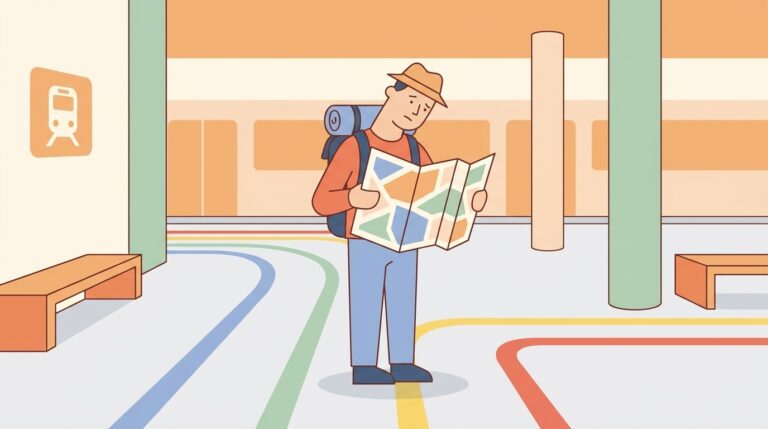
Phase 1: Empathy & K-Culture Cold Open
Hello! I am the lead editor of Daily Hangul. Have you ever watched a K-Drama where the protagonist is running late? They sprint into the Seoul Subway, effortlessly tap their T-money card, and gracefully hop onto the next train right before the doors close. It looks so easy on screen!
But let’s talk about your reality: You are standing in the middle of Seoul Station or Sindorim. Your map app looks like a bowl of brightly colored noodles. You see signs pointing everywhere, people walking at the speed of light, and you need to get to Hongdae. If you take the wrong train, you might end up in Incheon instead! You need to ask someone for help, but how?
Knowing how to ask about transfers (환승 – hwan-seung) is a true survival skill in Korea. Not only will it save you time, but locals will be deeply impressed that you aren’t just relying on your phone. This guide is built directly from the panicked questions of my past beginner students. Let’s master the art of transferring in Korea!
Phase 2: Deep Dive into Core Expressions
Here are the top 3 lifesaver expressions you need when navigating Korean public transport.
1. 어디서 갈아타요? (Where do I transfer?)
- Pronunciation: eo-di-seo ga-ra-ta-yo? (Sound analogy: ‘ga-ra’ sounds like ‘Gaga’, but with a soft rolling R).
- Meaning: Literal: Where do I change and ride? / Real nuance: Where do I transfer trains/buses?
- K-Culture Moment: Imagine you are on a bus headed to Namsan Tower. The bus driver announces a detour, and you need to switch buses. You tap the shoulder of the kind-looking university student next to you and ask this phrase.
- Editor’s Insight: This phrase feels very active. Instead of using the formal noun ‘transfer’, Koreans prefer the action-oriented verb ‘갈아타다’ (to change and ride) in everyday speech. It sounds much friendlier!
- Situation Spectrum:
- Casual (Friends): ✅
- Semi-formal (Strangers/Staff): ✅
- Formal (Boss/Elders): ⚠️ (Better to say: 어디서 갈아타야 하나요?)
- 🤔 Think About It: Why do you think Korean often uses combined verbs like ‘change-and-ride’ (갈아타다) instead of a single abstract noun? Does your native language do something similar?
2. 몇 호선으로 가요? (Which line do I go to?)
- Pronunciation: myeot ho-seo-neu-ro ga-yo?
- Meaning: Literal: Toward which line number do I go? / Real nuance: Which subway line do I transfer to?
- K-Culture Moment: Seoul has over 20 subway lines! When you ask a friend how to get to their neighborhood for a Chimaek (Chicken and Beer) party, they won’t just say ‘take the train.’ They will specify the exact line number.
- Editor’s Insight: ‘호선 (ho-seon)’ means ‘line number’. Koreans almost exclusively refer to subway lines by their numbers (Line 2) or colors, rarely by their terminal destinations.
- Situation Spectrum:
- Casual: ✅
- Semi-formal: ✅
- Formal: 🚫 (Use: 몇 호선으로 가야 합니까?)
- 🤔 Think About It: In cities like London or New York, lines have names or letters (e.g., Bakerloo, the A train). Why might a massive system like Seoul’s rely on numbers and colors instead?
3. 반대 방향이에요? (Is it the opposite direction?)
- Pronunciation: ban-dae bang-hyang-i-e-yo?
- Meaning: Literal: Is it the opposite direction? / Real nuance: Am I going the wrong way?
- K-Culture Moment: You confidently tapped your card and walked down the stairs, only to realize the sign says you are heading south when you want to go north. You ask another passenger this before leaving the gates!
- Editor’s Insight: This is crucial because, in many older Seoul subway stations, if you go through the wrong gate, you cannot cross over to the other side without tapping your card again!
- Situation Spectrum:
- Casual: ✅
- Semi-formal: ✅
- Formal: ⚠️
- 🤔 Think About It: Asking for confirmation shows vulnerability. Koreans are generally very helpful to lost travelers. How do locals in your country react when someone asks for directions?
Phase 3: Textbook vs. Real Korean
Let’s see how textbook Korean differs from what you’ll actually hear in the fast-paced subway stations.
[Situation 1: Asking for the transfer location]
* 📖 Textbook Korean: 환승역이 어디입니까? (Where is the transfer station? – hwan-seung-yeok-i eo-di-im-ni-kka?)
* 🗣️ Real Korean: 여기서 갈아타요? (Do I transfer here? – yeo-gi-seo ga-ra-ta-yo?)
* 💡 Why is it different?: ‘환승역’ is a Sino-Korean (Hanja) word usually reserved for official announcements. Locals prefer the softer, native Korean verb ‘갈아타다’.
[Situation 2: Following the transfer signs]
* 📖 Textbook Korean: 환승하는 곳으로 가세요. (Please go to the transfer area.)
* 🗣️ Real Korean: 저기 화살표 따라가세요. (Follow the arrows over there. – jeo-gi hwa-sal-pyo tta-ra-ga-se-yo.)
* 💡 Why is it different?: Seoul subway stations have colored arrows painted on the floor for every transfer line. Locals will naturally tell you to just ‘follow the color/arrow’ instead of giving complex compass directions!
Bottom Note: At the A2 level, you don’t need fancy vocabulary. Pointing and using simple verbs like ‘가다’ (go) and ‘타다’ (ride) will get you exactly where you need to be.
Phase 4: Cultural Context — K-Culture Deep Dive
4-1. Non-Verbal Cues and ‘Nunchi’
In Korea, ‘눈치 (Nunchi)’—the ability to read the room—is essential, even in transit. If someone is power-walking with AirPods in, looking intently ahead, they are likely rushing to work. Do not stop them! Instead, use your Nunchi to find someone waiting on the platform, a group of friendly students, or a station attendant (usually wearing a vest). Also, when asking, slightly bow your head to show politeness.
4-2. K-Travel Connection: The Transfer System
The Korean public transit system is world-class, largely thanks to the T-money Transfer Discount System (환승 할인). Did you know that if you transfer from a subway to a bus (or vice versa) within 30 minutes, the transfer is virtually free?
When you tap your card during a valid transfer, the machine won’t say ‘Beep!’ It will clearly say “환승입니다 (It is a transfer)”.
Critical Note: To get this discount, you MUST tap your card when getting off the bus. “내릴 때 카드를 찍으세요” (Tap your card when you get off!). If you forget, you will be charged extra on your next ride!
Phase 5: Real-Life Roleplay Scenario
Setting: It’s Friday, 6:00 PM. You are at Sindorim Station, famously known as ‘Hell-dorim’ because of its massive crowds. You need to get to Gangnam for a dinner reservation, but you are totally lost between Line 1 and Line 2.
Characters:
– YOU: A traveler slightly panicked about being late.
– Min-su: (28, a local office worker waiting for his train, looking at his phone).
Dialogue:
YOU: 저기요… 혹시 강남역 가려면 어디서 갈아타요?
(jeo-gi-yo… hok-si gang-nam-yeok ga-ryeo-myeon eo-di-seo ga-ra-ta-yo?)
[Excuse me… By any chance, where do I transfer to go to Gangnam Station?]
(🎭 Stage Direction: You show Min-su your phone map with a desperate smile)
Min-su: 아, 강남이요? 여기서 2호선으로 갈아타셔야 돼요.
(a, gang-nam-i-yo? yeo-gi-seo i-ho-seo-neu-ro ga-ra-ta-syeo-ya dwae-yo.)
[Ah, Gangnam? You have to transfer to Line 2 here.]
YOU: 2호선이요? 어느 쪽으로 가요?
(i-ho-seon-i-yo? eo-neu jjo-geu-ro ga-yo?)
[Line 2? Which way do I go?]
Min-su: 저기 바닥에 초록색 선 보이시죠? 그거 따라가시면 돼요.
(jeo-gi ba-da-ge cho-rok-saek seon bo-i-si-jyo? geu-geo tta-ra-ga-si-myeon dwae-yo.)
[Do you see the green line on the floor over there? You just need to follow that.]
🔀 Your Turn! How do you respond?
– A) “아, 초록색이요? 정말 감사합니다!” (Ah, the green one? Thank you so much!)
– B) “너 참 친절하다!” (You are very kind!)
– C) “저랑 같이 가요!” (Go with me!)✅ Best Choice: A — It confirms the information and politely shows gratitude.
⚠️ Choice B & C Analysis: ‘너’ (You) in B is strictly for close friends; it sounds extremely rude to a stranger. C is too aggressive and might scare Min-su away!
Phase 6: 10-Second Shadowing Drill
Practice this sentence out loud. Pay attention to the pauses (/) and the emotion!
🥺 저기요, / 강남 가려면 / 어디서 갈아타요?
(jeo-gi-yo, / gang-nam ga-ryeo-myeon / eo-di-seo ga-ra-ta-yo?)
Emotion Guide: Look slightly helpless but polite! Raise your pitch slightly at the end of ‘타요?’
Phase 7: K-Culture Mini Dictionary
1. 환승
* Romanization: hwan-seung
* English: Transfer
* Context: The official noun. You will see it on LED signs (“환승역” – Transfer Station) and hear it from the card reader (“환승입니다”).
2. 호선
* Romanization: ho-seon
* English: Subway Line
* Context: Used with Sino-Korean numbers. 1호선 (Line 1 – Blue), 2호선 (Line 2 – Green), 3호선 (Line 3 – Orange).
3. 막차
* Romanization: mak-cha
* English: The last train/bus
* Context: Crucial for nightlife! “막차 끊겼어” (I missed the last train). Subways usually stop around midnight in Seoul.
4. 교통카드
* Romanization: gyo-tong-ka-deu
* English: Transit card (e.g., T-money, Cashbee)
* Context: The lifeline of Korean travel. You can buy and recharge these at any convenience store.
Phase 8: Traveler’s Survival Kit
🆘 Survival Phrases TOP 3 for the Subway
- 🇰🇷 이쪽 맞아요? (i-jjok ma-ja-yo?)
- 🗣️ English: Is this way correct?
- 📍 Use it when: You are pointing at the stairs or train doors and need quick confirmation.
- 🇰🇷 이거 강남 가요? (i-geo gang-nam ga-yo?)
- 🗣️ English: Does this go to Gangnam?
- 📍 Use it when: The train is arriving, and you aren’t sure of the direction.
- 🇰🇷 나가는 곳이 어디예요? (na-ga-neun go-si eo-di-ye-yo?)
- 🗣️ English: Where is the exit?
- 📍 Use it when: You are trapped in the underground maze and want to see the sky again.
📌 Editor’s Travel Note
– Must-have Apps: Never use Google Maps for walking/transit in Korea (due to security laws, it doesn’t work well). Download KakaoMetro, Naver Map, or KakaoMap.
– Transfer Trap: When transferring between subway lines, NEVER go through the turnstiles that say “나가는 곳” (Exit). Look for the transfer gates, or just follow the colored arrows on the ground!
Phase 9: Critical Thinking Corner — “One Step Deeper”
🧠 Think Deeper: Language and Practicality in the Global Era
Have you noticed that the Korean subway system relies heavily on numbers (1호선), colors (초록선), and visual arrows rather than long, complex street names? This is a brilliant reflection of Korea’s ‘Pali-pali’ (hurry up) culture and its push toward globalization. The language naturally evolved to match this efficiency. Instead of memorizing long Korean station names, tourists and locals alike can simply communicate with “Green line?” or “Number 2?”. It makes the language incredibly accessible and pragmatic.
💬 Your Turn: Does your home country prioritize efficiency and symbols in public spaces, or does it stick to traditional names? Share your thoughts below!
Phase 10: FAQ & Avoiding Misunderstandings
- Q: Can I use “갈아타요?” to the subway station master?
- A: Maybe. It’s a bit casual for an official. If you want to be completely respectful to older staff, add “요” to the end of everything, or better, use “어디서 갈아타야 하나요?” (eo-di-seo ga-ra-ta-ya ha-na-yo?).
- Q: Is it okay to tap someone’s shoulder to ask for help?
- A: Yes, but gently. Koreans usually mind their own business in public, but if you approach with an “Excuse me” (저기요 – jeo-gi-yo), they are usually very eager to help foreigners!
❌ Common Mistake #1: Tapping your card at the “Exit” instead of the “Transfer” gate. If you exit the station completely and re-enter, you will be charged a brand new fare!
✅ Do this instead: Follow the signs that say “갈아타는 곳” (Transfer), not “나가는 곳” (Way Out).
Phase 11: Summary & Action Items
One-Liner Summary: To navigate Korea like a pro, skip the complex textbook words and simply ask “어디서 갈아타요?” (Where do I transfer?).
Action Mission 3 Steps:
– 🥉 Bronze (Solo): Look in the mirror and practice asking “어디서 갈아타요?” with a friendly, inquiring face 3 times.
– 🥈 Silver (Online): Go to a Korean learning forum or Discord and write a short sentence: “강남 가려면 어디서 갈아타요?”
– 🥇 Gold (Real World): The next time you are in Korea (or speaking to a Korean friend), show them a map and ask them how to get from Seoul Station to Hongdae using today’s phrase!
K-Culture Mission:
Download the ‘KakaoMetro’ app right now! Select any two random stations in Seoul, and look at the route. Find exactly where the app tells you to ‘환승’ (transfer) and what color line you need to switch to.
Engagement: Have you ever gotten totally lost in a foreign country’s subway system? Tell us your funniest travel mishap in the comments!
Phase 12: Quiz — Interactive Challenge
1. You are at a subway station and want to ask someone, “Which line do I transfer to?” What should you say?
– A) 나가는 곳이 어디예요?
– B) 몇 호선으로 갈아타요?
– C) 환승입니다.
2. True or False — K-Culture Edition:
If you transfer from a Seoul subway to a city bus within 30 minutes, you have to pay the full fare again. (T/F)
3. Situation Judgment: You see a staff member and ask “어디서 갈아타요?” They point and say, “저기 바닥에 초록색 화살표 따라가세요.” What should you do?
– A) Look for a green arrow on the floor and follow it.
– B) Look up at the ceiling for a green sign.
– C) Wait for a green train to arrive.
(Answers: 1: B, 2: False – it’s free/discounted!, 3: A – 바닥 means floor, and 화살표 means arrow!)
Frequently Asked Questions (FAQ)
Q: What does "어디서 갈아타요? (Where do I transfer?)" mean in Korean and how do you pronounce it?
A: In Korean, "어디서 갈아타요? (Where do I transfer?)" is pronounced [eo-di-seo ga-ra-ta-yo? (Sound analogy: 'ga-ra' sounds like 'Gaga', but with a soft rolling R] and means: Literal: Where do I change and ride? / Real nuance: Where do I transfer trains/buses?
Q: What does "몇 호선으로 가요? (Which line do I go to?)" mean in Korean and how do you pronounce it?
A: In Korean, "몇 호선으로 가요? (Which line do I go to?)" is pronounced [myeot ho-seo-neu-ro ga-yo?] and means: Literal: Toward which line number do I go? / Real nuance: Which subway line do I transfer to?
Q: What does "반대 방향이에요? (Is it the opposite direction?)" mean in Korean and how do you pronounce it?
A: In Korean, "반대 방향이에요? (Is it the opposite direction?)" is pronounced [ban-dae bang-hyang-i-e-yo?] and means: Literal: Is it the opposite direction? / Real nuance: Am I going the wrong way?







