

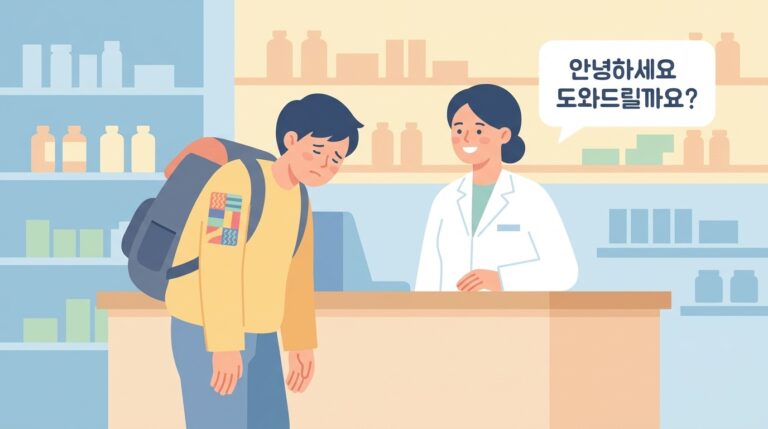
Phase 1: Empathy (The “Ouch” Moment)
Hello there! This is your Daily Hangul Editor.
Picture this: You just took a K-Pop dance class in Hongdae, or maybe you finally conquered Bukhansan Mountain with your Korean friends. You felt invincible yesterday. But today? You wake up, try to get out of bed, and suddenly your body feels like it’s made of rusty metal. You manage to drag yourself to the local pharmacy (약국), but how do you explain this specific, agonizing muscle stiffness? Saying “I’m sorry” won’t help you here!
If you just say “아파요” (It hurts), the pharmacist might hand you some basic painkillers. But to get the real Korean remedy—the legendary, magical pain relief patch known as ‘파스’ (Pas)—you need to speak the local language.
Knowing how to describe muscle pain won’t just save your back; it will instantly make you sound like someone who truly understands Korean daily life. Let’s dive into the expressions that will save your muscles and impress your Korean friends! This guide is built from the real groans and struggles of my past students, so trust me, I’ve got your back (literally).
Phase 2: Deep Dive into Core Expressions
1. 알 배겼어요 (I have severe muscle soreness)
- Pronunciation: al baegyeosseoyo [al bae-gyuh-sso-yo]
- Meaning: Literal: “Eggs are embedded” / Real nuance: “My muscles are extremely stiff and sore from working out.”
- K-Culture Moment: You’ll hear this constantly on Monday mornings at Korean offices, especially in Spring or Fall when everyone goes hiking over the weekend.
- Editor’s Insight: This is the ultimate B1/B2 level expression. We use this specifically for DOMS (Delayed Onset Muscle Soreness). It’s incredibly descriptive because your stiff muscle knots literally feel like hard little eggs!
- Situation Spectrum:
- Friends (Casual): ✅ (알 배겼어)
- Coworkers (Semi-formal): ✅ (알 배겼어요)
- Boss/Elders (Formal): ⚠️ (Use with caution, better to say 근육통이 심합니다)
- 🤔 Think About It: Why does the Korean language use such sensory, physical imagery (like eggs in a muscle) to describe pain? Does your native language have a funny metaphor for muscle cramps?
2. 파스 좀 붙여주세요 (Please put a patch on me)
- Pronunciation: paseu jom buchyeojuseyo [pa-seu jom boo-chyo-joo-se-yo]
- Meaning: Literal: “Please attach a Pas a little” / Real nuance: “Could you help me put this pain patch on?”
- K-Culture Moment: The classic K-Drama trope! The hardworking protagonist is exhausted, and the caring romantic interest gently slaps a Pas on their shoulder. It’s a prime example of expressing ‘정’ (Jeong – affection/attachment).
- Editor’s Insight: Notice the verb 붙이다 (to attach/stick). You do not “wear” (입다) a patch in Korean! Also, the word ‘좀’ (a little) softens the request, making it sound polite rather than demanding.
- Situation Spectrum:
- Friends (Casual): ✅ (파스 좀 붙여줘)
- Coworkers (Semi-formal): ⚠️ (Only if you are very close!)
- Boss/Elders (Formal): 🚫 (Do not ask your boss to put a patch on you!)
- 🤔 Think About It: Asking someone to touch your back to apply a patch requires a level of intimacy. In Korean culture, physical touch among close friends of the same gender is very common. Would this be normal in your culture?
3. 온몸이 쑤셔요 (My whole body aches)
- Pronunciation: onmomi ssusyeoyo [on-mo-mi ssoo-shyo-yo]
- Meaning: Literal: “My whole body is being poked” / Real nuance: “I have deep, throbbing aches all over.”
- K-Culture Moment: When the weather is about to rain, you might hear Korean grandparents saying this. But younger generations use it too after a heavy gym session or a moving day.
- Editor’s Insight: ‘아프다’ (to hurt) is a generic pain. ‘쑤시다’ implies a deep, throbbing, pulsating ache. If you use ‘쑤시다’ at the pharmacy, the pharmacist will instantly respect your Korean skills.
- Situation Spectrum:
- Friends (Casual): ✅ (온몸이 쑤셔)
- Coworkers (Semi-formal): ✅ (온몸이 쑤셔요)
- Boss/Elders (Formal): ✅ (온몸이 쑤십니다)
- 🤔 Think About It: Korean has dozens of specific words for different types of pain (stabbing, throbbing, burning). Why might traditional Korean medicine (which focuses on energy flows and deep tissue) have influenced this vocabulary?
Phase 3: Textbook vs. Real Korean
[Describing Post-Workout Pain]
* 📖 Textbook Korean: 어제 운동을 해서 근육이 아픕니다. (I exercised yesterday so my muscles hurt.)
* 🗣️ Real Korean: 아, 어제 하체 했더니 다리에 알 배겼어. (Ah, I did leg day yesterday and my legs are completely sore.)
* 💡 Why the difference?: Koreans love borrowing gym slang (like 하체 – lower body) and combining it with traditional idioms (알 배기다) for a more dramatic, expressive effect.
[Applying the Pain Patch]
* 📖 Textbook Korean: 파스를 제 등에 붙여 주시겠습니까? (Would you please attach the patch to my back?)
* 🗣️ Real Korean: 여기 파스 좀. 손이 안 닿아. (Patch here, please. My hands can’t reach.)
* 💡 Why the difference?: In close relationships, explaining why you need help (“I can’t reach”) is often enough of a polite justification to drop the overly formal request structure.
Bottom Note: At the B1 level, aim to replace the basic “아파요” (It hurts) with more specific descriptors like “쑤셔요” (throbs) or “알 배겼어요” (sore/stiff). It makes your Korean sound 3D!
Phase 4: Cultural Context — K-Culture Deep Dive
4-1. Non-verbal Elements & ‘Nunchi’
When asking someone to apply a Pas for you, it’s all about the setup. You don’t just hand them the patch. You massage your own shoulder, let out a small “아이고…” (Aigo…), and try to reach your own back, failing miserably. Then you hand them the patch. This non-verbal display of struggle makes the request softer and taps into Korean 눈치 (Nunchi)—the art of reading the room. A good friend will often offer to apply it before you even ask!
4-2. The “Pas” Trope in K-Dramas
Have you ever noticed how often pain relief patches appear in K-Dramas?
In Korean culture, “Pas” is more than just medicine; it’s a symbol of hardworking, blue-collar life, and unspoken affection.
When a mother runs a busy restaurant, her wrists are often covered in small coin-sized patches (동전 파스). When the male lead sees the female lead working part-time jobs late into the night, what does he buy her at the convenience store? A warm drink and a Pas.
Critical View: While dramas make applying a Pas look incredibly romantic with lingering eye contact, in reality, your friend will probably slap it on your back like a sticker, complain about the strong menthol smell, and tell you to take a shower!
Phase 5: Real-Life Roleplay Scenario
Setting: Monday morning, 9:00 AM at the office pantry. You are making instant coffee, but wincing with every movement. You went hiking at Bukhansan Mountain yesterday for the first time.
Characters:
– YOU: A foreign expat who underestimated the Korean mountains.
– Min-ji (30s): Your friendly Korean coworker who practically lives in yoga pants on weekends.
Dialogue:
Min-ji: 00씨, 걷는 폼이 왜 그래요? 어디 다쳤어요?
(00-ssi, geonneun pomi wae geuraeyo? eodi dachyeosseoyo?)
[00, why are you walking like that? Are you hurt?]
YOU: 주말에 북한산 다녀왔거든요. 와… 다리에 완전히 알 배겼어요.
(jumare bukhansan danyeowatgeodeunyo. wa… darie wanjeonhi al baegyeosseoyo.)
[I went to Bukhansan over the weekend. Wow… my legs are completely sore.]
Min-ji: 헉, 초보자가 북한산을요? 무리했네요. (가방을 뒤적이며) 저한테 파스 있는데, 드릴까요?
(heok, chobojaga bukhansaneullyo? murihaenneyo. jeohante paseu inneunde, deurilkkayo?)
[Gasp, a beginner went to Bukhansan? You overdid it. I have a Pas, do you want it?]
YOU: 진짜요? 너무 감사합니다!
(jinjjayo? neomu gamsahamnida!)
[Really? Thank you so much!]
Min-ji: 어깨도 뭉친 것 같은데. 제가 하나 붙여줄까요?
(eokkaedo mungchin geot gateunde. jega hana buchyeojulkkayo?)
[Your shoulders look stiff too. Should I put one on for you?]
🔀 Your Turn! How do you reply to Min-ji?
– A) “네, 제 등에 붙여 주시겠습니까?” (Yes, would you please attach it to my back?)
– B) “아유, 괜찮아요! 화장실 가서 제가 붙일게요.”
– C) “빨리 붙여주세요! 온몸이 쑤셔요!”✅ Best Choice: B — Reason: While Min-ji is friendly, the office is still a semi-formal environment. Asking a coworker of the opposite (or even same) gender to touch your back in the office can be a bit awkward. Politely declining and doing it yourself in the restroom is the most culturally safe and polite choice here.
⚠️ Choice A & C Analysis: ‘A’ sounds like a robot from a textbook. ‘C’ is way too demanding and casual for a coworker!
Phase 6: 10-Second Shadowing Drill
Time to practice your sick-and-tired acting! Read this out loud, focusing on the pauses (/) and the emotion tags.
😫 아이고 / 온몸이 / 쑤셔요. (aigo / onmomi / ssusyeoyo)
🥺 여기 / 파스 좀 / 붙여주세요. (yeogi / paseu jom / buchyeojuseyo)
😌 아~ / 이제 좀 / 살 것 같다. (a~ / ije jom / sal geot gatda)
(Translation for the last line: Ah~ I feel like I can finally live/breathe now.)
Phase 7: K-Culture Mini Dictionary
Here are the essential cultural keywords related to today’s topic:
1. 파스 (Paseu)
* Romanization: paseu
* English: Pain relief patch
* Context: Derived from the German word ‘Pasta’ (paste). It comes in Hot (후끈한 파스) and Cool (쿨파스) varieties. The smell is instantly recognizable on public transit.
2. 시원하다 (Siwonhada)
* Romanization: siwonhada
* English: Refreshing / Cool (but also used for hot things!)
* Context: When a Korean person applies a burning hot Pas, or steps into a boiling hot bath, they say “시원하다!” It means the tension/pain is melting away, making them feel “refreshed.”
3. 한의원 (Haniwon)
* Romanization: haniwon
* English: Traditional Korean Medicine Clinic
* Context: If a Pas doesn’t work, Koreans go here for acupuncture (침) or cupping therapy (부항) to treat severe muscle soreness.
4. 엄살 (Eomsal)
* Romanization: eomsal
* English: Exaggerating pain / Being a crybaby
* Context: If you complain too much about your sore muscles, your friends might say “엄살 피우지 마!” (Stop exaggerating!)
Phase 8: Traveler’s Survival Kit
If you’re traveling in Korea, you will walk at least 15,000 steps a day. You will need a pharmacy! Look for the sign that says 약 (Yak).
🆘 Survival Expressions at the Pharmacy
– 🇰🇷 “먹는 약 말고, 붙이는 파스 주세요.” (meongneun yak malgo, buchineun paseu juseyo.)
– 🗣️ English: I don’t want pills, please give me patches to attach.
– 📍 Where to use: Pharmacy (약국)
– 💡 Pro Tip: Pharmacists will often ask if you want a 쿨파스 (Cool Pas – for acute injuries/swelling) or a 핫파스 (Hot Pas – for chronic pain/stiffness). If you have DOMS from hiking, Hot Pas is usually better!📌 Editor’s Travel Note
– Weekend Emergencies: Most pharmacies close on Sundays. However, you can buy basic pain patches at any convenience store (GS25, CU, 7-Eleven) 24/7! They are kept behind the counter or in the small medicine aisle.
– Pharmacy Culture: Korean pharmacists don’t just sell boxes; they act like mini-doctors. They will ask you exactly where it hurts and how it hurts. Don’t be shy!
Phase 9: Critical Thinking Corner — “One Step Deeper”
Language & The Body: The Magic of “Siwonhada” (시원하다)
🧠 Think Deeper:
Have you ever wondered why Koreans exclaim “Ah, it’s so cold/refreshing!” (아, 시원하다!) when they put a burning hot pain patch on their skin, or when someone aggressively massages their aching shoulders? In Korean culture, physical pain is often viewed as a “blockage” of energy (기 – Gi). When that blockage is cleared—even through painful pressure, spicy food, or a stinging patch—the resulting sensation of release is described as “Siwonhada” (refreshing, clearing). It shows a cultural mindset where momentary discomfort is embraced if it leads to inner balance and relief.💬 Your Turn: Does your culture have a concept where “pain equals pleasure/healing”? How do people react when getting a deep tissue massage? Share in the comments!
Phase 10: FAQ & Avoiding Misunderstandings
Q: Can I use “알 배겼어요” when I have a stomachache?
No! “알 배기다” is strictly for muscle stiffness from physical exertion (DOMS). For a stomachache, just say “배가 아파요” (My stomach hurts).
Q: Is it okay to ask a stranger at the gym to put a patch on my back?
Absolutely not. Touching someone’s back is considered intimate. Only ask close friends, family members, or a romantic partner.
❌ Common Mistake #1: Saying “파스를 입어요” (I wear a Pas).
✅ Do This Instead: Always use “파스를 붙여요” (Attach a Pas). Koreans treat it like a sticker, not an item of clothing.❌ Common Mistake #2: Putting a Pas on an open wound.
✅ Do This Instead: Only use it on unbroken skin. If you have a scratch, you need a band-aid (밴드), not a Pas!
Phase 11: Summary & Action Items
One-Liner Summary: When your muscles scream after a K-Pop dance class, tell your friends “알 배겼어요” and head to the pharmacy to say “파스 주세요!”
Your Action Missions:
– 🥉 Bronze (Solo): Stand in front of your mirror, massage your shoulder, and dramatically sigh, “아이고, 온몸이 쑤셔요!”
– 🥈 Silver (Online): Tweet or post in your Korean learning community: “I worked out today. 알 배겼어요 ㅠㅠ”
– 🥇 Gold (Real World): Next time you visit Korea, successfully buy a “쿨파스” from a convenience store!
Special K-Culture Mission:
Next time you watch a K-Drama, look closely at the older characters (especially the grandmas in the markets). I guarantee you will spot a round “coin patch” (동전 파스) on their wrists or necks within 3 episodes!
Phase 12: Interactive Quiz
Let’s test your survival skills!
1. Situational Judgment: You went to a 1MILLION dance class yesterday. Today, your thighs are so stiff you can’t walk down the stairs. What do you say to your friend?
– A) 다리가 부러졌어요 (My leg is broken)
– B) 다리에 알 배겼어요 (My legs are severely sore)
– C) 다리가 시원해요 (My legs are refreshing)
2. Fill in the Blank:
어깨가 너무 아파요. 여기 파스 좀 ________ 주세요.
(My shoulder hurts so much. Please ________ a patch here.)
Hint: Don’t “wear” it!
3. True or False – K-Culture Edition:
You can easily buy pain relief patches (Pas) at a Korean convenience store at 2 AM. (T/F)
(Answers: 1. B / 2. 붙여 (buchyeo) / 3. True! Look for the medicine section near the cashier!)
Frequently Asked Questions (FAQ)
Q: What does "알 배겼어요 (I have severe muscle soreness)" mean in Korean and how do you pronounce it?
A: In Korean, "알 배겼어요 (I have severe muscle soreness)" is pronounced [al baegyeosseoyo [al bae-gyuh-sso-yo] and means: Literal: "Eggs are embedded" / Real nuance: "My muscles are extremely stiff and sore from working out."
Q: What does "파스 좀 붙여주세요 (Please put a patch on me)" mean in Korean and how do you pronounce it?
A: In Korean, "파스 좀 붙여주세요 (Please put a patch on me)" is pronounced [paseu jom buchyeojuseyo [pa-seu jom boo-chyo-joo-se-yo] and means: Literal: "Please attach a Pas a little" / Real nuance: "Could you help me put this pain patch on?"
Q: What does "온몸이 쑤셔요 (My whole body aches)" mean in Korean and how do you pronounce it?
A: In Korean, "온몸이 쑤셔요 (My whole body aches)" is pronounced [onmomi ssusyeoyo [on-mo-mi ssoo-shyo-yo] and means: Literal: "My whole body is being poked" / Real nuance: "I have deep, throbbing aches all over."







