

Phase 1: Empathy (The Busking Magic)
Hello! This is your lead editor from Daily Hangul.
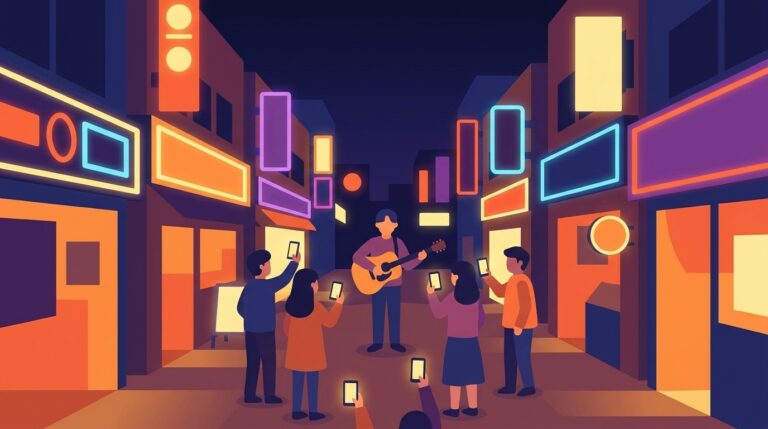
Imagine this: You step out of Hongdae Station Exit 9 on a crisp Friday evening. The air is vibrating with bass lines and acoustic melodies. You join a crowd circling a talented indie singer. The vibe is exactly like a scene straight out of a K-Drama—the neon lights, the romantic atmosphere, the young energy.
The singer finishes a song, the crowd goes wild, and they ask, “Does anyone have a song they want to hear?” You desperately want to shout out your favorite K-Pop acoustic cover, but… your mind goes blank. You also want to drop a tip to show your appreciation, but you don’t see a guitar case, only a small whiteboard with some numbers on it. What’s going on?
If you’ve ever felt the urge to jump into Korea’s vibrant street performance (busking) culture but hesitated because of the language barrier, you are not alone. This guide is crafted from the real experiences of my students who wanted to do more than just stand in the back and clap. Let’s turn you into a true insider of the Korean busking scene!
Phase 2: Core Expressions Deep Dive
Here are the three ultimate phrases you need to survive and thrive in a Korean busking crowd.
1. 혹시 신청곡도 받으시나요?
- Pronunciation: hok-si sin-cheong-gok-do ba-deu-si-na-yo? [hok-shee sheen-chung-gok-do bah-deu-shee-na-yo]
- Meaning: (Literal) By any chance, do you also receive requested songs? / (Real nuance) Do you take song requests?
- K-Culture Moment: The busker is tuning their guitar, looking at the audience. The crowd is a bit shy. Someone bravely raises a hand and asks this. The busker smiles and says, “Sure, what do you want to hear?”
- Editor’s Insight: The magic word here is 혹시 (hoksi – by any chance). It softens your question, making it polite and not demanding. In Korea, softening a request is a huge part of being a polite audience member.
- Situation Spectrum:
- Casual street busker: ✅
- Small indoor live café: ✅
- Large formal concert: 🚫
- 🤔 Think About It: Why do Koreans love using “혹시” (by any chance) before almost every question? How does indirectness show respect in Korean culture compared to your native language?
2. 무대 완전 찢었다!
- Pronunciation: mu-dae wan-jeon jji-jeot-da! [moo-dae wahn-jun jee-jut-da!]
- Meaning: (Literal) You completely tore the stage! / (Real nuance) You totally killed it! / The performance was insane!
- K-Culture Moment: A dance cover team just finished a high-energy BTS choreography. The crowd erupts, and you hear teenagers and young adults screaming this phrase.
- Editor’s Insight: 찢었다 (jjijeotda) literally means “tore.” It’s a B2-level slang term heavily used by Millennials and Gen Z to describe a performance that was overwhelmingly good. It’s the ultimate compliment for an artist’s energy.
- Situation Spectrum:
- Shouting from the crowd: ✅
- Saying it to the busker (same age/younger): ✅
- Formal review for a classical orchestra: 🚫
- 🤔 Think About It: “Killing it” in English and “Tearing it” in Korean—why do languages often use violent or destructive verbs to describe incredibly positive performances?
3. 인스타 아이디 좀 알려주세요!
- Pronunciation: in-seu-ta a-i-di jom al-lyeo-ju-se-yo! [een-seu-tah ah-ee-dee johm ahl-lyuh-joo-seh-yo!]
- Meaning: (Literal) Please let me know your Insta ID a little bit! / (Real nuance) Could I get your Instagram handle?
- K-Culture Moment: The show is over. Fans are packing up. You want to follow their future schedules. You approach the singer while they pack their mic stand.
- Editor’s Insight: Korean buskers survive and grow through Instagram. Asking for their ID is actually the highest form of praise you can give. Adding 좀 (jom – a little) makes the request sound friendly and less aggressive.
- Situation Spectrum:
- To a street performer: ✅
- To a friendly band member: ✅
- To an A-list idol on the street: ⚠️ (Security might stop you!)
- 🤔 Think About It: How has social media changed the way street artists connect with their audience?
Phase 3: Textbook vs. Real Korean
[Situation 1: Cheering after a great song]
* 📖 Textbook Korean: 노래를 정말 잘 부르시네요. (You sing songs very well.)
* 🗣️ Real Korean: 와, 음색 대박! 미쳤다! (Wow, your vocal tone is amazing! This is crazy!)
* 💡 Why the difference?: Textbooks teach full, polite sentences, but street culture thrives on short, explosive reactions like “대박” (daebak) and focusing on specific details like “음색” (eumsaek – vocal tone).
[Situation 2: Asking about tipping]
* 📖 Textbook Korean: 팁은 어디에 놓으면 됩니까? (Where should I place the tip?)
* 🗣️ Real Korean: 혹시 계좌번호 띄워두셨나요? (Did you happen to display your bank account number?)
* 💡 Why the difference?: Korea is virtually a cashless society. Instead of a hat for coins, buskers display a whiteboard with their KakaoBank account number for digital transfers.
Phase 4: Cultural Context — K-Culture Deep Dive
4-1. Non-Verbal Cues: The Art of “Nunchi” in the Crowd
In Korea, being a good audience member involves 눈치 (Nunchi)—reading the room. If a busker starts singing a slow, emotional ballad, watch the crowd. Someone will suddenly turn on their smartphone flashlight and sway it in the air. Within seconds, everyone follows. Joining in this silent coordination shows you truly “get” the Korean concert vibe.
4-2. The K-Drama & K-Pop Connection
If you’ve watched dramas like Hospital Playlist or Record of Youth, you know that the street performance is a classic trope for character growth or a romantic turning point. But in reality, Hongdae and Sinchon busking zones are fiercely competitive. K-Pop companies often send their rookie idols to do “guerrilla busking” disguised as ordinary performers to build their stage presence and gather a grassroots fandom. If you spot a busker with a surprisingly high-end camera crew and perfect choreography, you might be looking at tomorrow’s biggest K-Pop stars!
Phase 5: Real-Life Roleplay Scenario
Setting: Saturday night, 8 PM. The pedestrian street in Hongdae. A young man with an acoustic guitar just finished a fantastic cover of a Paul Kim song. You are standing in the front row with your Korean friend, Minji.
Characters:
– YOU: An international student, huge fan of Korean indie music.
– Busker (Ji-hoon, 22): Friendly, trying to build his audience.
– Minji (24): Your local guide and best friend.
Dialogue:
Busker: 감사합니다! 날씨가 추운데 많이 들어주셔서 감사해요. 🎸
(gam-sa-ham-ni-da! nal-ssi-ga chu-un-de ma-ni deu-reo-ju-syeo-seo gam-sa-hae-yo.)
[Thank you! Thanks for listening even though the weather is cold.]
Minji: 와, 목소리 진짜 좋다. 너 뭐 듣고 싶은 거 없어?
(wa, mok-so-ri jin-jja jo-ta. neo mwo deut-go si-peun geo eop-seo?)
[Wow, his voice is really good. Is there anything you want to hear?]
Busker: 혹시… 다음 곡으로 듣고 싶은 신청곡 있으신 분?
(hok-si… da-eum go-geu-ro deut-go si-peun sin-cheong-gok i-sseu-sin bun?)
[By any chance… anyone have a requested song you want to hear next?]
(🎭 Stage Direction: The busker makes direct eye contact with YOU.)
🔀 Your Turn! How do you respond?
– A) “노래해! 아이유 노래해!” (Sing! Sing an IU song!)
– B) “혹시 아이유의 ‘밤편지’ 되나요?” (By any chance, can you do ‘Through the Night’ by IU?)
– C) “아무거나 좋아요!” (Anything is fine!)✅ Best Choice: B — Reason: Using “혹시” and “되나요?” (is it possible?) shows excellent B2-level politeness while confidently participating.
⚠️ Choice A Analysis: This is banmal (informal speech). Yelling this at a stranger, even a busker, sounds incredibly rude in Korea!
Phase 6: 10-Second Shadowing Drill
Practice these lines with the right emotion and timing. Pay attention to the pauses (/)!
- 🥺 Polite & Hopeful: 혹시 / 신청곡도 / 받으시나요?
(hok-si / sin-cheong-gok-do / ba-deu-si-na-yo?) - 😤 Mind-Blown/Excited: 와… / 무대 완전 / 찢.었.다!
(wa… / mu-dae wan-jeon / jji.jeot.da!) - 😊 Friendly & Supportive: 혹시 / 인스타 아이디 좀 / 알려주세요!
(hok-si / in-seu-ta a-i-di jom / al-lyeo-ju-se-yo!)
Phase 7: K-Culture Mini Dictionary
1. 버스킹 (beo-seu-king)
* Meaning: Busking / Street performance.
* Context: The English word has been fully adopted into Korean. You don’t say “길거리 공연” much anymore; young people just say “버스킹 보러 가자” (Let’s go watch busking).
2. 떼창 (tte-chang)
* Meaning: Sing-along.
* Context: “떼” (group/flock) + “창” (singing). Korean concert culture is famous globally for massive, perfectly timed audience sing-alongs.
3. 호응 (ho-eung)
* Meaning: Audience reaction / cheering.
* Context: Buskers often say “호응 많이 해주세요!” (Please react/cheer a lot!). It means clapping, shouting, and hyping them up.
4. 계좌 이체 (gye-jwa i-che)
* Meaning: Bank transfer.
* Context: The standard way to tip in Korea. Buskers will have their account details on a sign. You just use your banking app to send 5,000 or 10,000 KRW!
Phase 8: Traveler Survival Kit 🎒
If you are exploring the streets of Seoul for music, you need these.
🆘 Survival Phrases for Hongdae/Sinchon
– 🇰🇷 “여기 버스킹 존이 어디예요?” (yeo-gi beo-seu-king jo-ni eo-di-ye-yo?)
– 🗣️ Meaning: Where is the busking zone around here?
– 📍 Usage: Asking locals or staff near the subway station.
- 🇰🇷 “이거 무료 공연인가요?” (i-geo mu-ryo gong-yeo-nin-ga-yo?)
- 🗣️ Meaning: Is this a free performance?
- 📍 Usage: When a crowd is fenced off and you’re not sure if it requires a ticket.
📌 Editor’s Travel Note:
– Best Times: Fridays after 7 PM and Saturday evenings are peak times for Hongdae (Exit 9) and Sinchon (Uplex square).
– Cashless Tip: If you’re a tourist without a Korean bank account, you can’t do a bank transfer. Don’t worry! It’s completely acceptable to just enjoy the music, clap loudly, and follow their Instagram. You are not forced to tip!
Phase 9: Critical Thinking — “One Step Deeper”
🧠 Think Deeper: The Cashless Evolution of Street Art
When we think of busking globally, we picture tossing coins into an open guitar case. But in Korea’s highly digitized, cashless society, the guitar case has been replaced by an iPad or a whiteboard displaying a KakaoBank account number. On one hand, this is incredibly convenient and safe (no one can steal a bucket of cash). On the other hand, does it change the romantic, spontaneous nature of tipping an artist? Sending a wire transfer requires you to pull out your phone, log in, type a PIN, and verify a name. It shifts street art from a casual, physical interaction to a digital transaction.
💬 Your Turn: Does your country still use cash for street performances? How would you feel about doing a bank transfer to tip a street musician? Share your thoughts below!
Phase 10: FAQ & Avoiding Misunderstandings
- Q: “Can I use banmal (informal speech) if the busker looks younger than me?”
- A: NO. Even if they are teenagers, they are performers, and you are the audience. Always use polite form (-요) when making requests or asking questions unless you become personal friends.
- Q: “Is it okay to film the performance and post it?”
- A: YES. Actually, they want you to! But as a courtesy, tag their Instagram handle when you post it.
- Q: “Can I give them a physical gift, like a hot drink?”
- A: YES! Giving a hot canned coffee (캔커피) during winter busking is a classic, heartwarming K-Culture move. Say, “추운데 힘내세요!” (Cheer up in the cold!).
❌ Common Mistake: Interrupting the performance to shout a song request.
✅ Do this instead: Wait until they finish their song and explicitly ask, “Are there any requests?” (신청곡 있나요?). Timing is everything in Nunchi!
Phase 11: Summary & Action Items
- One-Liner Summary: Soften your requests with “혹시” (by any chance) and praise their energy with “찢었다” (tore it up) to enjoy Korean busking like a true local.
-
Action Mission:
- 🥉 Bronze: Say “무대 완전 찢었다!” out loud 3 times in front of your mirror with maximum energy.
- 🥈 Silver: Search “홍대 버스킹” (Hongdae Busking) on YouTube and leave a comment: “와~ 무대 완전 찢었다!”
- 🥇 Gold: Next time you are in Korea, actually request a song using “혹시 신청곡 받으시나요?”
- K-Culture Mission: Go on Instagram, search the hashtag #홍대버스킹, find an artist you like, and hit follow!
Phase 12: Interactive Challenge (Quiz Time!)
1. Situational Judgment: The busker just hit an incredibly high note flawlessly. What is the most natural Korean reaction to shout?
– A) 노래를 아주 잘 부릅니다!
– B) 완전 대박! 미쳤다!
– C) 인스타 아이디가 뭐예요?
2. Fill in the Blank:
“_______ 신청곡도 받으시나요?” (By any chance, do you take song requests?)
– A) 진짜
– B) 혹시
– C) 빨리
3. True or False (K-Culture Edition):
“In Korea, if you don’t have physical cash to tip a busker, you should just walk away quickly so you don’t look rude.”
(Answers: 1: B, 2: B, 3: False! You can do a bank transfer, or simply cheer loudly and follow their social media. Supporting their online presence is highly valued!)
Frequently Asked Questions (FAQ)
Q: What does "혹시 신청곡도 받으시나요?" mean in Korean and how do you pronounce it?
A: In Korean, "혹시 신청곡도 받으시나요?" is pronounced [hok-si sin-cheong-gok-do ba-deu-si-na-yo? [hok-shee sheen-chung-gok-do bah-deu-shee-na-yo] and means: (Literal) By any chance, do you also receive requested songs? / (Real nuance) Do you take song requests?
Q: What does "무대 완전 찢었다!" mean in Korean and how do you pronounce it?
A: In Korean, "무대 완전 찢었다!" is pronounced [mu-dae wan-jeon jji-jeot-da! [moo-dae wahn-jun jee-jut-da!] and means: (Literal) You completely tore the stage! / (Real nuance) You totally killed it! / The performance was insane!
Q: What does "인스타 아이디 좀 알려주세요!" mean in Korean and how do you pronounce it?
A: In Korean, "인스타 아이디 좀 알려주세요!" is pronounced [in-seu-ta a-i-di jom al-lyeo-ju-se-yo! [een-seu-tah ah-ee-dee johm ahl-lyuh-joo-seh-yo!] and means: (Literal) Please let me know your Insta ID a little bit! / (Real nuance) Could I get your Instagram handle?







