

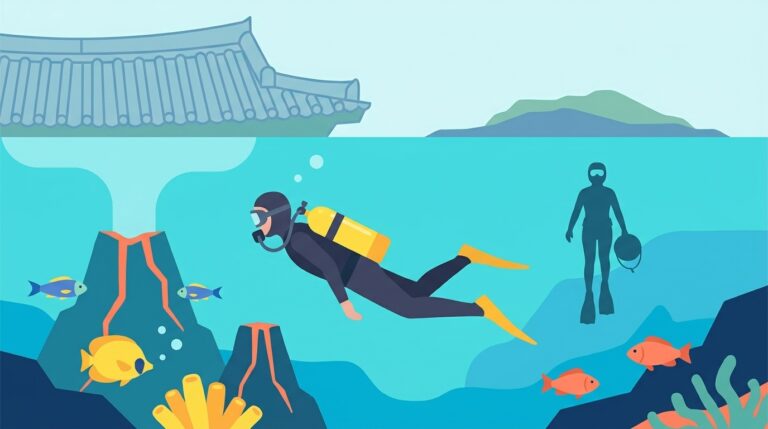
Phase 1: Empathy (Immersive Open)
Hello! I’m your Daily Hangul Editor.
Imagine this: You’re standing on the rocky shores of Jeju Island. The salty summer breeze is blowing, and the crystal-clear water stretches out before you, straight out of a scene from the K-Drama Welcome to Samdal-ri. A local dive master approaches you, pointing at your dive computer. You know how to say “I like swimming” in Korean, but how do you say, “I got my Open Water certification three years ago, but I haven’t dived since, and honestly, my skills are a bit rusty”?
For advanced (C1) Korean learners, talking about your hobbies—especially niche ones like scuba diving (스쿠버 다이빙)—requires more than just textbook translations. You need to know the specific jargon, the slang, and the cultural context of how Koreans approach their weekend leisure activities.
If you use standard textbook phrases at a bustling dive shop in Seogwipo or Gangneung, they’ll understand you. But if you drop a phrase like, “My license is totally stuck in the closet” or “Did the sea flip over today?” you won’t just be a customer; you’ll instantly become part of the local diving crew. Let’s dive in!
Phase 2: Core Expressions Deep Dive
1. 자격증을 따다 (To get a certification)
- Pronunciation: [jageokjeungeul ttada] + [ja-gyuk-jung-eul tta-da! (‘tta’ sounds like the sharp click of your tongue)]
- Meaning: Literal: “To pluck/pick a certification” | Real nuance: “To officially acquire a license or certification.”
- K-Culture Moment: In Korea, there is a strong culture of self-improvement. Whether it’s TOEIC, scuba diving, or barista skills, Koreans love “picking” (따다) certifications. If you meet a fellow diver at an after-dive BBQ, the first question will always be, “어느 단체 자격증 땄어요?” (Which agency did you get certified with?).
- Editor’s Insight: Why use 따다 (to pluck, like a fruit) instead of 받다 (to receive)? 받다 implies someone simply handed it to you. 따다 carries the weight of the blood, sweat, and pool sessions you endured to achieve it.
- Situation Spectrum:
- Casual friends: ✅
- Coworkers (Semi-formal): ✅
- Formal/Elders: ✅ (Add ‘-요’: 땄어요)
- 🤔 Think About It: Why is the Korean society so focused on tangible proof of skills (자격증)? Does your home country also require a “certificate” to prove you’re good at a hobby?
2. 바다가 뒤집어지다 (The water conditions are terrible)
- Pronunciation: [badaga dwijibeojida] + [ba-da-ga dwee-jee-buh-jee-da]
- Meaning: Literal: “The sea flipped over” | Real nuance: “The water is extremely choppy, murky, or has terrible visibility.”
- K-Culture Moment: You wake up early for a morning dive in Gangwon-do. You check the group chat, and the dive master has sent a message: “오늘 바다 완전 뒤집어졌어요. 다이빙 취소합니다.” (The sea completely flipped over today. Diving is canceled.)
- Editor’s Insight: This is a highly visual, native-level expression. It perfectly paints the picture of the ocean floor’s sand and mud being churned up to the surface by a storm.
- Situation Spectrum:
- Casual friends: ✅
- Coworkers (Semi-formal): ✅
- Formal/Elders: ⚠️ (Use ‘뒤집어졌습니다’ for formal announcements)
- 🤔 Think About It: Koreans love using dramatic verbs (like “flipping over”, “tearing”, “exploding”) to describe natural phenomena. How does this compare to the weather descriptions in your language?
3. 장롱면허 (Closet license / Rusty skills)
- Pronunciation: [jangnongmyeonheo] + [jang-nong-myun-huh (‘jang’ sounds like ‘jhang’ and ‘nong’ is like a nasal ‘noong’)]
- Meaning: Literal: “Wardrobe/Closet license” | Real nuance: “A license you earned but haven’t used, so your skills are completely rusty.”
- K-Culture Moment: This word originally comes from people who got their driver’s license but never drove, keeping the card hidden in their “wardrobe.” Now, it’s perfectly applied to scuba diving! If a dive instructor asks about your experience, saying “저 완전 장롱면허예요” is the humblest, most charming way to ask them to keep a close eye on you.
- Editor’s Insight: Koreans value humility. Admitting you have a 장롱면허 lowers expectations in a polite, slightly self-deprecating, and humorous way.
- Situation Spectrum:
- Casual friends: ✅
- Coworkers (Semi-formal): ✅
- Formal/Elders: ✅
- 🤔 Think About It: Is there a specific idiom in your language for someone who holds a qualification on paper but lacks practical, real-world experience?
Phase 3: Textbook vs. Real Korean
[Explaining your diving experience]
* 📖 Textbook: 저는 3년 전에 스쿠버 다이빙 자격증을 받았습니다. (I received my scuba diving certification 3 years ago.)
* 🗣️ Real Korean: 저 3년 전에 오픈워터 땄는데, 완전 장롱면허예요. (I got my Open Water 3 years ago, but it’s totally a closet license.)
* 💡 Why the difference?: Real conversations use specific jargon (Open Water) and the verb ‘따다’, combined with self-deprecating humor (장롱면허) to build instant rapport.
[Asking about water visibility]
* 📖 Textbook: 오늘 물속이 잘 보입니까? (Can you see well underwater today?)
* 🗣️ Real Korean: 오늘 시야(Visibility) 어때요? 바다 안 뒤집어졌어요? (How’s the visibility today? Did the sea flip over?)
* 💡 Why the difference?: Divers use the Sino-Korean word ‘시야’ (sight/visibility) rather than full sentences, maximizing efficiency in a busy, noisy dive shop.
Bottom Note: At a C1 level, your goal is not just to communicate, but to belong. Using industry-specific slang (like 시야 and 따다) shows you respect the local subculture.
Phase 4: Cultural Context — K-Culture Deep Dive
4-1. Non-verbal cues: The “Nunchi” on the Boat
When you’re on a dive boat in Korea, Nunchi (눈치) is essential. Space is cramped, and everyone is gearing up. If an older, experienced diver (often called 강사님 – Instructor, or 마스터님 – Divemaster) is struggling with a zipper, it’s common courtesy to quietly step in and help. Also, never take up more space than your designated seat. Group harmony on the boat ensures safety in the water.
4-2. The “After-Dive” K-Food Ritual
In K-Dramas featuring coastal towns, you’ll often see characters eating right by the sea. In the Korean diving community, the post-dive meal is practically a religion.
After stripping off your wet suits and washing the gear, the group will inevitably head to a local restaurant for 물회 (Spicy raw fish soup) if it’s summer, or 해물라면 (Seafood ramen) to warm up the body.
Critical Note: Never drink alcohol before or between dives in Korea (or anywhere!). But the post-dive dinner (회식) usually involves Somac (Soju + Beer). This is where the real networking happens, and where your C1 conversational skills will truly shine.
Phase 5: Real-world Roleplay Scenario
Setting: Saturday morning, 8:00 AM. A bustling dive resort in Seogwipo, Jeju Island. The smell of neoprene wetsuits and salty air fills the room. You’re trying to rent gear and book a “Fun Dive” for the afternoon.
Characters:
– YOU: An expat living in Korea. You have an Advanced Open Water cert, but you haven’t dived since your trip to the Philippines two years ago.
– Instructor Park (35): A tanned, energetic local dive master who speaks rapidly.
Dialogue:
Instructor Park: 어서 오세요! 오늘 펀다이빙 하러 오셨어요? 자격증은 있으시죠?
(Eoseo oseyo! Oneul peondaibing hareo osyeosseoyo? Jageokjeungeun isseusijyo?)
[Welcome! Are you here for fun diving today? You have a certification, right?]
(🎭 Stage Direction: Park wipes down a regulator while looking at you with a friendly smile)
YOU: 네, 2년 전에 어드밴스드 땄어요. 근데 그 뒤로 한 번도 안 해서…
(Ne, inyeon jeone eodeubaenseudeu ttasseoyo. Geunde geu dwiro han beondo an haeseo…)
[Yes, I got my Advanced two years ago. But I haven’t done it once since then, so…]
Instructor Park: 아, 그래요? 로그 수(Log count)는 얼마나 되세요?
(A, geuraeyo? Rogeu suneun eolmana doeseyo?)
[Ah, really? How many logs do you have?]
YOU: 한 30깡 정도 되는데, 너무 오래돼서 감을 다 잃었어요.
(Han samsipkkang jeongdo doeneunde, neomu oraedwaeseo gameul da ileosseoyo.)
[About 30 dives (깡 – slang for tank/dive), but it’s been so long I lost my touch.]
Instructor Park: 에이, 괜찮아요. 물에 들어가면 몸이 다 기억합니다. 오늘 시야가 진짜 좋거든요.
(Ei, gwaenchayo. Mure deureogamyeon momi da gieokhamnida. Oneul siyaga jinjja jokeodeunyo.)
[Ah, it’s fine. Once you get in the water, your body remembers everything. The visibility is really good today.]
🔀 Your Turn! How do you reply?
– A) 다행이네요. 안전하게 잘 부탁드립니다! (What a relief. Please take good care of me safely!)
– B) 아, 그래요? 저 완전 장롱면허니까 물속에서 저 버리시면 안 돼요! (Oh, really? I’m a total closet license, so you can’t abandon me underwater!)
– C) 저는 다이빙을 너무 잘합니다 걱정 마세요. (I am very good at diving, do not worry.)✅ Best Choice: B — Reason: It uses the native C1 term (장롱면허) and adds a playful, witty warning (“Don’t abandon me”). Instructor Park will instantly see you as a fun, approachable diver.
⚠️ Choice A Analysis: Safe, polite, but a bit too standard. Good, but not C1-level charismatic.
🚫 Choice C Analysis: Sounds arrogant and unnatural. In Korean culture, even experts feign a bit of modesty.
Instructor Park: (Laughs) 하하, 걱정 마세요. 제 바로 뒤에 딱 붙어오시면 됩니다. 수트 대여하시나요?
(Haha, geokjeong maseyo. Je baro dwie ttak buteoosimyeon domnida. Suteu daeyeohasinayo?)
[Haha, don’t worry. Just stick right behind me. Are you renting a wetsuit?]
YOU: 네, 5미리 수트로 부탁드릴게요.
(Ne, omiri suteuro butakdeurilgeyo.)
[Yes, a 5mm suit, please.]
Phase 6: 10-Second Shadowing Drill
Let’s practice the rhythm and intonation of a crucial phrase!
😊 저 / 오픈워터 땄는데, / 완전 / 장~~롱면허예요!
(jeo / opeunwoteo ttanneunde, / wanjeon / jang~~nongmyeonheoyeyo!)
- Tip: Elongate the “장~~” to emphasize just how long your license has been sitting in the closet. Give a slightly bashful, smiling expression as you say it.
Phase 7: K-Culture Mini Dictionary
1. 해녀
* Romanization: haenyeo
* English: Female divers (Sea Women)
* Context: Jeju Island’s iconic female divers who free-dive to harvest seafood without oxygen tanks. They are a UNESCO Intangible Cultural Heritage and a symbol of Korean coastal culture.
2. 깡
* Romanization: kkang
* English: Tank / Number of dives
* Context: Slang derived from “can” (깡통). Divers use it to count their dives. “100깡” means 100 logged dives.
3. 수트
* Romanization: suteu
* English: Wetsuit
* Context: Konglish for wetsuit. Koreans don’t say “잠수복” (diving suit) in modern leisure diving; they just say 수트 (suit).
4. 물멍
* Romanization: mulmeong
* English: Zoning out while looking at the water
* Context: A modern relaxation trend. After a dive, sitting on the boat and just staring blankly into the ocean is the ultimate healing experience.
Phase 8: Traveler’s Survival Kit
If you are visiting Jeju or the East Sea for diving, save these vital phrases to your phone.
🆘 Survival Expression #1: Equalizing
– 🇰🇷 “이퀄라이징(압력 평형)이 안 돼요.” (ikwollaijingi an dwaeyo.)
– 🗣️ Pronunciation: [ee-kwol-la-ee-jing-ee an dwae-yo]
– 📍 Where to use: On the surface before descending, or explaining to the instructor why you aborted a dive.
– 💡 Pro Tip: Koreans use the English word “Equalizing” more often than the Korean medical term.🆘 Survival Expression #2: Temperature check
– 🇰🇷 “물속 수온은 좀 어때요?” (mulsok suoneun jom eottaeyo?)
– 🗣️ Pronunciation: [mool-sok soo-on-eun jom uh-ttae-yo]
– 📍 Where to use: Asking the divemaster about the water temp so you know whether to rent a 3mm or 5mm wetsuit.📌 Editor’s Travel Note
– Jeju Island Diving: Be prepared for strong currents and unpredictable weather. Always have the 네이버 지도 (Naver Map) app to navigate to remote dive shops.
– Tipping: There is NO tipping culture in Korean dive shops. Do not tip your dive master; instead, buying them an iced Americano after the dive will make you their favorite customer.
Phase 9: Think Deeper — Critical Thinking Corner
🧠 Think Deeper: The Korean Culture of “Hobby Certifications” (글로벌 시대의 한국어와 문화)
In Korea, hobbies are rarely just “casual pastimes.” Because of a heavily competitive, achievement-oriented society, even leisure activities are often pursued with academic intensity. You don’t just ‘swim’; you get a master’s level certificate. You don’t just ‘make coffee’; you get a barista license. This phenomenon is reflected in the language: the phrase 자격증을 따다 (to acquire a certification) is used with pride and frequency. However, recent generations are pushing back, valuing the 물멍 (zoning out) and the pure connection to nature over just logging another ‘깡’ (tank) for a badge.💬 Your Turn: In your culture, do people feel pressured to get “certified” in their hobbies, or is it purely for relaxation? Share your thoughts below!
Phase 10: FAQ & Avoiding Common Mistakes
Q: Can I call the instructor “Teacher” (선생님)?
Yes! While 강사님 (Instructor-nim) is the precise term, 선생님 is a universally polite term for anyone teaching or guiding you in Korea.
Q: In K-Dramas, people eat raw fish right off the boat. Can we do that?
Sometimes! If the captain or divemaster catches some fresh seafood (legally), they might slice it right on the boat. It’s considered the ultimate luxury. Just don’t forget the 초장 (vinegar gochujang sauce)!
❌ Common Mistake #1: Saying “산소통” (Oxygen tank) instead of “공기통” (Air tank)
– Lots of beginners (even Koreans) call it an oxygen tank (산소통). But in scuba diving, you breathe compressed air, not pure oxygen.
– ✅ Do this instead: Use 공기통 (gonggitong) to sound like a true C1-level professional diver!❌ Common Mistake #2: Using formal textbook Korean when panicked underwater
– If you surface with an issue, don’t worry about honorifics.
– ✅ Do this instead: Just shout the core problem loudly: “쥐 났어요!” (I have a cramp!) or “숨차요!” (I’m out of breath!). Safety > Politeness.
Phase 11: Summary & Action Items
One-Liner Summary: To navigate the Korean scuba diving scene, confidently declare you’ve 땄다 (acquired) your cert, humorously admit if it’s a 장롱면허 (closet license), and always check if the sea 뒤집어졌다 (flipped over).
Action Mission 3 Steps:
– 🥉 Bronze (Solo): Stand in front of a mirror and dramatically act out checking the water and saying, “오늘 바다 뒤집어졌네!” 3 times.
– 🥈 Silver (Online): Go to an Instagram post of a Korean diving shop in Jeju and leave a comment: “올해는 꼭 펀다이빙 가고 싶어요!” (I really want to go fun diving this year!)
– 🥇 Gold (Real World): Visit a local pool or dive shop, and if you meet a Korean diver, ask them: “자격증 언제 땄어요?”
🌊 K-Culture Mission:
Search “제주도 스쿠버 다이빙” on YouTube. Watch a vlog, and listen carefully to see if you can catch the word 시야 (visibility) or 깡 (dive count)!
Phase 12: Interactive Quiz
1. Situational Judgment:
You arrive at the beach in Gangneung for a dive, but the waves are crashing violently and the water looks like chocolate milk. What is the most natural Korean phrase to describe this?
– A) 바다가 너무 슬퍼요.
– B) 바다가 뒤집어졌어요.
– C) 수트가 작아요.
2. Fill in the Blank:
“저 5년 전에 어드밴스드 자격증 ( _____ ) 완전 ( _____ )예요. 잘 부탁드립니다.”
– A) 받았는데 / 장난감
– B) 땄는데 / 장롱면허
– C) 잃었는데 / 산소통
3. True or False — K-Culture Edition:
In Korea, it is customary to tip the dive master 15-20% after a good fun dive. (T/F)
🚨 Click here for the answers!
1. B (The sea flipped over. Perfect description for bad visibility and waves.)
2. B (땄는데 / 장롱면허. Plucked the cert / Closet license.)
3. False. Korea does not have a tipping culture. A polite bow and offering a cold drink (like an Iced Americano) is much more appreciated!
Frequently Asked Questions (FAQ)
Q: What does "자격증을 따다 (To get a certification)" mean in Korean and how do you pronounce it?
A: In Korean, "자격증을 따다 (To get a certification)" is pronounced [jageokjeungeul ttada] and means: Literal: "To pluck/pick a certification" | Real nuance: "To officially acquire a license or certification."
Q: What does "바다가 뒤집어지다 (The water conditions are terrible)" mean in Korean and how do you pronounce it?
A: In Korean, "바다가 뒤집어지다 (The water conditions are terrible)" is pronounced [badaga dwijibeojida] and means: Literal: "The sea flipped over" | Real nuance: "The water is extremely choppy, murky, or has terrible visibility."
Q: What does "장롱면허 (Closet license / Rusty skills)" mean in Korean and how do you pronounce it?
A: In Korean, "장롱면허 (Closet license / Rusty skills)" is pronounced [jangnongmyeonheo] and means: Literal: "Wardrobe/Closet license" | Real nuance: "A license you earned but haven't used, so your skills are completely rusty."







