

Phase 1: Empathy (Immersive Opening)
Hello! I’m the Lead Editor of Daily Hangul.
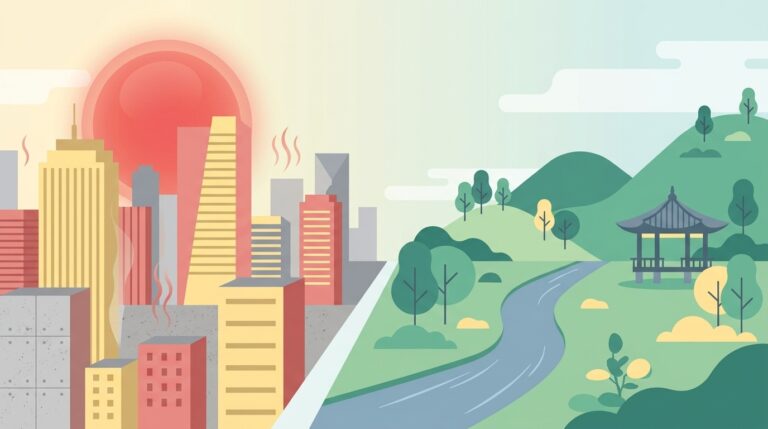
Imagine this: It’s mid-August in Seoul. You step out of the subway station in Gangnam, and the heat hits you like a physical wall. The asphalt is radiating heat like a grill at a K-BBQ joint. You’re experiencing the infamous 도심 열섬 현상 (Urban Heat Island effect). But then, you take a detour and walk toward Cheonggyecheon Stream or Seoul Forest. Suddenly, the air cools down, the breeze picks up, and you can breathe again.
Have you ever wondered why K-Drama protagonists are always jogging along the Han River or living near lush, breezy parks? It’s not just for the cinematic aesthetics—it’s highly calculated urban planning! At a C2 (Advanced) level, you’re no longer just talking about the weather by saying “날씨가 더워요” (It’s hot). You want to discuss real estate trends, environmental strategies, and quality of life like a true Seoulite.
If you don’t know these terms, you’ll miss out on the deep socio-economic conversations happening in Korean cafes right now. Let’s dive into the sophisticated world of Korean urban greenery!
Phase 2: Core Expressions Deep Dive
1. 숲세권
- Pronunciation: sup-se-gwon [Sounds like: soup-seh-gwon]
- Meaning: (Literal) Forest-influence area / (Real nuance) A premium residential area located near a park or forest.
- K-Culture Moment: In high-end K-Dramas like Penthouse or Sky Castle, wealth isn’t just about having a big house; it’s about having nature at your doorstep in the middle of a concrete jungle like Seoul.
- Editor’s Insight: This is a portmanteau of ‘숲’ (forest) and ‘역세권’ (station-influence area). It shows a massive shift in Korean values—from purely valuing convenience (subways) to valuing well-being and cooling green spaces.
- Situation Spectrum:
- Casual friends: ✅
- Colleagues (Semi-formal): ✅
- Bosses/Elders (Formal): ✅ (Often used in news and professional real estate contexts!)
- 🤔 Think About It: Why does the Korean language create so many words ending in ‘-세권’ (e.g., 스세권 for Starbucks, 슬세권 for wearing slippers)? What does this say about the extreme importance of “location” in dense Korean cities?
2. 열대야를 피하다
- Pronunciation: yeol-dae-ya-reul pi-ha-da [Sounds like: yull-dae-yah-reul pee-ha-dah]
- Meaning: (Literal) To escape the tropical night / (Real nuance) To find a cool spot (like a park or stream) to escape the sweltering summer nights.
- K-Culture Moment: It’s 10 PM on a July night. The temperature hasn’t dropped below 25°C (the definition of 열대야). You’ll see thousands of Koreans setting up picnic mats at the Han River park, eating fried chicken and beer (치맥), using the river’s microclimate to cool down.
- Editor’s Insight: You can’t use this for daytime heat. It specifically captures the exhaustion of sleepless summer nights and the cultural phenomenon of late-night outdoor socialization.
- Situation Spectrum:
- Casual friends: ✅
- Colleagues (Semi-formal): ✅
- Bosses/Elders (Formal): ✅
- 🤔 Think About It: How does urban planning (like opening 24-hour parks) directly influence a country’s drinking and socializing culture?
3. 바람길을 내다
- Pronunciation: ba-ram-gil-eul nae-da [Sounds like: bah-ram-geel-eul nae-dah]
- Meaning: (Literal) To make a wind path / (Real nuance) To design buildings and streets in a way that allows natural air currents to flow through the city, cooling it down.
- K-Culture Moment: You’ll hear this in sophisticated documentaries or high-level business meetings discussing the reconstruction of old apartment complexes in Seoul.
- Editor’s Insight: This phrase beautifully combines traditional Korean architectural philosophy (풍수지리 – Feng Shui) with modern eco-friendly urban planning.
- Situation Spectrum:
- Casual friends: ⚠️ (A bit too academic for a casual chat over soju)
- Colleagues (Semi-formal): ✅
- Bosses/Elders (Formal): ✅
- 🤔 Think About It: Does your language have a poetic yet technical term for allowing nature to flow through artificial structures?
Phase 3: Textbook vs. Real Korean
[Situation 1: Complaining about the city heat]
* 📖 Textbook Korean: 도시가 너무 더워서 힘듭니다. (The city is so hot, it’s difficult.)
* 🗣️ Real Korean: 아, 진짜 도심 열섬 현상 장난 아니네요. 아스팔트에서 찜질하는 것 같아요. (Ah, the urban heat island effect is no joke. It feels like taking a sauna on the asphalt.)
* 💡 Why the difference?: C2 speakers use highly descriptive, slightly exaggerated metaphors (찜질 – Korean sauna) mixed with technical terms (열섬 현상) to express frustration vividly.
[Situation 2: Discussing where to live]
* 📖 Textbook Korean: 공원 근처에 있는 집이 좋습니다. (A house near a park is good.)
* 🗣️ Real Korean: 요즘 대세는 숲세권이죠. 집값 비싸도 그만한 가치가 있어요. (The trend these days is ‘Sup-se-gwon’. Even if housing prices are high, it’s worth it.)
* 💡 Why the difference?: Real estate is a massive topic in Korea. Using coined terms like “대세” (main trend) and “숲세권” instantly makes you sound like a local insider.
Phase 4: Cultural Context — K-Culture Deep Dive
4-1. Non-verbal Elements & Nunchi
When discussing topics like real estate and “숲세권” (living near premium green spaces), you need extreme Nunchi (눈치). Housing prices in Seoul are notoriously high, and bragging about moving to a luxurious green neighborhood can spark jealousy or frustration. If someone mentions they are struggling with the heat in their small apartment, nodding sympathetically rather than boasting about your park-side view is the ultimate form of Korean social grace.
4-2. K-Drama Connection: The Wealth Paradigm Shift
If you’ve watched K-Dramas from the early 2000s, the wealthy characters lived in giant mansions behind high walls. But watch a modern K-Drama today, and the ultimate flex of wealth is gazing out of a high-rise floor-to-ceiling window at the lush greenery of Seoul Forest or the Han River.
Greenery in Seoul is no longer just “nature”; it is a luxury commodity. The government’s urban planning strategies to mitigate the heat island effect—like planting vertical forests or restoring urban streams—directly inflate the surrounding real estate value. So, when a drama character casually says, “Let’s take a walk in the park,” they are often subtly showing off their multi-million dollar neighborhood.
Phase 5: Real-Life Roleplay Scenario
Setting: It’s 1 PM on a Friday in mid-July. The temperature is 34°C. You and your Korean colleagues are walking back to the office after lunch in Seongsu-dong, near Seoul Forest. The heat radiating from the concrete is unbearable, but as you step into the shade of the park’s trees, a cool breeze hits you.
Characters:
– YOU: A foreign urban planning consultant working in Seoul.
– Min-soo (32): Your Korean colleague. Friendly, complains a lot about the weather, currently looking for a new apartment.
Dialogue:
Min-soo: 아, 밖은 완전 찜통이네요. 아스팔트 열기 때문에 숨이 턱턱 막혀요.
(A, bakkeun wanjeon jjimtong-ineyo. Aseupalteu yeolgi ttaemune sumi teokteok makhyeoyo.)
[Ah, it’s a total steamer outside. I can barely breathe because of the heat from the asphalt.]
YOU: 진짜 도심 열섬 현상이 심각하긴 하네요. 그래도 이쪽 나무 그늘로 오니까 살 것 같지 않아요?
(Jinjja dosim yeolseom hyeonsang-i simgakhagin haneyo. Geuraedo ijjeok namu geuneullo onikka sal geot gatji anayo?)
[The urban heat island effect is really serious. But doesn’t it feel like we can survive now that we’re under the tree shade here?]
Min-soo: 맞아요. 서울숲 쪽에서 불어오는 바람길 덕분에 주변 온도가 한 2도는 낮은 것 같아요.
(Majayo. Seoulsup jjogeseo bureooneun baramgil deokbune jubyeon ondoga han 2-doneun najeun geot gatayo.)
[You’re right. Thanks to the wind path blowing from Seoul Forest, the surrounding temperature feels about 2 degrees lower.]
YOU: 그래서 요즘 사람들이 다들 숲세권, 숲세권 하는군요.
(Geuraeseo yojeum saramdeuri dadeul supsegwon, supsegwon haneungunyo.)
[So that’s why everyone is talking about ‘Sup-se-gwon’ these days.]
Min-soo: 네, 저도 이번에 이사 갈 때 무조건 공원 근처로 가려고요. 출퇴근 좀 멀어져도 열대야 피하는 게 먼저예요.
(Ne, jeodo ibeone isa gal ttae mujogeon gong-won geuncheoro garyeogoyo. Chultoegeun jom meoreojyeodo yeoldaeya pihaneun ge meonjeoyeyo.)
[Yeah, when I move this time, I’m definitely going near a park. Even if my commute gets longer, escaping the tropical nights is my priority.]
🔀 Your Turn! How should you respond?
– A) “공원 근처는 집값이 너무 비싸서 포기하세요.” (Give up because houses near parks are too expensive.)
– B) “오, 좋은 생각이네요! 혹시 눈여겨본 동네 있어요?” (Oh, great idea! Are there any neighborhoods you’ve got your eye on?)
– C) “저는 더운 게 좋아요.” (I like it when it’s hot.)✅ Best Choice: B — It acknowledges his goal, shows empathy, and smoothly continues the conversation about real estate, which Koreans love discussing.
⚠️ Choice A Analysis: While factually true, it’s a “nunchi-fail” (눈치 없음). It crushes his dream bluntly, which can come off as condescending.
Phase 6: 10-Second Shadowing Drill
Practice speaking like a native! Pay attention to the pauses (/) and the intonation guide.
- 😫 (Exhausted) 아, / 도심 열섬 현상 때문에 / 진짜 숨이 턱턱 막혀요.
(A, / dosim yeolseom hyeonsang ttaemune / jinjja sumi teokteok makhyeoyo.) - 😌 (Relieved) 그래도 / 숲세권으로 오니까 / 살 것 같네요.
(Geuraedo / supsegwoneuro onikka / sal geot gatneyo.) - 😄 (Excited) 오늘 밤에는 / 한강 가서 / 열대야를 피해야겠어요!
(Oneul bamineun / hangang gaseo / yeoldaeyareul pihaeyagesseoyo!)
Phase 7: K-Culture Mini Dictionary
1. 숲세권 (sup-se-gwon)
* English: Premium forest/park vicinity
* Context: A crucial real estate term highlighting the high value placed on urban greenery for cooling and mental health.
2. 손풍기 (son-pung-gi)
* English: Handheld mini fan
* Context: A literal survival tool for Koreans navigating the urban heat island. You will see business executives in suits holding these tiny fans in July.
3. 열대야 (yeol-dae-ya)
* English: Tropical night
* Context: When the nighttime temperature stays above 25°C. It triggers a massive shift in nighttime business hours and outdoor drinking culture.
4. 청계천 (Cheonggyecheon)
* English: Cheonggyecheon Stream
* Context: A prime example of Korean urban planning. An old elevated highway was torn down to restore this stream, significantly reducing the downtown heat island effect.
Phase 8: Traveler’s Survival Kit
Even as an advanced learner, you need quick, practical phrases when you’re sweating through the Seoul concrete jungle.
🆘 Survival Expression #1: Finding an Oasis
– 🇰🇷 “근처에 좀 쉴 만한 공원이나 그늘 있나요?” (geuncheo-e jom swil manhan gong-won이나 geuneul itnayo?)
– 🗣️ English Guide: Is there a park or some shade nearby where I can rest?
– 📍 Where to use: Asking locals or convenience store clerks when the heat is unbearable.
– 💡 Pro Tip: In Seoul, you don’t always need a park. Just look for a cafe; they blast the AC so high you might actually need a light cardigan!📌 Editor’s Travel Note
– Useful Apps: Use KakaoMap and search for ‘공원’ (Park) or ‘수변 공간’ (Waterside spaces).
– Public Shelters: During severe heatwaves (폭염), banks and community centers operate as official “무더위 쉼터” (Cooling shelters). Anyone can walk in and cool down for free!
Phase 9: Critical Thinking Corner — “One Step Deeper”
🧠 Think Deeper: Environment & Social Class (Language & Power)
In the rapid industrialization era of the 1980s and 90s, the ultimate dream in Korea was to live in an “역세권” (subway-adjacent) apartment. Nature was an afterthought to efficiency. However, as the “도심 열섬 현상” (Urban Heat Island effect) worsens due to climate change, clean air and cool breezes have become the new currency of wealth.
The creation of the word “숲세권” perfectly encapsulates this socio-economic divide. Green urban planning strategies are essential for the city’s survival, but they ironically drive up real estate prices, pushing the working class deeper into concrete-heavy, hotter areas. When we talk about “creating wind corridors” (바람길), we must ask: whose neighborhoods are getting the breeze?
💬 Your Turn: How does your city handle the urban heat island effect? Do green spaces in your country also dictate social class as clearly as they do in Seoul? Share your thoughts below!
Phase 10: FAQ & Avoiding Misunderstandings
Q: Can I use ‘열대야’ if it’s really hot during the day?
* No. “열대야” literally means “tropical night.” Using it during the day sounds very awkward. For daytime heatwaves, use 폭염 (pok-yeom).
Q: Is it okay to casually ask a Korean colleague how much their ‘숲세권’ apartment costs?
* Maybe, but tread carefully. Real estate is a very sensitive topic in Korea right now due to skyrocketing prices. Unless you are very close friends, it’s safer to praise the neighborhood (“동네가 정말 좋네요”) rather than asking for the exact price tag.
❌ Common Mistake #1: Assuming “바람길” (wind path) is just a poetic phrase for a windy road.
✅ Do this instead: Recognize it as an advanced architectural/urban planning term. If you use it in an academic or business setting, Koreans will be highly impressed by your C2 vocabulary!
Phase 11: Summary & Action Items
- One-Liner Summary: Mastering terms like 숲세권 and 열섬 현상 elevates your Korean from simple weather small talk to deep, socio-economic urban planning discussions.
Action Mission:
– 🥉 Bronze: Say “도심 열섬 현상 장난 아니네요” out loud three times to practice the rhythm.
– 🥈 Silver: Write a short journal entry in Korean describing your ideal “숲세권.”
– 🥇 Gold: Discuss the weather with a Korean friend today using the word “열대야” or “숲세권.”
🇰🇷 K-Culture Mission:
Open KakaoMap or Google Street View, locate “Seoul Forest (서울숲),” and explore the surrounding high-rise apartments. Imagine the “바람길” (wind corridors) designed between those buildings to let the Han River breeze cool down the neighborhood!
Phase 12: Quiz — Interactive Challenge
1. Situational Judgment: You are at a business lunch in July. The Korean client wipes their sweat and complains about the concrete jungle. What is the most sophisticated (C2) response?
– A) 네, 너무 더워요. 에어컨 켜주세요. (Yes, it’s too hot. Turn on the AC.)
– B) 그러게요. 서울 도심 열섬 현상이 갈수록 심해지는 것 같아 걱정입니다. (Indeed. I’m worried the urban heat island effect in Seoul is getting worse by the day.)
– C) 저는 여름이 좋아요! (I like summer!)
(Answer: B. It shows high-level vocabulary and empathy.)
2. Fill in the Blank:
“밤 11시인데도 너무 덥네요. 진짜 완벽한 [ ]네요. 한강 가서 치맥이나 할까요?”
(Answer: 열대야 – yeol-dae-ya)
3. T/F — K-Culture Edition:
In Seoul, “무더위 쉼터” (Cooling shelters) are only for paying customers.
(Answer: False. Banks and public offices offer free public cooling shelters during extreme heatwaves!)
Frequently Asked Questions (FAQ)
Q: What does "숲세권" mean in Korean and how do you pronounce it?
A: In Korean, "숲세권" is pronounced [sup-se-gwon [Sounds like: soup-seh-gwon] and means: (Literal) Forest-influence area / (Real nuance) A premium residential area located near a park or forest.
Q: What does "열대야를 피하다" mean in Korean and how do you pronounce it?
A: In Korean, "열대야를 피하다" is pronounced [yeol-dae-ya-reul pi-ha-da [Sounds like: yull-dae-yah-reul pee-ha-dah] and means: (Literal) To escape the tropical night / (Real nuance) To find a cool spot (like a park or stream) to escape the sweltering summer nights.
Q: What does "바람길을 내다" mean in Korean and how do you pronounce it?
A: In Korean, "바람길을 내다" is pronounced [ba-ram-gil-eul nae-da [Sounds like: bah-ram-geel-eul nae-dah] and means: (Literal) To make a wind path / (Real nuance) To design buildings and streets in a way that allows natural air currents to flow through the city, cooling it down.







