

Phase 1: Empathy (The Muddy Sneaker Crisis)
Hello! I’m your Daily Hangul Editor, your local guide and Korean tutor.
Imagine this: You just survived the standing section of a wild K-Pop concert, or maybe you spent the whole day walking 20,000 steps exploring the beautiful, hilly alleys of Bukchon Hanok Village. You look down, and your favorite white sneakers are… completely ruined. Muddy, scuffed, and crying for help.
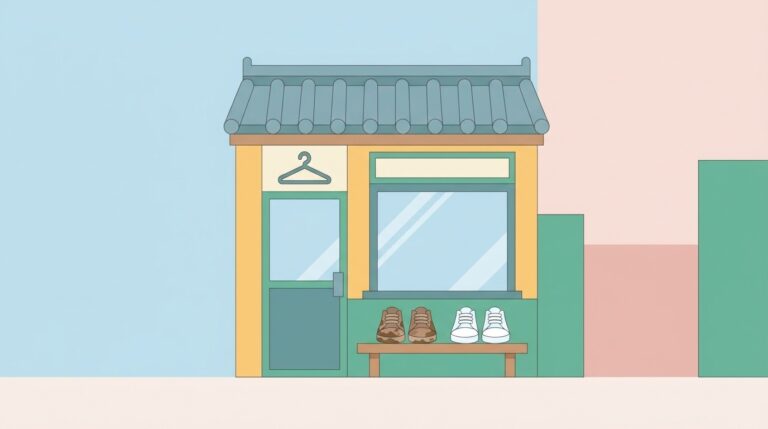
In your home country, you might just throw them in the washing machine or spend hours scrubbing them with an old toothbrush. But here in Korea? We don’t do that. We take them to the magic neighborhood spot: the 세탁소 (se-tak-so, dry cleaner).
For less than the price of a fancy cafe latte (around 5,000 KRW), Korean dry cleaners will return your sneakers wrapped in crisp plastic, smelling like fresh sunshine, looking brand new. But wait—how do you ask for this magic when you barely know the Korean alphabet?
Don’t worry. As a beginner (A1), you only need a few survival phrases. Let’s get those shoes shining again!
Phase 2: Core Expressions Deep Dive
Here are the 3 magical phrases you need.
1. 운동화 세탁해 주세요 (un-dong-hwa se-tak-hae ju-se-yo)
- Pronunciation: [un-dong-hwa se-tak-hae ju-se-yo] (‘hwa’ sounds like a soft ‘wa’, and ‘se-tak’ sounds like ‘say-tock’)
- Meaning: Please clean my sneakers. (Literal: Sneaker laundry do please.)
- K-Culture Moment: Walk into any small neighborhood shop with clothes hanging everywhere. The owner might be busy ironing. You just hold up your bag of shoes and say this with a smile.
- Editor’s Insight: ‘주세요 (ju-se-yo)’ is your absolute best friend in Korea. It means ‘please give me’ or ‘please do this for me’. Attach it to anything you need!
- Situation Spectrum:
- Casual (Friends): 🚫 (Friends don’t clean your shoes!)
- Shop Owners/Staff: ✅ (Perfect and polite!)
- 🤔 Think About It: Notice how we don’t say “I would like to wash my shoes”? Korean is incredibly efficient. We skip the “I” and get straight to the object and the request. Does your language use “I” for everything?
2. 언제 돼요? (eon-je dwae-yo?)
- Pronunciation: [uhn-jeh dway-yo?] (‘dwae’ rhymes with ‘way’)
- Meaning: When will it be ready? (Literal: When does it become?)
- K-Culture Moment: Korea is the land of ‘Pali-pali’ (hurry hurry). But sneakers usually take 2-3 days because they dry them perfectly to prevent bad smells. Always ask this to manage your expectations!
- Editor’s Insight: This phrase is a lifesaver. You can use it at cafes, restaurants, or when waiting for a taxi. It simply means “When is it ready/done?”
- Situation Spectrum:
- Casual (Friends): ✅ (Say “언제 돼?” without ‘yo’)
- Shop Owners/Staff: ✅
- 🤔 Think About It: “돼요 (dwae-yo)” comes from a verb meaning “to become” or “to be completed.” Korean focuses more on the state of the object rather than who is doing the action.
3. 얼마예요? (eol-ma-ye-yo?)
- Pronunciation: [ull-mah-yay-yo?]
- Meaning: How much is it?
- K-Culture Moment: The owner will usually write the price on a small paper receipt or punch it into a calculator.
- Editor’s Insight: It’s short, polite, and essential. Use it everywhere from street food stalls in Myeongdong to luxury boutiques in Gangnam.
- Situation Spectrum:
- Anyone you are paying: ✅
Phase 3: Textbook vs. Real Korean
Let’s see how textbooks teach it vs. how you should actually speak to sound natural and polite!
[Requesting the service]
* 📖 Textbook Korean: 제 신발을 세탁하고 싶습니다. (I would like to wash my shoes.)
* 🗣️ Real Korean: 운동화 세탁해 주세요. (Sneakers clean please.)
* 💡 Why different?: Textbooks teach full grammatical sentences, but real Korean drops unnecessary pronouns (I, my) to be fast and polite.
[Asking for the time]
* 📖 Textbook Korean: 언제 찾으러 올 수 있습니까? (When can I come to pick them up?)
* 🗣️ Real Korean: 언제 돼요? (When is it ready?)
* 💡 Why different?: Efficiency! ‘언제 돼요’ is a universal shortcut for anything you are waiting for.
Bottom Note: As an A1 beginner, don’t worry about complex grammar. Short, polite phrases ending in ‘~요 (yo)’ will make you sound very natural!
Phase 4: Cultural Context — K-Culture Deep Dive
4-1. Non-Verbal Cues (The Plastic Bag Rule)
Never walk into a dry cleaner carrying dirty shoes bare-handed! It’s considered a bit rude. Always put your dirty sneakers in a plastic bag (비닐봉지) or paper bag. When handing over the bag, use two hands or gently support your right arm with your left hand. This shows respect, especially since most dry cleaner owners are older adults (아저씨 – ajeossi / 아주머니 – ajumoni).
4-2. The “Pali-Pali” (Hurry) Service Culture
Korea is famous for its fast-paced lifestyle. You see this in K-Dramas where characters get things delivered in minutes. Neighborhood dry cleaners reflect this perfectly. While standard clothes might be ready the very next day, sneakers take about 2-3 days. Why? Because they hand-wash and use specialized drying machines to ensure the shape isn’t ruined and no odor remains.
Critical View: While “Pali-Pali” is great for customers, it means shop owners work incredibly hard. Saying a warm “감사합니다 (Thank you)” goes a long way to show appreciation for their fast labor.
Phase 5: Real-Life Roleplay Scenario
Setting: A small, cozy dry cleaner in a quiet Seoul neighborhood. The air smells like warm steam and fresh cotton. The owner (Ajeossi) is pressing a shirt.
Characters:
– YOU: A traveler whose white sneakers got destroyed by mud at a summer music festival.
– Ajeossi (60s): The kind, skilled owner of the dry cleaner.
Dialogue:
YOU: 안녕하세요! (an-nyeong-ha-se-yo!)
[Hello!]
(🎭 Stage Direction: You bow slightly and hand him the plastic bag with your shoes.)
Ajeossi: 네, 어서 오세요. 아이고, 신발이 많이 더럽네!
(ne, eo-seo o-se-yo. a-i-go, sin-ba-ri ma-ni deo-reom-ne!)
[Yes, welcome. Oh my, the shoes are very dirty!]
YOU: 네… 이거 운동화 세탁해 주세요.
(ne… i-geo un-dong-hwa se-tak-hae ju-se-yo.)
[Yes… Please clean these sneakers.]
Ajeossi: 네, 알겠어요.
(ne, al-ge-sseo-yo.)
[Yes, understood.]
🔀 Your Turn! What do you ask next?
– A) “언제 돼요?” (eon-je dwae-yo? / When will it be ready?)
– B) “진짜요? 대박!” (jin-jja-yo? dae-bak! / Really? Awesome!)
– C) “빨리빨리!” (ppal-li-ppal-li! / Hurry hurry!)✅ Best Choice: A. You need to know when to come back!
⚠️ Choice C Analysis: Never say “Pali-pali” to a worker! It is considered very rude. “Pali-pali” is a cultural concept, not a command you give to elders.
YOU: 언제 돼요?
(eon-je dwae-yo?)
[When will it be ready?]
Ajeossi: 금요일에 오세요.
(geu-myo-i-re o-se-yo.)
[Come on Friday.]
YOU: 얼마예요?
(eol-ma-ye-yo?)
[How much is it?]
Ajeossi: 오천 원이에요. 선불입니다.
(o-cheon wo-ni-e-yo. seon-bu-rim-ni-da.)
[It’s 5,000 won. Payment is upfront.]
YOU: 감사합니다!
(gam-sa-ham-ni-da!)
[Thank you!]
Phase 6: 10-Second Shadowing Drill
Let’s practice the most important sentence. Speak out loud with the feeling tags!
🥺 Polite & Asking: 이거 / 운동화 / 세탁해 / 주세요~
(i-geo / un-dong-hwa / se-tak-hae / ju-se-yo~)
“Please clean these sneakers~”
Phase 7: K-Culture Mini Dictionary
1. 세탁소 (se-tak-so)
* Meaning: Dry cleaner
* Context: You can find these by looking for the ♨️ (steam) symbol or just a shop with hundreds of plastic-wrapped shirts hanging from the ceiling.
2. 아저씨 / 아주머니 (a-jeo-ssi / a-ju-meo-ni)
* Meaning: Middle-aged man / Middle-aged woman
* Context: A polite way to refer to older shop owners.
3. 선불 (seon-bul)
* Meaning: Upfront payment
* Context: For small items like shoes, many local dry cleaners ask you to pay when you drop them off, not when you pick them up.
4. 비닐봉지 (bi-nil-bong-ji)
* Meaning: Plastic bag
* Context: Always use one to carry dirty things out of respect for others’ clean spaces.
Phase 8: Traveler Survival Kit
Even if you just use a translation app, knowing these 3 phrases will save you!
🆘 Survival Phrases for the Dry Cleaner
– 🇰🇷 “운동화 세탁해 주세요.” (Please clean my sneakers)
– 🇰🇷 “언제 돼요?” (When will it be ready?)
– 🇰🇷 “얼마예요?” (How much is it?)
📌 Editor’s Travel Note
– Map Apps: Search “세탁소” on KakaoMap or Naver Map to find the nearest one.
– Cash vs Card: While Korea is a cashless society, small neighborhood dry cleaners prefer cash or bank transfers for small amounts like 5,000 won. Keep a 10,000 won bill handy!
– Luxury Shoes: If you have $1,000 designer sneakers (like Balenciaga or Gucci), go to a specialized “명품 세탁” (Luxury Dry Cleaner) instead of the neighborhood spot.
Phase 9: Critical Thinking — “One Step Deeper”
🧠 Think Deeper: Language & Respect
Did you notice we add “요 (yo)” to the end of everything? In Korean society, language is deeply tied to respect and age. The dry cleaner owner is likely older than you, so using the polite “요” form is crucial. It shows that you respect their age and their hard work. It’s not just about grammar; it’s about building a harmonious community feeling (정 – Jeong).💬 Your Turn: Does your language change depending on the age of the person you are talking to? Share in the comments!
Phase 10: FAQ & Avoiding Common Mistakes
Q: Can I just give them my shoes directly without a bag?
No! It’s an unspoken rule. Putting dirty shoes on their counter without a bag is considered unhygienic and a bit disrespectful.
Q: Can I use “언제 돼요?” at a restaurant for my food?
Yes! If your takeout is taking a long time, you can politely ask “저… 언제 돼요?” (Excuse me… when will it be ready?).
❌ Common Mistake #1: Expecting the shoes back on the same day.
✅ Do This: Always ask “언제 돼요?” Expect it to take 2-3 days.
❌ Common Mistake #2: Trying to pay with a 50,000 won bill for a 5,000 won service.
✅ Do This: Small shops might not have enough change. Bring smaller bills (1,000 or 10,000 KRW).
Phase 11: Summary & Action Items
One-Liner Summary: Bring your dirty shoes in a bag, say “운동화 세탁해 주세요” (Please clean my sneakers), and prepare some cash!
Action Mission 3 Steps:
– 🥉 Bronze (Solo): Stand in front of a mirror and say “운동화 세탁해 주세요” 3 times naturally.
– 🥈 Silver (Online): Write “언제 돼요?” in your notes app so you can show it to a shop owner if you forget the pronunciation.
– 🥇 Gold (Real Life): Take your dirty sneakers to a real Korean 세탁소 and use all 3 phrases!
K-Culture Mission:
Next time you use KakaoMap or Naver Map, type “세탁소” near your hotel and look at the street view. See if you can spot the colorful signs or clothes hanging outside!
Phase 12: Quiz — Interactive Challenge
1. You just handed your dirty shoes to the owner. What is the BEST phrase to ask when you can pick them up?
A) 빨리빨리! (Pali-pali!)
B) 언제 돼요? (Eon-je dwae-yo?)
C) 감사합니다! (Gam-sa-ham-ni-da!)
2. True or False – K-Culture Edition:
“It is perfectly fine to place your muddy sneakers directly on the dry cleaner’s counter.”
3. Fill in the blank:
You want to know the price. You ask: “_______ 예요?” (_______ ye-yo?)
(Answers: 1: B, 2: False – always use a bag! 3: 얼마 / eol-ma)
Did you find this guide helpful? Drop a comment below if you’ve ever had a shoe emergency while traveling!
Frequently Asked Questions (FAQ)
Q: What does "운동화 세탁해 주세요 (un-dong-hwa se-tak-hae ju-se-yo)" mean in Korean and how do you pronounce it?
A: In Korean, "운동화 세탁해 주세요 (un-dong-hwa se-tak-hae ju-se-yo)" is pronounced [un-dong-hwa se-tak-hae ju-se-yo] and means: Please clean my sneakers. (Literal: Sneaker laundry do please.)
Q: What does "언제 돼요? (eon-je dwae-yo?)" mean in Korean and how do you pronounce it?
A: In Korean, "언제 돼요? (eon-je dwae-yo?)" is pronounced [uhn-jeh dway-yo?] and means: When will it be ready? (Literal: When does it become?)
Q: What does "얼마예요? (eol-ma-ye-yo?)" mean in Korean and how do you pronounce it?
A: In Korean, "얼마예요? (eol-ma-ye-yo?)" is pronounced [ull-mah-yay-yo?] and means: How much is it?






