

Phase 1: Empathy & The K-Culture Cold Open
Hello! I’m your Daily Hangul Editor, your personal guide to navigating Korea like a true local.
Picture this: You are walking down the vibrant streets of Hongdae. Every few steps, you pass a brightly lit, aesthetically pleasing shop with rows of colorful little bottles and dazzling crystals. You’ve just watched your favorite K-Pop idol’s latest music video, and you are absolutely mesmerized by their sparkling, 3D gel nails. You want them. You need them. But then, reality hits.
Walking into a Korean nail salon can feel like stepping into a beautiful but intimidating laboratory. What if they ask about ‘parts,’ ‘overlays,’ or ‘syrup’ in rapid-fire Korean? Are they talking about breakfast or my hands?
Many of my students have confessed to walking past these salons, too nervous to book an appointment. But here is the secret: Korean nail art is not just a beauty service; it’s a massive cultural trend heavily tied to K-Pop and Instagram culture. Knowing just a few key phrases will not only get you those dream idol nails but also earn you that sweet ‘insider’ nod from the nail artist. Let’s dive in!
Phase 2: Core Expressions Deep Dive
Here are the absolute must-know phrases that will save your life (and your nails) in a Korean salon.
1. 이달의 아트로 할게요.
- Pronunciation: [idal-ui ateu-ro halgeyo] -> sounds like: ee-dal-eh ah-teu-ro hal-geh-yo
- Meaning: (Literal) I will do this month’s art. / (Real nuance) I’d like to choose a design from your promotional ‘Art of the Month’ board.
- K-Culture Moment: If you look at any Korean nail salon’s Instagram, you will see #이달의아트. Every month, salons release a set of heavily discounted, trendy designs. Saying this immediately shows you know how the K-Beauty system works!
- Editor’s Insight: This is the magic phrase for saving money while getting premium designs. It feels decisive and savvy.
- Situation Spectrum:
- Casual (to friends): 🚫 (Not used with friends)
- Semi-formal (to staff): ✅
- Formal (to boss): 🚫
- 🤔 Think About It: Why do Korean salons push ‘Art of the Month’? It reflects the fast-paced trend cycle in Korea (ppalli-ppalli culture). Instead of spending 30 minutes deciding, customers pick a pre-made trendy design, making the process hyper-efficient for everyone. Does your country have a similar ‘monthly special’ culture for beauty services?
2. 큐티클 조금만 정리해 주세요.
- Pronunciation: [kyutikeul jogeumman jeongnihae juseyo] -> sounds like: kyu-tee-keul jo-geum-man jeong-nee-hae joo-seh-yo
- Meaning: (Literal) Please organize the cuticles a little bit. / (Real nuance) Please be gentle/only trim a little bit of the cuticles.
- K-Culture Moment: Korean nail techs are famous for their meticulous, sometimes aggressive cuticle care to make the nail bed look longer. If you have sensitive skin, you must use this phrase before they bring out the nippers!
- Editor’s Insight: Notice the word ‘정리하다’ (to organize/tidy up). Koreans rarely say ‘자르다’ (to cut) in this context because ‘tidying up’ sounds much gentler and more professional.
- Situation Spectrum:
- Casual: 🚫
- Semi-formal (to staff): ✅
- Formal: 🚫
- 🤔 Think About It: Using softer verbs like ‘organize’ instead of ‘cut’ is a classic Korean linguistic trait to make requests sound polite and less harsh. Can you think of a time when English uses a softer word to sound polite?
3. 타샵 젤 제거 있나요?
- Pronunciation: [tasyap jel jegeo innayo?] -> sounds like: ta-syap jel jeh-geo in-na-yo?
- Meaning: (Literal) Is there other-shop gel removal? / (Real nuance) I have gel polish on from another salon, can you remove it? (And implies: How much is it?)
- K-Culture Moment: When booking via direct message (DM) on Instagram or Naver, they will always ask this. Salons usually charge extra (around 10,000 to 20,000 KRW) if you need to remove gel that was applied at a different shop (타샵).
- Editor’s Insight: ‘타샵’ (Ta-shop) is a brilliant K-Beauty Konglish abbreviation meaning ‘Other (타) Shop (샵)’. It’s essential survival vocabulary for booking.
- Situation Spectrum:
- Casual: 🚫
- Semi-formal (to staff / DM booking): ✅
- Formal: 🚫
- 🤔 Think About It: Why is it more expensive to remove gel from another shop? It’s partly a loyalty tactic! If you return to the same shop (자샵 – Ja-shop), removal is often free or cheaper.
Phase 3: Textbook vs. Real Korean
[Situation 1: Asking for a style]
* 📖 Textbook Korean: 저는 빨간색 매니큐어를 바르고 싶습니다. (I want to apply red manicure.)
* 🗣️ Real Korean: 시럽 네일 레드로 해주세요. (Please do a red syrup nail.)
* 💡 Why the difference?: In Korea, ‘manicure’ means regular air-dry polish, which 99% of modern Korean salons no longer do! They exclusively do Gel (젤). Also, ‘Syrup’ (translucent jelly-like color) is the standard trendy look right now.
[Situation 2: Showing a reference picture]
* 📖 Textbook Korean: 이 사진과 똑같이 만들어 주시겠어요? (Could you make it exactly like this picture?)
* 🗣️ Real Korean: 이 디자인 가능할까요? (Is this design possible?)
* 💡 Why the difference?: Asking ‘is it possible?’ (가능할까요?) shows consideration for the artist’s skills and materials, reflecting the Korean culture of polite, indirect requests.
Phase 4: Cultural Context — K-Culture Deep Dive
4-1. Non-verbal Communication & ‘Nunchi’
In a Korean nail salon, Nunchi (눈치 – the ability to read the room) is key.
When the nail artist is working on your hands, relax your fingers completely. Do not try to ‘help’ them by stiffening your fingers or pointing them in a certain direction. Let your hand be completely limp. Also, while some artists love to chat, many prefer to focus quietly on the intricate art. Read their vibe—if they are quietly focusing on placing a tiny rhinestone (part), let them concentrate!
4-2. The K-Pop Connection: ‘Parts’ (파츠)
If you’ve seen K-Pop idols like BLACKPINK or aespa perform, their nails are often adorned with massive gems, pearls, and chains. In K-Beauty slang, these 3D decorations are called ‘파츠’ (Pacheu – Parts).
If you want that idol look, you can ask: “파츠 많이 붙여주세요!” (Please attach a lot of parts!). But be warned: typing on your phone will become an extreme sport afterward!
Phase 5: Real-Life Roleplay Scenario
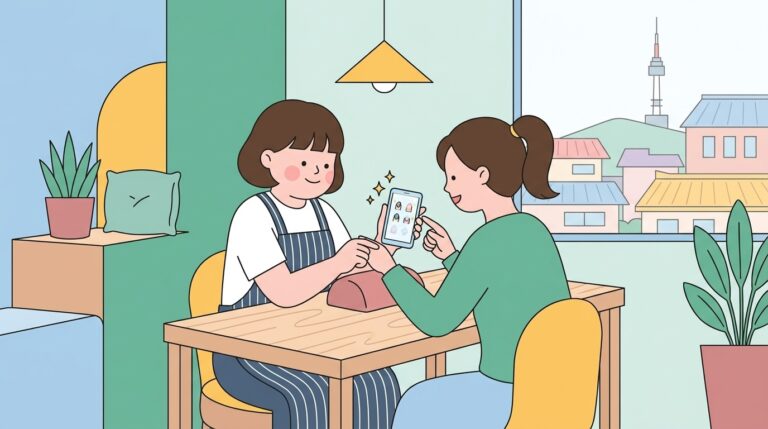
Setting: Saturday afternoon in Yeonnam-dong. You walk into a cozy nail salon smelling of peach lotion and acetone. K-indie music is playing softly. You are sitting across from Sujin, the trendy nail artist wearing a neat apron.
Characters:
– YOU: A foreign resident wanting to try K-Pop style nails for a weekend trip.
– Sujin (28): A friendly, meticulous Korean nail artist.
Dialogue:
Sujin: 안녕하세요! 예약하고 오셨나요? 😊
(annyeonghaseyo! yeyakhago osyeonnayo?)
(English) Hello! Did you make a reservation?
(🎭 Stage Direction: Sujin greets you with a bright smile from behind the counter.)
YOU: 네, 두 시 예약했어요.
(ne, du si yeyakhaesseoyo.)
(English) Yes, I have a reservation for 2 o’clock.
Sujin: 네, 이쪽으로 앉으세요. 오늘 어떤 디자인으로 하시겠어요?
(ne, ijjogeuro anjeuseyo. oneul eotteon dijaineuro hasigesseoyo?)
(English) Yes, please sit this way. What kind of design would you like today?
YOU: 인스타그램에서 본 이달의 아트로 할게요.
(inseutageuraemeseo bon idal-ui ateu-ro halgeyo.)
(English) I’ll do the Art of the Month I saw on Instagram.
Sujin: 아, 이 디자인요! 모양은 어떻게 잡아드릴까요?
(a, i dijainyo! moyang-eun eotteoke jabadeurilkkayo?)
(English) Ah, this design! How should I shape them?
🔀 Your Turn! How do you answer?
– A) “스퀘어로 해주세요.” (Please make it square.)
– B) “네, 잘 부탁드립니다.” (Yes, please take care of it.)
– C) “아무거나요!” (Anything!)✅ Best Choice: A — You must specify a shape in Korea! The most popular shapes are Square (스퀘어), Round (라운드), and Coffin (코핀).
⚠️ Choice C Analysis: Saying ‘anything’ (아무거나) might stress the artist out. If you don’t know, it’s better to ask for a recommendation: “어떤 모양이 예쁠까요?” (Which shape would look pretty?)
YOU: 스퀘어로 해주세요.
(seukwe-eo-ro haejuseyo.)
(English) Please make it square.
(🎭 Stage Direction: Sujin begins filing your nails with incredible speed.)
Sujin: 네, 알겠습니다. 혹시 큐티클 예민하신 편인가요?
(ne, algetseumnida. hoksi kyutikeul yeminhasin pyeon-ingayo?)
(English) Yes, understood. Are your cuticles on the sensitive side by any chance?
YOU: 네, 큐티클 조금만 정리해 주세요.
(ne, kyutikeul jogeumman jeongnihae juseyo.)
(English) Yes, please just tidy up the cuticles a little bit.
Sujin: 걱정 마세요. 안 아프게 해드릴게요!
(geokjeong maseyo. an apeuge haedeurilgeyo!)
(English) Don’t worry. I’ll do it so it doesn’t hurt!
Phase 6: 10-Second Shadowing Drill
Practice these sentences out loud to get the perfect rhythm. Pay attention to the pauses (/) and the emotion tags!
- 💅 Assertive but polite:
이달의 아트로 / 할게요.
(i-dal-ui a-teu-ro / hal-ge-yo.) -
🥺 A little worried:
큐티클은 / 조금만 / 정리해 주세요.
(kyu-ti-keu-reun / jo-geum-man / jeong-ni-hae ju-se-yo.) -
🤔 Curious:
이 디자인 / 가능한가요?
(i di-ja-in / ga-neung-han-ga-yo?)
Phase 7: K-Culture Mini-Dictionary
1. 이달의 아트
* Romanization: idal-ui ateu
* English: Art of the Month
* Context: A monthly curated menu of heavily discounted, trendy nail designs. The lifeblood of Korean nail salons.
2. 파츠
* Romanization: pacheu
* English: Parts (Nail charms/rhinestones)
* Context: The 3D gems, pearls, and crystals glued to the nail. Essential for the “K-Pop idol” aesthetic.
3. 예약금
* Romanization: yeyakgeum
* English: Reservation Deposit
* Context: Most salons require you to wire transfer a 10,000~20,000 KRW deposit to secure your booking to prevent no-shows.
4. 타샵 제거
* Romanization: tasyap jegeo
* English: Other-shop removal
* Context: The fee applied when removing gel polish that was applied at a different salon.
Phase 8: Traveler Survival Kit
Since getting your nails done is a huge part of beauty tourism in Korea, you need these practical tools!
🆘 Survival Phrases #1
– 🇰🇷 “여기 예약 되나요?” (yeogi yeyak doenayo?)
– 🗣️ English: Can I make a reservation here?
– 📍 Where to use: Walk-ins are almost impossible in Korea. You must message them on Instagram or walk in to ask for a future time.
– 💡 Pro Tip: Show them your phone calendar to point at the date you want!📌 Editor’s Travel Note
– Useful Apps: Naver Map (to find nearby salons) and Instagram (search #홍대네일, #강남네일 to find portfolios and DM them to book).
– Payment: Card is widely accepted, but sometimes paying in cash or bank transfer (계좌이체) gets you a small discount or a free color upgrade.
– Tipping Culture: DO NOT TIP! There is absolutely no tipping culture in Korea. The price you see is the final price. Tipping might confuse the artist.
Phase 9: Critical Thinking — “One Step Deeper”
🧠 Think Deeper: Language in the Global Era (Konglish in K-Beauty)
Have you noticed how much English is used in a Korean nail salon? Words like Parts, Syrup, Overlay, Extension, Art. In modern K-Beauty, using English loanwords (Konglish) is seen as trendy, sophisticated, and professional. However, this has created an interesting social issue. While young people navigate these terms easily, older generations often feel alienated because they don’t understand the ‘menu’. It sparks a debate: Should Korea purify these words into traditional Korean, or accept Konglish as the natural evolution of a globalized industry?💬 Your Turn: In your culture, do beauty and fashion industries use a lot of foreign words to sound ‘fancy’? Share your thoughts in the comments!
Phase 10: FAQ & Avoiding Mistakes
Q: Can I just walk into a salon and get my nails done immediately?
A: NO. 95% of nail salons in Korea are strictly ‘100% 예약제’ (100% reservation based). Always DM them on Instagram or book via Naver at least 2-3 days in advance.
Q: Can I use informal language (반말) if the nail artist seems to be my age?
A: NO. Even if you chat comfortably for two hours and become friendly, they are providing a professional service. Always stick to the polite ‘요(yo)’ form.
❌ Common Mistake #1: Asking for a “매니큐어” (Manicure).
✅ Do this instead: Ask for “젤 네일” (Gel nail) or “기본 케어” (Basic care – just trimming and shaping without polish). If you ask for a manicure, they might tell you they don’t do it, meaning they don’t carry regular air-dry polish!
Phase 11: Summary & Action Items
One-Liner Summary: To master the Korean nail salon, always make a reservation, know your ‘Art of the Month’, and embrace the Konglish!
Action Mission 3 Steps:
– 🥉 Bronze (Solo): Say “이달의 아트로 할게요” out loud 3 times while looking at your hands.
– 🥈 Silver (Online): Go to Instagram, search #이달의아트, and find a design you love.
– 🥇 Gold (Real World): Next time you visit Korea (or a Korean salon in your city), show them a picture and ask, “이 디자인 가능할까요?”
K-Culture Mission:
Go to YouTube and search “Kpop idol nail artist.” Watch how they apply the massive ‘파츠’ (parts) and see if you can hear any of the words we learned today!
Phase 12: Quiz — Interactive Challenge
1. Situational Judgment:
You arrive at the salon, but you have old gel polish from a different shop on your nails right now. What should you have checked beforehand?
– A) Do they have a bathroom?
– B) 타샵 제거 (Ta-shop gel removal fee)
– C) What music they play
(Answer: B. They need extra time and will charge you a fee for removing another shop’s gel!)
2. Fill in the Blank:
To ask them to be gentle with your cuticles, you say: “큐티클 ( ____ ) 정리해 주세요.”
(Answer: 조금만 – jogeumman, meaning ‘just a little bit’)
3. True or False — K-Culture Edition:
“If the nail artist does an amazing job with your K-Pop styling, you should give them a 15% tip.”
(Answer: FALSE! Tipping does not exist in Korea and will only cause awkward confusion. A big smile and saying ‘너무 예뻐요! 감사합니다!’ (It’s so pretty! Thank you!) is the best tip.)
Frequently Asked Questions (FAQ)
Q: What does "이달의 아트로 할게요." mean in Korean and how do you pronounce it?
A: In Korean, "이달의 아트로 할게요." is pronounced [idal-ui ateu-ro halgeyo] and means: (Literal) I will do this month's art. / (Real nuance) I'd like to choose a design from your promotional 'Art of the Month' board.
Q: What does "큐티클 조금만 정리해 주세요." mean in Korean and how do you pronounce it?
A: In Korean, "큐티클 조금만 정리해 주세요." is pronounced [kyutikeul jogeumman jeongnihae juseyo] and means: (Literal) Please organize the cuticles a little bit. / (Real nuance) Please be gentle/only trim a little bit of the cuticles.
Q: What does "타샵 젤 제거 있나요?" mean in Korean and how do you pronounce it?
A: In Korean, "타샵 젤 제거 있나요?" is pronounced [tasyap jel jegeo innayo?] and means: (Literal) Is there other-shop gel removal? / (Real nuance) I have gel polish on from another salon, can you remove it? (And implies: How much is it?)







