

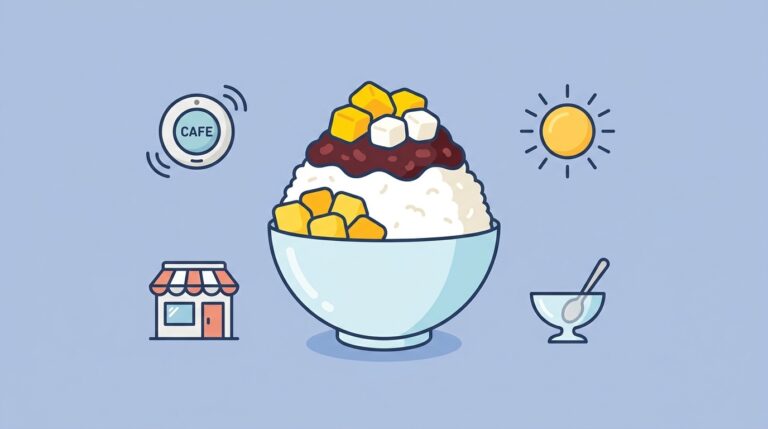
Phase 1: Empathy & The K-Culture Cold Open
Hello there! It’s your friendly Lead Editor from Daily Hangul.
Picture this: It’s mid-July in Seoul. The monsoon humidity is wrapping around you like a wet blanket, the cicadas are screaming at the top of their lungs, and the asphalt is practically melting your sneakers. You stumble into a cafe looking for a sweet, icy escape. In K-Dramas, this is the exact moment the main characters sit across from each other, a massive, snow-like mountain of ice between them, gently scooping it up while sharing a romantic glance.
But in reality? You are standing in front of a kiosk, sweating, staring at words like ‘인절미 (Injeolmi)’, ‘연유 (Yeonyu)’, and wondering why people are aggressively guarding their tables with a single MacBook or a tiny handbag.
Surviving a Korean summer means mastering the art of 빙수 맛집 도장 깨기 (Bingsu Cafe Hopping). If you don’t know the specific lingo, you might end up with a watery, mixed-up soup of ice instead of a fluffy, Instagram-worthy dessert.
This guide is crafted from the real, sweaty struggles of my B2-level students who just wanted a decent bowl of shaved ice without feeling lost. Let’s turn you into a Bingsu insider!
Phase 2: Core Expressions Deep Dive
Let’s break down the essential phrases you need to conquer any Bingsu spot like a true local.
1. 도장 깨기 하러 가자 (dojang kkaegi ha-reo gaja)
- Pronunciation: [Doh-jang kkeh-gee ha-reo ga-ja] Think of the ‘kk’ in ‘kkaegi’ as a sharp, tense sound, like a tiny hiccup before saying the letter K.
- Meaning:
- Literal: Let’s go break the dojos.
- Real Nuance: Let’s go cafe-hopping / Let’s conquer the famous spots on our list.
- K-Culture Moment: This comes from martial arts where a fighter travels to different dojos to defeat their masters. Now, Gen Z and Millennials use it for food! “Bingsu Dojang Kkaegi” means visiting all the top-rated bingsu cafes in town one by one.
- Editor’s Insight: This phrase instantly makes you sound fluent. It shows you have a mission and you’re serious about your food.
- Situation Spectrum:
- 친구 사이 (Casual): ✅
- 직장 동료 (Semi-formal): ⚠️ (Okay with close coworkers)
- 직장 상사·어른 (Formal): 🚫 (Too slangy)
- 🤔 Think About It: Why does Korean youth culture use a combat term like ‘breaking a dojo’ for eating desserts? Does your culture have an intense word for tracking down good food?
2. 다 섞지 말고 그냥 퍼서 드세요 (da seok-ji malgo geunyang peoseo deuseyo)
- Pronunciation: [da seok-jee mal-go geu-nyang peo-seo deu-seh-yo] ‘퍼’ (peo) sounds like the start of the word ‘pun’, but with a softer P.
- Meaning:
- Literal: Don’t mix it all, just scoop and eat.
- Real Nuance: Please don’t stir it into a soup; gently scoop it top-down to enjoy the texture.
- K-Culture Moment: If you vigorously mix a modern milk bingsu (like Sulbing) the way people mixed the old-school ice bingsu in the 90s, Koreans will look at you with deep sorrow. The delicate milk ice flakes melt instantly if you stir them!
- Editor’s Insight: ‘퍼서 먹다’ (to scoop and eat) is a crucial action verb for soups, rice, and bingsu.
- Situation Spectrum:
- 친구 사이 (Casual): ✅ (Say: 그냥 퍼서 먹자!)
- 직장 동료 (Semi-formal): ✅
- 직장 상사·어른 (Formal): ⚠️ (Say: 섞지 말고 드시는 게 더 맛있어요)
- 🤔 Think About It: Koreans love mixing things (like Bibimbap). Why is Bingsu the big exception to the mixing rule in modern times?
3. 연유 따로 주실 수 있나요? (yeonyu ttaro jusil su innayo?)
- Pronunciation: [yeon-yu tta-ro joo-shil soo in-na-yo?] ‘따로’ (ttaro) has a strong, tense ‘T’ sound, like the ‘t’ in ‘stop’.
- Meaning:
- Literal: Can you give the condensed milk separately?
- Real Nuance: Can I get the condensed milk on the side?
- K-Culture Moment: You order a massive green tea bingsu. It comes with a tiny cup of sweet, thick milk (연유). If you pour it all at once, the ice collapses! Pros ask for extra on the side or pour it in stages.
- Editor’s Insight: ‘따로’ (separately) is your survival word for customization. You can use it for sauces, side dishes, or even splitting bills (따로 계산할게요).
- Situation Spectrum:
- 친구 사이 (Casual): ✅
- 식당/카페 직원 (Staff): ✅ (Perfectly polite)
- 🤔 Think About It: How does the word ‘따로’ reflect the Korean dining culture where many dishes are highly customizable at the table?
Phase 3: Textbook vs. Real Korean
Let’s upgrade your B2 textbook knowledge to street-smart Seoulite Korean!
[Claiming a Table]
* 📖 Textbook Korean: 저기에 가방을 놓아서 자리를 예약하겠습니다. (I will reserve the seat by placing a bag there.)
* 🗣️ Real Korean: 저기 자리 먼저 잡자. (Let’s grab that seat first.)
* 💡 Why the difference?: ‘자리(를) 잡다’ is the absolute go-to phrase for securing a table in a crowded cafe before ordering.
[Asking for Extra Toppings]
* 📖 Textbook Korean: 팥을 더 많이 주시겠습니까? (Would you please give me more red beans?)
* 🗣️ Real Korean: 팥 좀 많이 주세요~ / 팥 추가 되나요? (Please give me a lot of red beans / Can I add red beans?)
* 💡 Why the difference?: Koreans use ‘추가’ (addition) as a noun to ask if something can be added to their order efficiently.
[Commenting on the Heat]
* 📖 Textbook Korean: 오늘 날씨가 정말 무덥습니다. (Today’s weather is very hot and humid.)
* 🗣️ Real Korean: 오늘 진짜 쪄 죽겠다. 빙수 각이다. (I’m gonna roast to death today. It’s the perfect angle/timing for bingsu.)
* 💡 Why the difference?: ‘각이다’ is internet slang derived from billiards, meaning ‘the conditions are perfect for X’. It’s super common among people under 40!
Bottom Note: For B2 learners, using ‘각이다’ around friends will get you an impressed “Oh, you know that?!” but stick to ‘자리 잡다’ and ‘추가 되나요’ for everyday, polite use.
Phase 4: Cultural Context — K-Culture Deep Dive
4-1. The Ultimate Test of ‘Nunchi’ (눈치)
When you walk into a popular Bingsu cafe in Hongdae or Yeonnam-dong, do not head straight to the counter. Use your Nunchi! You must scan the room to see who is about to leave, stand casually near them, and the second they stand up, swoop in.
Also, Koreans will leave their phones, laptops, or expensive bags on the table to ‘reserve’ it while they order. Yes, it’s safe. No, you shouldn’t move their stuff!
4-2. The Evolution of the Summer Trope
In K-Dramas from the early 2000s, sharing a bowl of bingsu was a classic trope. The guy would playfully put some red bean on the girl’s nose. Fast forward to today, the K-Culture food scene has exploded. We now have luxury ‘Hotel Apple Mango Bingsu’ costing over $80!
When K-Pop idols do V-Live streams in the summer, you’ll often see them doing a ‘Bingsu Mukbang’. They meticulously debate with fans in the comments: “Are you a ‘Mix it’ (섞어파) or ‘Scoop it’ (퍼먹파) person?”
Critical Viewpoint: While dramas show people cleanly sharing a bowl with elegant spoons, in reality, it’s a messy battle against the melting ice. And post-COVID, many people actually prefer asking for small separate bowls (앞접시) to scoop their portion into.
Phase 5: Real-Life Roleplay Scenario
Setting: Saturday, 2 PM. A packed Sulbing (a popular bingsu franchise) in Gangnam. The AC is blasting. The sound of ice shaving machines roars in the background.
Characters:
– YOU: A foreign professional working in Seoul. It’s your first time trying traditional Injeolmi (roasted soybean powder) bingsu.
– Minsoo (32): Your friendly Korean coworker who takes his food very seriously.
Dialogue:
Minsoo: 와, 밖은 완전 찜질방이네요. 빨리 자리부터 잡아요!
(Wa, bakkeun wanjeon jjimjilbang-ineyo. Ppalli jaributeo jabayo!)
[Wow, outside is totally a sauna. Let’s grab a seat first!]
YOU: 저기 창가 쪽에 빈 자리 있어요. 제가 가방 놓을게요.
(Jeogi changga jjoge bin jari isseoyo. Jaega gabang noeulgeyo.)
[There’s an empty seat by the window over there. I’ll put my bag down.]
Minsoo: 나이스! 메뉴는 제가 고를게요. 인절미 빙수 어때요?
(Naiseu! Menyuneun jaega goreulgeyo. Injeolmi bingsu eottaeyo?)
[Nice! I’ll pick the menu. How about Injeolmi bingsu?]
YOU: 좋아요! 그런데 팥은 안 들어가나요?
(Joayo! Geureonde pateun an deureoganayo?)
[Sounds good! But does it not have red bean in it?]
Minsoo: 네, 기본은 팥이 없어요. 팥 추가할까요?
(Ne, giboneun pachi eopseoyo. Pat chugahalkkayo?)
[Yeah, the basic one doesn’t have it. Should we add red bean?]
YOU: 네, 추가해 주세요. 그리고 저… 달달한 거 좋아해요.
(Ne, chugahae juseyo. Geurigo jeo… daldalhan geo joahaeyo.)
[Yes, please add it. And um… I like sweet things.]
Minsoo: 아하, 그럼 연유 듬뿍 달라고 할게요. 제가 쏩니다!
(Aha, geureom yeonyu deumppuk dallago halgeyo. Jaega ssomnida!)
[Aha, then I’ll ask for plenty of condensed milk. It’s my treat!]
🔀 Your Turn! How should you respond?
– A) “아, 감사합니다! 잘 먹겠습니다!” (Ah, thank you! I will eat well!)
– B) “에이~ 오늘은 제가 살게요! 제가 도장 깨기 하자고 했잖아요.”
(Hey~ I’ll pay today! I’m the one who suggested we go cafe hopping.)
– C) “진짜요? 대박! 나 돈 없었는데 다행이다.”
(Really? Awesome! I had no money, what a relief.)✅ Best Choice: B — Korean culture loves the ‘mil-dang’ (push and pull) of offering to pay. Suggesting you pay because it was your idea shows great etiquette. Even if Minsoo insists and pays, he will appreciate the gesture.
⚠️ Choice C Analysis: Too casual and a bit rude. It makes you sound like a freeloader unless you are extremely close childhood friends.
(🎭 Stage Direction: Minsoo comes back with a vibrating bell, and later returns with a mountain of yellow powder and ice)
Minsoo: 자, 나왔습니다! 섞지 말고 조심해서 퍼 드세요. 기침 조심하시고요!
(Ja, nawatseumnida! Seok-ji malgo josimhaeseo peo deuseyo. Gichim josimhasigoyo!)
[Here it is! Don’t mix it, carefully scoop it. And watch out for coughing!]
YOU: 켁! (기침) 인절미 가루가 목에 걸렸어요!
(Kek! Injeolmi garuga moge geollyeosseoyo!)
[Cough! The bean powder got caught in my throat!]
Minsoo: 거봐요, 숨 참으면서 먹어야 한다니까요! ㅋㅋㅋ
(Geobwayo, sum chameumyeonseo meogeoya handanilkkayo! Hahaha)
[Told you, I said you have to hold your breath while eating! Hahaha]
🎭 Bonus K-Culture Roleplay: The Kiosk Panic
You are at a trendy new Bingsu spot. There’s no cashier, only a kiosk.
Kiosk Screen: ‘포장 (To-go) / 매장 (Dine-in)’
You: (Clicks ‘To-go’)
Kiosk Screen: ‘이동 시간이 어떻게 되십니까? (What is your travel time?)’
You (Panicking to the person behind you): 저기요, 이거 왜 물어보는 거예요?
(Jeogiyo, igeo wae mureoboneun geoyeyo?)
[Excuse me, why is it asking this?]
Kind Stranger: 아, 드라이아이스 포장해 주려고 그러는 거예요. 30분이라고 누르시면 돼요!
(Ah, deurai-aiseu pojanghae juryeogo geureoneun geoyeyo. 30bun-irago nureusimyeon dwaeyo!)
[Ah, they want to pack it with dry ice for you. Just press 30 minutes!]
Phase 6: 10-Second Shadowing Drill
Let’s practice your pronunciation with the right emotion and rhythm. The forward slash (/) indicates a slight pause.
🥺 Politely requesting:
저기요 / 연유 좀 / 따로 주실 수 있나요?
(jeo-gi-yo / yeon-yu jom / tta-ro / ju-sil su in-na-yo?)
Make sure to slightly raise the tone at the end to sound soft and polite!
😤 Explaining the rules to a friend:
야! / 다 섞지 말고 / 그냥 / 위에서부터 / 퍼서 먹자니까!
(ya! / da seok-ji mal-go / geu-nyang / wi-e-seo-bu-teo / peo-seo meok-ja-ni-kka!)
Emphasis on ‘퍼’ (scoop) to show your sheer dedication to the bingsu texture.
Phase 7: K-Culture Mini Dictionary
Let’s add some essential Bingsu & Cafe vocabulary to your arsenal.
1. 도장 깨기
* Romanization: dojang kkaegi
* English: Cafe hopping / Checking off a bucket list
* Context: Breaking the dojo. Used when visiting all famous restaurants or cafes of a specific genre (e.g., Macaron dojang kkaegi, Bingsu dojang kkaegi).
2. 진동벨
* Romanization: jindong-bel
* English: Vibrating pager/buzzer
* Context: The disk you receive after ordering. You must wait for it to aggressively vibrate and flash before picking up your food. Don’t take it home!
3. 앞접시
* Romanization: ap-jeopsi
* English: Individual small plate/bowl
* Context: Literally ‘front plate’. Crucial when sharing a massive bingsu with people who aren’t close friends, preventing the ‘sharing one spoon’ awkwardness.
4. 1인 1메뉴
* Romanization: il-in il-menyu
* English: One order per person policy
* Context: Most cafes require each person to buy at least one drink. However, for large Bingsu, it often counts as a 2-person order. Always check the menu board!
Phase 8: Traveler Survival Kit 🧳
Navigating Korean cafes in the summer heat can be daunting. Here are your lifesavers!
🆘 Survival Phrases TOP 3
🇰🇷 1. “혹시 이거 몇 인분이에요?” (hoksi igeo myeot inbun-iyeyo?)
🗣️ Meaning: By any chance, how many portions is this?
📍 Use it: When the bingsu looks gigantic and you want to know if it feeds two or three.🇰🇷 2. “드시고 가세요, 포장해 가세요?” (deusigo gaseyo, pojanghae gaseyo?)
🗣️ Meaning: For here or to go?
📍 Note: You will hear this from the cashier 100% of the time. Reply: “먹고 갈게요” (For here) or “포장해 주세요” (To go).🇰🇷 3. “다 드신 그릇은 저쪽으로 반납해 주세요.” (da deusin geureuseun jeojjog-euro bannap-hae juseyo.)
🗣️ Meaning: Please return the empty dishes over there.
📍 Use it: Listening comprehension! In Korea, you almost always bus your own tray at cafes.📌 Editor’s Travel Note
– The Kiosk Fear: Many dessert cafes only use digital kiosks now. You can usually change the language to English at the top right corner.
– No Tipping: Never leave cash on the table as a tip. The staff might chase you down the street thinking you forgot your change!
– Water Stations: Almost all cafes have a self-serve water station (물은 셀프) near the counter or trash bin.
Phase 9: Critical Thinking — “One Step Deeper”
Food & Identity: The Culture of the Communal Bowl
🧠 Think Deeper:
Historically, Korean food culture has been heavily communal. Jjigae (stews) bubbling in the center, side dishes shared by everyone, and yes, one giant mountain of Patbingsu that three friends dig into simultaneously. This builds Jeong (정) — a deep, emotional connection and collective identity.
However, as Korea becomes more globalized and especially after the pandemic, this is shifting. Younger generations are increasingly asking for individual bowls (앞접시), and franchises are releasing ‘1인용 빙수’ (Bingsu for one). The shift in how Bingsu is eaten perfectly mirrors the transition of Korean society from a collective mindset to a more individualistic one.💬 Your Turn: Does sharing a single bowl of food with friends feel intimate or unhygienic to you? How does your culture handle sharing desserts? Let me know in the comments!
Phase 10: FAQ & Avoiding Misunderstandings
Let’s clear up some common confusions B2 learners face in cafes.
- Q: Can I just ask for “Ice Cream” when I want Bingsu?
- A: NO. Ice cream (아이스크림) and Bingsu (빙수) are completely different categories in Korea. Bingsu is shaved ice (usually milk-based now), while ice cream is, well, ice cream. Don’t mix the words up!
- Q: Can I ask the staff for more toppings for free?
- A: MAYBE. Condensed milk (연유) or syrup is often free for the first refill. But solid toppings like red bean, rice cakes, or fruits require a ‘추가’ (add-on) fee.
❌ Common Mistake #1: Mixing up ‘포장’ (to pack/to-go) with ‘가방’ (bag). Students sometimes say “이거 가방해 주세요” (Please bag this).
✅ Do this: Always use “포장해 주세요” (Please pack this for me) for takeout.❌ Common Mistake #2: Staring blankly when the kiosk asks for travel time.
✅ Do this: Ice cream and Bingsu melt! They give you dry ice based on your travel time. Choose appropriately (e.g., 30분).
Phase 11: Summary & Action Items
One-Liner Summary: To survive a Korean summer, master the art of “Bingsu Dojang Kkaegi” by securing your table first, customizing your toppings, and never, ever mixing the milk ice!
Action Mission 3 Steps:
– 🥉 Bronze (Solo): Stand in front of your mirror and practice saying “연유 따로 주실 수 있나요?” naturally, without pausing.
– 🥈 Silver (Online): Go to YouTube, search “빙수 먹방” (Bingsu Mukbang), and listen carefully. See if you can catch the word ‘퍼먹다’ (scoop and eat)!
– 🥇 Gold (Real Life): Visit a Korean dessert cafe, claim a table by leaving a relatively safe item (like a jacket or notebook), order an Injeolmi bingsu, and ask for an extra bowl (앞접시) in Korean!
🌟 K-Culture Mission:
Find a video of your favorite K-Pop idol doing a summer live stream. I guarantee they will mention eating Bingsu. Comment below with what flavor they like!
Phase 12: Interactive Quiz
Let’s test your Bingsu survival skills!
1. Situational Judgment: You are eating a delicate Mango Milk Bingsu with a Korean friend. The friend goes to the bathroom. What should you do to the Bingsu?
– A) Vigorously stir the mango chunks into the ice so it blends nicely.
– B) Wait for them, or carefully scoop a piece from the top.
– C) Pour all the extra syrup at once.
2. Fill in the Blank:
이번 여름에 홍대 빙수 카페 ____________ 할래? (Wanna go cafe hopping for Bingsu in Hongdae this summer?)
– A) 자리 잡기
– B) 도장 깨기
– C) 진동벨
3. True or False – K-Culture Edition:
– When visiting a Korean cafe, leaving your laptop on the table while you go to the bathroom is generally safe and a common way to reserve a seat. (T/F)
(Answers: 1. B – Never mix milk bingsu! 2. B – 도장 깨기, 3. True – Welcome to Korea’s high-trust cafe society!)
Stay cool out there, and happy Dojang Kkaegi! 🍧
Frequently Asked Questions (FAQ)
Q: What does "도장 깨기 하러 가자 (dojang kkaegi ha-reo gaja)" mean in Korean and how do you pronounce it?
A: In Korean, "도장 깨기 하러 가자 (dojang kkaegi ha-reo gaja)" is pronounced [Doh-jang kkeh-gee ha-reo ga-ja] and means: Literal: Let's go break the dojos.
Q: What does "다 섞지 말고 그냥 퍼서 드세요 (da seok-ji malgo geunyang peoseo deuseyo)" mean in Korean and how do you pronounce it?
A: In Korean, "다 섞지 말고 그냥 퍼서 드세요 (da seok-ji malgo geunyang peoseo deuseyo)" is pronounced [da seok-jee mal-go geu-nyang peo-seo deu-seh-yo] and means: Literal: Don't mix it all, just scoop and eat.
Q: What does "연유 따로 주실 수 있나요? (yeonyu ttaro jusil su innayo?)" mean in Korean and how do you pronounce it?
A: In Korean, "연유 따로 주실 수 있나요? (yeonyu ttaro jusil su innayo?)" is pronounced [yeon-yu tta-ro joo-shil soo in-na-yo?] and means: Literal: Can you give the condensed milk separately?







