

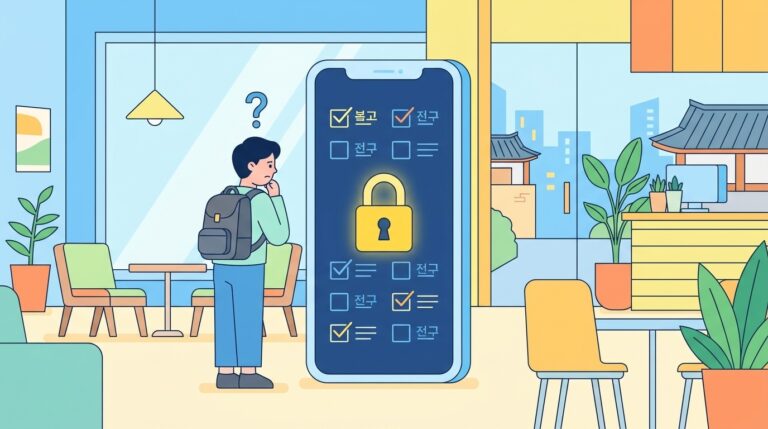
Phase 1: Empathy (Immersion Open)\n\nHello! I’m your Daily Hangul Editor. ☕\n\nPicture this: You are sitting in a sleek cafe in Seoul. You finally snagged an amazing seat, and you’re ready to order delivery from a famous dessert shop using an app. Or maybe you’re trying to secure front-row VIP tickets for your favorite K-Pop idol’s concert. You breeze through the menus, hit ‘Checkout,’ and suddenly—BAM! A wall of Korean text appears with five different checkboxes, all demanding your ‘Consent’ (동의). You panic, check ‘Agree to All’ (전체 동의), and by tomorrow, you’re receiving 10 spam texts about real estate and plastic surgery.\n\nIf you live, work, or study in Korea at an advanced level (C1), you cannot escape Data Privacy Issues (개인정보 보호 이슈). Korea is incredibly tech-savvy, but it also has some of the strictest data privacy laws in the world. Whether you are analyzing user statistics in a Pangyo tech startup or just trying to sign up for Olive Young’s membership, knowing how to navigate ‘Personal Data’ (개인정보) is a pure survival skill.\n\nLet’s dive into the words that will save your data, your time, and your sanity!\n\n—\n\n## Phase 2: Deep Dive into Core Expressions\n\n> ### 1. 선택 항목은 빼셔도 돼요.\n> – Pronunciation: [seontaek hangmogeun ppaesyeodo dwaeyo.] (seon-taek sounds like ‘sun-tech’, ppae sounds like the sharp ‘ppe’ in ‘pepper’)\n> – Meaning: Literal: ‘You can remove the optional items.’ / Real nuance: ‘You don’t have to agree to the optional terms.’\n> – K-Culture Moment: You are at a makeup store or a telecom agency. The staff hands you an iPad to sign up for a membership. To save you from future marketing spam, a kind staff member will quickly point to the screen and whisper this to you.\n> – Editor’s Insight: The Korean digital world is strictly divided into 필수 (Mandatory) and 선택 (Optional). ‘선택’ usually means they want to use your data for marketing. Knowing the word ‘빼다’ (to take out/exclude) shows you have native-level intuition.\n> – Situation Spectrum:\n> – Casual (Friends): ✅ (e.g., 야, 선택은 빼고 체크해!)\n> – Semi-formal (Clerks/Coworkers): ✅\n> – Formal (Bosses): ⚠️ (Better to say: 선택 항목은 제외하셔도 됩니다)\n> – 🤔 Think About It: Why are Korean apps so obsessed with dividing terms into ‘Mandatory’ and ‘Optional’? It’s legally required by the Personal Information Protection Act (PIPA). Does your country’s apps clearly separate marketing consent from basic usage consent?\n\n> ### 2. 비식별화 조치\n> – Pronunciation: [bisikbyeolhwa jochi] (bi-shik-byul-hwa)\n> – Meaning: Literal: ‘De-identification measures.’ / Real nuance: ‘Anonymizing data.’\n> – K-Culture Moment: In a tense K-Drama office scene, the data team is arguing with the marketing team. The marketing team wants raw user data, and the data analyst firmly states, ‘We can only hand it over after de-identification measures.’\n> – Editor’s Insight: This is pure C1/C2 business Korean. If you use ‘비식별화’ (De-identification) instead of just ‘익명’ (Anonymous) in a meeting, your Korean colleagues will instantly respect your professional vocabulary.\n> – Situation Spectrum:\n> – Casual (Friends): 🚫 (Too academic)\n> – Semi-formal (Coworkers): ✅\n> – Formal (Business Meetings): ✅\n> – 🤔 Think About It: ‘식별’ means ‘to identify’ and ‘비’ means ‘non-‘. Adding ‘화’ makes it a process (‘-ization’). How many other tech words can you think of that use this Hanja structure?\n\n> ### 3. 내 개인정보는 이미 공공재야.\n> – Pronunciation: [nae gaeinjeongboneun imi gonggongjaeya.] (gong-gong-jae sounds like ‘gong-gong-jay’)\n> – Meaning: Literal: ‘My personal information is already a public good.’ / Real nuance: ‘My data has been leaked so many times, it belongs to the public now.’\n> – K-Culture Moment: A news anchor reports yet another massive data breach at a major bank or shopping mall. You sigh, and your Korean friend jokingly says this phrase. \n> – Editor’s Insight: ‘공공재’ (Public good/property) is an economic term, but Koreans use it as dark humor. Because of frequent hacking incidents in the 2010s, many Koreans joke that their resident registration numbers (주민등록번호) are practically public property.\n> – Situation Spectrum:\n> – Casual (Friends): ✅\n> – Semi-formal (Coworkers): ⚠️ (Okay during casual coffee breaks)\n> – Formal (Bosses): 🚫\n> – 🤔 Think About It: Using high-level economic terms (public goods) for self-deprecating humor is a huge part of modern Korean internet slang. What’s a similar sarcastic joke in your culture?\n\n—\n\n## Phase 3: Textbook vs. Real Korean\n\n[Situation 1: Refusing to give unnecessary personal data]\n* 📖 Textbook: 저는 개인정보 제공에 동의하지 않습니다. (I do not agree to provide my personal information.)\n* 🗣️ Real Korean: 아, 마케팅 수신 동의는 뺄게요. (Ah, I’ll exclude the marketing reception consent.)\n* 💡 Why the difference?: Refusing everything sounds robotic and might halt your sign-up. Specifying ‘마케팅 수신’ (Marketing reception) shows exactly what you are rejecting while allowing the app to function.\n\n[Situation 2: Reacting to a data leak]\n* 📖 Textbook: 내 데이터가 무단으로 유출되었습니다. (My data has been leaked without authorization.)\n* 🗣️ Real Korean: 아, 내 정보 또 털렸어. (Ugh, my info got robbed again.)\n* 💡 Why the difference?: ‘털리다’ (to be robbed/shaken off) is the absolute go-to slang for getting hacked or having data leaked.\n\n[Situation 3: Confirming identity online]\n* 📖 Textbook: 신원을 증명해야 합니다. (You must prove your identity.)\n* 🗣️ Real Korean: 본인인증 하셔야 돼요. (You have to do identity verification.)\n* 💡 Why the difference?: ‘본인인증’ (Identity verification via phone or PASS app) is a fixed noun in Korea. You will hear and see this word daily.\n\n—\n\n## Phase 4: Cultural Context — K-Culture Deep Dive\n\n### 4-1. Non-verbal Nuance: The ‘Nunchi’ of Checking Boxes\nWhen signing up for something in front of a Korean clerk, they might quickly tap the screen for you, checking only the mandatory boxes. It’s a non-verbal understanding—a mix of ‘빨리빨리’ (Hurry hurry) culture and consideration for your privacy. If you take 5 minutes to read every single line of the Terms of Service, the line behind you will grow restless. Scanning for ‘필수’ (Mandatory) and ‘선택’ (Optional) is the ultimate Korean survival Nunchi.\n\n### 4-2. The Digital Real-Name System (인터넷 실명제) & K-Pop Ticketing\nIf you are a K-Pop fan, you know the absolute terror of trying to buy concert tickets on Interpark or Melon Ticket. Korea operates on a strict system where your online identity is tied to your phone number, which is tied to your ARC (Alien Registration Card). \nWithout 본인인증 (Identity Verification), you can’t buy tickets, order Baemin, or even play PC games late at night. When a K-Drama character is tracking down a troll online, it’s often easier than in Hollywood movies because almost every account is tied to a real person’s SSN or phone number!\n\n—\n\n## Phase 5: Real-life Roleplay Scenario\n\nSetting: A Friday afternoon in a glass-walled meeting room at a tech startup in Pangyo (Korea’s Silicon Valley). You are an expatriate Data Analyst, and you are reviewing a new app feature with your Project Manager, Minji.\n\nCharacters:\n- YOU: A sharp data analyst who knows Korean compliance laws.\n- Minji (34): A fast-paced, result-driven Project Manager who just wants to launch the feature ASAP.\n\nDialogue:\n\nMinji: 이번 추천 알고리즘 퀄리티를 높이려면, 유저들의 상세 구매 내역 데이터가 다 필요해요. 📊\n(ibeon chucheon algorijeum kwollitireul nopiryeomyeon, yujeodeurui sangse gumae naeyeok deiteoga da piryohaeyo.)\n[To raise the quality of this recommendation algorithm, we need all the detailed user purchase history data.]\n\nYOU: 그 데이터들, 제3자 제공 동의는 다 받은 건가요?\n(geu deiteodeul, jesamja jegong dong-ineun da badeun geongayo?)\n[Did we get third-party provision consent for all that data?]\n\nMinji: 아… 필수 약관에 대충 포함되어 있지 않을까요? 빨리 개발부터 하죠!\n(a… pilssu yakgwane daechung pohamdoe-eo itji aneulkkayo? ppalli gaebalbuteo hajo!)\n[Ah… isn’t it roughly included in the mandatory terms? Let’s just start developing!]\n\n> 🔀 Your Turn! How should you respond to Minji?\n> – A) 네, 그럼 바로 데이터 뽑을게요! (Sure, I’ll extract the data right away!) [Too passive, legally dangerous]\n> – B) 안 돼요. 개인정보보호법 위반이에요. (No. It’s a violation of the Personal Information Protection Act.) [A bit too blunt/aggressive]\n> – C) 민지님, 이거 비식별화 조치 안 하고 쓰면 나중에 법적 문제 생길 수 있어요. \n> \n> ✅ Best Choice: C — Reason: It uses the C1-level professional term ‘비식별화 조치’ (de-identification measures) and politely warns of legal issues without aggressively shutting her down. It shows high competence and good workplace Nunchi.\n\nMinji: 아, 맞다. 작년에도 타사에서 개인정보 유출돼서 난리 났었죠…\n(a, matda. jangnyeonedo tasa-eseo gaeinjeongbo yuchuldaeseo nalli nasseotjo…)\n[Oh, right. Last year another company had a data leak and it was a mess…]\n\n(🎭 Stage Direction: Minji sighs and opens the legal compliance document.)\n\nYOU: 네, 그러니까 필수 항목만 먼저 익명 처리해서 테스트해 보죠.\n(ne, geureonikka pilssu hangmongman meonjeo ingmyeong cheorihaeseo teseuteuhae bojo.)\n[Yes, so let’s anonymize just the mandatory items first and test it.]\n\n—\n\n## Phase 6: 10-Second Shadowing Drill\n\nPractice your professional tone! Read this aloud, pausing at the slashes.\n\n😤 이 데이터는 / 반드시 / 비식별화 조치를 / 거쳐야 합니다! \n(i deiteoneun / bandeusi / bisikbyeolhwa jochireul / geochyeoya hamnida!)\n[Firmly] This data / absolutely / must undergo / de-identification measures!\n\n—\n\n## Phase 7: K-Culture Mini Dictionary\n\n1. 본인인증 (bonin injeung)\n* English: Identity Verification\n* Context: The final boss of the Korean internet. Usually requires you to enter your name, telecom provider, phone number, and a 6-digit code sent via SMS. \n\n2. 공공재 (gonggongjae)\n* English: Public Good\n* Context: Used sarcastically to describe one’s personal information that has been leaked in so many data breaches that it is no longer private.\n\n3. 필수 / 선택 (pilssu / seontaek)\n* English: Mandatory / Optional\n* Context: The two words you must scan for when looking at checkboxes. Always check ‘필수’, always skip ‘선택’ unless you want ad messages.\n\n4. 털리다 (teollida)\n* English: To be robbed/hacked (Slang)\n* Context: Originally means ‘to be dusted off’, but widely used to mean getting hacked, losing a game badly, or having your data leaked. (e.g., 계정 털렸어 = My account got hacked).\n\n—\n\n## Phase 8: Traveler Survival Kit\n\nEven if you’re just visiting or living here short-term, you will encounter privacy screens at self-checkout kiosks or when signing up for public Wi-Fi.\n\n> 🆘 Survival Phrases for Kiosks & Sign-ups\n> – 🇰🇷 “전체 동의 안 해도 되나요?” (jeonche dong-i an haedo doenayo?)\n> – 🗣️ English: Do I have to agree to all?\n> – 📍 Where to use: Olive Young, Telecom shops, Gym registrations.\n> – 💡 Pro Tip: If a kiosk asks you for your phone number to earn points (포인트 적립), you can just press ‘건너뛰기’ (Skip) if you don’t want to leave your data.\n\n> 📌 Editor’s Privacy Note\n> – Spam Texts: If you start receiving texts with [Web발신] (Sent from Web) about stocks or loans, it means you accidentally checked a ‘선택’ (Optional) box somewhere!\n> – CCTV Capital: Korea has CCTVs everywhere. This limits physical crime drastically, but it’s a huge topic of debate regarding surveillance privacy.\n\n—\n\n## Phase 9: Critical Thinking — “One Step Deeper”\n\n> 🧠 Think Deeper: The Irony of “Ppal-li Ppal-li” vs. Security (Bureaucracy & Tech)\nKorea is famous for its ultra-fast internet and ‘빨리빨리’ (hurry hurry) culture. Yet, ironically, completing a simple online credit card payment or signing up for a website can take longer than in many other countries due to excessive security plugins and identity verification (본인인증) steps. This stems from a history of strict financial security laws designed to prevent fraud. The culture demands speed, but the legal framework demands absolute verification. This creates a unique digital environment where efficiency and massive bureaucratic security measures constantly clash.\n>\n> 💬 Your Turn: How easy is it to buy something online in your country? Do you prefer a quick 1-click checkout (like Amazon), or do you prefer Korea’s strict multi-step verification for safety? Share in the comments!\n\n—\n\n## Phase 10: FAQ & Avoiding Mistakes\n\nQ: If I’m a tourist without an ARC, can I still verify my identity online?\nNo. Unfortunately, standard ‘본인인증’ requires a Korean phone number linked to a Resident Registration Number or an Alien Registration Card (ARC). Tourists often have to rely on global apps or ask a Korean friend to book tickets for them.\n\nQ: Can I use the slang ‘털리다’ in a business meeting?\nDefinitely not. If you are reporting a data breach to your boss, you must use ‘유출되었습니다’ (It has been leaked) or ‘해킹 당했습니다’ (We were hacked). ‘털리다’ is strictly for friends.\n\n> ❌ Common Mistake #1: Automatically checking ‘전체 동의’ (Agree to All) out of habit.\n> ✅ Do this instead: Look for the tiny text that says (선택) or 마케팅 수신 (Marketing Reception) and uncheck them. Your inbox will thank you.\n\n—\n\n## Phase 11: Summary & Action Items\n\nOne-Liner Summary: Protect your data and sound like a pro by distinguishing between ‘필수’ (Mandatory) and ‘선택’ (Optional), and mastering terms like ‘비식별화’ (De-identification)!\n\nAction Mission 3 Steps:\n- 🥉 Bronze (Solo): Look at your Korean apps (Kakao, Baemin) and find the privacy settings. Look for the words ‘동의’ and ‘선택’.\n- 🥈 Silver (Online): Write a sentence in your notebook: “제 개인정보는 소중하니까 선택 약관은 뺄게요!”\n- 🥇 Gold (Real World): Next time you sign up for a point card at a Korean cafe or store, ask the staff: “선택 항목은 빼주세요!”\n\nK-Culture Mission: \nWatch a Korean corporate drama (like Start-Up or Search: WWW). Keep an ear out for the word ‘데이터 유출’ (Data Leak) or ‘개인정보’ (Personal Info). You’ll be surprised how often tech privacy drives the plot!\n\n💬 What was the most confusing app you tried to sign up for in Korea? Let me know in the comments!\n\n—\n\n## Phase 12: Interactive Quiz\n\n1. You are at Olive Young. The clerk hands you an iPad to register for a membership. Which box should you leave UNCHECKED?\nA) [필수] 개인정보 수집 및 이용 동의\nB) [필수] 서비스 이용약관 동의\nC) [선택] 맞춤형 혜택 안내 수신 동의\n\nAnswer: C. ‘선택’ means optional, and ‘맞춤형 혜택’ is marketing.\n\n2. Fill in the blank (C1 Business Level):\n”이 고객 데이터를 분석하려면 먼저 ______ 조치를 해야 합니다.” (We need to take ____ measures before analyzing this customer data.)\nA) 공공재 (Public good)\nB) 비식별화 (De-identification)\nC) 털리기 (Robbing)\n\nAnswer: B. Anonymizing data is crucial in analysis.\n\n3. True or False – K-Culture Edition:\n”In Korea, you can easily play online PC games at a PC Bang without providing any phone number or identity verification.”\n\nAnswer: False. Due to the Shutdown Law history and game account regulations, most Korean games require ‘본인인증’ (Identity verification) to play.
Frequently Asked Questions (FAQ)
Q: What does "선택" mean in Korean and how do you pronounce it?
A: In Korean, "선택" is pronounced [Optional] and means: . '선택' usually means they want to use your data for marketing. Knowing the word '빼다' (to take out/exclude) shows you have native-level intuition.\n> -
Q: What does "본인인증" mean in Korean and how do you pronounce it?
A: In Korean, "본인인증" is pronounced [Identity Verification] and means: , you can't buy tickets, order Baemin, or even play PC games late at night. When a K-Drama character is tracking down a troll online, it's often easier than in Hollywood movies because almost every account is tied to a real person's SSN or phone number!\n\n---\n\n## Phase 5: Real-life Roleplay Scenario\n\n







