

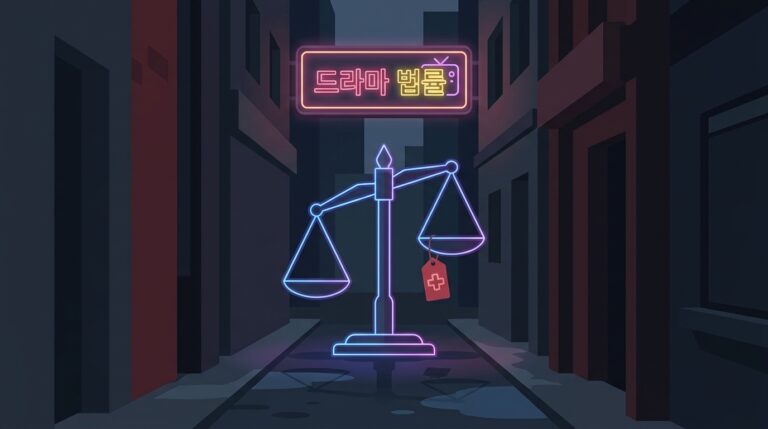
Phase 1: Empathy & K-Culture Cold Open
Hello! I am the Lead Editor of Daily Hangul, your veteran Korean tutor and local culture navigator.
Imagine this: A dimly lit room. A desperate protagonist stares at the floor as aggressive men in suits storm in, slapping bright red stickers (빨간 딱지) on the TV, the fridge, and even the sofa. You’ve probably seen this exact scene in K-Dramas like Squid Game, My Mister, or Vincenzo.
In dramas, characters often make life-or-death choices to escape crippling debt. But what happens in reality? If Seong Gi-hun from Squid Game had simply consulted a Korean lawyer, could he have avoided the deadly games?
Today, we are diving into a C2-level (Advanced) topic: Legal Basics surrounding Individual Rehabilitation and Bankruptcy (개인 회생 및 파산 신청 자격과 면책). As an advanced learner, you are likely reading Korean news, watching complex legal thrillers, or discussing socio-economic issues with local friends. Understanding these terms isn’t just about passing a TOPIK exam; it’s about deeply comprehending the weight of the Korean economy, the social stigma of debt, and the legal safety nets available.
This guide is designed to bridge the gap between heavy legal jargon and everyday Korean socio-cultural context. Let’s unlock the language behind the law!
Phase 2: Deep Dive into Core Expressions
Let’s break down the three most critical expressions you need to understand this legal process.
1. 개인회생 (Individual Rehabilitation)
- Pronunciation: [gae-in-hoe-saeng] / Sounds like: “gay-in” + “hweh” (like a short breath out) + “sang”
- Meaning: (Literal) Individual Revival / (Real Nuance) Court-approved debt restructuring program.
- K-Culture Moment: This is the legal procedure where a debtor who earns a regular income is allowed to pay off a portion of their debt over 3-5 years, after which the rest is forgiven. You’ll often hear this in news reports discussing the economic struggles of young adults in Korea.
- Editor’s Insight: The word 회생 (Revival/Resuscitation) carries a heavy emotional weight. It implies that being drowning in debt is akin to social death, and this legal process is a “life-saving” measure.
- Situation Spectrum:
- Close Friends (Casual): ✅ (When discussing a mutual acquaintance’s serious struggles)
- Colleagues (Semi-formal): ⚠️ (Too personal unless it’s a general news discussion)
- Formal/Legal (Formal): ✅ (Standard legal terminology)
- 🤔 Think About It: Why does Korean law use a medical/biological term like “resuscitation” (회생) for financial debt? What does this say about the relationship between money and social survival in Korea?
2. 파산 및 면책 (Bankruptcy and Discharge/Exemption)
- Pronunciation: [pa-san mit myeon-chaek] / Sounds like: “pah-san” + “meet” + “myun-check”
- Meaning: (Literal) Bankruptcy and Exemption of Responsibility / (Real Nuance) Complete liquidation of assets and wiping the debt slate clean.
- K-Culture Moment: While ‘개인회생’ is for those with income, ‘파산’ is the absolute last resort for those with no ability to pay. In K-Dramas, when a chaebol (conglomerate) company faces this, it’s usually accompanied by dramatic press conferences and executives bowing in apology.
- Editor’s Insight: “면책” (Discharge) is the ultimate goal here. It literally means “exemption from responsibility.” Without “면책”, “파산” just means you are broke but still legally haunted.
- Situation Spectrum:
- Close Friends (Casual): ✅ (Often used metaphorically: “나 파산이야” = I’m totally broke)
- Colleagues (Semi-formal): ⚠️
- Formal/Legal (Formal): ✅
- 🤔 Think About It: In many Western cultures, bankruptcy is viewed as a strategic business decision. In Korea, why is it often viewed as a deep moral failure?
3. 빚을 탕감받다 (To have debt written off)
- Pronunciation: [bijeul tang-gam-bat-da] / Sounds like: “beej-eul” + “tang-gahm-baht-dah”
- Meaning: (Literal) To receive a reduction of debt / (Real Nuance) To be forgiven of the remaining debt.
- K-Culture Moment: This is a politically charged buzzword. During election seasons, politicians often debate whether the government should “탕감해 주다” (forgive) the debts of young people who borrowed heavily to invest in crypto or real estate.
- Editor’s Insight: “탕감” gives off a sense of grace or mercy from a higher authority (the court or the government).
- Situation Spectrum:
- Close Friends (Casual): ✅
- Colleagues (Semi-formal): ✅ (Common in political/economic discussions)
- Formal/Legal (Formal): ✅
- 🤔 Think About It: Does your home country have political debates about “debt forgiveness”? How does the vocabulary used differ from the Korean “탕감”?
Phase 3: Textbook vs. Real Korean
When discussing financial ruin or recovery, the way Koreans speak casually is vastly different from legal documents.
[Describing Financial Ruin]
* 📖 Textbook Korean: 그의 사업은 심각한 재정난으로 파산했습니다. (His business went bankrupt due to severe financial difficulties.)
* 🗣️ Real Korean: 걔네 집 이번에 완전 쫄딱 망했대. / 빚더미에 앉았어. (I heard his family completely went under. / They are sitting on a mountain of debt.)
* 💡 Why the difference?: “쫄딱 망하다” uses vivid sound symbolism (쫄딱 – completely/thoroughly) which Koreans love for emphasizing disastrous situations. “빚더미” (mountain of debt) paints a crushing visual picture.
[Describing a Fresh Start]
* 📖 Textbook Korean: 채무자는 면책 결정을 받아 채무가 소멸되었습니다. (The debtor received a discharge decision, and the debt was extinguished.)
* 🗣️ Real Korean: 이제 빚 다 털어냈어. 드디어 새출발이야! (I’ve dusted off all my debt. Finally, a fresh start!)
* 💡 Why the difference?: The verb “털어내다” (to dust off/shake off) treats debt like physical dirt or a heavy burden on one’s shoulders, perfectly capturing the emotional relief.
Bottom Note: At the C2 level, using expressions like “빚더미에 앉다” or “새출발” in casual conversations shows that you don’t just know vocabulary; you understand the emotional topography of the Korean language.
Phase 4: Cultural Context — K-Culture Deep Dive
4-1. Non-verbal Elements & ‘Nunchi’ (눈치)
Money, especially debt, is a highly taboo subject in polite Korean society. If a friend opens up about filing for ‘개인회생’, this requires immense Nunchi.
– Eye Contact: Avoid staring deeply into their eyes with pity. Instead, listen quietly, perhaps looking at your drink, offering a heavy, empathetic sigh (“하아…”) to show you feel their burden.
– Gestures: Pouring them a drink (usually Soju) with two hands is a powerful non-verbal way to say, “I’m here for you, no matter your financial status.”
4-2. The K-Drama Trope: The Red Tag (빨간 딱지)
If you watch a Korean drama involving bankruptcy, you will inevitably see the dreaded “빨간 딱지” (Red Tag) scene. When a person completely defaults, court bailiffs visit their home and attach red stickers to all valuable assets (TVs, furniture, even the rice cooker). It means these items are provisional attachments (가압류) to be auctioned off.
Critical Viewpoint: While dramas use the Red Tag for dramatic effect (often showing loan sharks placing them), in reality, only court officials can legally do this. K-Dramas blur the lines between illegal loan sharks (사채업자) and legal debt collection to heighten emotional tension.
Phase 5: Real-life Roleplay Scenario
Setting: A Friday night at a quiet Izakaya near Gangnam Station. The atmosphere is heavy. Your close Korean friend, Min-su, recently had to close his tech startup. He looks exhausted, staring blankly at his glass of Soju. You, having lived in Korea for years and deeply understanding the society, are trying to offer him practical comfort.
Characters:
– YOU (The Reader): An expat living in Seoul, fluent enough to discuss complex adult issues.
– Min-su (32): Your close friend. Usually bright, but currently crushed under startup debt.
Dialogue:
민수: 하아… 대출 이자 갚는 것도 이제 한계다. 그냥 다 포기하고 싶네.
(Haa… daechul ija gamneun geotdo ije hangeda. Geunyang da pogihago simne.)
[Sigh… Paying off the loan interest has reached its limit. I just want to give up on everything.]
(🎭 Stage Direction: Min-su rubs his face in frustration, avoiding eye contact.)
YOU: 민수야, 혼자 다 떠안으려고 하지 마. 요즘 법적으로 도움받을 수 있는 제도가 얼마나 많은데.
(Minsuya, honja da tteoaneuryeogo haji ma. Yojeum beopjeogeuro doumbadeul su inneun jedoga eolmana maneunde.)
[Min-su, don’t try to shoulder it all by yourself. There are so many legal systems that can help you these days.]
민수: 법적 도움? 파산하라는 소리야? 내 인생에 빨간 줄 긋긴 싫어…
(Beopjeok doum? Pasanhara-neun soriya? Nae insaeng-e ppalgan jul geutgin sileo…)
[Legal help? Are you telling me to go bankrupt? I don’t want a red mark on my life record…]
YOU: 파산이 아니라, 알아봤는데 직장 구해서 소득만 있으면 신청할 수 있는 게 있대.
(Pasani anira, arabwanneunde jikjang guhaeseo sodeungman isseumyeon sincheonghal su inneun ge itdae.)
[Not bankruptcy. I looked it up, and there’s something you can apply for as long as you get a job and have income.]
민수: 아… 그거… 이자는 안 내도 된다던데.
(Ah… geugeo… ijaneun an naedo doendadeonde.)
[Ah… that thing… I heard you don’t have to pay the interest.]
🔀 Your Turn! How should you respond?
– A) “맞아, 개인회생 절차야. 변호사 만나보자.” (Correct, it’s the Individual Rehabilitation process. Let’s meet a lawyer.)
– B) “맞아, 파산 신청이야. 변호사 만나보자.” (Correct, it’s the Bankruptcy application. Let’s meet a lawyer.)
– C) “맞아, 돈 안 갚아도 돼! 대박이지?” (Right, you don’t have to pay the money back! Awesome, right?)✅ Best Choice: A — Reason: You correctly distinguish between “개인회생” (which requires an income to restructure debt) and “파산” (total bankruptcy).
⚠️ Choice B/C Analysis: Choice B is factually wrong based on the context. Choice C is incredibly insensitive to the heavy reality of legal debt restructuring.
Phase 6: 10-Second Shadowing Drill
Let’s practice delivering a heavy but supportive sentence with the exact C2-level cadence. Notice the pauses!
😤 혼자서 / 끙끙 앓지 말고, / 법률 상담부터 / 받아보는 게 어때?
(Honjaseo / kkeungkkeung alchi malgo, / beomnyul sangdambuteo / badaboneun ge eottae?)
Translation: Don’t suffer alone, how about getting a legal consultation first?
Pro-Tip: The word 끙끙 앓다 mimics the sound of a dog whining or a person groaning in pain. Emphasize the “kk” sound deeply in your throat to show you truly understand his agony.
Phase 7: K-Culture Mini Dictionary
To fully grasp Korean economic discussions, you need these K-Culture keywords:
1. 영끌 (Yeong-kkeul)
* Romanization: yeong-kkeul
* English: Scraping up one’s soul (to gather money)
* Context: A slang combining ‘영혼’ (soul) and ‘끌어모으다’ (to scrape up). It refers to the phenomenon of young Koreans taking out maximum possible loans to buy real estate or stocks, fearing they will be left behind.
2. 빚투 (Bit-too)
* Romanization: bit-too
* English: Debt-investing
* Context: ‘빚’ (Debt) + ‘투자’ (Investment). Borrowing heavily to invest in high-risk assets like cryptocurrency. This is a major cause of the recent surge in ‘개인회생’ applications.
3. 신불자 (Sin-bul-ja)
* Romanization: sin-bul-ja
* English: Credit delinquent
* Context: Short for 신용불량자. Someone who has defaulted on their loans. In Korea’s heavily card-dependent society, becoming a 신불자 means you cannot use credit cards or get standard phone plans.
4. 빨간 줄 (Ppal-gan jul)
* Romanization: ppal-gan jul
* English: Red line (Criminal/Bad record)
* Context: While legally referring to a criminal record, people often use it metaphorically to describe the permanent social stigma attached to things like bankruptcy.
Phase 8: Traveler/Expat Survival Kit
Even if you aren’t going bankrupt, living in or traveling to Korea means navigating strict administrative and financial systems. Here is your survival kit for dealing with Korean banks or administrative offices (주민센터).
🆘 Survival Expressions for Administration/Banks
– 🇰🇷 “신용 조회 기록에 남나요?” (Sinyong johoe giroge namnayo?)
– 🗣️ English: Will this leave a mark on my credit inquiry record?
– 📍 Where to use: Banks, when inquiring about loans or credit cards.
– 💡 Pro Tip: Korea is incredibly strict about credit scores (신용점수). Just checking certain financial products too many times used to negatively impact scores, so it’s a common question.📌 Editor’s Expat Note
– Certificates: Korean legal and banking processes require an endless amount of certificates (증명서).
– Digital Signature: Always set up your “공동인증서” (Joint Certificate) or “금융인증서” (Financial Certificate) on your phone. Without it, verifying your legal identity in Korea is nearly impossible.
Phase 9: Critical Thinking Corner — “A Step Deeper”
🧠 Think Deeper: Media vs Reality & The Pressure of “Hell Joseon”
Why do K-Dramas feature so many desperate characters playing deadly games or fighting loan sharks? It reflects a stark reality. In Korea, the societal pressure to succeed—to own an apartment in Seoul, to send kids to top hagwons (cram schools)—is immense. This intense competition led to the “영끌” (soul-scraping) investment culture.
When these high-risk bets fail, the fall is devastating because Korean society has traditionally offered few second chances. The “개인회생” (Individual Rehabilitation) system was expanded precisely to prevent the tragedy of youth permanently dropping out of society due to debt. The language we learned today isn’t just legal terminology; it’s the vocabulary of survival in a hyper-competitive capitalist society.
💬 Your Turn: How does your culture treat the concept of “debt”? Is it a taboo topic of shame, or just a normal part of financial management? Share in the comments!
Phase 10: FAQ & Avoiding Misunderstandings
Q: Can I use “나 파산했어” (I’m bankrupt) casually with friends when I’m just out of cash for the weekend?
– Maybe, but be careful. While young people do say it playfully, it sounds quite dramatic. A more natural slang for being temporarily out of money is “나 텅장이야” (My bank account is empty / 텅텅 빈 통장) or “나 완전 거지됐어” (I became a total beggar).
Q: Is it rude to ask a Korean friend how much debt they have?
– Absolutely NO. Unless you are their spouse or their lawyer, asking about specific debt amounts (대출금, 빚) is considered highly intrusive. Wait for them to volunteer the information.
❌ Common Mistake #1: Confusing ‘개인회생’ (Rehabilitation) and ‘파산’ (Bankruptcy).
✅ How to fix: Remember, 회생 is for people who have a job and can pay some money back over time. 파산 is for people who have absolutely zero means to pay anything.
Phase 11: Summary & Action Items
- One-Liner Summary: “개인회생” is the legal lifeline to restructure debt, leading to “면책” (discharge), allowing someone burdened by “영끌” to finally start over.
-
Action Mission 3 Steps:
- 🥉 Bronze (Solo): Stand in front of a mirror and practice the phrase: “혼자 끙끙 앓지 말고 변호사를 만나보자” with a serious, empathetic face.
- 🥈 Silver (Online): Go to Naver News (Economy section) and search for the keyword “개인회생”. Read the headline of the first article you see.
- 🥇 Gold (Real-world): If you are an expat in Korea, check your own Korean credit score (신용점수) using apps like Toss or KakaoPay to familiarize yourself with the financial system.
- K-Culture Mission: Watch episode 1 of Squid Game or My Mister again, and listen specifically for the words 빚 (debt), 사채 (private loan), and 보증 (financial guarantee).
Did you find this deep dive into Korean legal culture helpful? Leave a comment below!👇
Phase 12: Quiz — Interactive Challenge
1. Situational Judgment: Your friend Min-su says he has maxed out his credit cards, but he just got hired at a solid company and wants to slowly fix his life. Which legal process is appropriate for him?
A) 파산 (Bankruptcy)
B) 개인회생 (Individual Rehabilitation)
C) 빚투 (Debt-investing)
2. True or False — K-Culture Edition:
“In K-Dramas, loan sharks often put red tags (빨간 딱지) on furniture. In real Korean law, loan sharks have the legal right to do this without a court order.”
– True / False
3. Fill in the Blank:
“이번 주에 쇼핑을 너무 많이 해서 내 통장이 완전 (____)이야!”
(I shopped so much this week that my bank account is a complete _____!)
A) 파산
B) 텅장
C) 면책
(Answers: 1: B – Since he has an income, he qualifies for rehabilitation. 2: False – Only official court bailiffs can attach red tags. 3: B – 텅장 is the perfect casual slang for an empty bank account.)
Frequently Asked Questions (FAQ)
Q: What does "개인회생 (Individual Rehabilitation)" mean in Korean and how do you pronounce it?
A: In Korean, "개인회생 (Individual Rehabilitation)" is pronounced [gae-in-hoe-saeng] and means: (Literal) Individual Revival / (Real Nuance) Court-approved debt restructuring program.
Q: What does "파산 및 면책 (Bankruptcy and Discharge/Exemption)" mean in Korean and how do you pronounce it?
A: In Korean, "파산 및 면책 (Bankruptcy and Discharge/Exemption)" is pronounced [pa-san mit myeon-chaek] and means: (Literal) Bankruptcy and Exemption of Responsibility / (Real Nuance) Complete liquidation of assets and wiping the debt slate clean.
Q: What does "빚을 탕감받다 (To have debt written off)" mean in Korean and how do you pronounce it?
A: In Korean, "빚을 탕감받다 (To have debt written off)" is pronounced [bijeul tang-gam-bat-da] and means: (Literal) To receive a reduction of debt / (Real Nuance) To be forgiven of the remaining debt.






