

Phase 1: Empathy & The K-Culture Cold Open
Hello there! Daily Hangul Editor here.
Picture this: You are watching your favorite K-Drama, and the main characters head into a bustling, old-school restaurant. The vibe is amazing, soju glasses are clinking, and then… the waiter brings out a bubbling, dark brown stew. The characters take one spoonful and let out a deep, satisfied sigh.
But wait, if you’ve actually been to a traditional Korean restaurant, you might have noticed a distinct, pungent aroma hitting your nose the moment you walked in. Some say it smells like old socks; others say it’s the smell of home.
Welcome to the world of Korean soybean stews! For intermediate (B2) learners, distinguishing between Doenjang-jjigae (된장찌개) and Cheonggukjang (청국장) is a true rite of passage. If you don’t know the difference, you might end up ordering a hardcore, pungent local dish when you just wanted a mild, comforting soup.
Don’t worry! This guide is built from the real, sometimes hilarious mistakes of my past students. Let’s dive into the delicious (and aromatic) world of Korean stews so you can order like a true local!
Phase 2: Core Expressions Deep Dive
Let’s break down the three most crucial concepts you need to survive a Korean stew menu.
1. 된장찌개
- Pronunciation: doen-jang-jji-gae [den-jahng jee-geh]
- Meaning: Soybean Paste Stew (Literal) / The everyday comfort stew (Real nuance)
- K-Culture Moment: This is the “chicken noodle soup” of Korea. In dramas, a mother always makes this for breakfast to show her care. It’s mild, savory, and usually contains tofu, zucchini, and sometimes beef or seafood.
- Editor’s Insight: This is your safe zone. If you like miso soup, Doenjang-jjigae is its heartier, more robust Korean cousin.
- Situation Spectrum:
- Casual with friends: ✅
- Semi-formal dinner: ✅
- Formal business lunch: ✅
- 🤔 Think About It: Why is Doenjang-jjigae almost always served at Korean BBQ restaurants? (Hint: The earthiness balances out the greasy pork!)
2. 청국장
- Pronunciation: cheong-guk-jang [chung-gook-jahng]
- Meaning: Extra-fermented Soybean Paste Stew (Literal) / The “blue cheese” of Korean stews (Real nuance)
- K-Culture Moment: On K-Pop variety shows, idols are sometimes divided into two camps: those who adore Cheonggukjang and those who run away from the smell. It’s famous for its strong, pungent odor due to rapid fermentation.
- Editor’s Insight: Ordering this proves you are an absolute Korean food insider. It’s incredibly healthy and deeply flavorful, but the smell is definitely an acquired taste!
- Situation Spectrum:
- Casual with friends: ✅ (If they like it!)
- Semi-formal dinner: ⚠️ (The smell sticks to your clothes!)
- Formal business lunch: 🚫 (Avoid smelling strongly of fermented beans in a meeting)
- 🤔 Think About It: Does your culture have a food that smells terrible to foreigners but tastes like heaven to locals?
3. 구수하다
- Pronunciation: gu-su-ha-da [goo-soo-ha-da]
- Meaning: Earthy, roasted, savory (Literal & Real nuance)
- K-Culture Moment: When an older Korean man takes a sip of boiling hot Doenjang-jjigae and goes “Aaaah, gusu-hada!”
- Editor’s Insight: This is the ultimate compliment for Korean stews and teas (like barley tea). It’s not just “delicious” (맛있다); it means it warms your soul with a deep, earthy, roasted bean flavor.
- Situation Spectrum:
- Casual with friends: ✅
- Speaking to restaurant owners: ✅ (They will love you for using this word!)
- Formal settings: ✅
- 🤔 Think About It: Why does the Korean language have a highly specific adjective just for the taste of roasted grains and fermented beans?
Phase 3: Textbook vs. Real Korean
[Describing the Taste]
* 📖 Textbook Korean: 이 찌개는 맛이 좋습니다. (This stew tastes good.)
* 🗣️ Real Korean: 와, 국물 진짜 구수하다! (Wow, this broth is so earthy/savory!)
* 💡 Why the difference?: Koreans use highly specific sensory adjectives to describe food. “Gusu-hada” shows a deep appreciation for traditional flavors.
[Ordering the Stew at a BBQ Place]
* 📖 Textbook Korean: 된장찌개 하나 주시겠습니까? (Would you please give me one Doenjang-jjigae?)
* 🗣️ Real Korean: 사장님, 여기 된장 하나요! (Boss, one Doenjang here!)
* 💡 Why the difference?: In bustling Korean restaurants, efficiency is key. Dropping “jjigae” and just saying “Doenjang” is standard native behavior.
Phase 4: Cultural Context — K-Culture Deep Dive
4-1. Non-Verbal Cues: The Ttukbaegi Rule
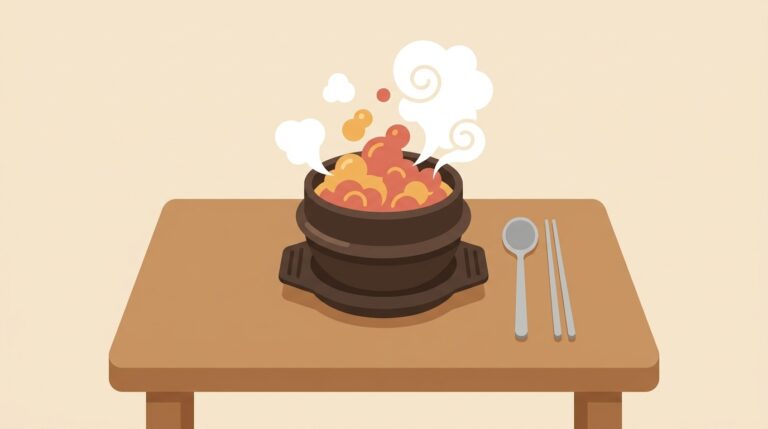
When eating Korean stews, they are served in a 뚝배기 (Ttukbaegi)—a traditional black earthen pot that keeps the stew boiling hot long after it leaves the stove.
* Crucial Rule: Unlike in Japan, where lifting the bowl to your mouth is polite, never lift the Ttukbaegi off the table in Korea. Leave it on the table and use your long metal spoon to scoop the broth.
4-2. K-Food Connection: The “Boiling Hot” Identity
Koreans love their food fiercely bubbling. This is deeply tied to the Korean concept of 시원하다 (siwon-hada). Wait, doesn’t that mean “cool/refreshing”? Yes! But Koreans also use it when drinking boiling hot soup because the heat “refreshes” the stomach and relieves stress. So, if your Korean friend eats a burning hot Cheonggukjang and says “Ah, it’s so refreshing!”—they aren’t crazy, it’s just Korean culture!
Phase 5: Real-Life Roleplay Scenario
Setting: Friday, 7:00 PM. A lively Samgyeopsal (pork belly) restaurant near Gangnam Station. The room is filled with smoke, chatter, and clinking soju glasses. You are having dinner with your Korean coworker, Minsu.
Characters:
– YOU: An expat in Seoul, leveling up your K-Food game.
– Minsu (32): Your friendly coworker who loves traditional food.
Dialogue:
Minsu: 고기 거의 다 먹었네요. 우리 찌개 시킬까요?
(gogi geoui da meogeonneyo. uri jjigae sikilkkayo?)
[We’re almost done with the meat. Shall we order a stew?]
YOU: 좋아요! 전 된장찌개 먹고 싶어요.
(joayo! jeon doenjangjjigae meokgo sipeoyo.)
[Sounds good! I want to eat Doenjang-jjigae.]
Minsu: 아, 여기 청국장도 진짜 유명한데. 혹시 청국장 먹어본 적 있어요?
(a, yeogi cheonggukjangdo jinjja yumyeonghande. hoksi cheonggukjang meogeobon jeok isseoyo?)
[Ah, their Cheonggukjang is really famous here too. Have you ever tried Cheonggukjang?]
YOU: 아니요, 아직 안 먹어봤어요. 냄새가 심하다고 들었어요.
(aniyo, ajik an meogeobwasseoyo. naemsaega simhadago deureosseoyo.)
[No, I haven’t tried it yet. I heard the smell is strong.]
Minsu: 냄새는 좀 나는데, 맛은 엄청 구수해요! 한번 도전해볼래요?
(naemsaeneun jom naneunde, maseun eomcheong gusuhaeyo! hanbeon dojeonhaebollaeyo?)
[It does smell a bit, but the taste is incredibly earthy/savory! Do you want to challenge yourself?]
🔀 Your Turn! How will you respond?
– A) “아니요, 저는 냄새나는 음식은 절대 안 먹어요.” (No, I never eat smelly food.)
– B) “진짜요? 그럼 오늘은 청국장 도전해볼게요!” (Really? Then I’ll challenge Cheonggukjang today!)
– C) “음… 오늘은 그냥 안전하게 된장찌개 먹을게요. 하하.”✅ Best Choice: B or C.
– If you are adventurous, B will make Minsu very happy.
– If you want to play it safe, C is a polite, humorous way to decline.
⚠️ Choice A Analysis: Saying “I never eat smelly food” can sound a bit direct and might slightly offend someone who considers it a beloved traditional dish. Use tact!
Minsu: (If you chose B) 오, 대박! 사장님~ 여기 청국장 하나요!
(o, daebak! sajangnim~ yeogi cheonggukjang hanayo!)
[Oh, awesome! Boss~ One Cheonggukjang here!]
Phase 6: 10-Second Shadowing Drill
Practice your intonation to sound like a native ordering at a restaurant!
😊 사장님~ / 여기 / 된장찌개 하나 / 주세요! (sajangnim~ / yeogi / doenjang-jjigae hana / juseyo!)
Tip: Raise your pitch slightly at “사장님~” to get their attention politely!
😋 와, / 국물이 / 진짜 / 구~수해요! (wa, / gungmuri / jinjja / gu~suhaeyo!)
Tip: Stretch out the “gu” in gusuhaeyo to emphasize just how rich and earthy it tastes.
Phase 7: K-Culture Mini Dictionary
1. 뚝배기
* Romanization: ttukbaegi
* English: Traditional Korean earthen pot
* Context: The heavy, black bowls that keep stews boiling for a long time. Never touch the sides—they are scorching hot!
2. 발효
* Romanization: balhyo
* English: Fermentation
* Context: The soul of Korean cuisine. Both Doenjang and Cheonggukjang are made via balhyo, giving them their unique health benefits and deep tastes.
3. 밥도둑
* Romanization: bap-doduk
* English: Rice thief
* Context: A slang term for a side dish or stew so incredibly delicious that your bowl of rice disappears before you know it. Cheonggukjang is a famous bap-doduk.
4. 고기집
* Romanization: gogi-jib
* English: Korean BBQ restaurant
* Context: Literally “meat house.” This is where you will most frequently order Doenjang-jjigae as a side to finish your meal.
Phase 8: Traveler’s Survival Kit
Are you heading to a Korean restaurant soon? Here are the top survival phrases you need when dealing with stews!
🆘 Survival Phrases #1
– 🇰🇷 “이거 많이 매워요?” (igeo mani maewoyo?)
– 🗣️ English: Is this very spicy?
– 📍 Where to use: Any traditional restaurant.🆘 Survival Phrases #2
– 🇰🇷 “덜 맵게 해주세요.” (deol maepge haejuseyo.)
– 🗣️ English: Please make it less spicy.
– 📍 Where to use: When ordering Doenjang-jjigae, as they sometimes add green chilies!🆘 Survival Phrases #3
– 🇰🇷 “앞치마 주세요.” (apchima juseyo.)
– 🗣️ English: Please give me an apron.
– 📍 Where to use: Stews bubble aggressively and will splatter on your white shirt. Always ask for an apron!📌 Editor’s Travel Note
– Smell Alert: If you eat Cheonggukjang, the smell will linger on your clothes. Many BBQ restaurants have Febreze (섬유탈취제) by the exit door. Spray yourself generously before getting on the subway!
Phase 9: Critical Thinking Corner — “Think Deeper”
Food & Identity: The Communal Pot
In traditional Korean dining, it was common for everyone at the table to share one large stew (찌개), dipping their spoons into the same boiling pot. This culture of sharing reflects Jeong (정)—deep emotional connection and communal identity. However, in the modern, global era—especially post-pandemic—many Koreans now prefer to use a geodeo-meokgi (거덜먹기/덜어먹기) method, using a ladle to serve the stew into individual bowls (앞접시). The food remains traditional, but the way Koreans interact with it is evolving to balance communal warmth with modern hygiene.
💬 Your Turn: Does your culture have dishes that are meant to be shared from one central pot? Do you prefer sharing or having your own individual bowl? Let me know in the comments!
Phase 10: FAQ & Avoiding Mistakes
Q: Is it rude to tell my Korean friend that Cheonggukjang smells bad?
A: Instead of saying “냄새가 나빠요” (It smells bad), which can sound insulting, use the word “특이하다” (teugi-hada – unique) or just admit “아직 익숙하지 않아요” (ajik iksukaji anayo – I’m not used to it yet).
Q: Can I ask the restaurant to make Cheonggukjang smell less?
A: No! The strong smell is the entire point of the dish. If you don’t want the smell, simply order Doenjang-jjigae instead.
❌ Common Mistake #1: Trying to pick up the hot Ttukbaegi bowl to drink the broth. You will burn your hands!
✅ How to fix it: Leave the bowl on the table and strictly use your spoon.❌ Common Mistake #2: Confusing 고추장찌개 (Gochujang-jjigae) with 된장찌개 (Doenjang-jjigae).
✅ How to fix it: Gochujang is red pepper paste (spicy and slightly sweet), while Doenjang is soybean paste (brown, earthy, savory).
Phase 11: Summary & Action Items
- One-Liner Summary: Doenjang-jjigae is your friendly, everyday soybean stew, while Cheonggukjang is the pungent, extra-fermented “blue cheese” stew for the ultimate foodie.
-
Action Mission 3 Steps:
- 🥉 Bronze (Solo): Say “와, 구수하다!” (Wow, it’s earthy/savory!) out loud 3 times today.
- 🥈 Silver (Online): Look up “Cheonggukjang” on YouTube and watch a K-Pop idol or foreigner react to tasting it for the first time.
- 🥇 Gold (Real Life): Visit a Korean restaurant and confidently order “사장님, 여기 된장찌개 하나 주세요!”
- K-Culture Mission: The next time you watch a K-Drama featuring a dining scene, look closely at the table. Can you spot the black earthen pot (Ttukbaegi)? Notice how they eat from it!
Phase 12: Quiz — Interactive Challenge
1. Situational Judgment: You are wearing a brand new, expensive white sweater and have a romantic date in two hours. Your friend suggests lunch. Which stew should you absolutely AVOID ordering?
– A) 된장찌개 (Doenjang-jjigae)
– B) 청국장 (Cheonggukjang)
Hint: The smell will haunt you.
2. Fill in the Blank: When the stew arrives bubbling hot and tastes incredibly earthy and hearty, the best native Korean compliment is:
“와, 이 찌개 정말 ______!”
– A) 달콤하다 (sweet)
– B) 구수하다 (earthy/savory)
– C) 시원하다 (refreshing)
3. True or False — K-Culture Edition:
“In Korea, it is polite to hold the heavy stew bowl (Ttukbaegi) in your hand while eating to show respect to the chef.”
(Answers: 1: B, 2: B, 3: False – Always leave it on the table!)
Frequently Asked Questions (FAQ)
Q: What does "된장찌개" mean in Korean and how do you pronounce it?
A: In Korean, "된장찌개" is pronounced [doen-jang-jji-gae [den-jahng jee-geh] and means: Soybean Paste Stew (Literal) / The everyday comfort stew (Real nuance)
Q: What does "청국장" mean in Korean and how do you pronounce it?
A: In Korean, "청국장" is pronounced [cheong-guk-jang [chung-gook-jahng] and means: Extra-fermented Soybean Paste Stew (Literal) / The "blue cheese" of Korean stews (Real nuance)
Q: What does "구수하다" mean in Korean and how do you pronounce it?
A: In Korean, "구수하다" is pronounced [gu-su-ha-da [goo-soo-ha-da] and means: Earthy, roasted, savory (Literal & Real nuance)







