

Phase 1: Empathy & Immersion (Cold Open)
Hello there! This is your Daily Hangul Editor.
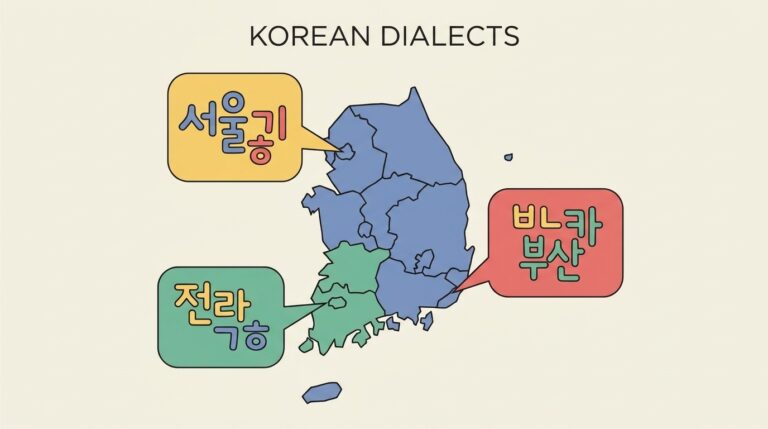
Picture this: You are watching a gritty K-Drama like Narco-Saints or a nostalgic hit like Reply 1997. In one scene, a character from Seoul gets angry. They yell a sharp, cold “Shi-bal!” and storm off. In the next scene, a character from Busan or Jeolla province gets fired up. Suddenly, they unleash a rapid-fire rhythm of words that sounds completely unrecognizable. The subtitles just say [Swearing], but you can tell there is so much more going on.
Why does Korean swearing sound so different depending on the region? And more importantly, why does a Busan grandmother calling you a “crazy kid” while serving you soup actually mean she likes you?
If you’ve ever felt completely lost when stepping outside of Seoul, or wondered why standard Korean textbooks leave you defenseless in real-life regional conversations, you are in the right place. Today, we are diving deep into the fascinating, slightly spicy world of Standard Seoul Swearing vs. Regional Dialect (Saturi) Slang.
Transparency Note: This guide is based on real questions from our B2 students who visited regions like Busan and Jeolla and wondered why the Korean they studied for years suddenly sounded like a foreign language!
Phase 2: Deep Dive into Core Expressions
Let’s break down how standard Seoul expressions transform when they hit the provinces.
1. 미친놈 / 미친년 (Standard) vs. 문디 자슥 (Gyeongsang Dialect)
- Pronunciation:
- Standard: Michin-nom / Michin-nyeon [Sounds like: mee-chin-nom]
- Saturi: Mundi jaseuk [Sounds like: moon-dee jah-seuk]
- Meaning:
- Literal: Crazy guy/girl vs. Leprosy-infected kid (historically).
- Real nuance: “You crazy bastard” (Standard, aggressive) vs. “You silly goose / You idiot” (Busan, often affectionate).
- K-Culture Moment: You are in a bustling Gukbap (pork soup) restaurant in Busan. You try to pay for your older friend’s meal. The restaurant Ajumma (auntie) laughs, smacks your friend on the back, and says, “아이고, 이 문디 자슥아! (Aigo, i mundi jaseuga!)” She’s not deeply insulting him; she’s affectionately calling him a fool for letting a guest try to pay.
- Editor’s Insight: Seoul’s “Michin-nom” feels like a sharp knife. It’s cold and often genuinely angry. “Mundi jaseuk” in Gyeongsang province, while literally carrying a heavy historical meaning, has evolved into a rough, earthy term of endearment among close friends and elders to youth.
- Situation Spectrum:
- Casual (Close friends in Busan): ✅
- Semi-formal (Co-workers): ⚠️ (Only if extremely close and casual)
- Formal (Boss/Elders): 🚫
- 🤔 Think About It: Why do regional dialects often use aggressive-sounding words to show affection? Does your native language have insults that are only used among best friends?
2. 닥쳐 (Standard) vs. 주둥아리 안 다무나 (Gyeongsang) / 아가리 싸물어라 (Jeolla)
- Pronunciation:
- Standard: Dak-chyeo [Sounds like a short, sharp dak-chuh]
- Saturi: Judung-ari an damuna / Agari ssamureora
- Meaning:
- Literal: Shut it vs. Aren’t you going to close your animal snout? / Shut your animal jaw.
- K-Culture Moment: Think of any high school K-Drama set in the countryside. The main characters are arguing over who gets the last piece of fried chicken. The standard “Dak-chyeo” is what the cool, aloof transfer student from Seoul says. The loud, rhythmic “Agari ssamureora!” is what the passionate local friend yells before stealing the chicken.
- Editor’s Insight: Standard Korean uses very direct verbs. Dialects love to use anatomical slang (like calling a human mouth an animal’s mouth: 주둥이/아가리) and stretch the sentence out. It adds theatricality and rhythm to the anger.
- Situation Spectrum:
- Casual (Close friends): ✅
- Semi-formal (Co-workers): 🚫
- Formal (Boss/Elders): 🚫
- 🤔 Think About It: In standard Korean, efficiency is key. In Saturi, rhythm and exaggeration take over. How does the pace of life in a capital city versus a coastal town affect the way people argue?
3. 존나 (Standard Slang) vs. 겁나 / 허벌나게 / 억수로 (Dialect Intensifiers)
- Pronunciation:
- Standard: Jonna [Sounds like: john-nah]
- Saturi: Geobna / Heobeollage / Eoksuro
- Meaning:
- Literal: F*cking (very) vs. Scarily / Vastly / Enormously.
- K-Culture Moment: You are at a K-Pop concert. A fan from Seoul might scream, “존나 잘생겼어! (He’s f*cking handsome!)” But a fan from Jeolla province will yell, “허벌나게 멋있어 부러!” and a fan from Busan will say, “억수로 까리하네!”
- Editor’s Insight: “Jonna” is technically a swear word (derived from a vulgar term for male anatomy), though younger generations use it like “very.” The Saturi equivalents (Geobna, Eoksuro) are actually safer to use because they aren’t rooted in vulgarity; they just mean “an overwhelming amount.”
- Situation Spectrum:
- Casual (Close friends): ✅
- Semi-formal (Co-workers): ⚠️ (Geobna/Eoksuro is okay, Jonna is highly unprofessional)
- Formal (Boss/Elders): 🚫
- 🤔 Think About It: “Jonna” has lost its original vulgar meaning for many Korean teens, becoming just an intensifier. Do you think a word’s meaning is defined by its history or how it’s used today?
Phase 3: Textbook vs. Real Korean
Let’s compare how you learned to express frustration in a classroom versus what you actually hear on the streets of different Korean cities.
[Expressing extreme frustration at a situation]
* 📖 Textbook Korean: 정말 짜증납니다. (Jeongmal jjajeungnamnida. – I am really annoyed.)
* 🗣️ Real Korean (Seoul): 아, 씨발 짜증나. (Ah, ssibal jjajeungna. – Ah, fcking annoying.)
* 🗣️ Real Korean (Jeolla): 아따, 염병하네 진짜. (A-tta, yeombyeonghane jinjja. – Oh man, this is a contagious disease/bullsht.)
* 💡 Why is it different?: Seoul slang often relies on the direct, aggressive “Ssibal,” while the Jeolla dialect brings in “Yeombyeong” (an old word for typhoid fever), turning the complaint into a colorful, sigh-inducing dramatic expression.
[Telling someone they are acting crazy]
* 📖 Textbook Korean: 제정신이 아니군요. (Jejeongsini anigunyo. – You are not in your right mind.)
* 🗣️ Real Korean (Seoul): 미쳤냐? 돌았네. (Michyeonnya? Doranne. – Are you crazy? You’ve spun out.)
* 🗣️ Real Korean (Gyeongsang): 단디 미칬네. (Dandi michinne. – You are thoroughly crazy.)
* 💡 Why is it different?: “단디 (Dandi)” means “properly” or “securely” in Busan dialect. Using it with “crazy” is an oxymoron that makes the phrase uniquely charming and regional.
Bottom Note: For B2 learners, using actual swear words like “씨발 (Ssibal)” or “존나 (Jonna)” is risky and often sounds awkward from foreigners. Instead, use the regional intensifiers like “겁나 (Geobna)” or “엄청 (Eomcheong)”. It shows you understand the culture without crossing the line into vulgarity.
Phase 4: Cultural Context — K-Culture Deep Dive
4-1. Non-Verbal Elements: The Art of Regional Swearing
Swearing in standard Seoul Korean is often delivered with cold eyes, a lowered chin, and a biting, sharp tone. It is meant to cut.
However, dialect swearing—especially in Gyeongsang (Busan/Daegu)—is highly physical. It involves loud volume, exaggerated facial expressions, and dynamic pitch accents (억양 – eogyang). If a Busan friend swears at you while laughing and slapping your shoulder, it’s not a fight; it’s a profound display of Jeong (정 – deep emotional connection).
4-2. K-Culture Connection: The “Tough Guy with a Heart of Gold” Trope
If you watch K-Dramas like Reply 1997 or gangster films like Friend (친구), you will notice a distinct pattern. The characters from the provinces swear constantly. Every other word is a colorful piece of Saturi slang.
- The Trope: The media often portrays people from Seoul as polite, calculating, and somewhat cold, while people from the provinces are portrayed as rough, loud, swearing constantly, but deeply loyal and warm-hearted.
- The Reality Check: While regional dialects do have a robust vocabulary of rough slang, not everyone in Busan or Gwangju speaks like a movie gangster! Media exaggerates this for entertainment. Real locals might find it burdensome if you assume they all swear to show affection.
Phase 5: Real-World Roleplay Scenario
Let’s put you in the middle of the action. You are the main character here.
Setting: A Friday night in Busan. A bustling, noisy Makchang (grilled intestines) restaurant. The air is thick with smoke and the sound of clinking Soju glasses. You are visiting Busan with your close Korean friend, Minho (30, born and raised in Busan, loud, very friendly).
Characters:
– YOU: A B2 Korean learner, visiting Busan for the first time.
– Minho: Your Busan friend.
– Ajumma: The charismatic restaurant owner.
Dialogue:
Minho: 이모! 여기 막창 3인분 팍팍 주이소! 🥩
(Imo! Yeogi makchang sam-inbun pakpak juiso!)
[Auntie! Give us 3 portions of makchang here, plenty of it!]
Ajumma: (Bringing the food) 아이고, 우리 똥강아지 또 왔나. 욕보데이.
(Aigo, uri ttong-gang-aji tto wanna. Yokbodei.)
[Oh my, our little poop-puppy came again. Good job working hard today.]
YOU: (Confused) 똥강아지요? Poop puppy…?
(Ttong-gang-ajiyo?)
Minho: (Laughs) 아, 이거 부산 사투리 애칭이야. 귀엽다는 뜻이야.
(Ah, igeo busan saturi aeching-iya. Gwiyeoptaneun tteusiya.)
[Ah, this is a Busan dialect term of endearment. It means you’re cute.]
Ajumma: (Looking at you) 외국인 친구가? 아이고 잘생깄네. 마이 무라, 문디 자슥아!
(Oegugin chin-guga? Aigo jalsaengginne. Mai mura, mundi jaseuga!)
[Is this your foreign friend? Oh my, he/she is good-looking. Eat a lot, you silly goose!]
(🎭 Stage Direction: The Ajumma affectionately pats your back a bit too hard and smiles widely.)
🔀 Your Turn! How do you respond?
– A) “저 문디 자슥 아닙니다!” (I am not a leprosy kid!)
– B) “감사합니다! 겁나 맛있겠네예!” (Thank you! It looks freaking delicious!)
– C) “씨발, 배고파요. 빨리 주세요.” (F*ck, I’m hungry. Give it quickly.)✅ Best Choice: B — Why? You are accepting her rough affection gracefully and even throwing in a cute attempt at Saturi (“예” ending and “겁나”). You will instantly become her favorite customer.
⚠️ Choice C Analysis: Absolutely disastrous. Using standard harsh swearing (“Ssibal”) to an elder is the ultimate taboo in Korea. The warm atmosphere would instantly freeze.
Phase 6: 10-Second Shadowing Drill
Let’s practice the melodic, dramatic rhythm of regional slang vs. standard Korean. Listen to the pitch and breaks!
- Standard (Cold, annoyed):
😤 아, / 진짜 / 미치겠네. (Ah, / jinjja / michigenne.)
[Flat tone, sharp drop at the end] - Saturi (Exaggerated, expressive):
🥺 아따~~~ / 환장하겄네, / 징벌라게! (A-tta~~~ / hwanjanghageonne, / jingbeollage!)
[Stretch the ‘tta’, make your voice go up and down like a rollercoaster]
Phase 7: K-Culture Mini Dictionary
1. 정 (Jeong)
* Romanization: Jeong
* English: Deep emotional connection / Attachment
* Context: The underlying reason why rough dialect swearing can be affectionate. Jeong is the invisible thread that binds Koreans together, often expressed through feeding someone or playfully insulting them.
2. 억양 (Eogyang)
* Romanization: Eogyang
* English: Intonation / Pitch accent
* Context: Standard Korean is relatively flat. Gyeongsang dialects have a distinct, bouncy pitch accent. Changing your eogyang changes the entire meaning of a word.
3. 구수하다 (Gusuhada)
* Romanization: Gusuhada
* English: Savory / Earthy / Folksy
* Context: Used to describe soybean paste soup, but also used to describe dialect swearing! When someone says “사투리가 구수하네 (The dialect is savory),” it means it sounds warm, traditional, and pleasantly rough.
4. 찰지다 (Chaljida)
* Romanization: Chaljida
* English: Chewy / Sticky / Having a good “smack” to it
* Context: Used to describe sticky rice, but applied to swearing. “욕이 찰지다” means someone swears with excellent rhythm and impact—usually referring to regional dialects.
Phase 8: Traveler’s Survival Kit
If you travel outside of Seoul (to Busan, Gwangju, Jeju), the language will sound significantly louder and sometimes more aggressive. Don’t panic! It’s just the local flavor.
🆘 Survival Phrases for Regional Travel
– 🇰🇷 “말씀이 너무 빨라서요, 조금만 천천히 부탁드려요!” (Malsseumi neomu ppallaseoyo, jogeumman cheoncheonhi butakdeuryeoyo!)
– 🗣️ English: You’re speaking a bit fast, could you please speak slowly?
– 📍 Where to use: Taxi rides in Busan, traditional markets like Gukje Market.
– 💡 Pro Tip: If a taxi driver is loudly complaining about traffic using words you don’t know, just nod and say “아이고, 맞심더 (Aigo, matsimdeo – Oh my, that’s right in Busan dialect).” They will love you for it.📌 Editor’s Travel Note
– Loud doesn’t mean angry: In traditional markets, merchants might yell “마! (Hey!)” or use rough language. 90% of the time, it’s an energetic sales tactic or friendly banter, not hostility.
– Translation Apps: Papago is excellent for standard Korean, but it struggles heavily with regional slang. If Papago gives you a bizarre translation (like “leprosy”), assume it’s Saturi slang!
Phase 9: Critical Thinking Corner — “One Step Deeper”
🧠 Think Deeper: Media vs. Reality (미디어와 현실)
In Korean cinema and K-Dramas, swearing in a regional dialect is often used as a cinematic tool. A character speaking Seoul standard is usually the educated lawyer or the cold villain. The character speaking Busan or Jeolla dialect is often the gangster, the comic relief, or the tough cop. While this makes for highly entertaining television, it creates a stereotype that regional areas are “rougher” or “less educated” than Seoul. In reality, millions of professionals, academics, and ordinary people use dialects daily without swearing. The “savory swearing” you see on TV is a caricature of regional identity. As Korean learners, it’s crucial to appreciate the charm of Saturi without reducing it to just “funny swear words.”
💬 Your Turn: Does your country’s media portray certain regional accents as “tough” or “funny”? How does that compare to reality? Let us know in the comments!
Phase 10: FAQ & Avoiding Misunderstandings
Q: “Can I use ‘존나 (Jonna)’ or dialect swear words to my Korean friends to sound like a native?”
A: Maybe, but tread carefully. Swearing in a second language lacks the emotional weight you feel in your native tongue. You might think you sound cool, but you might actually sound extremely rude. Stick to safe intensifiers like “대박 (Daebak)” or “겁나 (Geobna).”
Q: “If a restaurant owner calls me ‘가시나 (Gasina – girl/wench)’, should I be offended?”
A: No! In Gyeongsang provinces, older women often call young girls “가시나” affectionately. It’s similar to calling someone “kiddo” or “lass” with a bit of a tough edge.
❌ Common Mistake #1: Assuming loud dialect with strong words means a fight.
✅ Do this instead: Look at their facial expressions and body language. If they are pouring Soju for each other and eating, it’s just enthusiastic conversation!❌ Common Mistake #2: Trying to use “씨발 (Ssibal)” as a casual filler word like the English “f*ck.”
✅ Do this instead: “Ssibal” is considered highly offensive in Korea, much heavier than in Western cultures. Never use it in public, and definitely never towards anyone older than you.
Phase 11: Summary & Action Items
One-Liner Summary:
Standard Korean swearing is meant to be sharp and direct, while regional dialect swearing is often theatrical, loud, and used as a rough form of endearment (Jeong).
Action Mission 3-Steps:
– 🥉 Bronze (Solo): Try the 10-second shadowing drill. Exaggerate your facial expressions for the Saturi version!
– 🥈 Silver (Online): Find a K-Drama clip on YouTube (search: Reply 1997 Saturi) and try to spot the physical gestures they use when arguing.
– 🥇 Gold (Real World): Next time you want to say “very” in Korean, skip “아주 (Aju)” and try using “겁나 (Geobna)” with a close Korean friend. Watch their surprised reaction!
K-Culture Mission:
Watch a clip of the hit movie The Thieves (도둑들) or the drama Narco-Saints. Pay attention to how the characters from Seoul sound completely different from the characters from the provinces when they get angry!
What’s the most confusing slang or swear word you’ve heard in a K-Drama? Drop it in the comments, and I’ll decode it for you! 👇
Phase 12: Quiz — Interactive Challenge
1. Situational Judgment: You are at a market in Busan. The old lady selling seafood laughs and says, “아이고, 문디 자슥아! (Aigo, mundi jaseuga!)” while giving you extra fish. What is she doing?
– A) Insulting your intelligence.
– B) Showing rough affection and treating you like a cute, silly kid.
– C) Telling you to leave the store.
2. Fill in the Blank:
To express that a K-Pop concert was “freaking awesome” without using vulgar standard swear words, a fan from Jeolla province might say: “_______ 멋있어!”
– A) 존나 (Jonna)
– B) 씨발 (Ssibal)
– C) 허벌나게 (Heobeollage)
3. True or False – K-Culture Edition:
“Loud volume and dynamic pitch accents (억양) in regional dialects always indicate that the speakers are angry.”
Click here for Answers!
1. B – It’s “Jeong”! She likes you.
2. C – “Heobeollage” is a vast/scary amount, perfect for safe, regional enthusiasm.
3. False – Regional dialects are naturally more melodic and louder than standard Seoul Korean. It’s passion, not anger!
Frequently Asked Questions (FAQ)
Q: What does "미친놈 / 미친년 (Standard) vs. 문디 자슥 (Gyeongsang Dialect)" mean in Korean and how do you pronounce it?
A: In Korean, "미친놈 / 미친년 (Standard) vs. 문디 자슥 (Gyeongsang Dialect)" is pronounced [Standard: Michin-nom / Michin-nyeon [Sounds like: mee-chin-nom] and means: a key conversational Korean expression covered in this lesson.
Q: What does "닥쳐 (Standard) vs. 주둥아리 안 다무나 (Gyeongsang) / 아가리 싸물어라 (Jeolla)" mean in Korean and how do you pronounce it?
A: In Korean, "닥쳐 (Standard) vs. 주둥아리 안 다무나 (Gyeongsang) / 아가리 싸물어라 (Jeolla)" is pronounced [Standard: Dak-chyeo [Sounds like a short, sharp dak-chuh] and means: a key conversational Korean expression covered in this lesson.
Q: What does "존나 (Standard Slang) vs. 겁나 / 허벌나게 / 억수로 (Dialect Intensifiers)" mean in Korean and how do you pronounce it?
A: In Korean, "존나 (Standard Slang) vs. 겁나 / 허벌나게 / 억수로 (Dialect Intensifiers)" is pronounced [Standard: Jonna [Sounds like: john-nah] and means: a key conversational Korean expression covered in this lesson.







