

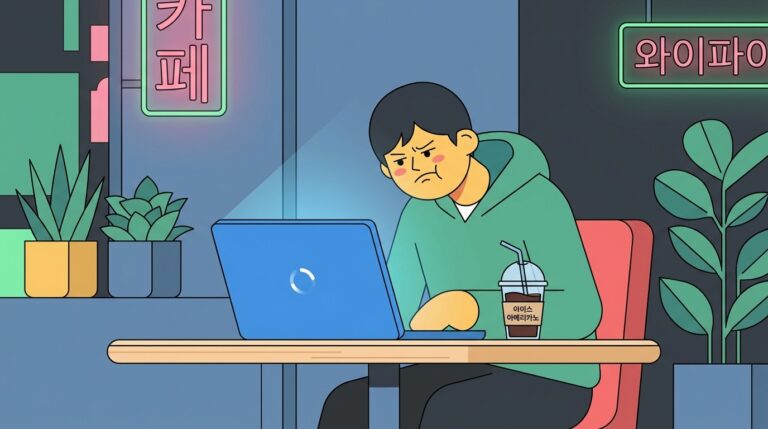
Why Korean Websites Stress Us Out: Surviving the Pali-Pali Loading Speed Complaint
Phase 1: Empathy & The K-Culture Cold Open
Hello there! I’m the Lead Editor at Daily Hangul, your veteran tutor and local Seoul navigator.
Picture this: You are sitting in a trendy, hyper-aesthetic cafe in Seongsu-dong. The iced Americano is perfect, the vibe is immaculate, and the cafe’s Wi-Fi is so fast it feels like you are living in the year 2050. But then, you try to open a foreign website or a heavy booking page. The loading wheel spins… once, twice, three times. It has only been three seconds, but your Korean friend is already violently tapping their fingers on the table, letting out a deep sigh.
“Ah, why is this so slow?!”
Welcome to the core of Korea’s Pali-Pali (빨리빨리 – Hurry, Hurry) culture. In a country that boasts some of the fastest internet speeds globally, waiting for a website to load is considered a mild form of digital torture.
If you don’t know how to express this specific digital frustration in Korean, you might just sit there smiling politely while your friends are internally screaming. But if you learn these B2-level phrases? You’ll instantly become an ‘insider’ (인싸) who truly understands the Korean soul. Let’s dive into the language of digital impatience!
Phase 2: Deep Dive into Core Expressions
Here are the top 3 expressions Koreans use when their screen freezes or loads endlessly.
1. 아, 왜 이렇게 느려? (Ah, wae ireoke neuryeo?)
- Pronunciation: [a, wae ireoke neuryeo?]
Tip: Drop your jaw and sigh heavily on the ‘Ah’. The ‘eo’ in neuryeo sounds like the ‘uh’ when you are disgusted.- Meaning: Literal: “Ah, why is it this slow?” / Real nuance: “I am losing my mind over this loading speed!”
- K-Culture Moment: You’ll see this in K-Dramas when the protagonist is trying to hack into a system or download a crucial file before the villains arrive, aggressively hitting the keyboard.
- Editor’s Insight: This isn’t a question; it’s an exclamation. You aren’t asking for the technical reason why the bandwidth is low. You are just complaining to the universe.
- Situation Spectrum:
- Casual (Friends/Talking to yourself): ✅
- Semi-formal (Co-workers): ⚠️ (Only if you are muttering it to yourself)
- Formal (Boss/Elders): 🚫
- 🤔 Think About It: Why do Koreans talk to themselves so much out loud (혼잣말)? In Korean culture, audibly expressing frustration is a way to relieve stress and share your mood with the room without directly confronting anyone.
2. 속 터져 죽겠네 (Sok teojyeo jukgenne)
- Pronunciation: [sok teojyeo jukgenne]
Tip: ‘Sok’ sounds like ‘soak’. ‘Jukgenne’ sounds like ‘jook-get-neh’. Put strong emphasis on ‘teojyeo’ (bursting).- Meaning: Literal: “My insides are bursting, I am going to die.” / Real nuance: “This is so frustrating I can’t stand it.”
- K-Culture Moment: Picture a K-Pop fan watching a live stream of their favorite idol, and the video starts buffering right at the climax of the performance.
- Editor’s Insight: The grammar
-아/어 죽겠다(to death) is crucial for B2 learners. We use it for everything: hungry to death (배고파 죽겠다), tired to death (피곤해 죽겠다). Here, your ‘insides’ (속) are bursting from frustration.- Situation Spectrum:
- Casual (Friends): ✅
- Semi-formal (Co-workers): ⚠️
- Formal (Boss/Elders): 🚫 (Never say “I’m dying” to an elder in a formal setting!)
- 🤔 Think About It: Why does the Korean language use such extreme, dramatic exaggerations for minor inconveniences like a slow website?
3. 로딩 실화냐? (Roding silhwanya?)
- Pronunciation: [roding silhwanya?]
Tip: ‘Silhwa’ means ‘true story’. Say it with a tone of utter disbelief, like “Are you kidding me?”- Meaning: Literal: “Is this loading a true story?” / Real nuance: “Is this endless loading for real right now?”
- K-Culture Moment: You are sitting in a PC Bang (Internet Cafe), playing League of Legends with your Korean friends, and someone’s character freezes.
- Editor’s Insight: The word 실화 (true story) combined with the slightly aggressive question ending
-냐?is top-tier internet slang. It shows disbelief at how bad the situation is.- Situation Spectrum:
- Casual (Close Friends only): ✅
- Semi-formal (Co-workers): 🚫
- Formal (Boss/Elders): 🚫
- 🤔 Think About It: Notice how English words like ‘Loading’ (로딩) are adopted and immediately combined with Korean slang suffixes. How does your native language adapt tech vocabulary?
Phase 3: Textbook vs. Real Korean
Let’s see how the textbook differs from the wild streets of the Korean internet.
[Situation 1: The website won’t load]
* 📖 Textbook Korean: 인터넷 연결이 좋지 않습니다. (The internet connection is not good.)
* 🗣️ Real Korean: 아 렉 걸렸어. (Ah, rek geollyeosseo. / Ah, I caught lag.)
* 💡 Why is it different?: In Pali-Pali culture, nobody has time for full sentences. “Lag” (렉) became a noun, and “caught” (걸리다) makes it sound like a sudden disease your computer caught!
[Situation 2: Telling a friend to refresh the page]
* 📖 Textbook Korean: 페이지를 새로고침 하세요. (Please refresh the page.)
* 🗣️ Real Korean: 에프오(F5) 눌러! (Epeuo nulleo! / Press F5!)
* 💡 Why is it different?: Efficiency! Why say “refresh the page” when you can just scream the keyboard shortcut?
Bottom Note: For B2 learners, using “아 렉 걸렸어” or “답답해 죽겠네” is perfectly safe and makes you sound incredibly natural without crossing the line into overly rude slang.
Phase 4: Cultural Context — K-Culture Deep Dive
4-1. Non-Verbal Elements (The Art of Nunchi)
When complaining about website speeds, body language is everything. You don’t just say it’s slow; you must show it.
* The Mouse Tap: Rapidly clicking the mouse even though you know it won’t help.
* The Sigh: A deep, audible breath out of the nose.
* Nunchi (눈치): If you are at work and the company intranet is slow, read the room (눈치). If your boss is sighing, you can quietly agree: “오늘 인터넷이 좀 느리네요” (The internet is a bit slow today). But never yell “속 터져 죽겠네!” in the office.
4-2. The K-Pop Connection: The Ticketing War (티켓팅)
Nowhere is the Pali-Pali loading speed culture more prominent than in K-Pop Ticketing (티켓팅 – tiketting).
When a popular idol group announces a concert in Seoul, fans rush to PC Bangs (because they have the fastest LAN speeds). At exactly 19:59:59, thousands of fans hit F5 (refresh). If the website gives you a loading circle of death, or the dreaded white screen… it’s over. The tickets are gone in 3 seconds. The phrases you learned today are screamed across PC Bangs nationwide during ticketing season.
* Critical view: The ticketing culture in Korea is so intense that there are actual ‘practice games’ online just to train your clicking speed. It shows how technology and fandom have merged into a hyper-competitive sport.
Phase 5: Real-Life Roleplay Scenario
Setting: A dimly lit, neon-accented PC Bang in Sinchon. It’s 7:58 PM on a Friday. You and your hardcore K-Pop fan friend, Min-su, are staring intensely at your monitors. The ticketing for the biggest concert of the year opens in 2 minutes.
Characters:
* YOU: An international student experiencing your first Korean “Ticketing War.”
* Min-su (24): Your Korean friend. He brought you here because “four hands are better than two.”
Dialogue:
Min-su: 야, 준비됐지? 8시 정각에 무조건 새로고침 눌러야 돼!
(Ya, junbidwaetji? yeodeolsi jeonggage mujogeon saerogochim nulleoya dwae!)
[Hey, you ready? At 8 sharp, you absolutely must hit refresh!]
(Min-su shakes his leg nervously)
YOU: 알았어. 근데 나 좀 긴장돼.
(Arasseo. geunde na jom ginjangdwae.)
[I got it. But I’m a bit nervous.]
Min-su: 10초 전… 5, 4, 3, 2, 1! 눌러!!!
(Sipcho jeon… o, sa, sam, i, il! Nulleo!!!)
[10 seconds… 5, 4, 3, 2, 1! Press it!!!]
YOU: 눌렀어! 어? 근데 화면이 하얗게 변했는데?
(Nulleosseo! Eo? geunde hwamyeoni hayake byeonhaenneunde?)
[I pressed it! Huh? But the screen turned white?]
Min-su: 아… 대기열 5만 명 떴어. 로딩 실화냐?
(A… daegi-yeol oman myeong tteosseo. roding silhwanya?)
[Ah… a queue of 50,000 people popped up. Is this loading for real?]
YOU: 계속 로딩 중이야. 아, 왜 이렇게 느려?
(Gyesok roding jung-iya. a, wae ireoke neuryeo?)
[It’s still loading. Ah, why is it so slow?]
Min-su: 절대 뒤로가기 누르지 마! 튕기면 끝이야. 아, 속 터져 죽겠네!
(Jeoldae dwirogagi nureuji ma! twing-gimyeon kkeuchiya. a, sok teojyeo jukgenne!)
[Never press back! If it bounces (crashes), it’s over. Ah, I’m dying of frustration!]
🔀 Your Turn! The screen freezes completely. How do you respond?
– A) 새로고침 다시 누를까? (Should I press refresh again?)
– B) 인터넷 연결이 좋지 않네요. (The internet connection is poor.)
– C) 컴퓨터 부숴버리고 싶다! (I want to smash the computer!)✅ Best Choice: A — Reason: It’s natural and practical in this chaotic situation. (Though Min-su will scream “NO!” because refreshing ruins your place in the queue).
⚠️ Choice B Analysis: Way too robotic and textbook. Min-su might think you are an AI.
🚫 Choice C Analysis: A bit too aggressive unless you are extremely close with Min-su!
Phase 6: 10-Second Shadowing Drill
Read this out loud. Pay attention to the pauses (/) and the emotion tags!
😤 아 진짜 / 화면 또 멈췄어. (A jinjja / hwamyeon tto meomchwosseo.)
😭 답답해서 / 속 터지겠네! (Dapdaphaeseo / sok teojigenne!)
(Translation: Ah seriously, the screen froze again. It’s so frustrating, my insides are gonna burst!)
Phase 7: K-Culture Mini Dictionary
| 한국어 (Korean) | Romanization | English Meaning | Cultural Context |
|---|---|---|---|
| 빨리빨리 | pali-pali | Hurry, hurry | The foundational mindset of modern Korean society; efficiency and speed above all. |
| 티켓팅 | tiketting | Ticketing | The fierce online battle to buy concert tickets the second they drop. |
| 피시방 | pisi-bang | PC Room (Internet Cafe) | High-tech gaming centers where Koreans go for hyper-fast internet and gaming. |
| 새로고침 | saerogochim | Refresh (F5) | Literally “new fix”. What you spam when a site is slow. |
| 렉 걸리다 | rek geollida | To lag | Using the English word ‘lag’ as a disease the computer catches. |
Phase 8: Traveler’s Survival Kit
Even if you aren’t fighting for K-Pop tickets, you will need Wi-Fi while traveling in Korea.
🆘 Survival Expressions TOP 3
– 🇰🇷 “와이파이 비밀번호 뭐예요?” (waipai bimilbeonho mwoyeyo?) – What is the Wi-Fi password?
– 🇰🇷 “인터넷이 자꾸 끊겨요.” (inteonesi jakku kkeungyeoyo.) – The internet keeps disconnecting.
– 🇰🇷 “여기 와이파이 잘 터져요?” (yeogi waipai jal teojyeoyo?) – Does the Wi-Fi work well here? (Lit: Does it burst well here?)📌 Editor’s Travel Note
– Free Wi-Fi: Korea has “Public WiFi Free” on almost every subway and bus. You usually just need to click the network and tap the middle button on the login page.
– Cafes: The Wi-Fi password is almost always printed at the bottom of your receipt (영수증)! Don’t throw it away immediately.
Phase 9: Critical Thinking — “One Step Deeper”
Media vs. Reality / The Miracle on the Han River
🧠 Think Deeper:
Korea wasn’t always this fast. The Pali-Pali culture was born out of the rapid economic growth in the 1970s and 80s, known as the “Miracle on the Han River.” To rebuild the nation, speed was survival. This mindset transitioned perfectly into the digital age, making Korea an IT powerhouse with the fastest internet. However, this same culture that built a hyper-convenient digital world also creates immense psychological pressure. The inability to wait even three seconds for a website to load is a reflection of a society that constantly feels it is running out of time.💬 Your Turn: How is internet speed viewed in your culture? Is a slow website just a minor annoyance, or does it ruin your day? Share your thoughts in the comments!
Phase 10: FAQ & Avoiding Misunderstandings
- Q: Can I yell “빨리빨리 해!” (Do it quickly!) to a waiter if my food is late?
- A: ABSOLUTELY NOT! 🚫 This is incredibly rude. While Pali-Pali is a cultural trait, demanding it aggressively from service workers is considered terribly disrespectful. Instead, politely ask: “혹시 주문 들어갔을까요?” (Did the order go through by any chance?)
- Q: Can I say “아 왜 이렇게 느려” in front of my Korean boss?
- A: MAYBE ⚠️. If you are clearly talking to your own computer screen in a hushed tone, it’s fine (and relatable). But don’t say it about a task your boss gave you!
❌ Common Mistake #1: Translating “I am frustrated” directly into “나는 좌절했다” (I am in despair/defeated).
✅ Do this instead: Use “답답하다” (dapdaphada). It perfectly captures the stifled, suffocating feeling of waiting for a slow website.
Phase 11: Summary & Action Items
💡 One-Liner Summary: To survive a digital delay in Korea, skip the textbook logic and dramatically express how your insides are bursting from the lag!
🎯 Action Missions:
– 🥉 Bronze (Solo): Look at your phone while it’s loading an app and sigh, “아, 왜 이렇게 느려?” 3 times.
– 🥈 Silver (Online): Go to a K-Pop or K-Drama YouTube video and leave a comment using “로딩 실화냐?” if the video buffers.
– 🥇 Gold (Real-Life): The next time you are at a cafe with a Korean friend and the Wi-Fi is slow, look at them and say “아, 속 터져 죽겠네!”
– 🇰🇷 K-Culture Mission: Watch any modern K-Drama on Netflix tonight. I guarantee you will find at least one scene where a character gets mad at their phone or computer screen. Spot what they do with their hands!
Phase 12: Interactive Quiz
1. Situational Judgment: You are trying to buy train tickets for Chuseok (Korean Thanksgiving), but the Korail website freezes. You are alone in your room. What is the most natural thing to yell?
– A) 인터넷 연결을 확인해 주세요!
– B) 아 렉 걸렸어! 속 터지네!
– C) 빨리빨리 해 주세요!
2. Fill in the Blank:
“The screen froze right when BTS came on stage! ________ 실화냐?”
– A) 로딩 (Loading)
– B) 좌절 (Despair)
– C) 영수증 (Receipt)
3. T/F – K-Culture Edition:
“If the internet is slow at a cafe in Korea, you should loudly yell ‘Pali-Pali!’ at the barista.”
– [True / False]
(Answers: 1: B, 2: A, 3: False – Never yell at service workers!)
Did you enjoy today’s Daily Hangul lesson? Drop a comment below and tell us about the most frustrating ‘loading’ experience you’ve had recently!
Frequently Asked Questions (FAQ)
Q: What does "아, 왜 이렇게 느려? (Ah, wae ireoke neuryeo?)" mean in Korean and how do you pronounce it?
A: In Korean, "아, 왜 이렇게 느려? (Ah, wae ireoke neuryeo?)" is pronounced [a, wae ireoke neuryeo?] and means: Literal: "Ah, why is it this slow?" / Real nuance: "I am losing my mind over this loading speed!"
Q: What does "속 터져 죽겠네 (Sok teojyeo jukgenne)" mean in Korean and how do you pronounce it?
A: In Korean, "속 터져 죽겠네 (Sok teojyeo jukgenne)" is pronounced [sok teojyeo jukgenne] and means: Literal: "My insides are bursting, I am going to die." / Real nuance: "This is so frustrating I can't stand it."
Q: What does "로딩 실화냐? (Roding silhwanya?)" mean in Korean and how do you pronounce it?
A: In Korean, "로딩 실화냐? (Roding silhwanya?)" is pronounced [roding silhwanya?] and means: Literal: "Is this loading a true story?" / Real nuance: "Is this endless loading for real right now?"







