

Phase 1: Empathy (Immersion Open)
Hello, learners! I’m your Lead Editor at Daily Hangul.
Imagine this: You’re watching a modern K-Drama. The female lead is running late for an important interview. She trips, scuffs her brand-new shoes, and drops her iced Americano. Instead of breaking down in tears, she lets out a deep sigh, dusts herself off, and says, “하아… 오늘 액땜 제대로 하네 (Haa… oneul aekttaem jedaero hane).” The subtitles simply read, “Well, that’s just my bad luck.”
But was it really just “bad luck”? Not at all. She was actually expressing a profound, centuries-old Korean mindset rooted in resilience and optimism.
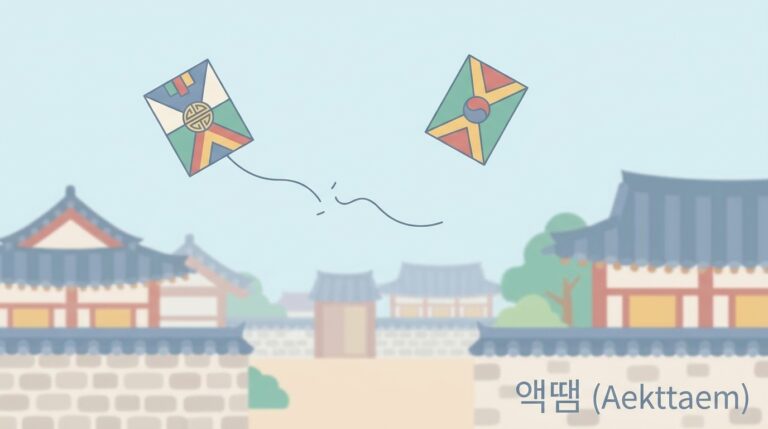
To truly understand this, we have to travel back in time to the traditional Korean skies during Seollal (Lunar New Year) and Jeongwol Daeboreum (the first full moon). Koreans would write their bad luck on a kite (연, yeon), fly it high into the sky, and intentionally cut the string to let it blow away forever. This custom is called 액막이 (Aengmagi – warding off misfortune).
If you’ve reached the C1 level, simply saying “운이 없어요 (I have no luck)” isn’t going to cut it anymore. Mastering the vocabulary born from this kite-flying tradition will instantly elevate your Korean from “textbook perfect” to “native-level profound.” Let’s cut the string and let your language barriers fly away!
Phase 2: Deep Dive into Key Expressions
Let’s explore the most essential advanced expressions derived from the culture of letting bad luck fly away.
1. 액땜하다
- Pronunciation: [aek-ttaem-ha-da] / The ‘액’ sounds like the sharp ‘ack’ in ‘acknowledge’, and ‘땜’ requires a tense, tight ‘dd’ sound, almost like a short, sharp ‘ddem’.
- Meaning: Literal: To pay off a misfortune. / Real Nuance: To suffer a small misfortune now, which serves as a “payment” to prevent a much larger disaster later.
- K-Culture Moment: You accidentally crack your phone screen the day before you travel to Jeju Island. Your Korean friend immediately comforts you: “여행 가기 전에 액땜 크게 했네! (You did a big aekttaem before the trip!)” It immediately flips the mood from tragic to optimistic.
- Editor’s Insight: This isn’t just a word; it’s a coping mechanism. It’s the ultimate Korean silver lining. You aren’t just unlucky—you just paid an “insurance premium” against future disasters.
- Situation Spectrum:
- Friends (Casual): ✅
- Co-workers (Semi-formal): ✅
- Formal/Boss (Formal): ⚠️ (Only use it regarding your own bad luck, not your boss’s. Telling your boss “You just did an aekttaem” when they crash their car is a terrible idea!)
- 🤔 Think About It: Why does Korean culture have a specific word for “preemptively suffering”? How does viewing bad luck as a “transaction” change how you deal with stress?
2. 훌훌 털어버리다
- Pronunciation: [hul-hul teo-reo-beo-ri-da] / ‘훌훌’ sounds like blowing softly on hot soup. ‘Hool-hool’.
- Meaning: Literal: To brush off lightly. / Real Nuance: To let go of lingering regrets, worries, or bad memories completely and freely.
- K-Culture Moment: This is the quintessential lyric in K-Pop songs about moving on from a breakup or a hard time. Like a kite flying away in the wind, you are letting the bad energy drift away.
- Editor’s Insight: The mimetic word (의태어) ‘훌훌’ is the star here. It mimics the light, airy motion of brushing dust off your clothes, or a bird taking off. It feels incredibly liberating.
- Situation Spectrum:
- Friends (Casual): ✅
- Co-workers (Semi-formal): ✅
- Formal/Boss (Formal): 🚫 (Too poetic and casual for strict professional settings.)
- 🤔 Think About It: Korean is rich in mimetic and onomatopoeic words (음성상징어). How does adding a sensory word like ‘훌훌’ change the emotional depth of simply saying “잊어버리다 (forget it)”?
3. 송액영복 (송厄迎福)
- Pronunciation: [song-aeng-nyeong-bok]
- Meaning: Literal: Send away bad luck (액), welcome good fortune (복).
- K-Culture Moment: In historical K-Dramas (Sageuk), you will often see scholars or commoners meticulously writing these four Hanja (Chinese characters) on a traditional shield kite (방패연) before sending it up into the winter sky.
- Editor’s Insight: As a C1 learner, knowing Four-Character Idioms (사자성어) gives you instant intellectual credibility. While you won’t use this in a café, dropping this idiom in an essay or a formal New Year’s greeting card will leave Koreans deeply impressed.
- Situation Spectrum:
- Friends (Casual): 🚫 (Too formal/academic)
- Written/New Year’s Greetings: ✅
- Formal Speeches: ✅
Phase 3: Textbook vs. Real Korean
How do native speakers actually talk when things go wrong, compared to what your textbooks taught you?
[Situation 1: Comforting a friend who just had a minor accident]
* 📖 Textbook Korean: 정말 운이 나빴네요. 기운 내세요. (You had really bad luck. Cheer up.)
* 🗣️ Real Korean: 야, 그냥 액땜했다고 쳐! 앞으로 좋은 일만 있을 거야. (Hey, just consider it aekttaem! Only good things will happen from now on.)
* 💡 Why the difference?: Textbook Korean states a depressing fact. Real Korean uses traditional cultural psychology to reframe the negative event into a positive prophecy.
[Situation 2: Telling someone to let go of their worries]
* 📖 Textbook Korean: 나쁜 기억은 잊어버리세요. (Please forget the bad memories.)
* 🗣️ Real Korean: 연에 실어서 훌훌 날려버려. (Load it onto a kite and let it fly away entirely.)
* 💡 Why the difference?: Native speakers love using physical metaphors (like flying a kite or brushing off dust) to describe emotional states, making the comfort feel much more tangible.
Bottom Note: At the C1 level, your goal is emotional resonance, not just grammatical accuracy. Adopting the “Aekttaem” mindset shows you understand the Korean heart (정/한).
Phase 4: Cultural Context — K-Culture Deep Dive
4-1. Non-Verbal Cues: The Act of “Cutting Off” (끊어내다)
When Koreans traditional fly kites for Aengmagi, the most crucial step is cutting the string (얼레줄을 끊다). Without cutting the string, the bad luck stays tethered to you. In modern conversations, when someone says “훌훌 털어버려 (Let it go),” you might see them physically wave their hands outward, mimicking the act of pushing something away or brushing dust off their shoulders.
4-2. K-Drama Connection: The Symbolic Kite
If you watch historical K-Dramas like The Red Sleeve or Under the Queen’s Umbrella, kites are never just toys. They are heavy with symbolism. A flying kite often represents a character’s trapped desires. When the string is cut, it can mean two things: a tragic severing of ties, or a liberating release of a heavy burden (Aengmagi).
Critical View: While dramas make kite-flying look like a solemn, lonely, and romantic act, traditionally during the Joseon dynasty, kite-flying was a noisy, hyper-competitive sport! People would coat their kite strings in crushed glass and try to cut other people’s kites out of the sky in epic “kite battles” (연싸움).
Phase 5: Real-world Roleplay Scenario
Setting: A crisp, windy February afternoon at Han River Park (Yeouido). You are with your Korean friend, Min-su (32, energetic and slightly clumsy). You both bought cheap kites from a convenience store to experience traditional Aengmagi.
Characters:
– YOU: An expat working in Seoul, looking for some good luck for an upcoming project.
– Min-su: Your Korean friend who insists he is a “Kite Master.”
Dialogue:
Min-su: 야, 바람 딱 좋다! 내 가오리연 나는 거 잘 봐라! 🪁
(Ya, baram ttak jota! Nae gaoriyeon naneun geo jal bwara!)
[Hey, the wind is perfect! Watch my stingray kite fly!]
(🎭 Stage Direction: Min-su confidently releases his kite, but immediately gets the string tangled in a nearby tree branch. Snap! The string breaks.)
YOU: 헐… 시작하자마자 끊어졌어?
(Heol… sijakajamaja kkeuneojeosseo?)
[Omg… it snapped right as you started?]
Min-su: 아… 내 오천 원… 올해 운수 왜 이러냐…
(A… nae ocheon won… olhae unsu wae ireonya…)
[Ah… my 5,000 won… why is my luck like this this year…]
🔀 Your Turn! How should you respond?
– A) “거봐, 내가 조심하라고 했잖아.” (See, I told you to be careful.)
– B) “진짜 운이 없네. 집에 가자.” (You really have no luck. Let’s go home.)
– C) “에이, 액땜 제대로 했다고 쳐! 네 나쁜 운이 연이랑 같이 날아간 거야.”✅ Best Choice: C
Reason: You just mastered the Korean art of comfort! By framing his mistake as Aekttaem, you’ve turned his lost 5,000 won into a cheap price paid to ward off real disaster in the new year. Min-su will instantly feel better and likely buy you dinner.
⚠️ Choice A & B Analysis: These are grammatically flawless but culturally abrasive. Empathy in Korea often requires shared optimism, not logical reprimands.
Phase 6: 10-Second Shadowing Drill
Let’s practice the magic phrase to comfort any Korean friend who experiences a minor setback. Read it aloud, paying attention to the pauses (/) and the tense consonants!
😤 단호하고 긍정적으로 (Firmly and positively):
“이번 일은 / 액땜했다고 치고, / 훌훌 / 날려버리자!”
(ibeon ireun / aekttaemhaetdago chigo, / hulhul / nallyeobeorija!)
“Let’s just consider this an aekttaem, and let it completely fly away!”
Phase 7: K-Culture Mini Dictionary
| 한국어 | Romanization | English | Cultural Context |
|---|---|---|---|
| 액땜 | aekttaem | Warding off bad luck with a minor mishap | A core psychological coping mechanism in modern Korea. |
| 정월 대보름 | Jeongwol Daeboreum | The first full moon of the Lunar Year | A major traditional holiday where kite-flying, nut-cracking (부럼깨기), and bonfire-burning (달집태우기) happen. |
| 방패연 | bangpaeyeon | Shield kite | The iconic rectangular Korean traditional kite with a hole in the middle to handle strong winds. |
| 얼레 | eolle | Kite spool | The traditional hexagonal wooden spool used to wind the kite string. |
Phase 8: Traveler Survival Kit
If you want to experience kite flying or traditional culture, you’ll likely visit places like Han River Park, Suwon Hwaseong Fortress, or Bukchon Hanok Village. Here are essential advanced phrases for your trip.
🆘 Survival Expressions for Traditional Spots
– 🇰🇷 “혹시 연 날리기 좋은 명당이 어디예요?” (hoksi yeon nalligi joeun myeongdangi eodiyeyo?)
– 🗣️ Meaning: By any chance, where is the best spot (myeongdang) to fly kites?
– 📍 Where to use: Asking locals or park rangers at vast areas like Han River.
- 🇰🇷 “바람이 꽤 부는데, 이 줄 안 끊어지겠죠?” (barami kkoae buneunde, i jul an kkeuneojigetjyo?)
- 🗣️ Meaning: The wind is blowing quite a bit, this string won’t snap, right?
- 📍 Where to use: When renting or buying a kite at a local vendor.
📌 Editor’s Travel Note
– App to use: Naver Map (카카오맵 is also good, but Naver Map is great for finding specific park zones).
– Cultural Tip: If you see people flying traditional kites around Seollal, don’t run to catch a kite if the string breaks and it drifts to the ground! Traditionally, that kite carries someone’s bad luck. Let it be!
Phase 9: Critical Thinking — “One Step Further”
🧠 Think Deeper: Language & Resilience (Mindset)
Let’s think critically about the concept of “액땜 (Aekttaem)”. Korea has modernized at an unprecedented, breakneck speed. In a highly competitive, fast-paced society, stress and minor failures are inevitable daily occurrences. The traditional shamanistic concept of “Aengmagi” (physically warding off evil) has evolved into a modern psychological tool: “Aekttaem”. By labeling a spilled coffee, a broken phone, or a minor car scratch as Aekttaem, Koreans strip the event of its power to ruin their day. It’s a brilliant, linguistically embedded form of cognitive behavioral therapy. It reveals that the Korean language is wired for collective resilience.
💬 Your Turn: Does your culture have a way of rationalizing minor bad luck? Do you “knock on wood” or say something specific to reframe a bad situation? Share it in the comments!
Phase 10: FAQ & Mistake Prevention
Q: Can I say “액땜했네요” to someone who suffered a major tragedy, like losing their job or a severe injury?
NO. Absolutely not. This is a very common mistake. Aekttaem is strictly reserved for minor inconveniences (losing a small amount of money, a minor scrape, a broken item). Using it for a major life crisis comes across as incredibly insensitive and dismissive of their real pain.
Q: What is the difference between 액막이 and 액땜?
액막이 (Aengmagi) is the preventative action you take (like flying a kite, eating red bean porridge, carrying a talisman). 액땜 (Aekttaem) is the rationalization after something slightly bad has already happened.
❌ Common Mistake #1: Saying “액땜 할게요” (I will do Aekttaem) before doing something dangerous.
✅ Do this instead: You don’t choose to do Aekttaem. It happens to you. You say “액땜했다고 치자” (Let’s assume I did Aekttaem) after the minor bad event occurs.
Phase 11: Summary & Action Items
- One-Liner Summary: Turn your minor bad luck into a shield against future disasters by mastering the mindset of Aekttaem and letting your worries fly away like a kite.
-
Action Mission 3 Steps:
- 🥉 Bronze (Solo): Next time you drop something or stub your toe, say aloud to yourself: “아, 액땜 제대로 했다!”
- 🥈 Silver (Online): Share a funny, minor “unlucky” moment on your social media or language exchange app using the hashtag #액땜.
- 🥇 Gold (Real World): Comfort a Korean friend who is annoyed by a minor inconvenience by telling them, “액땜했다고 치고 훌훌 털어버려요!”
- K-Culture Mission:
Watch an episode of a historical K-Drama (Sageuk) and spot a scene where a character is flying a kite. Pay attention to the moment the string is cut—now you know exactly what that represents!
Phase 12: Quiz — Interactive Challenge
1. Situational Judgment: Your co-worker, Jimin, just spilled her iced latte all over her keyboard right before a long weekend. She looks like she’s about to cry. What is the most culturally savvy C1 response?
A) 지민 씨, 키보드 고장 났네요. 운이 정말 없어요.
B) 지민 씨, 연휴 전에 액땜 크게 했다고 치고 훌훌 털어버려요!
C) 지민 씨, 키보드를 연에 매달아서 날려보내요.
2. True or False – K-Culture Edition:
“In traditional Korean culture, if you find a kite on the ground with a broken string on Lunar New Year, it is considered very lucky to pick it up and keep it.” (T/F)
(Check your answers by highlighting the blank space below!)
Answers:
1. B (A is too blunt, C is funny but non-sensical. B perfectly utilizes the cultural coping mechanism.)
2. False (F). That kite carries someone else’s bad luck (Aek)! You should leave it alone.
Frequently Asked Questions (FAQ)
Q: What does "액땜하다" mean in Korean and how do you pronounce it?
A: In Korean, "액땜하다" is pronounced [aek-ttaem-ha-da] and means: Literal: To pay off a misfortune. / Real Nuance: To suffer a small misfortune now, which serves as a "payment" to prevent a much larger disaster later.
Q: What does "훌훌 털어버리다" mean in Korean and how do you pronounce it?
A: In Korean, "훌훌 털어버리다" is pronounced [hul-hul teo-reo-beo-ri-da] and means: Literal: To brush off lightly. / Real Nuance: To let go of lingering regrets, worries, or bad memories completely and freely.
Q: What does "송액영복 (송厄迎福)" mean in Korean and how do you pronounce it?
A: In Korean, "송액영복 (송厄迎福)" is pronounced [song-aeng-nyeong-bok] and means: Literal: Send away bad luck (액), welcome good fortune (복).






