

Phase 1: The Steamy Red Magic of Korean Streets
Hello! I’m the Lead Editor of Daily Hangul, your personal Korean tutor and local culture navigator.
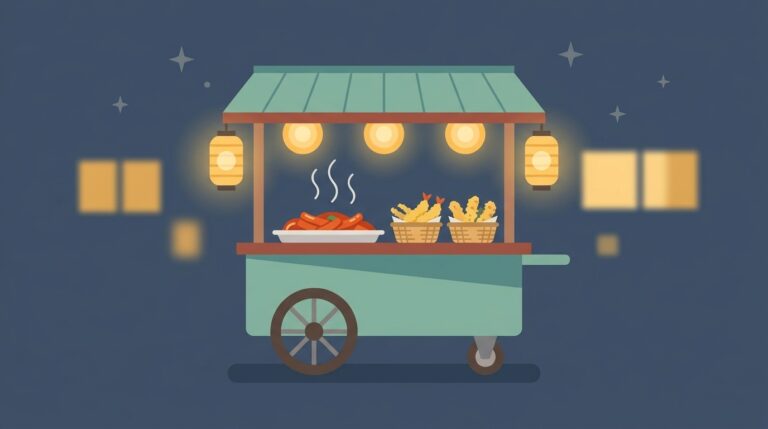
Picture this: You are walking down a vibrant street in Seoul—maybe Myeongdong or Hongdae. The air is chilly, but suddenly, you see a glowing tent. Steam is rising into the night sky, and you smell the irresistible aroma of spicy sauce and deep-fried goodness.
You step closer. You see the bubbling red Tteokbokki (spicy rice cakes) and the golden, crispy Twigim (fried snacks). In a K-Drama, this is the exact moment the main characters grab a skewer, take a bite, and forget all their worries.
But wait… how do you order? The menu is all in Korean, the stall owner (Ahjumma) looks busy, and you freeze. Do you just point? Do you say ‘One Tteokbokki’?
Don’t worry! Today, we are going to learn the absolute survival phrases for conquering Korean Street Food. Knowing these won’t just fill your stomach; it will make the Ahjumma smile and treat you like a true local!
Phase 2: Core Expressions for Street Food Mastery
For A1 absolute beginners, we don’t need complex grammar. We just need these magic “chunks” of language!
1. 이거 1인분 주세요 (One portion of this, please)
- Pronunciation: [igeo il-inbun juseyo] + Sounds like: Ee-guh ill-een-boon joo-say-yo
- Meaning: Literal: “This one portion give me.” / Real nuance: “I’d like one serving of this, please!”
- K-Culture Moment: In K-Dramas, you’ll often see high schoolers run to a stall after exams and shout, “Ahjumma, Tteokbokki il-inbun juseyo!” It’s the universal sound of craving comfort food.
- Editor’s Insight: Forget trying to say “Tteokbokki.” Just point to the pan and say “이거” (igeo = this). It saves you from pronunciation anxiety!
- Situation Spectrum:
- Street stall owner: ✅ (Perfect!)
- Fancy restaurant: ⚠️ (They usually have specific menus, but understood)
- Close friends: 🚫 (You’d just say “Igeo meokja!” – Let’s eat this)
- 🤔 Think About It: Why “1 portion” (1인분) instead of “1 piece” (1개)? In Korea, food is measured by the serving size for a person, emphasizing the communal dining culture!
2. 국물에 묻혀 주세요 (Please mix it in the sauce)
- Pronunciation: [gungmure muchyeo juseyo] + Sounds like: Gung-moo-reh moo-chuh joo-say-yo
- Meaning: Literal: “Smear it in the broth.” / Real nuance: “Please dip the Twigim into the spicy Tteokbokki sauce!”
- K-Culture Moment: This is the ultimate insider move! Koreans rarely eat fried food (Twigim) dry. They ask the owner to mix the crispy fried snacks right into the thick, spicy red sauce of the Tteokbokki.
- Editor’s Insight: If you say this, the stall owner will immediately think, “Wow, this foreigner knows how to eat!”
- Situation Spectrum:
- Pojangmacha (Street Stall): ✅ (Legendary move)
- Fast food burger joint: 🚫 (Don’t try this with ketchup!)
- 🤔 Think About It: Koreans love mixing textures—crispy with soggy, sweet with spicy. Do you have a food combination in your country that seems strange but tastes amazing?
3. 안 맵게 해 주세요 (Please make it not spicy)
- Pronunciation: [an maepge hae juseyo] + Sounds like: Ahn map-geh hae joo-say-yo
- Meaning: Literal: “Not spicy do please.” / Real nuance: “Please make it mild/not spicy.”
- K-Culture Moment: Even some Koreans can’t handle extreme spice! We call them “Maep-jjiri” (맵찌질이 – spice weaklings). It’s totally okay to ask for this.
- Editor’s Insight: Tteokbokki is inherently red and a bit spicy, but many stalls can wash the rice cakes slightly or offer a milder sauce version if you ask politely.
Phase 3: Textbook vs. Real Korean
Let’s see how language changes from the classroom to the streets of Seoul!
[Situation 1: Ordering your food]
* 📖 Textbook Korean: 떡볶이 한 그릇 주시겠습니까? (Would you please give me one bowl of Tteokbokki?)
* 🗣️ Real Korean: 이거 1인분요! (One portion of this!)
* 💡 Why the difference?: Street food is fast-paced. Long, polite textbook sentences are too slow when a crowd is waiting. Short, respectful phrases ending in “요(yo)” are perfect.
[Situation 2: Asking for the price]
* 📖 Textbook Korean: 이것의 가격은 얼마입니까? (What is the price of this item?)
* 🗣️ Real Korean: 다 해서 얼마예요? (How much is it for everything?)
* 💡 Why the difference?: You usually order multiple things (Tteokbokki + Twigim). “다 해서” (Da haeseo) means “all together,” which is incredibly practical.
Phase 4: Cultural Context — K-Culture Deep Dive
4-1. The Non-Verbal “Nunchi” at the Stall
At a busy Korean street stall, Nunchi (눈치)—the art of reading the room—is everything.
* Stand or Sit? If there are no stools, you just stand right in front of the food pan!
* Self-Service: See those long skewers next to the food? Grab one! You use it as your personal fork. Also, pouring water or grabbing napkins is almost always self-service.
4-2. The “Bunsik” (분식) Culture
Tteokbokki and Twigim fall under the category of Bunsik, which originally meant “flour-based food.” In modern K-Culture, Bunsik represents affordable, nostalgic comfort food.
Have you seen the K-Drama Weightlifting Fairy Kim Bok-joo? They are constantly eating Bunsik! It’s the food of youth, first dates, and post-study sessions. When you eat street food, you aren’t just eating a snack; you are experiencing the taste of Korean youth.
Phase 5: Real-Life Roleplay Scenario
Setting: It’s 8:00 PM in the bustling streets of Hongdae. You just finished shopping. You are standing in front of a glowing street stall. The Ahjumma is wearing an apron and quickly cutting fried squid with scissors.
Characters:
* YOU: A hungry A1 Korean learner wanting to try local food.
* Ahjumma (50s): The stall owner. Fast, loud, but very warm-hearted.
Dialogue:
YOU: 안녕하세요! 이거 1인분 주세요.
(Annyeonghaseyo! Igeo il-inbun juseyo.)
[Hello! One portion of this (Tteokbokki), please.]
Ahjumma: 네~ 튀김도 줄까요?
(Ne~ Twigim-do julkkayo?)
[Okay~ Should I give you some fried snacks (Twigim) too?]
YOU: 네! 오징어 튀김 주세요.
(Ne! Ojingeo twigim juseyo.)
[Yes! Fried squid, please.]
(🎭 Stage Direction: The Ahjumma cuts the crispy squid with her scissors and reaches for a plate.)
Ahjumma: 국물에 묻혀서? 아니면 그냥?
(Gungmure muchyeoseo? Animyeon geunyang?)
[Mixed in the sauce? Or just as it is?]
🔀 Your Turn! How should you respond?
* A) “묻혀 주세요!” (Muchyeo juseyo! – Mix it in the sauce!)
* B) “그냥 주세요!” (Geunyang juseyo! – Just give it to me plain!)
* C) “몰라요…” (Mollayo… – I don’t know…)✅ Best Choice: A or B!
If you choose A: You get the ultimate local flavor explosion (soggy, spicy, sweet).
If you choose B: The Twigim stays super crispy, and you can dip it yourself. (Both are great, but A gets you extra “local” points!)
Phase 6: 10-Second Shadowing Drill
Let’s practice the most important sentence. Speak aloud with the rhythm!
😊 이~~거 / 일인분 / 주세~요!
(ee~~guh / ill-een-boon / joo-say~yo!)
[Give me / one portion / of this please!]
Tone: Bright, pointing politely at the food, ending with a friendly, slightly prolonged ‘yo’.
Phase 7: K-Culture Mini Dictionary
| 한국어 (Korean) | Romanization | English | Cultural Context |
|---|---|---|---|
| 분식 | Bunsik | Snack food | Affordable comfort foods like Tteokbokki, Kimbap, and Twigim. |
| 포장마차 | Pojangmacha | Street stall/tent | A covered street tent selling food. A classic K-Drama date spot! |
| 튀김 | Twigim | Fried food | Deep-fried veggies, squid, and glass noodles. The perfect partner for Tteokbokki. |
| 어묵 국물 | Eomuk gukmul | Fish cake broth | The hot soup from the fish cake skewers. It’s usually FREE to drink! |
Phase 8: Traveler Survival Kit
Here are the absolute survival phrases you need when navigating Korean street food stalls.
🆘 Survival Phrases TOP 3
1. 🇰🇷 “다 해서 얼마예요?” (Da haeseo eolmayeyo?)
🗣️ Tah heh-suh uhl-ma-yeh-yo?
💡 Meaning: “How much is it for everything?”
2. 🇰🇷 “포장해 주세요.” (Pojanghae juseyo.)
🗣️ Po-jang-hae joo-say-yo.
💡 Meaning: “To-go, please.” (Many locals take it home to eat while watching TV!)
3. 🇰🇷 “계좌이체 할게요.” (Gyejwa-iche halgeyo.)
🗣️ Gyeh-jwa-ee-che hal-geh-yo.
💡 Meaning: “I will do a bank transfer.” (Crucial if you live in Korea, as street stalls prefer cash or transfers).📌 Editor’s Travel Note
* Cash is King on the Street: While Korea is 99% a cashless society, traditional street stalls and markets (like Gwangjang Market) often prefer physical cash. Always carry a 10,000 KRW bill!
* The Free Soup Hack: See the paper cups near the fish cakes? You can scoop the hot fish cake broth yourself to drink while eating your Tteokbokki. It’s totally free and expected!
Phase 9: Critical Thinking Corner — “One Step Deeper”
Food & Identity: The “Beombeok” (범벅) Culture
In Western cultures, deep-fried food is usually meant to stay crispy. But in Korea, we intentionally drown our crispy Twigim into the thick, spicy Tteokbokki sauce (we call this Beombeok – a messy mixture). Why? Korean food culture is heavily based on harmony and blending flavors, much like Bibimbap. We don’t view foods in isolation; we look for how they complete each other. The blandness of the fried batter perfectly balances the intense spice of the red sauce. It reflects a culture that values “Togetherness” over individuality.
💬 Your Turn: Does your culture have a dish where you intentionally mix things together in a “messy” way? Share in the comments!
Phase 10: FAQ & Avoiding Mistakes
❌ Common Mistake #1: Saying “하나 주세요” (Hana juseyo – Give me one) for Tteokbokki.
✅ Do This Instead: Say “1인분 주세요” (Il-inbun juseyo – Give me 1 portion). Tteokbokki isn’t counted by individual rice cakes; it’s counted by the serving size!
K-Culture Specific FAQs:
* Q: Can I share one portion (1인분) with my friend?
* A: Yes! At a street stall, it’s very common for two friends to order 1 portion of Tteokbokki and 1 portion of Twigim and share both.
* Q: Do I leave a tip for the Ahjumma?
* A: NO! Tipping does not exist in Korea. Just give a bright smile and say “잘 먹었습니다” (Jal meogeotseumnida – I ate well) when you leave. That is the best tip!
Phase 11: Summary & Action Items
- One-Liner Summary: To eat street food like a local, point and say “이거 1인분 주세요!” and ask to mix the sauce!
Take Action:
* 🥉 Bronze (Solo): Stand in front of your mirror, point to an imaginary food pan, and say “이거 1인분 주세요” three times.
* 🥈 Silver (Online): Find a K-food video on YouTube about Tteokbokki and comment: “I want to try 1인분!”
* 🥇 Gold (Real World): Visit a local Korean market or a Korean restaurant in your area and order using “___ 주세요”!
K-Culture Mission:
Next time you watch a K-Drama, look closely at the street food scenes. Notice if they eat their Twigim crispy, or if it’s already mixed into the red sauce!
What is your favorite Korean street food? Let me know in the comments below! 👇
Phase 12: Interactive Quiz
1. Situational Judgment: You are at a street stall. You want Tteokbokki, but you absolutely cannot eat spicy food. What should you say?
* A) 이거 하나 주세요. (Give me one of this.)
* B) 안 맵게 해 주세요. (Please make it not spicy.)
* C) 국물 많이 주세요. (Give me a lot of broth.)
(Answer: B. It’s the ultimate survival phrase for a “Maep-jjiri”!)
2. True or False – K-Culture Edition: At a street stall, you must pay extra to drink the hot fish cake broth (어묵 국물).
(Answer: False! It is a free self-service bonus to warm you up!)
3. Fill in the Blank:
To order food to take back to your hotel, you say: “__________ 주세요.”
(Answer: 포장해 – Pojanghae / “Please pack it to go”)
Frequently Asked Questions (FAQ)
Q: What does "이거 1인분 주세요 (One portion of this, please)" mean in Korean and how do you pronounce it?
A: In Korean, "이거 1인분 주세요 (One portion of this, please)" is pronounced [igeo il-inbun juseyo] and means: Literal: "This one portion give me." / Real nuance: "I'd like one serving of this, please!"
Q: What does "국물에 묻혀 주세요 (Please mix it in the sauce)" mean in Korean and how do you pronounce it?
A: In Korean, "국물에 묻혀 주세요 (Please mix it in the sauce)" is pronounced [gungmure muchyeo juseyo] and means: Literal: "Smear it in the broth." / Real nuance: "Please dip the Twigim into the spicy Tteokbokki sauce!"
Q: What does "안 맵게 해 주세요 (Please make it not spicy)" mean in Korean and how do you pronounce it?
A: In Korean, "안 맵게 해 주세요 (Please make it not spicy)" is pronounced [an maepge hae juseyo] and means: Literal: "Not spicy do please." / Real nuance: "Please make it mild/not spicy."






