

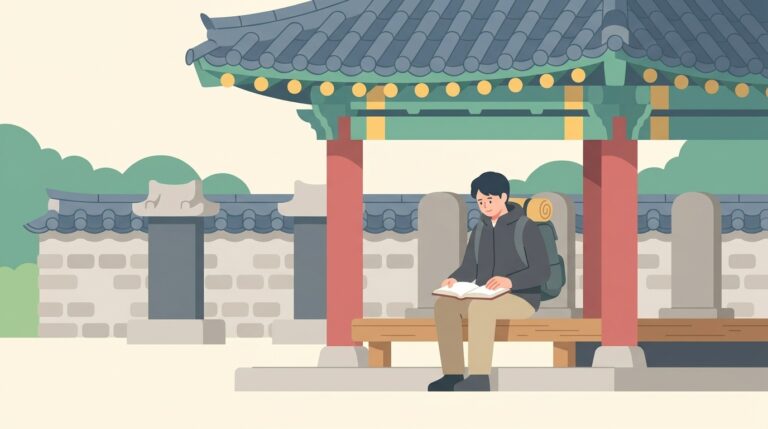
Phase 1: Empathy & Immersion
Hello there! I’m your Daily Hangul Editor, your veteran tutor and local culture navigator.
Imagine this: You’ve just finished watching a breathtaking, heart-wrenching K-Drama like Mr. Sunshine or Youth of May. You travel to Korea and decide to visit the real-life historical sites where these stories unfolded—perhaps the Seodaemun Prison History Hall or the DMZ. As you stand there, absorbing the heavy silence, the English word “sad” simply doesn’t cut it. Your Korean friends are murmuring phrases that carry a profound weight, and you want to respectfully participate in that shared moment of reflection.
Welcome to the nuanced world of Dark Tourism (다크 투어리즘) in Korea. At a C2 level, learning Korean is no longer just about ordering coffee or finding the subway; it’s about connecting with the deep, sometimes painful historical currents that shaped the nation. Knowing how to express empathy and historical awareness not only prevents unintended disrespect but elevates you to someone who truly understands Korea.
Everything you’ll read today is based on real experiences of advanced learners trying to navigate the emotional and ethical complexities of Korea’s memorial sites.
Phase 2: Core Expressions Deep Dive
1. 가슴이 먹먹하다 (A Heavy Heart)
- Pronunciation: gaseumi meongmeokhada [gah-seu-mee mung-muck-ha-dah] – Sound analogy: ‘meong-meok’ sounds like the deep, muffled clearing of a throat when you’re holding back tears.
- Meaning: Literal: The chest is stuffed/deafened. / Real Nuance: To feel choked up, overwhelmed with a heavy emotion that words cannot describe.
- K-Culture Moment: In historical documentaries or solemn news reports on Memorial Day (현충일), reporters and citizens alike use this exact phrase when looking at artifacts of independence activists or war veterans.
- Editor’s Insight: This isn’t just “sad” (슬프다). This is a visceral reaction. It’s the physical sensation of your chest tightening because the historical tragedy is too immense to process easily.
- Situation Spectrum:
- Close Friends (Casual): ✅ (가슴이 먹먹해…)
- Colleagues (Semi-formal): ✅ (가슴이 먹먹하네요.)
- Elders/Formal (Formal): ✅ (가슴이 먹먹해집니다.)
- 🤔 Think About It: Why does Korean rely heavily on physical sensations (chest stuffing, stomach aching) to describe profound emotional states? Does your native language localize grief in a specific body part?
2. 숙연해지다 (Becoming Solemn/Humbled)
- Pronunciation: sugyeonhaejida [soog-yun-hae-jee-dah] – Sound analogy: ‘soog’ starts like a quick breath in, bringing yourself to a sudden, quiet halt.
- Meaning: Literal: To become silent and respectful. / Real Nuance: To be humbled into a solemn silence by a place, event, or someone’s sacrifice.
- K-Culture Moment: Whenever a K-Pop idol or celebrity visits a historical site and posts a thoughtful reflection, they almost always write, “절로 숙연해지는 하루였습니다” (It was a day that naturally made me solemn).
- Editor’s Insight: Use this to describe your change in demeanor. It shows you recognize the gravity of the space. It’s the ultimate respectful compliment to a memorial site.
- Situation Spectrum:
- Close Friends (Casual): ⚠️ (A bit too literary for casual chats, but okay in deep talks)
- Colleagues (Semi-formal): ✅
- Elders/Formal (Formal): ✅
- 🤔 Think About It: In an age of fast-paced, loud tourism, having a specific verb for “becoming silenced by respect” highlights the traditional Korean value of Jeongseong (sincerity/devotion). How do you show reverence without words in your culture?
3. 고개 숙여 애도를 표합니다 (Bowing My Head in Condolence)
- Pronunciation: gogae sugyeo aedoreul pyohamnida [go-gae-soo-gyuh ae-do-reul pyo-ham-nee-dah]
- Meaning: Literal: I bow my head and express mourning. / Real Nuance: I offer my deepest condolences and respect.
- K-Culture Moment: You will see this written on wreaths (근조 화환) or in formal public statements during national mourning periods (like the Sewol Ferry tragedy or Itaewon tragedy).
- Editor’s Insight: This is highly formal and empathetic. While you wouldn’t say this casually while walking, writing this in a guestbook (방명록) at a memorial site shows a profound, C2-level grasp of Korean etiquette.
- Situation Spectrum:
- Close Friends (Casual): 🚫 (Too stiff)
- Colleagues (Semi-formal): ⚠️ (Only in written form for formal events)
- Elders/Formal (Formal): ✅ (Guestbooks, official speeches)
- 🤔 Think About It: The phrase explicitly includes the physical act of “bowing the head” (고개 숙여). How does tying a physical gesture to an emotional expression reinforce the sincerity of the phrase?
Phase 3: Textbook vs. Real Korean
[Situation 1: Describing a painful historical site]
* 📖 Textbook Korean: 정말 슬픈 장소입니다. (This is a very sad place.)
* 🗣️ Real Korean: 마음이 참 무겁네요. (My heart feels so heavy.) / 절로 숙연해집니다. (I am naturally humbled into silence.)
* 💡 Why the difference?: C2 Korean emphasizes internalized, somatic emotions over simple, direct adjectives when discussing collective grief.
[Situation 2: Writing in a Memorial Guestbook (방명록)]
* 📖 Textbook Korean: 희생자들을 기억할 것입니다. (I will remember the victims.)
* 🗣️ Real Korean: 잊지 않고 늘 기억하겠습니다. (I will not forget and will always remember.)
* 💡 Why the difference?: Adding “잊지 않고” (without forgetting) is a powerful cultural motif in modern Korean collective memory, symbolizing an active, ethical commitment rather than passive memory.
Phase 4: Cultural Context — K-Culture Deep Dive
4-1. Non-Verbal Elements: Nunchi at Dark Tourism Sites
Dark tourism demands top-tier Nunchi (눈치). While other tourists might take loud selfies, demonstrating Korean cultural competence means adopting a quiet demeanor. Keep your hands out of your pockets when reading memorial plaques (a sign of respect), and if you see a small incense burner (향로), observe how Koreans offer a single bow or a moment of silence. Your body language speaks louder than your vocabulary here.
4-2. K-Culture Connection: Media vs. Reality in Historical Dramas
Historical K-Dramas (시대극) often use sweeping orchestral scores and slow-motion to dramatize tragedies. But when you visit the actual sites—like the tiny, freezing cells of Seodaemun Prison—the reality is stark, silent, and entirely unglamorous. As a C2 learner, your ethical duty is to bridge that gap. Dramas introduce you to the history, but the physical sites ground you in the brutal reality. Using expressions like “가슴이 먹먹하다” shows that you are looking past the cinematic romance and acknowledging the real human cost.
Phase 5: Real-Life Roleplay Scenario
Scenario A: The Main Roleplay
- Setting: A brisk Saturday afternoon at the Seodaemun Prison History Hall. The red brick walls look imposing against the gray sky. You’ve just walked out of the execution building area.
- Characters:
- YOU (The Reader): An expat living in Seoul, deeply interested in Korean modern history.
- Ji-hoon (34, Male): Your Korean friend and history buff who offered to guide you.
Dialogue:
지훈 (Ji-hoon): 안에 직접 들어가 보니까 어때요? 영상으로 볼 때랑 많이 다르죠?
(ane jikjeop deureoga bonikka eottaeyo? yeongsangeuro bol ttaerang mani dareujo?)
[How does it feel seeing it inside in person? Very different from watching it on video, right?]
YOU: 네, 진짜 다르네요… 공기부터가 무거운 것 같아요.
(ne, jinjja dareuneyo… gonggibuteoga mugeoun geot gatayo.)
[Yes, it’s really different… Even the air feels heavy.]
지훈 (Ji-hoon): 맞아요. 저도 올 때마다 참 감정이 복잡해져요. 특히 아까 그 독방들 볼 때요.
(majayo. jeodo ol ttaemada cham gamjeongi bokjaphaejyeoyo. teukhi akka geu dokbangdeul bol ttaeyo.)
[Right. Every time I come, my emotions get so complicated. Especially looking at those solitary cells earlier.]
🔀 Your Turn! How do you respond?
– A) “그러게요. 너무 무서웠어요!” (I know. It was so scary!)
– B) “맞아요. 그분들의 희생을 생각하니 가슴이 정말 먹먹하네요.”
– C) “다 끝난 일이니까 이제 잊어야죠.”✅ Best Choice: B — “Right. Thinking about their sacrifices makes my heart feel incredibly heavy/choked up.” This hits the perfect C2 emotional depth, acknowledging the sacrifice (희생) and utilizing the advanced expression.
⚠️ Choice A & C Analysis: ‘A’ sounds like you just walked out of a haunted house theme park, lacking ethical gravity. ‘C’ is highly insensitive and ignores the Korean cultural emphasis on collective memory.
지훈 (Ji-hoon): (Nodding seriously) 네, 그분들 덕분에 지금 우리가 이렇게 자유롭게 있는 거겠죠.
(ne, geubundeul deokbune jigeum uriga ireoke jayuropge inneun geogetjo.)
[Yes, it’s thanks to them that we can be here freely right now.]
Scenario B: The Guestbook Challenge (Bonus)
- Setting: At the exit, there is a memorial guestbook (방명록).
- Action: Ji-hoon hands you a pen.
- You write: “역사의 아픔을 잊지 않고 기억하겠습니다. 고개 숙여 애도를 표합니다.”
(yeoksaui apeumeul itji anko gieokhagetseumnida. gogae sugyeo aedoreul pyohamnida.)
[I will not forget the pain of history and will remember it. I bow my head in condolence.]
Phase 6: 10-Second Shadowing Drill
Let’s practice the cadence of a solemn reflection.
😔 역사의 / 아픔을 마주하니 / 마음이 참 / 먹먹해집니다.
(yeoksaui / apeumeul majuhani / maeumi cham / meongmeokhaejimnida.)
(Tone: Speak slowly, lower your pitch slightly, pause distinctively at the slashes, exhaling slightly on ‘참’)
Phase 7: K-Culture Mini Dictionary (Dark Tourism Edition)
| Korean | Romanization | English | Context/Explanation |
|---|---|---|---|
| 추모 | chumo | Memorialization | Honoring the deceased, often seen in park names (추모공원). |
| 묵념 | mungnyeom | Silent tribute | A moment of silence with eyes closed and head bowed. |
| 방명록 | bangmyeongnok | Guestbook | Where visitors leave written reflections at historical sites. |
| 근현대사 | geunhyeondaesa | Modern and contemporary history | Often refers to the tumultuous 19th-20th centuries in Korea. |
| 희생 | huisaeng | Sacrifice | A keyword used to describe the actions of independence or democracy activists. |
Phase 8: Traveler’s Survival Kit
Even in solemn spaces, you have logistical needs. Here’s how to navigate them respectfully.
🆘 Survival Expression #1: Asking about Audio Guides
– 🇰🇷 “혹시 영어 오디오 가이드 대여 가능한가요?”
– 🗣️ (hoksi yeongeo odio gaideu daeyeo ganeunghangayo?)
– 📍 Used at: Ticket booths, Information desks.
– 💡 Pro Tip: Dark tourism sites in Korea often have excellent, free, or very cheap multilingual audio guides. They are essential for grasping the nuanced history.🆘 Survival Expression #2: Checking Photo Ethics
– 🇰🇷 “여기 사진 촬영해도 괜찮은 공간인가요?”
– 🗣️ (yeogi sajin chwaryeonghaedo gwaenchaneun gongganingayo?)
– 📍 Used at: Inside execution grounds, altar rooms, sensitive exhibits.
– 💡 Pro Tip: Always ask! Many interior cells or memorial plaques strictly forbid photography to preserve the sanctity of the space.🆘 Survival Expression #3: Asking for Directions Respectfully
– 🇰🇷 “추모탑으로 가는 길이 어느 쪽인지 알 수 있을까요?”
– 🗣️ (chumotabeuro ganeun giri eoneu jjoginji al su isseulkkayo?)
– 📍 Used at: Large memorial parks like Jeju 4.3 Peace Park or the War Memorial.
📌 Editor’s Travel Note:
– Dress Code: Avoid overly revealing or excessively casual clothing (like beachwear) at these specific sites.
– Volume Control: Keep your voice to a whisper. Laughter or loud phone calls in these areas are highly frowned upon.
Phase 9: Think Deeper — Critical Thinking Corner
🧠 Think Deeper: Media vs Reality (미디어와 현실)
As global fans consume Korean history through hyper-stylized K-Dramas and cinematic masterpieces, a unique ethical dilemma emerges. Dramas provide an emotional entry point, often romanticizing resistance fighters or tragic lovers against the backdrop of war or colonization. However, visiting real Dark Tourism sites strips away the dramatic OSTs and beautiful cinematography, leaving only the raw, brutal facts of human suffering. As advanced Korean speakers and global citizens, our responsibility is to let the media invite us in, but let the reality dictate our respect. True fluency involves recognizing that these locations are not “drama filming sets” but sacred grounds of actual national trauma.
💬 Your Turn: Have you ever visited a site of historical tragedy in your own country or abroad? How did the actual experience differ from what you learned in textbooks or saw in movies? Share your thoughts in the comments!
Phase 10: FAQ & Avoiding Mistakes
Q: Can I use “수고하셨습니다” (You worked hard) when referring to historical figures?
No. While used for colleagues, applying it to national martyrs sounds terribly casual. Instead, say “그분들의 숭고한 희생을 기립니다” (I honor their noble sacrifice).
Q: Is it okay to take selfies at the DMZ or Seodaemun Prison?
Outside, against general building backdrops, it’s usually acceptable, but maintain a neutral or respectful expression. Peace signs (V) or duck faces in front of execution chambers are considered highly offensive.
❌ Common Mistake #1: Saying “기분이 나빠요” (I feel bad/unpleasant) to express your sadness at a memorial.
✅ Do this instead: “기분이 나쁘다” usually means you are offended or angry at someone. To express the heavy sorrow of a historical tragedy, you MUST use “마음이 아픕니다” (My heart aches) or “가슴이 먹먹합니다” (My chest feels heavy).
Phase 11: Summary & Action Items
- One-Liner Summary: Navigate Korea’s historical depths by replacing generic “sadness” with profound, respectful expressions like “가슴이 먹먹하다.”
-
Action Mission 3 Steps:
- 🥉 Bronze (Solo): Stand quietly and whisper “절로 숙연해지네요” to yourself 3 times with the correct solemn intonation.
- 🥈 Silver (Online): Find a YouTube documentary about Korean modern history and leave a C2-level comment: “영상을 보니 가슴이 먹먹해집니다. 잊지 않겠습니다.”
- 🥇 Gold (Real-world): On your next trip to Korea, visit a memorial site and confidently write a respectful sentence in the guestbook (방명록).
- K-Culture Mission: Go on Google Street View and virtually walk through the War Memorial of Korea in Yongsan. Imagine where you would pause and use the expression “고개 숙여 애도를 표합니다.”
Phase 12: Quiz — Interactive Challenge
1. Situational Judgment: You are walking through the Jeju April 3rd Peace Park with a local guide. They finish explaining a tragic event. What is the MOST appropriate response?
A) “와, 진짜 대박이네요!” (Wow, that’s truly epic!)
B) “이야기를 들으니 마음이 참 먹먹해집니다.”
C) “기분이 아주 나빠요.”
2. Fill in the Blank:
“독립운동가들의 희생을 ________ 않고 기억하겠습니다.”
(Hint: without forgetting)
3. True or False – K-Culture Edition:
It is perfectly fine to wear colorful hanboks and take jumping photos inside the Seodaemun Prison History Hall because it promotes Korean culture. (T/F)
(Answers: 1. B – ‘A’ is too casual/enthusiastic, ‘C’ means offended. / 2. 잊지 / 3. False. While hanboks are great for palaces, jumping photos at a prison/memorial site lack Nunchi and basic respect.)
Frequently Asked Questions (FAQ)
Q: What does "가슴이 먹먹하다 (A Heavy Heart)" mean in Korean and how do you pronounce it?
A: In Korean, "가슴이 먹먹하다 (A Heavy Heart)" is pronounced [gaseumi meongmeokhada [gah-seu-mee mung-muck-ha-dah] and means: Literal: The chest is stuffed/deafened. / Real Nuance: To feel choked up, overwhelmed with a heavy emotion that words cannot describe.
Q: What does "숙연해지다 (Becoming Solemn/Humbled)" mean in Korean and how do you pronounce it?
A: In Korean, "숙연해지다 (Becoming Solemn/Humbled)" is pronounced [sugyeonhaejida [soog-yun-hae-jee-dah] and means: Literal: To become silent and respectful. / Real Nuance: To be humbled into a solemn silence by a place, event, or someone's sacrifice.
Q: What does "고개 숙여 애도를 표합니다 (Bowing My Head in Condolence)" mean in Korean and how do you pronounce it?
A: In Korean, "고개 숙여 애도를 표합니다 (Bowing My Head in Condolence)" is pronounced [gogae sugyeo aedoreul pyohamnida [go-gae-soo-gyuh ae-do-reul pyo-ham-nee-dah] and means: Literal: I bow my head and express mourning. / Real Nuance: I offer my deepest condolences and respect.







