

Phase 1: Empathy (The K-Culture Cold Open)
Hello there! This is the Lead Editor of Daily Hangul.
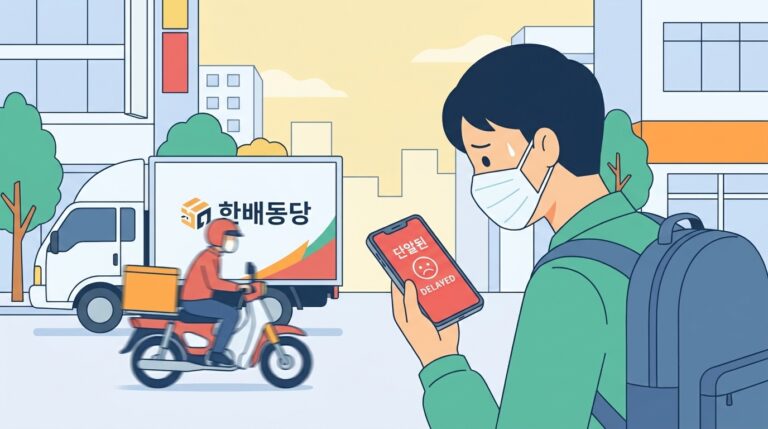
Imagine this: You finally scored VIP tickets to your favorite K-Pop idol’s highly anticipated concert in Seoul. You meticulously ordered the official lightstick and the perfect outfit a week in advance. Korea is the undisputed champion of Pali-Pali (hurry-hurry) culture and dawn deliveries, so you weren’t sweating it. But as the concert draws near, you check the delivery tracking app and see an ominous red banner: 택배 파업 (Parcel Delivery Strike). The concert is tomorrow, and your package hasn’t moved for three days.
For advanced learners living in or visiting Korea, navigating the logistics infrastructure isn’t just about ordering items; it’s about knowing what to do when this perfectly oiled machine suddenly halts. A delivery strike (파업) isn’t just an inconvenience here—it’s a national event that shifts how millions of people move goods. Today, we are going to dive deep into the advanced vocabulary, cultural nuances, and survival tactics you need when Korea’s legendary logistics system hits a bottleneck.
(Note: This guide is built on real frantic messages from our advanced C2 learners who found their essential travel gear or concert merch stuck in transit!)
Phase 2: Core Expressions Deep Dive
Let’s master the advanced expressions Koreans use when the delivery network is paralyzed.
1. 옥천 허브에 묶이다
- Pronunciation: [ok-cheon heo-beu-e mu-kki-da]
- Meaning: Literal: “Tied up at the Okcheon Hub.” / Real nuance: “Stuck in the Bermuda Triangle of Korean deliveries.”
- K-Culture Moment: Okcheon Hub is a real central logistics terminal in Korea. It processes so many packages that sometimes items seem to circle there endlessly. When a strike happens, millions of boxes get 묶이다 (tied up/stuck) here. You’ll see fans on X (formerly Twitter) crying over their delayed albums with screenshots of the Okcheon Hub status.
- Editor’s Insight: Using “묶이다” instead of the textbook “지연되다” (delayed) immediately marks you as a highly fluent speaker. It conveys a sense of physical constraint—your item is literally trapped.
- Situation Spectrum:
- Casual: ✅
- Semi-formal: ✅
- Formal: ⚠️ (Use ‘물류 센터에 계류 중입니다’ in strict business contexts)
- 🤔 Think About It: Why does Korean use the passive voice “묶이다” (to be tied) for delayed inanimate objects? How does it reflect the speaker’s feeling of helplessness?
2. 물류 대란
- Pronunciation: [mul-lyu dae-ran]
- Meaning: Logistics crisis / Supply chain disruption
- K-Culture Moment: You’ll hear news anchors grimly announcing this term on the 8 O’clock News. When the couriers go on strike demanding better working conditions, the entire nation braces for a 대란 (great chaos/crisis).
- Editor’s Insight: “대란” (大亂) is an advanced Hanja-based suffix used for widespread social inconveniences (e.g., 주차 대란 – parking crisis, 전세 대란 – housing lease crisis). Using this elevates your vocabulary to a sophisticated C2 level.
- Situation Spectrum:
- Casual: ⚠️ (A bit too dramatic for a late pizza, but fine for national news)
- Semi-formal: ✅
- Formal: ✅
- 🤔 Think About It: Calling a delivery delay a “great chaos” (대란) shows how deeply dependent Korean society is on hyper-fast logistics. Would this be considered a “crisis” in your home country?
3. 퀵으로 쏴주세요
- Pronunciation: [kwi-geu-ro sswa-ju-se-yo]
- Meaning: Literal: “Shoot it via Quick.” / Real nuance: “Send it immediately via motorcycle courier.”
- K-Culture Moment: In K-Dramas, when a ruthless CEO needs a physical contract delivered across Seoul in 30 minutes, they don’t use regular mail; they use 퀵서비스 (Quick Service).
- Editor’s Insight: “쏘다” literally means “to shoot” (like a gun or arrow), but in slang, it means to pay for a meal (내가 쏠게 = I’ll treat) OR to dispatch something with explosive speed. It’s the ultimate Plan B during a parcel strike.
- Situation Spectrum:
- Casual: ✅
- Semi-formal: ✅
- Formal: 🚫 (Use “퀵서비스로 발송해 주시겠습니까?” instead)
- 🤔 Think About It: Does your language have a verb as aggressive as “shoot” to describe sending a parcel?
Phase 3: Textbook vs. Real Korean
Let’s bridge the gap between your advanced textbook and the chaotic reality of a delivery crisis.
[Notification of Delay]
* 📖 Textbook Korean: 배송이 지연되고 있습니다. 양해 부탁드립니다. (Delivery is currently delayed. We ask for your understanding.)
* 🗣️ Real Korean: 파업 때문에 물건이 묶여서 기약이 없어요. (The items are tied up due to the strike, so there’s no telling when they’ll arrive.)
* 💡 Why the difference?: “기약이 없다” (no promise of a date) is a poetic yet highly common way to express total uncertainty in scheduling, reflecting the emotional fatigue of waiting.
[Requesting an Alternative]
* 📖 Textbook Korean: 다른 배송 방법을 이용할 수 있습니까? (Can I use a different delivery method?)
* 🗣️ Real Korean: 혹시 반값택배나 오토바이 퀵으로 우회 가능할까요? (Is it possible to detour via half-price delivery or a motorcycle courier?)
* 💡 Why the difference?: “우회하다” (to detour) is brilliantly used here metaphorically to mean bypassing the paralyzed main logistics network.
Phase 4: Cultural Context — K-Culture Deep Dive
4-1. Non-Verbal Nuances: The ‘F5’ Syndrome
When a package is delayed, Koreans don’t just wait; they suffer from 새로고침 증후군 (Refresh Syndrome). The act of constantly swiping down on the delivery app to update the tracking status is a shared national anxiety. If you are complaining about a delayed package to a Korean friend, mimic swiping down on your phone furiously—they will instantly relate.
4-2. The Clash of Titans: ‘Pali-Pali’ vs. Labor Rights
Korea’s delivery infrastructure is a modern marvel. But during a 택배 파업, the facade drops. For K-Pop fans, a strike during a comeback season is a nightmare—albums don’t arrive, which means missing out on crucial first-week sales counts (초동) and fansign lottery tickets.
However, critical thinkers must recognize that these strikes highlight the grueling reality of gig economy workers (택배 기사님) who handle hundreds of packages daily. Thus, while consumers complain about the 대란, there is also an underlying cultural shift towards supporting the workers’ right to rest, often expressed online with “천천히 와도 괜찮아요” (It’s okay if it arrives slowly).
Phase 5: Real-World Roleplay Scenario
Setting: It’s Thursday afternoon at a bustling cafe in Yeonnam-dong. You are panicking because the custom-made Hanbok you ordered for your friend’s wedding on Saturday is delayed. You are venting to your Korean friend, Ji-eun, while furiously checking your phone.
Characters:
– YOU (The Reader): An expat living in Seoul, highly fluent but currently stressed out of your mind.
– Ji-eun (30): Your savvy local friend who knows all the life hacks in Seoul.
Dialogue:
YOU: 지은아, 나 진짜 발을 동동 구르고 있어. 토요일이 결혼식인데 한복이 아직도 옥천 허브야!
(Ji-eun-a, na jinjja bareul dong-dong gureugo isseo. Toyoiri gyeolhonsiginde hanbogi ajikdo okcheon heobeuya!)
[Ji-eun, I’m literally stamping my feet in anxiety. The wedding is Saturday but my Hanbok is still at the Okcheon Hub!]
Ji-eun: 헐, 요즘 택배 노조 부분 파업하잖아. 운송장 번호 조회해 봐. 언제부터 거기 묶여 있었는데?
(Heol, yojeum taekbae nojo bubun pa-eophajana. Unsongjang beonho johoehae bwa. Eonjebuteo geogi mukkyeo isseonneunde?)
[Oh no, the courier union is on a partial strike these days. Check the waybill number. How long has it been stuck there?]
YOU: 월요일부터 계속 ‘간선상차’ 상태야. 이거 토요일 전까지 올 확률 없겠지?
(Woryoilbuteo gyesok ‘ganseonsangcha’ sangtaeya. Igeo toyoil jeonkkaji ol hwangnyul eopgetji?)
[It’s been stuck on ‘Trunk Line Loading’ since Monday. Zero chance it arrives before Saturday, right?]
Ji-eun: 어떡해… 옥천 허브면 기약이 없는데. 판매자한테 연락은 해봤어?
(Eotteokhae… okcheon heobeumyeon giyagi eomneunde. Panmaeja-hante yeollageun haebwasseo?)
[What do we do… If it’s Okcheon Hub, there’s no telling. Have you contacted the seller?]
YOU: 아직. 근데 이미 출고된 거면 취소도 안 되잖아.
(Ajik. Geunde imi chul-godoen geomyeon chwisodo an doejana.)
[Not yet. But if it’s already dispatched, I can’t even cancel it.]
Ji-eun: 맞네. 아, 그럼 차라리 매장에 직접 가서 픽업하거나 퀵으로 쏴달라고 하는 건 어때?
(Manne. A, geureom charari maejange jikjeop gaseo pigeophageona kwigeuro sswadallago haneun geon eottae?)
[True. Ah, then how about going to the store to pick it up directly, or asking them to shoot it over via Quick Service?]
🔀 Your Turn! How do you respond?
– A) “그래야겠다. 판매자한테 착불 퀵으로 우회 가능하냐고 물어봐야지.” (I should. I’ll ask the seller if they can detour it via Quick Service, pay-on-delivery.)
– B) “그냥 운을 믿고 기다려볼래.” (I’ll just trust my luck and wait.)
– C) “파업 너무 짜증나. 신고할래!” (Strikes are so annoying. I’m going to report them!)✅ Best Choice: A — Why? It uses C2 level vocabulary (“착불” – cash on delivery, “우회하다” – to detour) and offers a highly realistic, proactive Korean solution to a logistics bottleneck.
⚠️ Choice B & C Analysis: Waiting (B) during a strike when you have a deadline is a recipe for disaster in Korea. Reporting a legal labor strike (C) makes no sense and shows a lack of cultural understanding of “파업”.
Phase 6: 10-Second Shadowing Drill
Channel your inner stressed-out Seoulite. Pay attention to the pauses and the heavy sigh at the beginning!
😤 하아... / 운송장 조회해 보니까 / 제 택배가 옥천 허브에 묶여서 / 기약이 없네요. (Haa... / unsongjang johoehae bonikka / je taekbae-ga okcheon heo-beu-e mu-kkyeo-seo / gi-ya-gi eom-ne-yo.)
Phase 7: K-Culture Mini Dictionary
| 한국어 | Romanization | English | Cultural Context |
|---|---|---|---|
| 택배 노조 | taekbae nojo | Courier Union | The labor union for delivery drivers. Their negotiations directly impact nationwide logistics. |
| 반값택배 | ban-kkap-taek-bae | Half-price delivery | A brilliant C2C service where you send/receive parcels between convenience stores (like GS25/CU). They use the stores’ own logistics trucks, making them immune to major courier strikes! |
| 옥천 허브 | okcheon heobeu | Okcheon Hub | A massive logistics terminal in central Korea. It’s notoriously known as the “Black Hole” of parcels. |
| 착불 | chak-bul | Cash/Pay on Delivery | Paying the delivery fee when you receive the item. Essential when you urgently call a Quick Service. |
| 간선상차 | ganseon-sangcha | Trunk Line Loading | The tracking status meaning your parcel is loaded onto a massive truck. If it stays here, you panic. |
Phase 8: Traveler’s Survival Kit
Even as a traveler, you might order items to your hotel or need to send luggage. If a strike hits, you need these lifesavers.
🆘 Survival Phrases for Logistics Crises
– 🇰🇷 “택배 파업이라던데, 혹시 편의점 반값택배로 수령 가능한가요?”
– 🗣️ (taekbae pa-eop-i-ra-deon-de, hok-si pyeon-ui-jeom ban-kkap-taek-bae-ro su-ryeong ga-neung-han-ga-yo?)
– 📍 Use case: Asking an online seller on an app (like Karrot/Bunjang) to use the convenience store network instead of regular mail.
- 🇰🇷 “너무 급해서 그런데, 오토바이 퀵 착불로 보내주실 수 있나요?”
- 🗣️ (neo-mu geu-pae-seo geu-reon-de, o-to-ba-i kwik chak-bul-lo bo-nae-ju-sil su in-na-yo?)
- 📍 Use case: Begging a store to send your delayed item via motorcycle courier, promising to pay the delivery fee upon arrival.
📌 Editor’s Travel Note
– The Ultimate Hack: During major national courier strikes (CJ, Lotte, Hanjin), convenience store deliveries (GS25, CU) usually operate normally because they use their own private supply chain trucks! It takes a day or two longer, but it’s reliable.
– Apps to download: For Quick Service, locals use apps like 카카오 T (Kakao T) which has a ‘Quick/Delivery’ tab. You can easily summon a motorcycle to move items across Seoul within hours.
Phase 9: Critical Thinking Corner — “한 발 더 깊이”
Media vs Reality: The True Cost of ‘Pali-Pali’
K-Dramas and commercials often portray South Korea as a futuristic utopia where you order a fresh salad at 11:59 PM and it arrives at your doorstep by 7:00 AM the next day (Dawn Delivery). While this is statistically true, the media rarely shows the human cost behind this convenience.
The recurring 택배 파업 (delivery strikes) are a stark reality check. They force consumers to confront the grueling gig economy, the extreme physical toll on drivers, and the sheer volume of consumption in dense urban spaces like Seoul. When a strike occurs, the public discourse isn’t just about “Where is my package?”; it involves intense societal debates over corporate responsibility, labor rights, and whether our addiction to Pali-Pali is sustainable.
💬 Your Turn: Does your home country have “Dawn Delivery” or same-day shipping? How does your culture balance consumer convenience with labor rights? Share your thoughts in the comments!
Phase 10: FAQ & Avoiding Common Mistakes
Q: If I use Quick Service (퀵서비스) instead, how much does it usually cost?
A: Unlike regular parcels which cost around 3,000 KRW nationwide, Quick Service prices depend on distance and weather. Within Seoul, a motorcycle courier typically costs between 10,000 to 25,000 KRW. Rain or snow adds a premium surcharge!
Q: Can I tell my boss “서류를 퀵으로 쏠까요?” (Shall I shoot the documents via Quick?)
A: No! While “쏘다” is great for colleagues, it’s too slangy for upper management. Say “서류를 퀵으로 발송할까요?” instead.
❌ Common Mistake #1: Confusing 택배 (Parcel Courier) with 배달 (Food Delivery).
✅ Do this instead: Do not say “치킨 택배 왔어요” (The chicken parcel arrived). Use 배달 for ready-to-eat food and 택배 for boxed merchandise.❌ Common Mistake #2: Asking the hotel concierge to “just wait” for a delayed package after you check out.
✅ Do this instead: If a strike delays your package beyond your departure date, you must contact the seller for a 반송 (Return to sender). Hotels will usually discard unverified delayed packages.
Phase 11: Summary & Action Items
One-Liner Summary: When Korea’s legendary logistics network faces a strike, advanced speakers don’t just wait; they pivot using terms like 물류 대란, bypass the 옥천 허브, and detour via 반값택배 or 퀵서비스.
Action Mission:
– 🥉 Bronze: Say “내 택배가 옥천 허브에 묶였어!” aloud with a dramatic sigh.
– 🥈 Silver: Next time you order something in Korea, find out which courier company handles it and learn how to track the “간선상차” status.
– 🥇 Gold (K-Culture Mission): Go to a local CU or GS25 and locate the “Postbox” machine. Explore the menu to see how “반값택배” (Half-price delivery) works!
Phase 12: Interactive Quiz
1. Situational Judgment: You ordered a limited-edition K-Pop album, but the news reports a massive 물류 대란. You need it by tomorrow for a fan-sign event. What is the most culturally savvy and effective request to the seller?
A) “천천히 보내주세요.” (Please send it slowly.)
B) “파업 중이니까 제가 직접 매장으로 픽업 가도 될까요?” (Since there’s a strike, can I go pick it up directly at the store?)
C) “경찰에 신고할게요.” (I will report this to the police.)
2. Fill in the Blank:
“아오, 내 가방이 아직도 옥천 ( _____ )에 ( _____ ) 있어! 기약이 없네.”
3. True or False – K-Culture Edition:
During a nationwide courier strike by major companies like CJ and Lotte, convenience store ‘Half-price delivery’ (반값택배) is completely shut down as well. (T/F)
Click for Answers!
1. B – Being proactive and asking for in-person pickup or a Quick Service is your best bet.
2. 허브 (Hub), 묶여 (Tied up/Stuck) – The classic combo of logistics despair.
3. False – Convenience store deliveries use their own logistics network (supply trucks for the stores), making them a massive loophole during national courier strikes!
Frequently Asked Questions (FAQ)
Q: What does "옥천 허브에 묶이다" mean in Korean and how do you pronounce it?
A: In Korean, "옥천 허브에 묶이다" is pronounced [ok-cheon heo-beu-e mu-kki-da] and means: Literal: "Tied up at the Okcheon Hub." / Real nuance: "Stuck in the Bermuda Triangle of Korean deliveries."
Q: What does "물류 대란" mean in Korean and how do you pronounce it?
A: In Korean, "물류 대란" is pronounced [mul-lyu dae-ran] and means: Logistics crisis / Supply chain disruption
Q: What does "퀵으로 쏴주세요" mean in Korean and how do you pronounce it?
A: In Korean, "퀵으로 쏴주세요" is pronounced [kwi-geu-ro sswa-ju-se-yo] and means: Literal: "Shoot it via Quick." / Real nuance: "Send it immediately via motorcycle courier."






