

Phase 1: Empathy — Welcome to the Glowing World of Korean Temples
Hello there! I’m your Daily Hangul Editor, your veteran Korean tutor and local culture navigator.
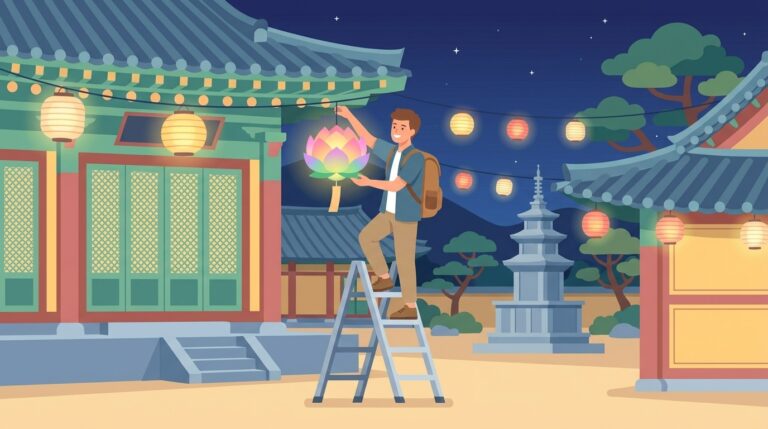
Imagine this: You’re watching a historical or healing K-Drama. The main characters are walking through a beautiful temple courtyard at night, illuminated by thousands of glowing, colorful lotus lanterns. It’s romantic, it’s peaceful, and it’s deeply spiritual. Fast forward to today—you are in Seoul during May, visiting Jogyesa or Bongeunsa Temple. You see people writing their heartfelt wishes on little slips of paper and hanging them under the vibrant lanterns.
You want to do it too. It’s the perfect way to participate in Korean culture, not just take photos for Instagram. But when you approach the registration desk, your mind goes blank. “How do I ask for one? Do I buy it? Do I just grab one?”
Don’t worry! Today, we are going to learn exactly how to participate in this beautiful Korean Buddhist tradition: hanging a lotus lantern (연등 달기). This guide is built from the real experiences of my students who wanted to leave their own glowing wishes in Seoul. Let’s dive in!
Phase 2: Core Expressions Deep Dive
Here are the 3 essential expressions you need to confidently secure your own glowing lantern.
1. 연등 하나 달고 싶은데요.
- Pronunciation: yeondeung hana dalgo sipeundeyo. [yeon-deung ha-na dal-go shi-peun-de-yo]
- Meaning: (Literal) I would like to hang one lotus lantern. / (Real nuance) I’d like to sponsor/purchase a lantern to hang.
- K-Culture Moment: You approach the white tent in the temple courtyard where volunteers (mostly older ladies) are sitting. You say this softly, and their faces will light up, ready to hand you a form.
- Editor’s Insight: Notice the ending
~ㄴ데요. It’s a softer, more polite way to state your intention or ask a question in Korean. It leaves room for the listener to respond, making it much more natural than a blunt “I want a lantern.”- Situation Spectrum:
- Temple volunteers/Monks (Formal & Polite): ✅
- Strangers (Semi-formal): ✅
- Close Friends (Casual): 🚫 (Use 달고 싶어 instead)
- 🤔 Think About It: Why do Koreans love using the “~ㄴ데요” (soft ending) when requesting something? How does your native language handle polite, indirect requests?
2. 소원지를 쓰고 싶어요.
- Pronunciation: sowonjireul sseugo sipeoyo. [so-won-ji-reul sseu-go shi-peo-yo]
- Meaning: I want to write a wish paper.
- K-Culture Moment: Every lantern comes with a small paper tag hanging from the bottom. This is where Koreans write their deepest wishes—usually for family health, success in the university entrance exam (수능), or finding a good job.
- Editor’s Insight: “소원” means wish, and “지” means paper. It’s a very straightforward expression that shows you understand how the lantern system works!
- Situation Spectrum:
- Temple volunteers (Polite): ✅
- Friends (Casual): ⚠️ (Use 쓰고 싶어)
3. 언제까지 걸려 있나요?
- Pronunciation: eonjekkaji geollyeo innayo? [eon-je-kka-ji geol-lyeo in-na-yo?]
- Meaning: Until when will it be hung up?
- K-Culture Moment: You want to know if you can come back with your friends next week to show them your lantern. Temples usually keep them up for a specific period, especially around Buddha’s Birthday (석가탄신일).
- Editor’s Insight: The ending
~나요?is a very gentle, curious way to ask a question. It sounds much friendlier than the rigid~습니까?.- Situation Spectrum:
- Temple volunteers (Polite): ✅
- Informational Desks (Formal): ✅
Phase 3: Textbook vs. Real Korean
Let’s look at how language changes from the textbook to the actual temple courtyard.
[Situation 1: Asking about the cost]
* 📖 Textbook Korean: 이 연등의 가격은 얼마입니까? (What is the price of this lotus lantern?)
* 🗣️ Real Korean: 연등 접수비가 얼마예요? (How much is the registration fee for the lantern?)
* 💡 Why it’s different: In a religious setting, Koreans avoid the word “가격” (price). Instead, they use “접수비” (registration fee) or “보시금” (donation/alms) to show respect to the religious nature of the act.
[Situation 2: Writing your wish]
* 📖 Textbook Korean: 나의 가족이 건강하기를 바랍니다. (I hope my family is healthy.)
* 🗣️ Real Korean: 가족 건강 / 우리가족 행복하게 해주세요. (Family health / Please make our family happy.)
* 💡 Why it’s different: Wish papers are small! Koreans use short, punchy noun phrases like “가족 건강” (Family health) or “만사형통” (Everything goes well) to fit their prayers onto the tag.
Phase 4: Cultural Context — K-Culture Deep Dive
4-1. Non-verbal Element: The “Hapjang” (합장) and Two Hands
When you interact with the monks (스님 – seunim) or the temple volunteers (usually called 보살님 – bosalnim, a respectful term for female Buddhist laypeople), it’s polite to use two hands when handing over your donation or receiving your lantern. If you want to show deep respect, you can place your palms together at your chest and do a slight bow. This is called hapjang (합장), and it instantly marks you as a respectful, culturally aware traveler.
4-2. K-Drama & K-Travel Connection
The Lotus Lantern Festival (연등회 – Yeondeunghoe) is so visually stunning that it’s a staple in K-Dramas. Think of historical dramas where the leads meet secretly under the glow of the lanterns, or modern healing dramas where a character goes to a temple stay to clear their mind.
If you are traveling in Korea during May (specifically around the 8th day of the 4th lunar month), visiting Jogyesa Temple in Insadong or Bongeunsa Temple in Gangnam is a must. The sky will be completely covered in a canopy of colorful lanterns. Even if you aren’t Buddhist, it’s a profound cultural experience to write your own sowonji (wish paper) and become part of that canopy.
Phase 5: Real-Life Roleplay Scenario
Setting: It’s a breezy evening in early May. You are at Jogyesa Temple in the heart of Seoul. The air smells faintly of incense. You walk up to the white tent where a friendly older volunteer (Bosalnim) is sitting behind stacks of colorful papers.
Characters:
– YOU: A traveler exploring Korean culture, wanting to hang a lantern.
– Bosalnim (60s): A warm, smiling temple volunteer wearing a traditional grey vest.
Dialogue:
YOU: 안녕하세요. 연등 하나 달고 싶은데요. 🪷
(annyeonghaseyo. yeondeung hana dalgo sipeundeyo.)
[Hello. I’d like to hang a lotus lantern.]
(🎭 Stage Direction: You bow slightly and approach the table.)
Bosalnim: 아유, 어서 와요! 본인 거 달려고요? 가족 거 달려고요?
(ayu, eoseo wayo! bonin geo dallyeogoyo? gajok geo dallyeogoyo?)
[Oh, welcome! Are you hanging it for yourself? Or for your family?]
YOU: 가족 연등으로 하고 싶어요. 접수비가 얼마예요?
(gajok yeondeungeuro hago sipeoyo. jeopsubiga eolmayeyo?)
[I’d like to do a family lantern. How much is the registration fee?]
Bosalnim: 일 년 동안 다는 건 10만 원이고, 한 달만 다는 건 3만 원이에요.
(il nyeon dongan daneun geon simman wonigo, han dalman daneun geon samman wonieyo.)
[Hanging it for a year is 100,000 won, and for one month is 30,000 won.]
YOU: 그럼 한 달짜리로 할게요.
(geureom han daljjariro halgeyo.)
[Then I’ll do the one-month one.]
(🎭 Stage Direction: You take out your wallet.)
Bosalnim: 네~ 여기 소원지에 소원 적어주세요. 예쁘게 적어봐요!
(ne~ yeogi sowonjie sowon jeogeojuseyo. yeppeuge jeogeobwayo!)
[Yes~ Please write your wish on this wish paper here. Write it beautifully!]
🔀 Your Turn! How should you write your wish?
– A) Write a long, detailed paragraph about your 5-year career plan in English.
– B) Write “가족 건강, 행복” (Family health, happiness) in neat Hangul.
– C) Leave it blank, the monks will know what you want.✅ Best Choice: B — Writing short, powerful keywords like “건강” (health) or “행복” (happiness) is the Korean way! Plus, writing it in Hangul makes it a great souvenir memory.
⚠️ Choice A Analysis: The tag is quite small (about the size of a bookmark), so a long paragraph physically won’t fit well!
YOU: 다 썼어요! 이거 어디에 달면 되나요?
(da sseosseoyo! igeo eodie dalmyeon doenayo?)
[I’m done writing! Where should I hang this?]
Bosalnim: 저기 마당 쪽에 빈자리 보이죠? 거기에 달면 돼요. 소원 꼭 이루어지길 바랄게요!
(jeogi madang jjoge binjari boijyo? geogie dalmyeon dwaeyo. sowon kkok irueojigil baralgeyo!)
[Do you see the empty spots over there in the courtyard? You can hang it there. I hope your wish comes true!]
YOU: 감사합니다! 안녕히 계세요.
(gamsahamnida! annyeonghi gyeseyo.)
[Thank you! Goodbye.]
Phase 6: 10-Second Shadowing Drill
Practice making your request sound natural and soft! Pay attention to the pauses (/) and the emotional tone.
- 🥺 Politely requesting:
안녕하세요~ / 저도 / 연등 하나 / 달고 싶은데요.
(annyeonghaseyo~ / jeodo / yeondeung hana / dalgo sipeundeyo.) -
😊 Asking happily:
여기 / 소원지에 / 쓰면 되나요?
(yeogi / sowonjie / sseumyeon doenayo?)
Phase 7: K-Culture Mini Dictionary
| Korean | Romanization | English | Contextual Meaning |
|---|---|---|---|
| 연등 | yeondeung | Lotus lantern | The colorful lanterns hung in temples, representing the lighting of the dark world with Buddha’s wisdom. |
| 소원지 | sowonji | Wish paper | A small tag attached to the lantern where you write your prayers. |
| 보살님 | bosalnim | Female lay Buddhist | A polite title used to address middle-aged/older women volunteering at the temple. (Literally means Bodhisattva). |
| 석가탄신일 | seokgatansinil | Buddha’s Birthday | A national holiday in Korea, usually in May. The peak time for lanterns! |
| 합장 | hapjang | Palms together | The Buddhist gesture of pressing palms together in front of the chest to show respect. |
Phase 8: Traveler’s Survival Kit
Visiting a Korean temple is generally free and open to everyone, but having a few survival phrases will make your experience so much richer.
🆘 Survival Phrases for Temple Visits
– 🇰🇷 “카드로 계산해도 되나요?” (kadeuro gyesanhaedo doenayo?)
– 🗣️ Meaning: Can I pay with a credit card?
– 📍 Where to use: Registration desk. (Yes, major Korean temples accept credit cards for lantern donations!)
– 🇰🇷 “사진 찍어도 되나요?” (sajin jjigeodo doenayo?)
– 🗣️ Meaning: Is it okay to take a picture?
– 📍 Where to use: Before taking photos of the monks or inside the main hall (대웅전).
– 🇰🇷 “화장실이 어디예요?” (hwajangsiri eodiyeyo?)
– 🗣️ Meaning: Where is the restroom?📌 Editor’s Travel Note
– Dress Code: Temples are sacred places. Avoid wearing overly revealing clothing (like short shorts or tank tops) if you plan to go inside the prayer halls.
– Silence is Golden: The courtyard might be bustling during festivals, but keep your voice down near the main halls where people are bowing and praying.
– Card is King: Don’t worry if you don’t have cash. Most large temples in Seoul have card terminals at the lantern registration desk.
Phase 9: Critical Thinking — “One Step Deeper”
🧠 Think Deeper: Space for Everyone (Religion in the Global Era)
In many cultures, religious spaces are strictly for followers of that specific faith. However, in Korea, temples during the Lotus Lantern Festival blur the line between religion, culture, and community festival. You will see young couples on dates, foreign tourists, and families of various backgrounds all hanging lanterns side by side. It reflects a very syncretic, flexible approach to belief in modern Korean society—where participating in a Buddhist tradition is seen as sharing good energy and seeking peace, rather than converting to a religion.
💬 Your Turn:
Are religious spaces in your home country open for cultural participation by outsiders, or are they strictly for practitioners? Share your thoughts in the comments!
Phase 10: FAQ & Mistake Prevention
- Q: I’m not Buddhist. Is it disrespectful for me to hang a lantern?
- A: Absolutely not! Korean temples are incredibly welcoming to foreigners and non-Buddhists. They view it as you participating in Korean culture and wishing for good things. They will be thrilled to help you.
- Q: Can I use English on my wish paper?
- A: Yes! The monks joke that Buddha is multilingual. Write in whatever language is most comfortable for your heart.
❌ Common Mistake #1: Walking through the middle door of the main hall (대웅전).
✅ Do this instead: If you enter the main prayer building, always use the side doors. The center door is traditionally reserved for the monks (스님).❌ Common Mistake #2: Taking flash photography inside the main hall while people are praying.
✅ Do this instead: Take all your beautiful photos outside in the courtyard under the lanterns. Inside the hall, put your camera away and enjoy the quiet atmosphere.
Phase 11: Summary & Action Items
One-Liner Summary: Use “연등 하나 달고 싶은데요” to confidently ask for a lantern, and write your heartfelt wishes on a “소원지” (wish paper).
Action Mission 3-Steps:
– 🥉 Bronze (Solo): Look at a photo of a Korean temple lantern and say, “연등 하나 달고 싶은데요” out loud 3 times.
– 🥈 Silver (Online): Comment below with what you would write on your “소원지” (Wish paper) using Korean! (e.g., 가족 건강)
– 🥇 Gold (Real Life): When you visit Korea, go to Jogyesa or Bongeunsa Temple and actually register for a lantern using today’s expressions!
🪷 K-Culture Mission:
Search “Lotus Lantern Festival Korea” on YouTube or find a historical K-Drama. Spot the little wish papers (소원지) hanging from the bottom of the lanterns!
Engagement: If you could hang a lantern tonight, what is the one wish you would write on it? Let me know in the comments below!
Phase 12: Interactive Quiz
1. Situational Judgment: You want to ask the temple volunteer how much the lantern costs. Which is the most natural Korean expression?
– A) 이 연등의 가격은 얼마입니까?
– B) 연등 접수비 얼마예요?
– C) 연등 싸게 주세요.
2. True or False — K-Culture Edition:
You must be a registered Buddhist to hang a lantern at a Korean temple. (T/F)
3. Fill in the Blank:
“I want to write a wish paper.” -> “[ ______ ]를 쓰고 싶어요.”
(Answers: 1. B (It’s more respectful to use ‘접수비’ instead of ‘가격’ in a temple), 2. False (Anyone is welcome!), 3. 소원지)
Frequently Asked Questions (FAQ)
Q: What does "연등 하나 달고 싶은데요." mean in Korean and how do you pronounce it?
A: In Korean, "연등 하나 달고 싶은데요." is pronounced [yeondeung hana dalgo sipeundeyo. [yeon-deung ha-na dal-go shi-peun-de-yo] and means: (Literal) I would like to hang one lotus lantern. / (Real nuance) I'd like to sponsor/purchase a lantern to hang.
Q: What does "소원지를 쓰고 싶어요." mean in Korean and how do you pronounce it?
A: In Korean, "소원지를 쓰고 싶어요." is pronounced [sowonjireul sseugo sipeoyo. [so-won-ji-reul sseu-go shi-peo-yo] and means: I want to write a wish paper.
Q: What does "언제까지 걸려 있나요?" mean in Korean and how do you pronounce it?
A: In Korean, "언제까지 걸려 있나요?" is pronounced [eonjekkaji geollyeo innayo? [eon-je-kka-ji geol-lyeo in-na-yo?] and means: Until when will it be hung up?







