

Phase 1: Empathy (Immersion Open)
Hello! I’m the Lead Editor of Daily Hangul.
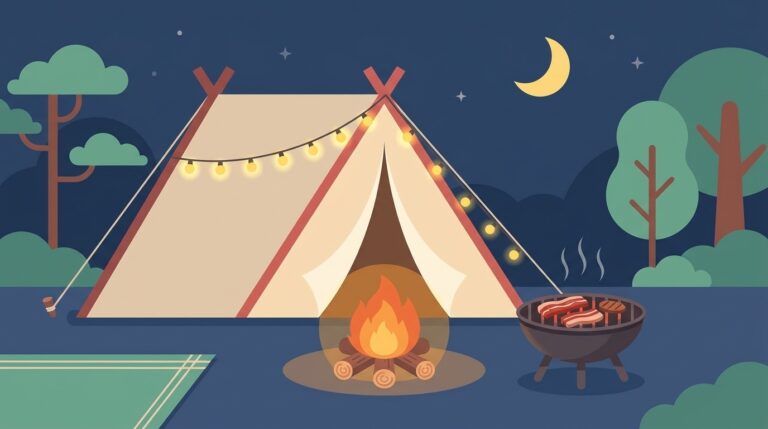
Imagine this: You’ve booked a gorgeous glamping site in Gapyeong after seeing those idyllic camping scenes in K-Dramas like Hospital Playlist. The string lights are glowing, the pork belly (samgyeopsal) is sizzling on the grill, and you’re ready to chat the night away with your friends. But suddenly, around 10 PM, the campsite manager walks by and softly says, “손님, 이제 매너타임입니다” (Guest, it is now manner time).
Wait, manner time? Are you being rude? Do you need to go to sleep immediately?
Camping and glamping have exploded in popularity in Korea, creating a unique subculture with its own set of rules and vocabulary. If you don’t know these terms, you might accidentally become the “noisy neighbor” or miss out on the best parts of the Korean outdoor experience.
This guide is based on real SOS messages from our B2 students who ventured into the Korean wilderness. Let’s make sure your next camping trip is perfectly chill!
Phase 2: Core Expressions Deep Dive
1. 불멍 (Bulmeong)
- Pronunciation: [bulmeong] (Sounds like bull-mung. The ‘eo’ sounds like the ‘u’ in ‘sung’.)
- Meaning: (Literal) Fire spacing out -> (Real nuance) Zoning out while staring at a campfire.
- K-Culture Moment: This is the holy grail of Korean camping. In reality shows like Gamsung Camping, after dinner, the cast always sits around the fire in complete silence, holding a warm mug.
- Editor’s Insight: This word is a portmanteau of 불 (fire) and 멍때리다 (to space out). It’s not just an activity; it’s a state of mind. Koreans use it as a healing mechanism to escape the fast-paced “Pali-Pali” city life.
- Situation Spectrum:
- Casual friends: ✅ (야, 오늘 불멍 때리자! – Hey, let’s do bulmeong today!)
- Semi-formal: ✅ (불멍하기 좋은 날씨네요. – It’s good weather for bulmeong.)
- Formal/Elders: ⚠️ (A bit slangy, better to say 모닥불 피울까요? – Shall we light a campfire?)
- 🤔 Think About It: Why do Koreans have a specific slang word for “staring blankly” (like 물멍 – staring at water, 숲멍 – staring at trees)? How does this reflect the psychological burnout of modern society?
2. 매너타임 (Maeneo-taim)
- Pronunciation: [maeneo-taim] (Konglish for “Manner Time”)
- Meaning: (Literal) Manner time -> (Real nuance) Quiet hours at a campsite (usually from 10 PM or 11 PM to 7 AM).
- K-Culture Moment: You’re laughing loudly with your friends, and a neighboring camper gives you the look and points at their watch. It’s 10:15 PM.
- Editor’s Insight: This is the absolute golden rule of Korean campsites. “Manner time” means no loud music, no shouting, and keeping conversations to a whisper. It shows how communal living spaces operate in Korea—even outdoors, you must consider others’ personal space.
- Situation Spectrum:
- Casual/Formal: ✅ (Universally used by all ages as an official campsite rule.)
- 🤔 Think About It: Does your country have a strict “quiet hour” at campsites, or is camping considered a time to party late into the night?
3. 장비 대여 (Jangbi daeyeo)
- Pronunciation: [jangbi daeyeo] (Jang-bee dae-yeo)
- Meaning: (Literal) Equipment rental -> (Real nuance) Renting camping gear like tents, grills, or heaters.
- K-Culture Moment: You realize you forgot your gas burner, and you need to ask the ahjussi at the camp store (매점) if you can rent one.
- Editor’s Insight: While beginners might just use 빌리다 (to borrow), using 대여하다 (to rent) instantly upgrades your Korean to a solid B2 level. It sounds much more natural in a commercial transaction.
- Situation Spectrum:
- Commercial/Staff: ✅ (화로대 대여 되나요? – Can I rent a fire pit?)
- Friends: 🚫 (Use 빌리다 with friends instead.)
- 🤔 Think About It: Notice how formal vocabulary (Sino-Korean words like 대여) is preferred in business transactions, while native Korean words (빌리다) are used in personal relationships?
Phase 3: Textbook vs. Real Korean
[Situation 1: Asking to rent a fire pit]
* 📖 Textbook Korean: 화로대를 빌리고 싶습니다. (I would like to borrow a fire pit.)
* 🗣️ Real Korean: 사장님, 혹시 화로대 대여 되나요? (Boss, by any chance, is the fire pit available for rent?)
* 💡 Why the difference?: Adding “혹시” (by any chance) and “사장님” (Boss/Manager) softens the request, making it polite and very local. Using “대여 되나요?” focuses on the availability of the service rather than your desire to rent it.
[Situation 2: Warning a friend about the noise]
* 📖 Textbook Korean: 조용히 해야 합니다. 밤이 늦었습니다. (We must be quiet. It is late at night.)
* 🗣️ Real Korean: 야, 쉿! 이제 매너타임이야. (Hey, shh! It’s manner time now.)
* 💡 Why the difference?: “Manner time” is such an ingrained concept that simply stating the term is enough to command immediate silence among Koreans.
Phase 4: Cultural Context — K-Culture Deep Dive
4-1. Non-verbal Element: “Nunchi” at the Campsite
In Korea, Nunchi (the subtle art of gauging others’ moods) doesn’t stop when you enter the woods. If you notice tents around you turning off their main lanterns and switching to dim string lights, your nunchi should tell you that “Manner Time” is approaching. Lowering your voice before being asked is considered top-tier camping etiquette.
4-2. K-Travel & K-Food Connection
Camping in Korea is heavily centered around K-Food. It’s less about “survival in the wild” and more about “eating a 5-course meal outdoors.” You will see Koreans grilling samgyeopsal, followed by boiling Ramyeon in the meat grease, and finishing with roasted sweet potatoes (고구마) in the campfire ashes. If you don’t bring enough food to feed a small army, you’re not doing Korean camping right! Therefore, knowing how to navigate the camp convenience store (매점 – maejeom) is a crucial survival skill.
Phase 5: Real-Life Roleplay Scenario
Setting: A beautiful glamping site in Gapyeong, 9:45 PM. The air is crisp. You are sitting with two Korean friends around a dying fire. You need more wood, so you walk to the camp’s small shop (매점).
Characters:
– YOU: A foreign resident who loves K-camping but wants to keep the fire going.
– 사장님 (Site Manager): A friendly but strict ahjussi (mid-50s) who enforces the rules.
Dialogue:
YOU: 사장님, 안녕하세요! 혹시 장작 한 망 살 수 있을까요?
(Sajangnim, annyeonghaseyo! Hoksi jangjak han mang sal su isseulkkayo?)
[Hello! Could I buy one bag of firewood, by any chance?]
사장님: 아이고, 어쩌죠? 지금 장작은 다 떨어졌어요. 숯만 남았는데.
(Aigo, eojjeojyo? Jigeum jangjageun da tteoreojyeosseoyo. Sutman namanneunde.)
[Oh dear, what should we do? We are completely out of firewood. We only have charcoal left.]
YOU: 아, 정말요? 저희 불멍 좀 더 하고 싶었는데 아쉽네요.
(Ah, jeongmallyo? Jeo-hui bulmeong jom deo hago sipeonneunde aswimneyo.)
[Ah, really? That’s a shame, we wanted to do a bit more bulmeong.]
사장님: 그리고 손님, 15분 뒤부터는 매너타임인 거 아시죠?
(Geurigo sonnim, sip-o-bun dwibuteoneun maeneo-taimin geo asijyo?)
[And guest, you know that manner time starts in 15 minutes, right?]
🔀 YOUR TURN! How should you respond?
– A) “아니요, 왜 조용히 해야 하죠? 우리는 놀러 왔어요!” (No, why should we be quiet? We came to play!)
– B) “네, 알고 있습니다. 10시부터는 조용히 할게요. 감사합니다!” (Yes, I know. We will be quiet from 10 PM. Thank you!)
– C) “매너타임이요? 대박!” (Manner time? Daebak!)✅ Best Choice: B — This acknowledges the rule respectfully and assures the manager you will comply.
⚠️ Choice A / C Analysis: A is incredibly rude and will likely get you a severe warning (or kicked out). C is too casual and completely misses the serious tone of enforcing camp rules.
사장님: 네, 10시 넘어서는 랜턴 불빛도 조금 줄여주시면 감사하겠습니다.
(Ne, yeolsi neomeoseoneun raenteon bulbitdo jogeum juryeojusimyeon gamsahagetseumnida.)
[Yes, I would appreciate it if you could also dim your lantern lights a bit after 10 PM.]
(🎭 Stage Direction: The manager smiles warmly but firmly, giving you a slight bow.)
YOU: 네, 명심할게요. 안녕히 주무세요!
(Ne, myeongsimhalgeyo. Annyeonghi jumuseyo!)
[Yes, I’ll keep that in mind. Good night!]
Phase 6: 10-Second Shadowing Drill
Practice this sentence to sound like a local when you need something at the camp store!
😊 사장님, / 장작 / 한 망만 / 더 주세요!
(sa-jang-nim, / jang-jak / han mang-man / deo ju-se-yo!)
Pitch your voice slightly higher at the end to sound polite and friendly! Make a brief pause after calling the manager, and emphasize ‘han mang-man’ (just one bag).
Phase 7: K-Culture Mini Dictionary
| Korean | Romanization | English | Context |
|---|---|---|---|
| 차박 | chabak | Car camping | Sleeping in your car (often an SUV). A massive trend in Korea right now! |
| 글램핑 | geullaemping | Glamping | Glamorous camping. Tents are pre-setup with beds, AC, and sometimes even a private bathroom. |
| 매점 | maejeom | Camp store | The small convenience store on-site where you buy snacks, water, and firewood. |
| 화로대 | hwarodae | Fire pit | Essential gear for grilling meat and doing bulmeong. |
| 숯불 | sutbul | Charcoal fire | The preferred fire for grilling Korean BBQ at the campsite. |
Phase 8: Traveler Survival Kit
🆘 Survival Phrase #1: Renting Gear
– 🇰🇷 “이거 대여 요금이 얼마예요?” (igeo daeyeo yogeumi eolmayeyo?)
– 🗣️ English Guide: [Ee-geo dae-yeo yo-geum-ee eol-ma-ye-yo?]
– 📍 Where to use: Glamping front desk, camp shop, ski resorts.
– 💡 Pro Tip: Always ask if there is a deposit (보증금 – bojeunggeum).🆘 Survival Phrase #2: Manner Time Warning
– 🇰🇷 “저기요, 매너타임이라서요. 조금만 조용히 해주세요.” (jeogiyo, maeneo-taimiraseoyo. jogeumman joyonghi haejuseyo.)
– 🗣️ English Guide: [Jeo-gi-yo, mae-neo ta-im-ee-ra-seo-yo. Jo-geum-man jo-yong-hee hae-ju-se-yo.]
– 📍 Where to use: When the tent next to you is playing EDM at 11 PM.
– 💡 Pro Tip: It’s often safer to text or call the campsite manager to handle noisy neighbors rather than confronting them directly!📌 Editor’s Travel Note: Camping Hacks in Korea
– Apps to use: ‘Campit’ (캠핏) or Naver Map for booking campsites.
– Trash Policy: You MUST separate your trash. Ask for a 종량제 봉투 (Jongnyangje bongtu – official garbage bag) when you check in. Failure to separate recycling (분리수거 – bunrisugeo) is a huge faux pas!
Phase 9: Critical Thinking — “One Step Further”
🧠 Think Deeper: Food & Identity in the Wild
Why is Korean camping so obsessed with cooking and eating elaborate meals together? Historically and culturally, sharing food from a communal pot (like a bubbling stew on a camp stove) is the ultimate expression of Jeong (정 – deep emotional bond/affection). In Korea, you aren’t just surviving nature; you are moving your dining room outdoors to strengthen relationships. A camping trip without sharing a meal is like a K-Drama without a plot twist.
💬 Your Turn: In your culture, what is the “must-do” activity when you go camping? Is it hiking, drinking, or perhaps making s’mores? Share in the comments!
Phase 10: FAQ & Avoiding Misunderstandings
Q: “Can I forage for firewood in the mountains near the campsite?”
No! In Korea, it is generally illegal to collect wood from national parks or private mountains. You must buy 장작 (firewood) at the camp store or bring your own.
Q: “Is Manner Time actually strictly enforced?”
Yes. Many modern private campsites have a “2-strike” or even “1-strike” out policy. If you are caught being loud after 10 PM or 11 PM, the manager will literally ask you to pack your tent and leave in the middle of the night.
❌ Common Mistake #1: Throwing all your trash into one big bag when leaving.
✅ Do this instead: Look for the 분리수거장 (Recycling Area). You must manually separate plastics, cans, glass, and especially 음식물 쓰레기 (food waste) before you check out!
Phase 11: Summary & Action Items
- One-Liner Summary: To survive Korean camping, master the art of Bulmeong (zoning out by the fire) and strictly respect the Manner Time (quiet hours).
Action Mission 3 Steps:
– 🥉 Bronze: Say “사장님, 이거 대여 되나요?” 3 times in front of the mirror.
– 🥈 Silver: Write down your ideal Korean camping menu (e.g., Samgyeopsal, Ramyeon) in Korean on your notebook.
– 🥇 Gold: On your next trip to Korea, book a Glamping spot on Naver and use these phrases with the manager!
🇰🇷 K-Culture Mission:
Watch a YouTube vlog of “한국 글램핑” (Korean Glamping) or an episode of Hospital Playlist where they go camping. Try to spot the exact moment they do Bulmeong!
Phase 12: Quiz — Interactive Challenge
1. Situational Judgment: It’s 10:30 PM at the campsite. Your friends are laughing loudly playing a card game. What is the most appropriate thing to say to them?
– A) 얘들아, 더 크게 웃어! (Guys, laugh louder!)
– B) 쉿, 이제 매너타임이야. (Shh, it’s manner time now.)
– C) 사장님 부르자! (Let’s call the manager!)
2. True or False – K-Culture Edition:
In Korea, it’s totally fine to leave your food waste and regular trash in the same plastic bag when you leave a campsite. (T / F)
3. Fill in the Blank:
사장님, 혹시 화로대 _____ 되나요? (Boss, is it possible to rent a fire pit?)
Hint: Look at Phase 2!
Click to see answers!
1. B (It’s manner time, you must lower your voices!)
2. False! You must strictly separate your recycling and food waste (bunrisugeo).
3. 대여 (daeyeo)
Frequently Asked Questions (FAQ)
Q: What does "불멍 (Bulmeong)" mean in Korean and how do you pronounce it?
A: In Korean, "불멍 (Bulmeong)" is pronounced [bulmeong] and means: (Literal) Fire spacing out -> (Real nuance) Zoning out while staring at a campfire.
Q: What does "매너타임 (Maeneo-taim)" mean in Korean and how do you pronounce it?
A: In Korean, "매너타임 (Maeneo-taim)" is pronounced [maeneo-taim] and means: (Literal) Manner time -> (Real nuance) Quiet hours at a campsite (usually from 10 PM or 11 PM to 7 AM).
Q: What does "장비 대여 (Jangbi daeyeo)" mean in Korean and how do you pronounce it?
A: In Korean, "장비 대여 (Jangbi daeyeo)" is pronounced [jangbi daeyeo] and means: (Literal) Equipment rental -> (Real nuance) Renting camping gear like tents, grills, or heaters.







