

Phase 1: Empathy & The “Gyegok” Reality Check
Hello! I’m the Lead Editor at Daily Hangul.
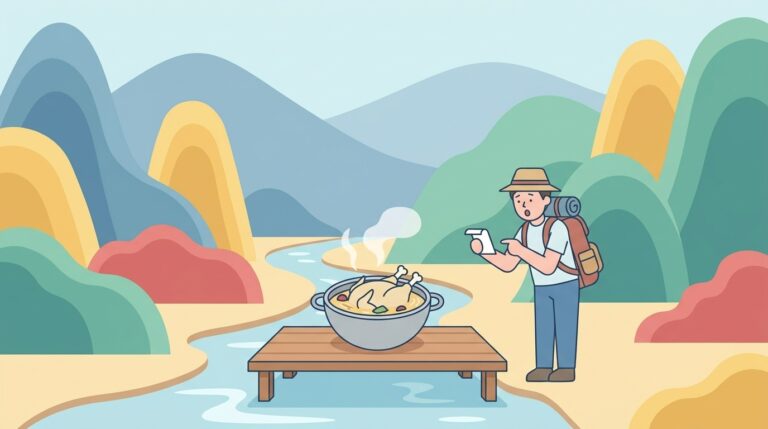
Picture this: It’s the peak of the sweltering Korean summer. You’ve seen it in countless K-Dramas—the whole family escapes the city heat to a lush mountain valley, known as a Gyegok (계곡). There’s crystal-clear water flowing, and right by the stream (or sometimes literally in the water), people are sitting on low tables, sharing a massive, boiling pot of whole chicken soup called Baeksuk (백숙).
It sounds like a rustic, romantic summer getaway, right? But then the bill arrives. 150,000 KRW (over $100) for a single chicken? Wait… did the subtitles miss something?
Welcome to the infamous Gyegok Baeksuk Price Controversy (계곡 백숙 바가지 논란). Surviving a Korean summer isn’t just about handling the humidity; it’s about navigating ‘tourist prices’ like a local. If you don’t know the cultural context or the right words, you might end up paying a small fortune just to sit by a public river. This guide, built from the real experiences of my students, will teach you how to spot a tourist trap, politely negotiate, and enjoy K-Summer without losing your cool.
Phase 2: Core Expressions Deep Dive
1. 바가지 쓴 거 아니야?
- Pronunciation: [bagaji sseun geo aniya?] / ba-ga-ji sseun guh a-ni-ya?
- Meaning: Literal: “Didn’t we wear a gourd?” / Real nuance: “Didn’t we just get ripped off?”
- K-Culture Moment: You’ll often hear this in reality shows or dramas when a character checks a receipt at a tourist spot and their jaw drops. Bagaji means a large gourd bowl. Historically, getting ‘covered with a gourd’ meant being unfairly blamed or scammed.
- Editor’s Insight: This expression is incredibly common among friends. You wouldn’t say this directly to the store owner, but you’d whisper it to your travel buddy when the price seems suspiciously high.
- Situation Spectrum:
- Casual with friends: ✅
- Talking to colleagues (Semi-formal): ⚠️ (Use ‘바가지 쓴 것 같아요’)
- To the restaurant owner (Formal): 🚫 (Never say this to their face!)
- 🤔 Think About It: Why do Koreans use a ‘gourd bowl’ to describe a scam? Could it be related to old market games where scammers hid items under gourds? Does your native language have an interesting idiom for being overcharged?
2. 가격이 좀 센데요.
- Pronunciation: [gagyeogi jom sendeyo] / ga-gyuh-gi johm sen-de-yo
- Meaning: Literal: “The price is a bit strong.” / Real nuance: “That’s a bit too expensive / That’s steep.”
- K-Culture Moment: You’re at a traditional market near the valley, trying to buy some watermelon. The vendor names a price. You playfully smile, scratch your head, and drop this line. It’s the perfect, polite pushback.
- Editor’s Insight: Saying “너무 비싸요” (It’s too expensive) can sometimes sound a bit direct or complaining. Saying the price is “strong” (세다) is a socially smoothed-over way to express hesitation without offending the seller.
- Situation Spectrum:
- Casual: ✅ (가격이 좀 세다)
- Semi-formal/To vendors: ✅
- Highly formal business: ⚠️
- 🤔 Think About It: Notice how Koreans use the word ‘strong’ (세다) instead of ‘high’ (높다) for prices in daily conversation? It gives a physical weight to the concept of money.
3. 자릿세 포함된 거예요?
- Pronunciation: [jaritse pohamdoen geoyeyo?] / ja-rit-seh po-ham-dwen guh-yeh-yo?
- Meaning: Literal: “Is the seating tax included?” / Real nuance: “Am I paying extra just for sitting here?”
- K-Culture Moment: This is the core of the Gyegok controversy. Historically, illegal pop-up restaurants claimed public valley spots and charged a “seat fee” disguised as the price of the chicken.
- Editor’s Insight: Use this if a place asks you to pay upfront before you even order, or if the food price is absurdly high. It shows you know how the system works.
- Situation Spectrum:
- Casual: ✅
- To a vendor: ⚠️ (Use with caution, as it can sound confrontational, but necessary if you suspect a scam)
Phase 3: Textbook vs. Real Korean
[Situation 1: Reacting to an absurdly high price]
* 📖 Textbook Korean: 이것은 너무 비쌉니다. (This is too expensive.)
* 🗣️ Real Korean: 와, 가격 진짜 사악하네. (Wow, the price is purely evil.)
* 💡 Why the difference?: Younger Koreans love using dramatic adjectives like 사악하다 (evil) or 미쳤다 (crazy) to describe extreme things, including high prices, adding a layer of humorous exaggeration.
[Situation 2: Deciding to eat elsewhere]
* 📖 Textbook Korean: 다른 식당으로 가겠습니다. (I will go to another restaurant.)
* 🗣️ Real Korean: 그냥 딴 데 가자. (Let’s just go somewhere else.)
* 💡 Why the difference?: Efficiency! In spoken Korean, ‘다른 곳’ (another place) is quickly contracted to ‘딴 데’.
Bottom Note: For B2 learners, using words like “사악하네” with close friends will make you sound incredibly fluent and culturally plugged-in. Just avoid using it in front of the restaurant owner!
Phase 4: Cultural Context — K-Culture Deep Dive
4-1. Non-verbal Cue: The Art of the ‘Awkward Laugh’
When negotiating or pointing out a high price in Korea, avoid intense, confrontational eye contact. Instead, employ Nunchi (눈치). Give a slightly awkward smile, maybe tilt your head, and use a soft tone. You aren’t starting a fight; you’re gently letting them know, “Hey, I know this is a bit overpriced, let’s work this out.”
4-2. K-Food Connection: Why Hot Chicken in Summer?
You might wonder, why are Koreans eating boiling chicken soup while sweating by a river? This is rooted in the concept of 이열치열 (I-yeol-chi-yeol), which means “fighting heat with heat.” During the hottest days of summer (Boknal), Koreans consume hot, nutritious foods like Baeksuk or Samgyetang to replenish the stamina lost to sweating. The controversy arises because opportunistic vendors exploit this deep-rooted cultural tradition by overcharging families trying to enjoy their annual summer ritual.
Phase 5: Practical Roleplay Scenario
Setting: Saturday, 1 PM. A crowded mountain valley in Gapyeong. The sound of cicadas is deafening. You and your Korean friend, Min-su, just found an empty table right by the cool water. An owner wearing an apron approaches you.
Characters:
* YOU: An expat living in Seoul, excited for your first Gyegok experience but aware of tourist traps.
* Min-su (29): Your energetic Korean friend.
* Owner (50s): The fast-talking restaurant owner.
Dialogue:
Owner: 어서 와요! 자리 좋은데 잡았네. 백숙 하나 줄까?
(eoseo wayo! jari joeunde jamanne. baeksuk hana julkka?)
[Welcome! You grabbed a good spot. Should I get you one Baeksuk?]
(🎭 Stage Direction: The owner wipes the table quickly, implicitly pressuring you to order.)
Min-su: 네, 사장님! 여기 토종닭 백숙 얼마예요?
(ne, sajangnim! yeogi tojongdak baeksuk eolmayeyo?)
[Yes, boss! How much is the native chicken Baeksuk here?]
Owner: 우리 집은 닭이 엄청 커! 한 마리에 15만 원.
(uri jibeun dalgi eomcheong keo! han marie siboman won.)
[Our chickens are huge! It’s 150,000 won for one.]
Min-su: (Eyes widening) 네? 15만 원이요?
(ne? siboman woniyo?)
[Excuse me? 150,000 won?]
🔀 Your Turn! How do you react to help Min-su?
* A) “아, 네. 알겠습니다. 주세요.” (Ah, okay. I understand. Please give it to us.)
* B) “사장님, 가격이 좀 센데요… 자릿세 포함된 거예요?” (Boss, the price is a bit steep… Is the seat fee included in this?)
* C) “와, 완전 사기꾼이네요! 바가지 안 써요!” (Wow, you’re a total scammer! I won’t get ripped off!)✅ Best Choice: B — Reason: It shows you understand the situation without being outright insulting. Often, vendors might back down or offer side dishes for free if they see you aren’t an easy target.
⚠️ Choice C Analysis: Calling someone a scammer (사기꾼) directly is a massive taboo and will likely result in a screaming match. Always preserve face (기분).
Bonus K-Culture Roleplay: The Market Escape
You decide to leave the valley and buy food at a local market instead.
YOU: 이거 수박 한 통에 얼마예요?
(igeo subak han tonge eolmayeyo?)
[How much is one whole watermelon?]
Vendor: 3만 원인데, 학생들한테는 2만 5천 원에 줄게.
(samman woninde, haksaengdeulhanteneun iman ocheon wone julge.)
[It’s 30,000 won, but I’ll give it to you students for 25,000 won.]
YOU: 우와, 감사합니다!
(uwa, gamsahamnida!)
[Wow, thank you!]
(Pro Tip: Being called ‘student’ (학생) is a common friendly term for any young adult in markets!)
Phase 6: 10-Second Shadowing Drill
Practice this sentence to perfect your polite-but-firm negotiation tone.
😬 사장님, / 가격이 / 좀 / 센데요~ (sajangnim, / gagyeogi / jom / sendeyo~)
Note: Stretch the final ‘yo’ slightly to soften the blow. Keep your tone light, not aggressive!
Phase 7: K-Culture Mini Dictionary
| Korean | Romanization | English | Cultural Context |
|---|---|---|---|
| 눈치 | nunchi | Social intuition | The core Korean skill of “reading the room” or reading between the lines. |
| 계곡 | gyegok | Mountain valley | The ultimate traditional Korean summer getaway spot. |
| 백숙 | baeksuk | Boiled whole chicken | A stamina-boosting soup, unseasoned compared to Samgyetang. |
| 바가지 | bagaji | Rip-off / Overcharge | Refers to being scammed, typically at tourist traps or festivals. |
| 자릿세 | jaritse | Seating fee | Often illegally charged by vendors who monopolize public nature spots. |
Phase 8: Traveler Survival Kit
If you are traveling to rural Korean spots this summer, these phrases are your armor.
🆘 Survival Expression #1
* 🇰🇷 “메뉴판 좀 볼 수 있을까요?” (menyupan jom bol su isseulkkayo?)
* 🗣️ me-nyu-pan johm bol soo is-seul-kka-yo?
* 📍 Where to use: Before sitting down at ANY tourist restaurant.
* 💡 Pro Tip: If a restaurant doesn’t have prices listed on their menu, walk away. It’s a classic red flag for a tourist trap.🆘 Survival Expression #2
* 🇰🇷 “저희 그냥 갈게요.” (jeohui geunyang galgeyo.)
* 🗣️ juh-hui geu-nyang gal-ge-yo.
* 📍 Where to use: When the price is too high and you want to safely exit.📌 Editor’s Travel Note
* The Law: The Korean government has recently cracked down on illegal Gyegok restaurants. If you see places blocking the river with fences, it’s likely illegal.
* Cash vs. Card: While Korea is a card heaven, some rural valley spots will ask for cash or bank transfers (계좌이체) to avoid taxes. It’s best to insist on card to ensure you get a proper receipt.
Phase 9: Critical Thinking Corner — “One Step Deeper”
🧠 Think Deeper: Media vs. Reality
K-Dramas often portray summer trips to the Gyegok as idyllic, heartwarming family bonding moments where local store owners are generous and welcoming. However, the reality of the “Baeksuk Controversy” reveals a clash between romanticized media images and modern consumer rights. Young Koreans today are actively using social media to expose these tourist traps, refusing to accept the “it’s just how it is during vacation season” excuse. This shift shows how the newer generation in Korea values fairness and transparency over simply “keeping the peace” (눈치) with older vendors.
💬 Your Turn: Have you ever experienced a “tourist trap” in your own country that completely shattered the romanticized media image of that location? Share your story in the comments!
Phase 10: FAQ & Avoiding Misunderstandings
- Q: Can I haggle at a normal restaurant in Seoul?
- A: No! Haggling (깎아주세요) is strictly for traditional markets (시장), street vendors, or unregulated tourist spots like valleys. In a standard restaurant or cafe, prices are fixed.
- Q: If I buy the food, can I stay by the water all day?
- A: Usually, yes. That’s the “trade-off” vendors use to justify the high price of the chicken. You are essentially renting the table for the afternoon.
❌ Common Mistake: Using aggressive language like “당신 도둑이야!” (You are a thief!) when feeling overcharged.
✅ Do This Instead: Use “가격이 좀 세네요” (It’s a bit steep) and simply walk away. Koreans prefer non-confrontational exits over loud public arguments.
Phase 11: Summary & Action Items
- One-Liner Summary: A trip to the Korean summer valley is beautiful, but protect your wallet by knowing how to spot Bagaji (rip-offs) and politely decline steep prices.
-
Action Mission 3 Steps:
- 🥉 Bronze: Say “사장님, 가격이 좀 센데요” out loud 3 times to your mirror.
- 🥈 Silver: Write a short fictional dialogue in a Korean learning forum where you escape a tourist trap.
- 🥇 Gold: Next time you go to a traditional market in Korea, try asking for a slight discount with a big smile!
- K-Culture Mission: Search “계곡 백숙” (Gyegok Baeksuk) on YouTube or Google Images. Look at how the tables are set up right in the water. Can you spot why this causes a clash between nature lovers and restaurant owners?
Phase 12: Quiz — Interactive Challenge
1. Situational Judgment: You sit down at a valley restaurant. The owner says the chicken is 200,000 KRW. What is the most culturally appropriate way to leave?
* A) Flip the table and yell “바가지!”
* B) Smile awkwardly and say “아, 가격이 좀 세네요. 저희 그냥 갈게요.”
* C) Say “너무 비쌉니다! 깎아주세요!” and refuse to move.
(Answer: B. It’s polite, clear, and avoids a scene.)
2. True or False — K-Culture Edition:
* “Eating boiling hot chicken soup in the middle of summer is considered strange in Korea.”
(Answer: False. It is a deeply loved tradition called I-yeol-chi-yeol, meant to restore summer stamina!)
3. Fill in the Blank:
My friend checked the receipt and realized we paid double. He whispered to me: “우리 ___ 쓴 거 아니야?”
(Answer: 바가지 – bagaji)
Frequently Asked Questions (FAQ)
Q: What does "바가지 쓴 거 아니야?" mean in Korean and how do you pronounce it?
A: In Korean, "바가지 쓴 거 아니야?" is pronounced [bagaji sseun geo aniya?] and means: Literal: "Didn't we wear a gourd?" / Real nuance: "Didn't we just get ripped off?"
Q: What does "가격이 좀 센데요." mean in Korean and how do you pronounce it?
A: In Korean, "가격이 좀 센데요." is pronounced [gagyeogi jom sendeyo] and means: Literal: "The price is a bit strong." / Real nuance: "That's a bit too expensive / That's steep."
Q: What does "자릿세 포함된 거예요?" mean in Korean and how do you pronounce it?
A: In Korean, "자릿세 포함된 거예요?" is pronounced [jaritse pohamdoen geoyeyo?] and means: Literal: "Is the seating tax included?" / Real nuance: "Am I paying extra just for sitting here?"







