

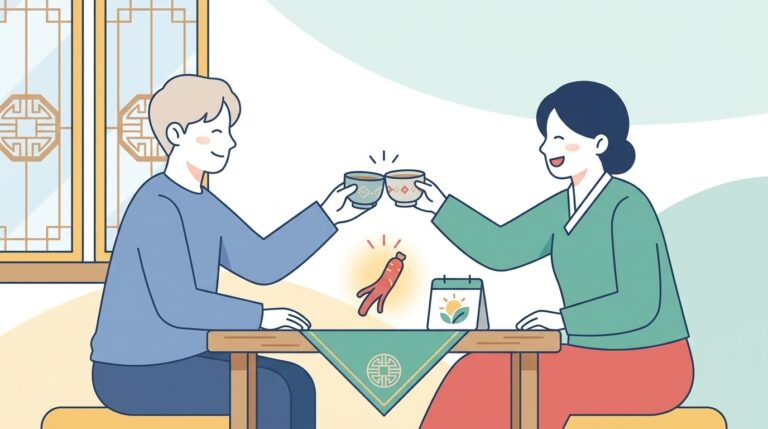
Phase 1: Empathy & The K-Culture Connection
Hello! It’s your Daily Hangul Editor.
Picture this: You are watching a K-Drama. The main character is working late, exhausted, eyes barely open. Suddenly, they whip out a small, foil packet, tear the top with their teeth, and suck down a dark liquid. Is it an emergency potion? Nope! It’s 홍삼 (Hongsam – Red Ginseng).
If you’ve watched enough K-Dramas, you might wonder why Korean characters are so obsessed with vitamins, health foods, and telling each other to “stay healthy.” Whether it’s New Year’s Day, a birthday, or just the end of an email, the ultimate wish in Korea always circles back to one thing: Health and Longevity.
Today, we are going to learn how to talk about your future plans and wishes, specifically the universally approved goal: “건강하게 오래 사는 것이 목표다” (My goal is to live a long and healthy life). Knowing how to express this won’t just help you ace your B1 Korean test; it will instantly make you sound like a true local who understands the heart of Korean culture. Let’s dive in!
Phase 2: Core Expressions Deep Dive
1. 건강하게 오래 사는 것이 목표예요.
- Pronunciation: geonganghage orae saneun geosi mokpyoyeyo. (Gun-gang-ha-ge oh-rae sa-neun geo-she mok-pyo-ye-yo.)
- Meaning: My goal is to live a long and healthy life.
- K-Culture Moment: It’s January 1st, and you are hiking up a mountain at 6 AM to see the first sunrise (a classic Korean New Year’s tradition). When your friend asks what you wished for, saying this will get you enthusiastic nods of approval.
- Editor’s Insight: This phrase sounds very mature and grounded. While younger people might joke about wanting to be a billionaire, saying your priority is health shows deep wisdom. The word 목표 (goal) can be used for anything from career to fitness.
- Situation Spectrum:
- Casual (Friends): ✅ (You can drop the ‘요’ and say “목표야”)
- Semi-formal (Co-workers): ✅
- Formal (Boss/Elders): ✅
- 🤔 Think About It: Why does Korean culture value health so much in daily conversation? Does your culture prioritize health as a main “life goal,” or is it usually career and wealth?
2. 무조건 건강이 최고예요.
- Pronunciation: mujogeon geongangi choegoyeyo. (Moo-jo-geon gun-gang-ee chwe-go-ye-yo.)
- Meaning: Health is absolutely the best / Health is the number one priority.
- K-Culture Moment: You are at a team dinner (회식), and a colleague complains about having a cold from overworking. The senior manager pours them some warm tea and says this.
- Editor’s Insight: “무조건” (unconditionally/absolutely) is a fantastic B1 adverb. It adds that dramatic, relatable emphasis. You are saying, “No matter what else happens (money, fame), health wins.”
- Situation Spectrum:
- Casual (Friends): ✅
- Semi-formal (Co-workers): ✅
- Formal (Boss/Elders): ⚠️ (Better to say “건강이 가장 중요합니다”)
- 🤔 Think About It: “최고” (the best) is used for everything from food to people. How does adding “무조건” change the emotional weight of the sentence?
3. 아프지 말고 건강하세요.
- Pronunciation: apeuji malgo geonganghaseyo. (Ah-peu-jee mal-go gun-gang-ha-se-yo.)
- Meaning: Don’t get sick and stay healthy.
- K-Culture Moment: K-Pop fans use this constantly! If you read letters to idols on Weverse, 90% of them end with “오빠/언니, 아프지 말고 건강하세요!” (Please don’t get sick and stay healthy!).
- Editor’s Insight: This is the ultimate caring phrase. It’s a wish for the future, but used as a goodbye greeting. It shows you care about their physical well-being above all else.
- Situation Spectrum:
- Casual (Friends): ✅ (아프지 말고 건강해!)
- Semi-formal (Co-workers): ✅
- Formal (Boss/Elders): ✅
Phase 3: Textbook vs. Real Korean
[Setting a Future Goal]
* 📖 Textbook: 저의 장래 희망은 건강하게 사는 것입니다. (My future hope is to live healthily. – Sounds like a robot writing a school essay.)
* 🗣️ Real Korean: 제 인생 목표요? 무조건 건강하게 오래 사는 거죠! (My life goal? Absolutely living long and healthy!)
* 💡 Why the difference?: Real conversations use rhetorical questions (“제 인생 목표요?”) and filler endings (“~는 거죠”) to sound conversational and engaged, rather than reciting facts.
[Wishing Someone Longevity]
* 📖 Textbook: 오래오래 생존하시기를 바랍니다. (I hope you survive for a long time. – Creepy and unnatural!)
* 🗣️ Real Korean: 건강하게 오래오래 사세요! (Please live long and healthily! / 만수무강하세요! – very formal, usually for grandparents’ 70th/80th birthdays.)
* 💡 Why the difference?: Direct translations of “survive” or “exist” feel cold. Korean uses “살다” (to live) with the repeating adverb “오래오래” (long long) for a warm, melodic wish.
Bottom Note: At the B1 level, try using adverbs like “무조건” (absolutely) or “오래오래” (for a very long time) to make your sentences sound much more native-like.
Phase 4: Cultural Context — K-Culture Deep Dive
4-1. Non-Verbal Elements: The Art of Giving
When talking about health goals or wishing someone health, Koreans often pair it with a physical gesture: giving health supplements. If you hand someone a box of vitamins or red ginseng, always use two hands. If a senior colleague tells you “건강이 최고예요” and hands you a vitamin C packet, the proper Nunchi (눈치) move is to bow slightly, say “감사합니다,” and drink/eat it right there to show appreciation for their care.
4-2. K-Food Connection: 보양식 (Stamina Food)
In Korea, health isn’t just about medicine; it’s heavily tied to food. When you say “건강하게 오래 사는 것이 목표예요,” a Korean friend might immediately suggest going to eat 보양식 (Boyangsik).
In the peak of summer (복날), Koreans eat boiling hot Samgyetang (Ginseng Chicken Soup) to “fight heat with heat” and replenish their energy. Food is viewed as medicine. If you want to impress your Korean friends, say: “건강을 위해서 주말에 보양식 먹으러 갈까요?” (Shall we go eat some healthy stamina food this weekend for our health?).
Phase 5: Real-Life Roleplay Scenario
Setting: January 2nd, 7 PM. A cozy, warmly lit cafe in Yeonnam-dong. You are having coffee with your Korean friend, Min-ji, and talking about the New Year.
Characters:
– YOU: A foreigner living in Seoul, trying to balance work and Korean studies.
– Min-ji (28): Your lively Korean friend who loves asking deep questions.
Dialogue:
Min-ji: 새해가 밝았네요! 올해 특별한 계획이나 소망 있어요? 🌅
(saehaega balganneyo! olhae teukbyeolhan gyehoegina somang isseoyo?)
[The new year has dawned! Do you have any special plans or wishes for this year?]
YOU: 음… 여러 가지가 있지만, 저는 건강하게 오래 사는 것이 목표예요.
(eum… yeoreo gajiga itjiman, jeoneun geonganghage orae saneun geosi mokpyoyeyo.)
[Hmm… I have a few, but my goal is to live a long and healthy life.]
Min-ji: 오, 진짜요? 완전 공감해요. 작년에 너무 바빠서 맨날 아팠잖아요. 😢
(o, jinjjayo? wanjeon gonggamhaeyo. jangnyeone neomu bappaseo maennal apatjanayo.)
[Oh, really? I totally relate. You were always sick last year because you were so busy.]
YOU: 맞아요. 그래서 올해는 운동도 시작했어요.
(majayo. geuraeseo olhaeneun undongdo sijakaesseoyo.)
[Right. So I even started exercising this year.]
Min-ji: 대박! 무슨 운동 해요?
(daebak! museun undong haeyo?)
[Awesome! What kind of exercise are you doing?]
YOU: 헬스장에 등록했어요. 무조건 건강이 최고잖아요.
(heulseujange deungnokaesseoyo. mujogeon geongangi choegojanayo.)
[I registered at a gym. Health is absolutely the best, you know.]
Min-ji: 맞아요. 돈 명예 다 필요 없어~ 건강 잃으면 끝이에요!
(majayo. don myeongye da pilyo eopseo~ geongang ireumyeon kkeuchieyo!)
[That’s right. You don’t need money or fame~ If you lose your health, it’s over!]
YOU: 민지 씨는 목표가 뭐예요?
(minji ssineun mokpyoga mwoyeyo?)
[What is your goal, Min-ji?]
Min-ji: 저도 당연히 건강이죠! 우리 다 같이 아프지 말고 건강하게 지내요!
(jeodo dangyeonhi geongangijyo! uri da gachi apeuji malgo geonganghage jinaeyo!)
[For me, it’s naturally health too! Let’s all not get sick and stay healthy!]
🔀 Your Turn! How should you respond to Min-ji?
– A) “네, 알겠습니다.” (Too robotic and formal for a friend.)
– B) “좋아요! 우리 건강을 위해서 홍삼 하나 사 먹을까요?” (Witty, culturally aware, and enthusiastic!)
– C) “아니요, 저는 돈이 더 좋아요.” (Funny, but might ruin the warm vibe.)✅ Best Choice: B! Suggesting a “health item” like Red Ginseng perfectly matches the cultural context of prioritizing health.
Phase 6: 10-Second Shadowing Drill
Read this out loud. Pay attention to the pauses (/) and the emotion!
😤 제 인생 / 목표는 / 무조건! / 건강하게 / 오래 사는 거예요.
(je insaeng / mokpyoneun / mujogeon! / geonganghage / orae saneun geoyeyo.)
Emotion Guide: Say “무조건!” (absolutely) with strong conviction, nodding your head slightly. You are stating your ultimate life truth!
Phase 7: K-Culture Mini-Dictionary
| 한국어 | Romanization | English | Context |
|---|---|---|---|
| 보양식 | boyangsik | Health/Stamina food | Foods like Samgyetang or Eel, eaten to restore energy. |
| 홍삼 | hongsam | Red Ginseng | The most popular health supplement in Korea, often given as a gift. |
| 만수무강 | mansumugang | Longevity | A traditional phrase wishing an elder a long life without illness. |
| 건강 검진 | geongang geomjin | Health Check-up | Koreans get comprehensive health screenings regularly. It’s a huge part of adult life! |
Phase 8: Traveler’s Survival Kit (Pharmacy/Hospital Edition)
If your goal is to stay healthy while traveling in Korea, you need to know how to navigate a Korean pharmacy (약국).
🆘 Survival Phrases for Staying Healthy in Korea
– 🇰🇷 “머리가 아파요. 진통제 주세요.” (meoriga apayo. jintongje juseyo.)
– 🗣️ Meaning: My head hurts. Please give me painkillers.
– 📍 Where to use: 약국 (Pharmacy)
- 🇰🇷 “소화가 안 돼요. 소화제 주세요.” (sohwaga an dwaeyo. sohwaje juseyo.)
- 🗣️ Meaning: I have indigestion. Please give me digestive medicine.
- 📍 Where to use: After eating too much spicy K-Food!
📌 Editor’s Travel Note
– Pharmacies are everywhere: Look for the word “약” (Yak) in big red or green letters.
– Weekend emergencies: Most pharmacies close on Sundays, but you can buy basic pain relievers (like Tylenol) and digestive medicine at any convenience store (CU, GS25)!
Phase 9: Critical Thinking — “One Step Deeper”
Language and Care: Why do Koreans obsess over health greetings?
🧠 Think Deeper:
In many Western cultures, asking about someone’s health is usually reserved for when they are visibly sick. In Korea, saying “밥 챙겨 먹어” (Make sure you eat) or “건강 챙기세요” (Take care of your health) are used as everyday hellos and goodbyes. This reflects Korea’s historically collective society, where caring for the physical well-being of your community members was a way of showing deep affection (정 – Jeong). It’s not just small talk; it’s a verbal blanket wrapping the other person in care.💬 Your Turn: In your culture, what is the most common way to show someone you care about them through words? Do you mention health, or something else? Share in the comments!
Phase 10: FAQ & Avoiding Common Mistakes
Q: Can I tell my boss “아프지 말고 건강하세요”?
Yes! It is actually a very polite and warm thing to say, especially around the holidays or if they look tired. Just make sure to use the formal ending (~세요 or ~하십시오).
Q: Can I use “목표” (goal) for small things, like my goal for the weekend?
Yes. While “계획” means a specific plan, “목표” implies a desired outcome. Saying “주말 목표는 하루 종일 자는 거예요” (My weekend goal is sleeping all day) is perfectly natural and funny.
❌ Common Mistake #1: Saying “건강해요” as a greeting to mean “Be healthy.”
✅ Do this instead: “건강해요” is an adjective meaning “I am healthy” or “He is healthy.” To wish someone health, you must use the imperative form: “건강하세요” (Please be healthy).
Phase 11: Summary & Action Items
One-Liner Summary: To sound like a true local when discussing future plans, declare that health is your absolute priority: “건강하게 오래 사는 것이 목표예요!”
Action Mission 3 Steps:
– 🥉 Bronze (Solo): Say “무조건 건강이 최고예요” out loud 3 times while stretching today.
– 🥈 Silver (Online): Leave a comment on your favorite K-Pop idol’s video saying “아프지 말고 건강하세요! ❤️”
– 🥇 Gold (Real World): Next time a Korean friend asks how you are doing, tell them about a healthy habit you started and say “건강하게 오래 사는 게 목표거든요!”
🎬 K-Culture Mission: Watch an episode of a modern K-Drama this week. Count how many times you see a character eating a health supplement (like a red ginseng stick) or telling another character to “eat well” or “stay healthy.”
Phase 12: Interactive Quiz
1. Situational Judgment: Your older Korean coworker is retiring. What is the BEST thing to write in their farewell card?
– A) 오래오래 생존하세요.
– B) 건강하게 오래오래 사세요.
– C) 부자가 되세요.
2. Fill in the Blank:
A: 인생에서 제일 중요한 게 뭐라고 생각해요?
B: 돈도 좋지만, _________ 건강이 최고죠!
(Hint: The B1 adverb meaning ‘absolutely/unconditionally’)
3. True or False (K-Culture Edition):
Koreans often use phrases related to food and health as everyday greetings, even if nobody is actually sick. (T/F)
Answers (Click to reveal)
1. B – ‘생존하세요’ means ‘survive’ and is very unnatural. B is the perfect, warm wish for an elder.
2. 무조건 (mujogeon) – It adds the perfect emphasis!
3. True! Asking “Did you eat?” or saying “Stay healthy” are deeply embedded ways of saying “I care about you.”
Frequently Asked Questions (FAQ)
Q: What does "건강하게 오래 사는 것이 목표예요." mean in Korean and how do you pronounce it?
A: In Korean, "건강하게 오래 사는 것이 목표예요." is pronounced [geonganghage orae saneun geosi mokpyoyeyo. (Gun-gang-ha-ge oh-rae sa-neun geo-she mok-pyo-ye-yo.] and means: My goal is to live a long and healthy life.
Q: What does "무조건 건강이 최고예요." mean in Korean and how do you pronounce it?
A: In Korean, "무조건 건강이 최고예요." is pronounced [mujogeon geongangi choegoyeyo. (Moo-jo-geon gun-gang-ee chwe-go-ye-yo.] and means: Health is absolutely the best / Health is the number one priority.
Q: What does "아프지 말고 건강하세요." mean in Korean and how do you pronounce it?
A: In Korean, "아프지 말고 건강하세요." is pronounced [apeuji malgo geonganghaseyo. (Ah-peu-jee mal-go gun-gang-ha-se-yo.] and means: Don't get sick and stay healthy.







