

Phase 1: Empathy & The K-Culture Cold Open
Hello there! I’m your lead editor at Daily Hangul.
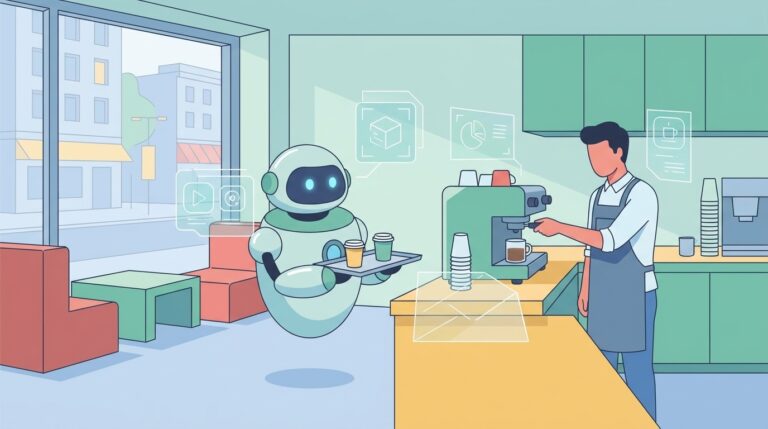
Picture this: It’s Friday night in Gangnam. You and your colleagues step into a bustling K-BBQ restaurant, mouths watering for some premium Samgyeopsal. But instead of a friendly ajumma rushing over with side dishes, a sleek, blinking robot with cat ears rolls up to your table, playing a cheerful melody. You take your plates, and the robot zips away. It’s incredibly efficient, very ‘Korea,’ and undeniably cool. But as you pour a glass of Soju, a thought crosses your mind… “Wait, whose job did this cute little machine just replace?”
South Korea has one of the highest robot densities in the world. From unstaffed convenience stores (무인 편의점) to robot baristas, automation is woven deeply into the fabric of daily K-Life. For an advanced (C2) Korean learner, this isn’t just about ordering food anymore. It’s about participating in the profound societal debates happening at those very dinner tables: Tech Ethics, the Future of Labor, and the Robot Tax (로봇세).
If you want to move beyond textbook pleasantries and truly connect with Korean professionals, academics, or simply your highly opinionated friends, you need the linguistic tools to navigate these complex, nuanced conversations. Let’s dive into the vocabulary that will make you sound like a true Seoulite intellectual.
Phase 2: Core Expressions Deep Dive
1. 시기상조다 (To be premature / too early)
- Pronunciation: [sigisangjoda] Sounds like: shee-gee-sang-jo-da
- Meaning: (Literal) Time is still early. / (Real Nuance) It’s jumping the gun; society isn’t ready for this yet.
- K-Culture Moment: You’ll hear this constantly on Korean news panels or during intense startup meetings. When someone suggests replacing all human HR staff with AI, the senior director will cross their arms, sigh, and drop this four-character Hanja idiom.
- Editor’s Insight: This is a power word. Using four-character idioms (사자성어) instantly elevates your Korean to a professional, highly educated level. It sounds much more sophisticated than just saying “아직 일러요” (It’s still early).
- Situation Spectrum:
- Casual friends: ⚠️ (A bit too stiff, unless debating seriously)
- Colleagues (Semi-formal): ✅
- Boss/Elders (Formal): ✅
- 🤔 Think About It: Why does Korean rely heavily on Chinese character idioms (Hanja) for formal or intellectual debates? How does this dual vocabulary system (Native Korean vs. Sino-Korean) compare to the Germanic/Latin divide in English?
2. 밥그릇을 뺏기다 (To have one’s livelihood threatened)
- Pronunciation: [bapgeureuseul ppaetgida] Sounds like: bap-geu-reus-eul ppet-gee-da
- Meaning: (Literal) To have one’s rice bowl stolen. / (Real Nuance) To lose one’s job or source of income to a competitor (or in this case, a machine).
- K-Culture Moment: A taxi driver ranting about self-driving cars, or local baristas talking about the new robot cafe across the street.
- Editor’s Insight: This is highly emotional and visceral. While “일자리를 잃다” (to lose a job) is factual, “밥그릇을 뺏기다” hits right at the core of human survival. In a historically agricultural society, your rice bowl is your life.
- Situation Spectrum:
- Casual friends: ✅
- Colleagues (Semi-formal): ✅
- Boss/Elders (Formal): ⚠️ (Use cautiously in formal debates; it’s quite colloquial)
- 🤔 Think About It: Food metaphors are everywhere in Korean. What does the equation of “job = rice bowl” tell you about the historical values of Korean society?
3. 불가피한 흐름 (An inevitable trend)
- Pronunciation: [bulgapihan heureum] Sounds like: bull-gah-pee-han heu-reum
- Meaning: (Literal) Unavoidable flow. / (Real Nuance) An unstoppable shift in society or technology.
- K-Culture Moment: The tech CEO on a podcast defending automation, arguing that resisting AI is like trying to stop the tide.
- Editor’s Insight: ‘흐름’ (flow/trend) is a beautiful word. Koreans often view history and societal changes as a flowing river rather than static events. Using ‘불가피한’ (inevitable) shows you understand the macro-perspective.
- Situation Spectrum:
- Casual friends: ⚠️ (A bit heavy)
- Colleagues (Semi-formal): ✅
- Boss/Elders (Formal): ✅
Phase 3: Textbook vs. Real Korean
Let’s upgrade your vocabulary from “Classroom” to “Boardroom/Bar.”
[Expressing Concern Over Job Losses]
* 📖 Textbook: 로봇 때문에 사람들의 일자리가 없어집니다. (Because of robots, people’s jobs will disappear.)
* 🗣️ Real Korean: 기계한테 밥그릇 뺏기게 생겼어요. (Looks like we’re going to have our livelihoods snatched by machines.)
* 💡 Why the difference?: The C2-level grammar “-게 생기다” expresses a looming, often negative realization, adding an emotional layer that flat textbook sentences lack.
[Discussing the Implementation of a Robot Tax]
* 📖 Textbook: 로봇세를 지금 시작하는 것은 안 좋습니다. (Starting a robot tax now is not good.)
* 🗣️ Real Korean: 로봇세 도입은 아직 시기상조라는 지적이 많습니다. (There is much criticism that the introduction of a robot tax is still premature.)
* 💡 Why the difference?: Using “-라는 지적이 많다” (There is much pointing out/criticism that…) is a brilliant way to state an opinion objectively, a common tactic in high-level Korean discourse.
[Describing the Lack of Human Touch]
* 📖 Textbook: 로봇만 있어서 외로워요. (I am lonely because there are only robots.)
* 🗣️ Real Korean: 편하긴 한데, 사람 냄새가 안 나서 좀 씁쓸하네요. (It’s convenient, but it’s a bit bittersweet because it lacks the human touch.)
* 💡 Why the difference?: “사람 냄새” (Human smell/scent) is the quintessential Korean phrase for warmth, empathy, and Jeong. It’s poetic and profoundly natural.
Bottom Note: At the C2 level, your goal isn’t just to be understood; it’s to resonate emotionally and intellectually with native speakers.
Phase 4: Cultural Context — K-Culture Deep Dive
4-1. Non-Verbal Cues in Deep Debates
When discussing heavy topics like the Future of Labor, Koreans employ subtle non-verbal cues. If you disagree with someone’s stance on the Robot Tax, don’t just say “아니요” (No) directly. Instead, inhale slightly through your teeth (a soft “tss” sound), tilt your head a few degrees, and say, “글쎄요… 그건 좀…” (Well… that’s a bit…). This indirectness preserves harmony (기분, gibun) while making your disagreement clear.
4-2. K-Food & K-Life: The Kiosk Reality
South Korea’s “무인화” (Unmanned automation) is staggering. Step into a fast-food joint, a cafe, or even a traditional soup restaurant, and you’ll likely order through a towering screen.
While young people love the speed (Ppalli-ppalli culture at its finest), there is a growing social discourse around “디지털 소외계층” (The digitally marginalized)—mostly the elderly who struggle to use kiosks and feel excluded from society. When discussing the Robot Tax, mentioning this generational divide shows deep, empathetic understanding of modern Korean society.
Phase 5: Real-Life Roleplay Scenario
Setting: A trendy tech-startup networking after-party at a high-end Makgeolli bar in Seongsu-dong. A serving robot gracefully navigates the narrow aisles to deliver your drinks.
Characters:
– YOU: A foreign tech consultant who understands both the economic and human elements of tech.
– Ji-hoon (35): A Korean startup founder. Tech-optimist, fast-talker, practical.
Dialogue:
Ji-hoon: 저 서빙 로봇 보세요. 진짜 효율적이죠? 인건비도 줄이고 실수도 없고요.
(jeo seobing robot boseyo. jinjja hyoyuljeogijyo? ingeonbido jurigo silsudo eopgoyo.)
[Look at that serving robot. Really efficient, right? Cuts labor costs and makes no mistakes.]
(🎭 Stage Direction: Ji-hoon picks up the Makgeolli bottle from the robot’s tray with a satisfied smile.)
YOU: 맞아요. 기술 발전 속도가 진짜 무서울 정도네요.
(majayo. gisul baljeon sokdoga jinjja museoul jeongdoneyo.)
[Right. The speed of technological advancement is honestly frightening.]
Ji-hoon: 근데 일각에서는 로봇세(Robot Tax)를 걷어서 기본소득 재원으로 쓰자고 하잖아요. 전 솔직히 그건 혁신을 가로막는 거라고 봅니다.
(geunde ilgageseoneun robotse-reul geodeoseo gibonsodeuk jaewoneuro sseujago hajanayo. jeon soljikhi geugeon hyeoksineul garomangneun georago bomnida.)
[But some sectors say we should collect a robot tax to fund universal basic income. Honestly, I think that hinders innovation.]
🔀 Your Turn! How do you respond?
– A) “저도 동의해요. 로봇세는 나빠요.” (Too simple, feels like A2 level.)
– B) “하지만 로봇 때문에 일자리를 잃는 사람들의 생계는 누가 책임지나요?” (Direct, but slightly aggressive for a networking event.)
– C) “물론 시기상조라는 의견도 이해합니다만, 장기적으로는 기술 소외계층을 위한 안전망도 필요하지 않을까요?”✅ Best Choice: C — Why? It acknowledges his point (“시기상조라는 의견도 이해합니다만” – I understand the view that it’s premature, but…) while gently introducing your counter-argument using a sophisticated vocabulary (“안전망” – safety net, “기술 소외계층” – tech-marginalized class). It’s the epitome of high-class conversational Korean.
Ji-hoon: 아… 듣고 보니 그렇네요. 너무 기업 입장만 생각했나 봅니다.
(a… deutgo boni geureonneyo. neomu gieop ipjangman saenggakaenna bomnida.)
[Ah… hearing that, you’re right. I guess I was only thinking from a corporate perspective.]
Phase 6: 10-Second Shadowing Drill
Let’s practice the rhythm of a C2-level debate sentence. Pay attention to the pauses (/) and the intonation!
😤 솔직히 / 혁신도 중요하지만, / 기계한테 밥그릇을 뺏기는 사람들을 위한 / 대책도 / 마련해야 한다고 봅니다.
(soljikhi / hyeoksindo jungyohajiman, / gigyehante bapgeureuseul ppaetgineun saramdeureul wihan / daechaekdo / maryeonhaeya handago bomnida.)
(Translation: Honestly, innovation is important, but I believe we must also prepare measures for the people whose livelihoods are being taken by machines.)
Phase 7: K-Culture Mini Dictionary (Tech & Society)
| 한국어 (Korean) | Romanization | English | Contextual Meaning |
|---|---|---|---|
| 무인화 | muinhwa | Automation / Unmanned | The rapid trend of removing human staff from stores and services. |
| 밥그릇 | bapgeureut | Rice bowl | Used metaphorically to mean one’s livelihood or job security. |
| 사람 냄새 | saram naemsae | Human scent | The feeling of human warmth, affection, and interaction. |
| 시기상조 | sigisangjo | Premature | A formal idiom used when society isn’t ready for a new policy or idea. |
| 인건비 | ingeonbi | Labor costs | A keyword in any business discussion about why robots are being adopted. |
Phase 8: Traveler Survival Kit (The Automated Korea)
Since you’ll be navigating a highly automated Korea, interacting with machines is unavoidable. Here are the survival phrases you need when dealing with the realities of the “Future of Labor” today.
🆘 Survival Expression #1: Dealing with Kiosks
– 🇰🇷 “직원 호출 버튼이 어디에 있나요?” (jigwon hochul beoteuni eodie innayo?)
– 🗣️ Meaning: Where is the ‘Call Staff’ button?
– 📍 Where to use: Unstaffed cafes, fast food kiosks when the machine freezes.
– 💡 Pro Tip: Look for words like 매장 식사 (Dine-in) and 포장 (Takeout/To-go) on the first screen.📌 Editor’s Travel Note
– Cashless Society: Unstaffed stores (무인 매장) generally do not accept cash. Always have a physical credit card or Apple/Samsung Pay ready.
– The Robot Server Etiquette: When a serving robot brings your food, you must move the plates to your table yourself, then press the “확인” (Confirm) or “돌아가기” (Return) button on its screen so it can leave.
Phase 9: Critical Thinking — “One Step Deeper”
Language & Power: The Paradox of Automation and ‘Jeong’ (정)
South Korea is a society built on Jeong (deep emotional connection, warmth, and communal bonds). Historically, dining out or going to the market was as much about chatting with the owner as it was about buying goods. However, Korea is also driven by Ppalli-ppalli (extreme efficiency and speed).
Automation fulfills the desire for speed and lower costs, but it aggressively erodes the spaces where Jeong happens. The debate over the Robot Tax in Korea isn’t just an economic issue about universal basic income; subconsciously, it is a cultural panic. It’s society asking, “If we automate every human interaction for the sake of efficiency, what happens to the ‘human scent’ (사람 냄새) that holds us together?”
💬 Your Turn: In your home country, is automation viewed purely as an economic issue, or does it also threaten a specific cultural value? Share your thoughts in the comments!
Phase 10: FAQ & Avoiding Misunderstandings
- Q: Can I tell my boss “부장님, 그건 시기상조입니다!”?
- A: Maybe, but be careful. While it’s formal, outright declaring your boss’s idea “premature” can be seen as challenging their authority. Soften it: “부장님, 그 부분은 아직 시기상조가 아닐까 조심스럽게 생각해 봅니다.” (I cautiously wonder if that part might still be premature.)
- Q: If I see a serving robot, how do I address it?
- A: You don’t! Don’t say “감사합니다” to the robot (unless you’re joking around with friends). Koreans treat them purely as tools.
❌ Common Mistake: Translating “Robot Tax” literally as “로봇의 세금” (The tax belonging to the robot).
✅ Do this instead: Use “로봇세” (Robot Tax). The suffix ‘-세’ (tax) attaches directly to the noun, just like 소득세 (Income tax) or 부가세 (VAT).
Phase 11: Summary & Action Items
- One-Liner Summary: To master high-level Tech Ethics debates in Korean, blend formal vocabulary like 시기상조 with culturally resonant metaphors like 밥그릇 and 사람 냄새.
-
Action Mission 3 Steps:
- 🥉 Bronze: Shadow the 10-second drill sentence three times in front of a mirror, focusing on looking serious and thoughtful.
- 🥈 Silver: Search “로봇세 도입” on Naver News and read the comments. Try to spot words like ‘일자리’ or ‘시기상조’.
- 🥇 Gold: Next time you are at an automated cafe or store in Korea, spark a conversation with your Korean friend: “이런 거 보면 진짜 로봇세 도입해야 하는 거 아닐까요?” (Seeing things like this, shouldn’t we really introduce a robot tax?)
Phase 12: Quiz — Interactive Challenge
1. Situational Judgment: You are watching a news segment about AI replacing bank tellers. Your friend sighs. What is the most natural, C2-level empathetic response?
– A) 네, 은행이 참 나빠요. (Yes, banks are very bad.)
– B) 맞아요, 기계한테 밥그릇 뺏기게 생겨서 참 씁쓸하네요. (Right, it’s bittersweet that livelihoods are going to be snatched by machines.)
– C) 로봇세는 불가피한 흐름입니다. (Robot tax is an inevitable trend.)
Answer: B. It captures the exact emotional and colloquial nuance needed for a conversation with a friend, whereas C sounds like a politician.
2. Fill in the Blank:
“키오스크가 빠르고 좋긴 한데, 가끔은 식당 아주머니의 친절한 ___ ___가 그리워요.”
(Kiosks are fast and good, but sometimes I miss the friendly ___ ___ of the restaurant aunties.)
*Answer: 사람 냄새 (Human scent/touch)*
3. True or False (K-Culture Edition):
“In Korean restaurants, it is considered polite to say ‘Thank you’ to the robot server.”
Answer: False. While some people do it playfully, robots are treated as simple machinery, much like a moving tray. Real politeness is reserved for the human staff!
Frequently Asked Questions (FAQ)
Q: What does "시기상조다 (To be premature / too early)" mean in Korean and how do you pronounce it?
A: In Korean, "시기상조다 (To be premature / too early)" is pronounced [sigisangjoda] and means: (Literal) Time is still early. / (Real Nuance) It's jumping the gun; society isn't ready for this yet.
Q: What does "밥그릇을 뺏기다 (To have one's livelihood threatened)" mean in Korean and how do you pronounce it?
A: In Korean, "밥그릇을 뺏기다 (To have one's livelihood threatened)" is pronounced [bapgeureuseul ppaetgida] and means: (Literal) To have one's rice bowl stolen. / (Real Nuance) To lose one's job or source of income to a competitor (or in this case, a machine).
Q: What does "불가피한 흐름 (An inevitable trend)" mean in Korean and how do you pronounce it?
A: In Korean, "불가피한 흐름 (An inevitable trend)" is pronounced [bulgapihan heureum] and means: (Literal) Unavoidable flow. / (Real Nuance) An unstoppable shift in society or technology.







