

Hello! I’m the Lead Editor of Daily Hangul.
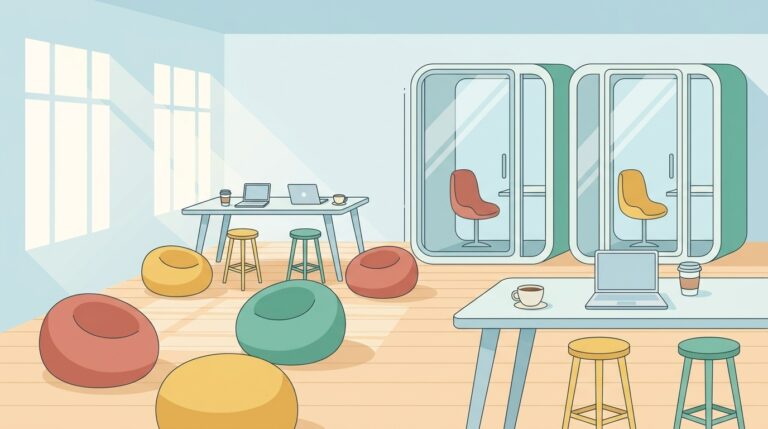
Imagine this: You’re watching a modern K-Drama like Start-Up or Search: WWW. The camera pans across a sleek, sunlit office in Pangyo (Korea’s Silicon Valley). There are no stuffy cubicles, no heavy mahogany desks for the bosses. Instead, people are lounging on beanbags, typing away on laptops at high tables, and grabbing espresso from a cafe-like pantry. Welcome to the Korean ‘Smart Office’ (스마트 오피스).
But wait—if you actually land a job or join a coworking space in Seoul, navigating this modern setup isn’t just about finding a good chair. It’s about a whole new vocabulary that blends traditional Korean corporate etiquette with fast-paced tech slang. If you don’t know the unwritten rules of 자율 좌석 (hot-desking) or 집중 업무 공간 (focus zones), you might accidentally sit in the CEO’s favorite unassigned seat, or disrupt a colleague’s “do not disturb” time.
This guide is built from the real-life struggles of my advanced expat students working in Gangnam and Pangyo. Let’s upgrade your workplace Korean to C1 level and help you blend in perfectly!
Phase 2: Core Expressions – The Smart Office Lexicon
Here are the essential terms you need to survive and thrive in a Korean smart office.
1. 자율 좌석제 (Autonomous Seating System)
- Pronunciation: [jayul jwaseokje] (ja-yool jwa-seok-jeh)
- Meaning: Literal: Autonomous seat system / Real nuance: Hot-desking or unassigned seating.
- K-Culture Moment: You walk into the office at 8:50 AM. Everyone has their phones out, fiercely tapping an internal app to reserve the best window seats before they’re gone. If you’re late, you might end up stuck right next to the department director!
- Editor’s Insight: The word ‘자율’ (autonomy) is a huge buzzword in modern Korean corporate culture, signaling a shift away from rigid, top-down structures.
- Situation Spectrum:
- Casual with coworkers: ✅ “오늘 자율 좌석 어디로 잡았어요?”
- Formal/HR announcements: ✅ “내일부터 자율 좌석제가 시행됩니다.”
- 🤔 Think About It: In traditional Korean companies, seating reflects hierarchy (the boss sits in the back, facing everyone). Why do you think tech companies are so eager to break this physical layout?
2. 집중 업무 공간 / 포커스 룸 (Focus Zone / Focus Room)
- Pronunciation: [jipjung eommu gonggan] / [pokeoseu rum]
- Meaning: Quiet zones or soundproof booths designed for deep, uninterrupted work.
- K-Culture Moment: You need to finish a massive report. You book the ‘포커스 룸’, put in your AirPods (the universal Korean sign for ‘don’t talk to me’), and grind for two hours.
- Editor’s Insight: Koreans are highly sensitive to Nunchi (reading the room). In an open-plan office, it’s hard to ignore others. The ‘Focus Room’ gives you social permission to completely block out your colleagues without seeming rude.
- Situation Spectrum:
- Booking via app/chat: ✅ “저 지금 포커스 룸에 있어서, 메신저로 남겨주세요.”
- Ignoring your boss in the open area: 🚫
- 🤔 Think About It: Does your home country have specific vocabulary for “leave me alone so I can work,” or is it just communicated through body language?
3. 퀵하게 싱크 맞추시죠 (Let’s sync up quickly)
- Pronunciation: [kwikhage singkeu matchusijo]
- Meaning: Let’s have a brief meeting to get on the same page.
- K-Culture Moment: You’re in the collaboration lounge. A colleague from the dev team comes over with a coffee and says this. It’s the ultimate “Pangyo Dialect” (판교 사투리) – a mix of Konglish and Korean grammar used by startup workers.
- Editor’s Insight: ‘퀵하게’ (Quick-hage) is used when you want to assure someone that you won’t take up much of their time. It’s trendy, efficient, and slightly informal.
- Situation Spectrum:
- Peers / Startup environment: ✅
- Traditional Corporate Boss: 🚫 (Use “잠시 회의하시죠” instead)
- 🤔 Think About It: Why do you think Korean startups adopt so many English loanwords (Konglish) for their daily operations?
Phase 3: Textbook vs. Real Korean (Smart Work Edition)
Let’s ditch the stiff textbook phrases and speak like a true Pangyo insider.
[Situation 1: Asking to have a brief meeting in the lounge]
* 📖 Textbook Korean: 휴게실에서 잠시 회의를 합시다. (Let’s have a meeting in the break room for a moment.)
* 🗣️ Real Korean: 라운지에서 퀵하게 캐치업(catch-up) 하시죠.
* 💡 Why the difference?: Modern offices call it a ‘Lounge’ rather than a ‘Break room’ (휴게실) to emphasize networking over just resting. The Konglish makes it sound more agile.
[Situation 2: Telling someone you need to concentrate]
* 📖 Textbook Korean: 저는 지금 바쁩니다. 나중에 오세요. (I am busy now. Come later.) Way too aggressive!
* 🗣️ Real Korean: 제가 지금 집중 근무 시간이라, 슬랙(Slack)으로 남겨주시겠어요?
* 💡 Why the difference?: In a culture that values collective harmony, directly saying “I’m busy” is harsh. Blaming the “focus work time” policy softens the rejection beautifully.
[Situation 3: Asking about someone’s desk location]
* 📖 Textbook Korean: 당신의 책상은 어디입니까? (Where is your desk?)
* 🗣️ Real Korean: 오늘 자리 어디쪽으로 잡으셨어요?
* 💡 Why the difference?: With hot-desking, you don’t ‘own’ a desk. ‘자리 잡다’ (grabbing/reserving a seat) implies the temporary nature of the modern workspace.
Phase 4: Cultural Context — K-Culture Deep Dive
4-1. The Non-Verbal ‘Nunchi’ of the Open Office
Smart offices remove physical barriers, which paradoxically requires more 눈치 (Nunchi – social awareness). If someone is wearing noise-canceling headphones, never tap them on the shoulder. Ping them on your work messenger first. When using the open collaboration lounge, keep your voice at a ‘cafe murmur’ level.
4-2. The K-Drama Illusion vs. Reality
In dramas like Start-Up, you see developers romantically staring out of glass windows overlooking the Han River, having deep conversations in the lounge.
Critical Reality Check: In reality, those window seats are fiercely fought over on the booking app at 8:00 AM. Also, while the space looks horizontal and equal, Korean hierarchy still exists in the language. Even if you’re sitting on a pink beanbag next to the CEO, you must still use formal Jondaetmal (존댓말) and address them as “대표님” (Daepyo-nim)!
Phase 5: Real-Life Roleplay Scenario
Setting: Monday morning, 9:30 AM. A sleek coworking space in Gangnam. Sunlight is pouring in, lo-fi beats are playing in the lobby.
Characters:
– YOU: An expat project manager who just transferred to the Seoul office.
– Min-su (32): Your trendy Korean colleague who practically lives on iced Americanos.
Dialogue:
Min-su: [You] 책임님, 주말 잘 보내셨어요? 오늘 자리 어디쪽으로 잡으셨어요? ☕️
(영어) [You] Manager, did you have a good weekend? Where did you grab a seat today?
(🎭 Stage Direction: Min-su holds two iced coffees and hands you one.)
YOU: 아, 민수 선임님! 감사합니다. 저는 오늘 창가 쪽 집중 업무 공간에 예약했어요.
(영어) Ah, Minsu! Thank you. I booked a seat in the focus zone by the window today.
Min-su: 아, 진짜요? 오늘 오후에 클라이언트 미팅 건으로 퀵하게 싱크 맞춰야 하는데…
(영어) Oh, really? We need to quickly sync up regarding the client meeting this afternoon…
🔀 Your Turn! How should you respond?
– A) “포커스 룸에서는 조용히 해야 합니다.” (It must be quiet in the focus room. – Too robotic/rude)
– B) “그럼 이따가 2시쯤 라운지에서 뵐까요?” (Then shall we meet in the lounge around 2 PM?)
– C) “제가 바쁘니까 이메일로 보내세요.” (I’m busy so send an email. – Say goodbye to your office reputation!)✅ Best Choice: B — It offers a collaborative solution. Moving to the ‘Lounge’ is the perfect cultural etiquette for casual meetings without disturbing the Focus Zone.
Min-su: 네, 좋아요! 2시에 라운지 커피 머신 앞에서 뵐게요. 슬랙 드릴게요!
(영어) Yes, sounds good! I’ll see you at 2 PM in front of the lounge coffee machine. I’ll Slack you!
Phase 6: 10-Second Shadowing Drill
Practice this until it flows naturally. Pay attention to the pauses (/)!
😊 오늘 / 자율 좌석 / 어디로 예약하셨어요?
(o-neul / ja-yul jwa-seok / eo-di-ro ye-yak-ha-syeo-sseo-yo?)
💼 오후에 라운지에서 / 퀵하게 미팅하시죠.
(o-hu-e ra-un-ji-e-seo / kwik-ha-ge mi-ting-ha-si-jo)
Phase 7: K-Culture Mini Dictionary
| Korean | Romanization | English | Context |
|---|---|---|---|
| 자율 좌석제 | jayul jwaseokje | Hot-desking | The system of unassigned seating, popular in tech. |
| 포커스 룸 | pokeoseu rum | Focus room | Soundproof booths for deep work or calls. |
| 판교 사투리 | pangyo saturi | Pangyo dialect | Startup Konglish (e.g., 어싸인, 싱크, 퀵하게). |
| 수평적 문화 | supyeongjeok munhwa | Horizontal culture | Flat hierarchy, often the goal of smart offices. |
| 슬랙/잔디 | seullaek/jandi | Slack/Jandi | Popular workplace messengers in Korea. |
Phase 8: Digital Nomad Survival Kit
Even if you don’t work in a corporate smart office, you’ll likely use coworking spaces or cafes. Korea is a paradise for remote work!
🆘 Survival Expressions for Cafe Workers
– 🇰🇷 “혹시 콘센트 있는 자리 있나요?” (hoksi konsenteu inneun jari innayo?)
– 🗣️ Meaning: Are there any seats with power outlets?
– 📍 Where to use: Cafes, libraries.
– 💡 Pro Tip: Koreans say ‘콘센트’ (concent – from Japanese/German) instead of ‘outlet’ or ‘socket’.📌 Editor’s Travel Note: The “Laptop Rule”
– Safety: Yes, the legends are true. You can leave your $2000 MacBook on a cafe table, go to the restroom for 10 minutes, and it will still be there. Koreans will steal your umbrella, but never your electronics!
– Etiquette: However, if a cafe is completely full during lunch rush, it’s considered bad nunchi to occupy a 4-person table by yourself with just one coffee for 5 hours (we call this ‘카공족’ – cafe-study tribe).
Phase 9: Critical Thinking — “A Step Deeper”
🧠 Think Deeper: Space, Language, and Power
In traditional Korean society, physical space dictated hierarchy. The most senior person sat farthest from the door, facing the entrance. The ‘Smart Office’ tries to demolish this by introducing hot-desking and removing physical barriers.
However, space is only half the battle. Can a company truly have a “horizontal culture” (수평적 문화) if the Korean language itself requires strict hierarchical honorifics? Many startups now use English names (e.g., “Hi, David”) or attach “-nim” (-님) to everyone’s name regardless of rank to bridge the gap between egalitarian spaces and hierarchical language.
💬 Your Turn: Does your workplace use space to show power (like corner offices)? How is the concept of a ‘Smart Office’ viewed in your country? Let us know in the comments!
Phase 10: FAQ & Avoiding Misunderstandings
Q: Can I use “퀵하게 미팅하시죠” (Let’s meet quickly) to my boss?
A: MAYBE, but proceed with caution. If you are in a hip startup where everyone goes by English names, yes. If you are in Samsung or Hyundai, absolutely not. Stick to “잠시 회의 가능하십니까?” (Are you available for a brief meeting?).
Q: Is it okay to take a nap in the collaboration lounge?
A: YES, but use the right spots. Many smart offices have dedicated “릴렉스 존” (Relax zones) or sleeping pods. Sleeping at your desk is actually quite common and accepted in Korea (it shows you worked hard!), but do it discreetly.
❌ Common Mistake #1: Treating the ‘Focus Zone’ like a regular office.
✅ Do this instead: Keep your phone on silent. If you must take a call, step out into the hallway or use a designated phone booth.
Phase 11: Summary & Action Items
One-Liner Summary: Korean smart offices blend cutting-edge tech environments with uniquely Korean workplace etiquette and ‘Pangyo Konglish’.
Action Mission 3 Steps:
– 🥉 Bronze (Solo): Read the 10-second shadowing drill out loud twice, focusing on the “Pangyo” confident vibe.
– 🥈 Silver (Online): Comment below with what you would look for first in a Korean smart office (Coffee machine? Focus room? Beanbags?).
– 🥇 Gold (Real Life): Next time you go to a cafe or coworking space in Korea, ask the staff: “혹시 콘센트 있는 자리 있나요?”
🎬 K-Culture Mission: Watch episode 1 of the drama Start-Up or Search: WWW and look at their office layouts. Can you spot the collaboration lounges and hot-desk setups?
Phase 12: Quiz — Interactive Challenge
1. Situational Judgment: You are concentrating in the ‘포커스 룸’ (Focus Room). A colleague needs you. What is the most polite, smart-office way for them to reach you?
– A) Knock loudly on the glass.
– B) Send you a message on Slack/Jandi first.
– C) Yell your name from the lounge.
2. Fill in the Blank:
“오늘 오후에 라운지에서 _________ 캐치업 하시죠.”
(Let’s do a catch-up _________ in the lounge this afternoon.)
– A) 퀵하게 (Quickly)
– B) 느리게 (Slowly)
3. True or False (K-Culture Edition):
If you leave your laptop on a table at a Korean coworking space to go grab lunch, it will definitely be stolen. (T/F)
Answers (Click to reveal)
1. B – Messaging first is the golden rule of Nunchi in focus zones.
2. A – 퀵하게 (Kwik-ha-ge) is the ultimate startup slang.
3. False – Korea is famous for its “leave your laptop anywhere” culture. Just don’t leave your umbrella on a rainy day!
Frequently Asked Questions (FAQ)
Q: What does "자율 좌석제 (Autonomous Seating System)" mean in Korean and how do you pronounce it?
A: In Korean, "자율 좌석제 (Autonomous Seating System)" is pronounced [jayul jwaseokje] and means: Literal: Autonomous seat system / Real nuance: Hot-desking or unassigned seating.
Q: What does "집중 업무 공간 / 포커스 룸 (Focus Zone / Focus Room)" mean in Korean and how do you pronounce it?
A: In Korean, "집중 업무 공간 / 포커스 룸 (Focus Zone / Focus Room)" is pronounced [jipjung eommu gonggan] and means: Quiet zones or soundproof booths designed for deep, uninterrupted work.
Q: What does "퀵하게 싱크 맞추시죠 (Let's sync up quickly)" mean in Korean and how do you pronounce it?
A: In Korean, "퀵하게 싱크 맞추시죠 (Let's sync up quickly)" is pronounced [kwikhage singkeu matchusijo] and means: Let's have a brief meeting to get on the same page.







