

Hello! I’m the Senior Editor at Daily Hangul.
Imagine a poignant scene from a weekend K-Drama: an older couple sits across from each other at a meticulously set dining table. The silence is heavy, but it isn’t filled with the fiery anger of their youth. Instead, there’s a quiet exhaustion. The wife gently sets down her spoon and says, “이제 그만합시다. 각자 편하게 살아요” (Let’s stop now. Let’s just live comfortably on our own).
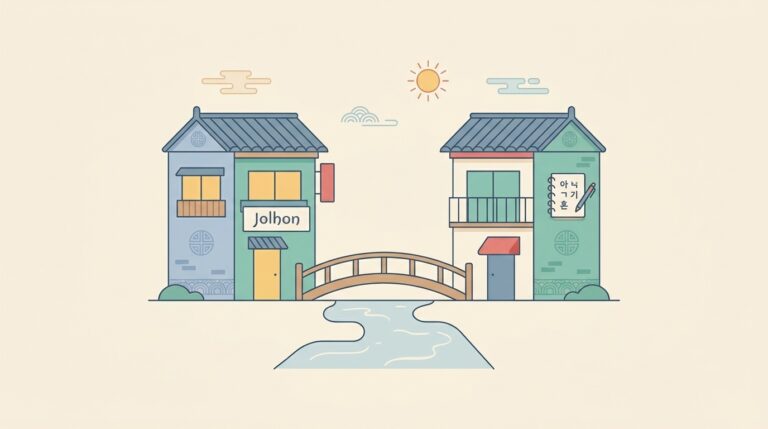
If you check the English subtitles, it might simply say, “I want a divorce.” But for those of us deeply immersed in Korean society, we know she isn’t necessarily asking for legal separation. She might be asking for a ‘Jolhon’ (졸혼).
As advanced (C2) learners of Korean, you are already past ordering coffee or asking for directions. You are analyzing the fabric of Korean society. Understanding terms like Jolhon is crucial because they aren’t just vocabulary words; they are linguistic mirrors reflecting a massive paradigm shift in Korean family dynamics, Confucian values, and the modern pursuit of individual happiness. Let’s dive deep into the changing landscape of older Korean couples.
Phase 2: Deep Dive into Core Expressions
1. 졸혼 (Jolhon)
- Pronunciation: [Jol-hon] (Sounds like “Joel-hone”)
- Meaning: Literal: Graduating from marriage / Real nuance: An arrangement where an older couple remains legally married but lives completely independent lives.
- K-Culture Moment: You’ll hear this on in-depth news panels or sophisticated family dramas. When a friend says their parents are doing Jolhon, the room usually reacts with a mix of surprise and understanding. It’s a heavy topic, but increasingly common.
- Editor’s Insight: This is a fascinating portmanteau of 졸업 (graduation) and 결혼 (marriage). It carries a profound emotional weight. By using “graduation” instead of “divorce,” it honors the decades of commitment and child-rearing they completed, softening the blow to traditional Korean sensibilities. It says, “Our duty is done, now we live for ourselves.”
- Situation Spectrum:
- Close Friends (Deep discussion): ✅
- Colleagues (Societal debate): ✅
- Asking an elder directly: 🚫 (Highly offensive!)
- 🤔 Think About It: Why does Korean society need a new word for this instead of just calling it separation (별거)? How does the concept of ‘saving face’ (체면 – Chemyon) influence the creation of new vocabulary?
2. 황혼 이혼 (Hwanghon Ihon)
- Pronunciation: [Hwang-hon Ee-hon] (Sounds like “Hwang-hone Ee-hone”)
- Meaning: Literal: Twilight divorce / Real nuance: Getting divorced late in life, typically after children are grown and married.
- K-Culture Moment: Often seen in legal dramas like Divorce Attorney Shin. It usually involves complex asset division after decades of the wife acting as a homemaker, whose unrecognized labor (희생 – huisaeng) is finally brought to court.
- Editor’s Insight: While Jolhon is a lifestyle choice, Hwanghon Ihon is the legal severing of ties. The word ‘twilight’ (황혼) gives it a somewhat melancholic but deeply resolute tone.
- Situation Spectrum:
- News & Academic discussions: ✅
- Gossip among friends: ⚠️
- Casual conversation: 🚫
- 🤔 Think About It: In your culture, is there a specific term for divorcing in old age, or is it just treated the same as any divorce?
3. 각자의 삶을 살다 (Gakja-ui salmeul salda)
- Pronunciation: [Gak-ja-we sal-meul sal-da]
- Meaning: Literal: To live each person’s life / Real nuance: To live independently, pursuing one’s own interests, often used to describe couples who give each other complete autonomy.
- K-Culture Moment: When celebrities announce an amicable split or a Jolhon arrangement, their press release will almost always include a phrase like, “서로의 앞날을 응원하며 각자의 삶을 살기로 했습니다” (We have decided to live our individual lives while supporting each other’s future).
- Editor’s Insight: This phrase emphasizes ‘autonomy’. In a hyper-collectivist society where family (가족) usually supersedes the individual (개인), “living one’s own life” in old age is a revolutionary act of reclaiming one’s identity.
- Situation Spectrum:
- Formal announcements: ✅
- Explaining a family situation politely: ✅
- Workplace context: ⚠️ (Depends on intimacy)
Phase 3: Textbook vs. Real Korean
At the C2 level, it’s about navigating societal nuances gracefully.
[Discussing Changing Family Trends]
* 📖 Textbook Korean: 노인 부부의 이혼율이 증가하고 있습니다. (The divorce rate among elderly couples is increasing.)
* 🗣️ Real Korean: 요즘 황혼 이혼이나 졸혼을 택하는 부부들이 늘어나는 추세예요. (There’s a growing trend of couples opting for twilight divorce or Jolhon these days.)
* 💡 Why the difference?: Using “추세예요” (is a trend) makes you sound like a native discussing sociological shifts over coffee, rather than a news anchor reading a teleprompter.
[Explaining a Friend’s Parents’ Situation politely]
* 📖 Textbook Korean: 제 부모님은 별거 중입니다. (My parents are separated.)
* 🗣️ Real Korean: 두 분이 각자의 삶을 존중하면서 따로 지내시기로 했어요. (They decided to live separately while respecting each other’s individual lives.)
* 💡 Why the difference?: “별거” (separation) carries a strong negative stigma of a broken marriage. Framing it around “respect” and “individual lives” softens the reality and presents it as a mature decision.
Phase 4: Cultural Context — K-Culture Deep Dive
4-1. The Non-verbal ‘Nunchi’ of Family Matters
When discussing topics like Jolhon or family discord in Korea, the non-verbal cues are just as important as the vocabulary.
* Avoid prolonged eye contact: If a Korean friend confides in you about their parents’ Jolhon, staring directly into their eyes can feel intrusive. Nod slowly and look slightly down to show empathetic listening.
* The Power of Hesitation: You’ll often hear a long drawn out “아…” (Ah…) or “그러시구나…” (I see…) before anyone responds. This pause is the ultimate expression of Nunchi—processing the emotional weight of the disclosure before speaking.
4-2. K-Drama Tropes: The Rebellious Matriarch
The concept of Jolhon didn’t just appear out of nowhere; it was popularized by media. In classic weekend K-Dramas, there is a recurring trope: The lifelong devoted mother (who endured a strict mother-in-law and an indifferent husband) finally snaps. She packs a single suitcase, leaves her luxurious home, rents a tiny rooftop apartment, and starts working at a bakery or taking art classes.
Critical Viewpoint: While dramas romanticize Jolhon as an exciting journey of self-discovery, the reality is starkly different. Sociological studies show that Jolhon is a luxury mostly available to the upper-middle class. For many older women, leaving the marital home without a legal divorce means financial peril. Dramas often gloss over the complex asset division and the deep, unresolved resentments that make real-life Jolhon a painful, rather than joyful, transition.
Phase 5: Real-World Roleplay Scenario
Setting: A quiet, upscale tea house in Bukchon Hanok Village. The rain is lightly tapping against the traditional paper windows. You are having tea with Ji-yeon (45), a close Korean friend and business associate.
Characters:
* YOU: An expat who has lived in Korea for 5 years, highly proficient in Korean, known for your empathy.
* Ji-yeon (45): A successful marketing director. She looks visibly stressed today.
Dialogue:
Ji-yeon: (Sighs) 요즘 친정집 분위기가 말이 아니야… 어제 엄마가 갑자기 중대 발표를 하시더라고.
(Yojeum chinjeongjip bunwigiga mari aniya… Eoje eommaga gapjagi jungdae balpyoreul hasideorago.)
[Translation: The atmosphere at my parents’ house is a mess lately… Yesterday, my mom suddenly made a major announcement.]
YOU: 무슨 일 있었어? 어머님 건강은 괜찮으시고?
(Museun il isseosseo? Eomeonim geongangeun gwaenchanehusigo?)
[Translation: What happened? Is your mother’s health okay?]
Ji-yeon: 건강은 괜찮으신데… 아빠랑 졸혼하시겠대.
(Geongangeun gwaenchanehusinde… Apparang jolhonhasigetdae.)
[Translation: Her health is fine, but… she says she’s going to do a Jolhon with my dad.]
YOU: 아… 갑자기 그러셔서 지연 씨도 많이 놀랐겠다.
(Ah… Gapjagi geureosyeoseo Ji-yeon ssido mani nollatgetda.)
[Translation: Ah… you must have been very surprised since she said it so suddenly.]
Ji-yeon: 처음엔 너무 당황했는데… 엄마 평생 우리 키우고 아빠 뒷바라지 하느라 희생하신 거 생각하면, 이해가 가기도 해.
(Cheoeumen neomu danghwanghaenneunde… Eomma pyeongsaeng uri kiugo appa dwitbaraji haneura huisaenghasin geo saenggakhamyeon, ihaega gagido hae.)
[Translation: I was so panicked at first, but… when I think about how she sacrificed her whole life raising us and supporting my dad, I kind of understand.]
🔀 Your Turn! How do you respond?
* A) “아버님은 뭐라고 하셔? 그냥 이혼하시는 게 낫지 않아?” (What does your dad say? Isn’t it better to just divorce?)
* B) “지연 씨 마음이 참 복잡하겠다. 그래도 어머님이 이제라도 본인의 삶을 찾고 싶으신가 봐.” (Your mind must be so complicated. Still, it seems your mother wants to find her own life, even now.)
* C) “대박! 요즘 졸혼이 트렌드라더니 진짜네요.” (Jackpot/Awesome! I heard Jolhon is a trend these days, and it’s real.)✅ Best Choice: B — As a C2 speaker, empathy is your strongest tool. Choice B validates Ji-yeon’s complex feelings while respectfully summarizing her mother’s desires using sophisticated phrasing (본인의 삶을 찾다 – finding one’s own life).
⚠️ Choice Analysis: Choice A is incredibly intrusive and aggressive in Korean culture. Choice C is offensively frivolous for a serious family matter.
Phase 6: 10-Second Shadowing Drill
Let’s practice the phrasing from the best response. Focus on the empathetic tone and the soft pauses.
😌 어머님도 / 이제는 / 각자의 삶을 / 즐기고 싶으신가 봐요.
(Eomeonimdo / ijeneun / gakjaui salmeul / jeulgigo sipeusinga bwayo.)
[Translation: It seems your mother, too, wants to enjoy her own life now.]
Editor’s Tip: Drag out the “도” slightly and let your voice drop softly at the end. It should sound comforting, not analytical.
Phase 7: K-Culture Mini Dictionary
| Korean | Romanization | English | Contextual Meaning |
|---|---|---|---|
| 졸혼 | jolhon | Marriage graduation | An arrangement to live independently while remaining legally married. |
| 황혼 이혼 | hwanghon ihon | Twilight divorce | Divorcing in one’s senior years, usually after decades of marriage. |
| 희생 | huisaeng | Sacrifice | A core concept in traditional Korean motherhood—giving up one’s identity for the family. |
| 뒷바라지 | dwitbaraji | Looking after / Supporting | The act of taking care of someone’s needs, often referring to a wife supporting a husband’s career or raising children. |
| 눈치 | nunchi | Social intelligence | The ability to read the room and unspoken emotional cues; crucial when discussing sensitive family topics. |
Phase 8: Traveler Survival Kit (Deep Conversations Edition)
Even as an advanced learner traveling or living in Korea, you might find yourself navigating conversations with older locals, perhaps your partner’s parents or a friendly host.
🆘 Survival Expression #1: Deflecting Sensitive Questions
* 🇰🇷 “아유, 한국 사회가 참 빠르게 변하는 것 같아요.” (Ayu, Hanguk sahoega cham ppareuge byeonhaneun geot gatayo.)
* 🗣️ Meaning: “Oh my, Korean society seems to be changing so fast.”
* 📍 Where to use: When an elder asks you a very direct question about marriage or family trends, and you want to give a polite, philosophical non-answer.
* 💡 Pro Tip: At the C2 level, you don’t have to answer every question directly. Shifting the topic to “societal change” is a very Korean, sophisticated way to deflect.📌 Editor’s Travel Note
* If you are invited to a Korean home, never bring up topics like divorce or Jolhon unless the host explicitly opens the door to deep, sociological debates.
* Respecting elders (경로사상) is still paramount, even if modern families are restructuring.
Phase 9: Critical Thinking Corner — “One Step Deeper”
🧠 Think Deeper: Language & Power (The Semantics of ‘Graduation’)
Why “Graduation”? The term Jolhon is a brilliant linguistic shield. In traditional Confucian society, getting a divorce (이혼) is often viewed as a failure—a severing of family ties that brings shame (체면 손상) not just to the couple, but to their extended families. By rebranding this separation as a “graduation” (졸업), it completely shifts the narrative from failure to completion. One graduates only after fulfilling all requirements and duties. Therefore, a woman who asks for Jolhon isn’t a “bad wife who left her family”; she is an “alumna” of a completed project (raising kids, supporting the husband). This linguistic innovation allows the older generation to pursue modern individualism without completely shattering traditional Confucian expectations.
💬 Your Turn: Does your native language have any terms that soften the blow of a socially stigmatized action? How do people in your culture navigate the desire for independence in old age? Share your thoughts in the comments!
Phase 10: FAQ & Avoiding Misunderstandings
- Q: Can I ask my older Korean friends if they plan to do Jolhon?
- No. Absolutely not. Even though it’s a media trend, it is a deeply private and painful family issue. You only discuss it if they bring it up first.
- Q: Is Jolhon a legally recognized status?
- No. Legally, they are still married. There is no official “Jolhon certificate.” It is purely a private arrangement, which is why it sometimes leads to legal complications regarding inheritance.
❌ Common Mistake: Using 별거 (Separation) and 졸혼 (Jolhon) interchangeably.
✅ Do this instead: Understand the nuance. 별거 implies hostility or a break before an inevitable divorce. 졸혼 implies an agreed-upon, permanent lifestyle change to grant each other freedom without legal dissolution.
Phase 11: Summary & Action Items
- One-Liner Summary: Jolhon (marriage graduation) is more than a buzzword; it’s a linguistic and cultural compromise between traditional Confucian duty and the modern desire for individual autonomy in old age.
-
Action Mission 3 Steps:
- 🥉 Bronze (Solo): Practice the pronunciation of “서로 각자의 삶을 존중하기로 했습니다” in the mirror, focusing on a calm, respectful tone.
- 🥈 Silver (Online): Write a short paragraph in a Korean journal or lang-exchange app analyzing why you think Jolhon is rising in Korea.
- 🥇 Gold (Real-world): Next time you watch a Korean news clip or read an article discussing changing demographics, try to spot the words 졸혼 or 황혼 이혼 and translate the context for a friend.
- K-Culture Mission: Search YouTube for “졸혼 다큐” (Jolhon documentary) or “황혼 이혼 뉴스” (Twilight divorce news). Watch a 5-minute clip without English subtitles and try to pick out how the commentators frame the issue. Do they sound critical, sympathetic, or neutral?
Phase 12: Interactive Challenge Quiz
1. Situational Judgment: Your Korean colleague tells you, “요즘 저희 부모님 사이가 안 좋으셔서… 결국 따로 지내시기로 했어요.” (My parents haven’t been getting along lately… they eventually decided to live apart.) What is the MOST appropriate empathetic response?
* A) 아, 혹시 그게 졸혼인가요?
* B) 마음 고생이 심하시겠어요. 부모님께서 편안한 길을 찾으셨길 바라요.
* C) 황혼 이혼 안 하신 게 다행이네요.
(Toggle for Answer:)
Answer: B.
Why? Never force a label like Jolhon (A) or bring up divorce (C) when someone is confiding in you about a difficult family matter. Empathize with their emotional strain (마음 고생) and wish them well.
2. True or False – K-Culture Edition:
* “Jolhon” is a legal status recognized by the South Korean family court system.
(Toggle for Answer:)
Answer: False. It is a social and personal arrangement, not a legal one. Legally, they remain married.
Keep pushing the boundaries of your Korean! See you in the next deep dive.
Frequently Asked Questions (FAQ)
Q: What does "졸혼 (Jolhon)" mean in Korean and how do you pronounce it?
A: In Korean, "졸혼 (Jolhon)" is pronounced [Jol-hon] and means: Literal: Graduating from marriage / Real nuance: An arrangement where an older couple remains legally married but lives completely independent lives.
Q: What does "황혼 이혼 (Hwanghon Ihon)" mean in Korean and how do you pronounce it?
A: In Korean, "황혼 이혼 (Hwanghon Ihon)" is pronounced [Hwang-hon Ee-hon] and means: Literal: Twilight divorce / Real nuance: Getting divorced late in life, typically after children are grown and married.
Q: What does "각자의 삶을 살다 (Gakja-ui salmeul salda)" mean in Korean and how do you pronounce it?
A: In Korean, "각자의 삶을 살다 (Gakja-ui salmeul salda)" is pronounced [Gak-ja-we sal-meul sal-da] and means: Literal: To live each person's life / Real nuance: To live independently, pursuing one's own interests, often used to describe couples who give each other complete autonomy.







