

Phase 1: Empathy (Immersive Opening)
Hello! I am the Lead Editor of Daily Hangul.
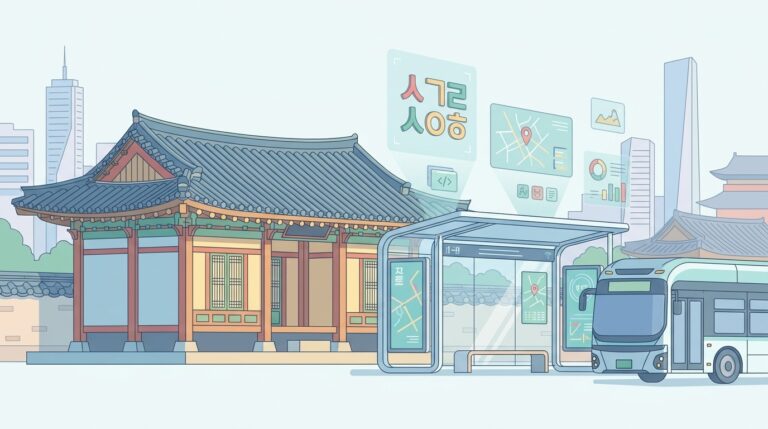
Picture this: You are standing in the middle of Seoul. To your left is a stunning 600-year-old wooden palace. To your right, a gleaming skyscraper. You look at your smartphone, and a local app tells you exactly which subway car to board so you can transfer fastest, down to the very second. You head to Seongsu-dong, where an old, crumbling shoe factory has been transformed into a hyper-modern, IoT-enabled art gallery and cafe.
Welcome to Korea—a living, breathing laboratory of Smart City Design and Urban Regeneration (건축과 도시 재생).
As an advanced (C1) Korean learner or expat, simply saying “이 건물 멋있어요” (This building is cool) doesn’t cut it anymore. When you meet Korean architects, tech professionals, or even trendy locals at a hip cafe, you need to speak their language. You need to understand how the “Pali-Pali” (hurry up) culture shaped this hyper-connected infrastructure, and how millennials are breathing new life into forgotten spaces.
Don’t worry. This guide is built from the exact conversations I’ve had with my advanced students when we walked through the newly regenerated streets of Seoul. Let’s upgrade your Korean vocabulary to “Smart City” level!
Phase 2: Core Expressions Deep Dive
1. 공간을 재생하다 (To regenerate a space)
- Pronunciation: [gongganeul jaesaenghada] / Gong-gan-eul jae-saeng-ha-da
- Meaning: Literal: To regenerate a space. Real nuance: Urban renewal; breathing new life into an old, dilapidated area while preserving its historical vibe.
- K-Culture Moment: Think of dramas like Itaewon Class or visiting Seongsu-dong. You see a rusted warehouse from the 1970s, but inside? It’s a high-tech cafe with robot baristas. Koreans don’t just say “they fixed it”—they say they “regenerated” it.
- Editor’s Insight: At the C1 level, replace simple verbs like ‘고치다’ (to fix) or ‘바꾸다’ (to change) with ‘재생하다’ when talking about architecture. It shows a deep understanding of modern urban planning trends.
- Situation Spectrum:
- Casual with friends: ✅ (Usually talking about a trendy spot)
- Professional / Co-workers: ✅ (Perfect for business or design discussions)
- Formal / Boss: ✅ (Highly professional)
- 🤔 Think About It: Why has “urban regeneration” become such a massive trend in Korea over the last decade, rather than just tearing everything down and building new apartments like in the 90s? How does this reflect a change in modern Korean values regarding history and memory?
2. 인프라가 잘 구축되어 있다 (The infrastructure is well-established)
- Pronunciation: [inpeuraga jal guchukdoeeo itda] / In-peu-ra-ga jal gu-chuk-dwae-eo it-da
- Meaning: Literal: Infrastructure is well-constructed. Real nuance: This place is hyper-connected, convenient, and technologically set up perfectly.
- K-Culture Moment: You are in a new smart city like Songdo or Sejong. There are no garbage trucks because waste is sucked through underground pneumatic tubes. High-speed Wi-Fi is everywhere. You nod and say this phrase.
- Editor’s Insight: ‘구축하다’ (to build/establish) is a golden C1 verb. We use it for networks, systems, and smart city tech. It makes you sound like a true industry insider compared to using ‘만들다’ (to make).
- Situation Spectrum:
- Casual with friends: ⚠️ (A bit too academic for a pub, but okay for intellectual debates)
- Professional / Co-workers: ✅
- Formal / Boss: ✅
- 🤔 Think About It: Koreans expect “perfect infrastructure” (fast internet, immediate deliveries). Do you think this expectation creates an unforgiving society for technological errors?
3. 기술을 접목시키다 (To integrate/graft technology)
- Pronunciation: [gisureul jeommoksikida] / Gi-sul-eul jeom-mok-si-ki-da
- Meaning: Literal: To graft technology. Real nuance: To seamlessly blend high-tech solutions into an existing framework or traditional setting.
- K-Culture Moment: In Bukchon Hanok Village, the traditional wooden houses look ancient, but the doors open with biometric scanners, and the floor heating (Ondol) is controlled via a smartphone app. That is ‘기술을 접목시킨 한옥’ (Hanok grafted with technology).
- Editor’s Insight: ‘접목하다’ comes from agriculture (grafting trees). In modern Korean, it’s the ultimate C1 vocabulary word to describe blending two different concepts—like tradition and smart tech.
- Situation Spectrum:
- Casual with friends: 🚫 (Too formal/stiff)
- Professional / Co-workers: ✅
- Formal / Boss: ✅
- 🤔 Think About It: Can you think of something in your home country where traditional culture has successfully “grafted” modern technology?
Phase 3: Textbook vs. Real Korean
[Describing a changing neighborhood]
* 📖 Textbook Korean: 이 동네는 도시 재생 프로젝트를 통해 많이 발전했습니다. (This neighborhood has developed a lot through urban regeneration projects.)
* 🗣️ Real Korean: 여기 완전 싹 바뀌었어. 요즘 제일 뜨는 핫플이잖아. (This place completely changed. It’s the hottest place these days.)
* 💡 Why different?: While professionals use terms like “regeneration,” locals experience it as the birth of a “핫플” (Hot-place / trendy spot).
[Talking about smart transit systems]
* 📖 Textbook Korean: 서울의 대중교통 정보 시스템은 매우 정확합니다. (Seoul’s public transportation information system is very accurate.)
* 🗣️ Real Korean: 버스 어플 봤어? 2분 뒤에 도착한대. 뛰자! (Did you see the bus app? It says it arrives in 2 mins. Let’s run!)
* 💡 Why different?: Koreans rarely praise the “system” in daily life; they just implicitly trust the app and act on it immediately, reflecting the “Pali-Pali” mindset.
Bottom Note: At the C1 level, you must know how to code-switch. Use ‘구축하다’ and ‘접목하다’ in your architectural firm or university seminar, but switch to ‘완전 싹 바뀌었다’ when grabbing a beer in Euljiro!
Phase 4: Cultural Context — K-Culture Deep Dive
4-1. Non-verbal Elements & ‘Nunchi’ in Urban Spaces
In a highly dense and hyper-connected smart city like Seoul, physical space is a premium. The unwritten rule of Nunchi applies directly to how we navigate these spaces. For example, on an escalator in the subway, you must stand on the right and leave the left for walkers. If you block the left side, you lack Nunchi.
4-2. K-Travel & Urban Regeneration (Euljiro & Seongsu)
Let’s talk about “Hip-jiro” (Euljiro) and Seongsu-dong. If you visit Korea, these are the frontline battlegrounds of urban regeneration.
Euljiro used to be full of printing presses and hardware stores. Now? You open a rusty, unmarked iron door, walk up a creepy, dimly-lit staircase, and suddenly you are in a futuristic, neon-lit wine bar.
* Pro Tip: In these regenerated areas, there are often no big signboards. Finding the cafe using a smart map app is part of the cultural experience.
* Critical View: As these industrial areas become trendy, the original factory workers and small business owners are being pushed out. This is why “젠트리피케이션” (gentrification) is a hot social issue in modern Korean urban planning.
Phase 5: Real-Life Roleplay Scenario
Setting: Friday evening, 7:00 PM. A hyper-modern cafe inside a renovated old shoe factory in Seongsu-dong. You and two Korean colleagues from your architecture/tech firm are having coffee after a site visit.
Characters:
– YOU: An expat urban planner/consultant working in Seoul.
– Min-su (34): Your Korean project manager. Loves showing off Seoul’s tech.
– Ji-yeon (29): A junior designer. Knows all the trendy spots.
Dialogue:
Min-su:
이야, 여기 옛날에는 진짜 다 쓰러져가는 공장이었는데. 공간을 아주 제대로 재생했네요.
(Iya, yeogi yennareneun jinjja da sseureojyeoganeun gongjangieonneunde. Gongganeul aju jedaero jaesaenghaenneyo.)
[Wow, this used to be a really crumbling factory in the past. They regenerated the space perfectly.]
Ji-yeon:
맞아요. 겉은 빈티지한데, 안에 스마트 IoT 기술을 다 접목시켰더라고요. 주문도 테이블에서 QR로 하고.
(Majayo. Geoteun bin-ti-ji-hande, ane seumateu IoT gisureul da jeommoksikyeotdeoragoyo. Jumundo teibeureseo QR-ro hago.)
[Right. The outside is vintage, but they grafted all the smart IoT tech inside. We even order via QR at the table.]
YOU:
그러게요. 전통적인 느낌과 최첨단 인프라가 이렇게 잘 구축되어 있는 게 서울의 매력 같아요.
(Geureogeyo. Jeontongjeogin neukkim-gwa choecheomdan inpeuraga ireoke jal guchukdoeeo inneun ge seourui maeryeok gatayo.)
[I agree. Having traditional vibes and cutting-edge infrastructure so well-established seems to be the charm of Seoul.]
Min-su:
오, ○○씨(You), 한국어 표현이 완전 전문가인데요? 맞아요. 이게 바로 K-스마트 시티죠! 그나저나 다음 프로젝트 기획안은 어떻게 할까요?
(O, OO-ssi, hangugeo pyohyeoni wanjeon jeonmun-gaindeyo? Majayo. Ige baro K-seumateu sitijyo! Geunajeona daeum peurojekteu gihoeganeun eotteoke halkkayo?)
[Oh, OO, your Korean expressions are totally expert-level! Right. This is exactly the K-Smart City! Anyway, what should we do about the next project proposal?]
🔀 Your Turn! How do you reply?
– A) “제가 다 알아서 할게요. 걱정 마세요.” (I’ll take care of it all. Don’t worry.)
– B) “이런 힙플에서 일 얘기는 나중에 하시죠! 오늘은 좀 즐겨요!” (Let’s talk about work later in a hip place like this! Let’s enjoy today!)
– C) “아직 생각 안 해봤습니다. 퇴근 시간이니까요.” (I haven’t thought about it. Because it’s after work hours.)✅ Best Choice: B — Reason: It uses a trendy local slang (힙플 – hip place) perfectly fitting the urban regeneration context, while playfully deflecting work talk in a socially acceptable, witty way.
⚠️ Choice A & C Analysis: ‘A’ sounds a bit arrogant for a team effort. ‘C’ is technically true but sounds too cold and blunt in Korean corporate culture, even in casual settings.
Phase 6: 10-Second Shadowing Drill
Read this aloud. Pay attention to the slashes for pausing and the emotion tags!
😲 겉모습은 / 옛날 건물인데, (Geonmoseubeun / yennal geonmurinde,)
✨ 안에는 / 스마트 인프라가 / 완~~전 잘 구축되어 있네요! (aneneun / seumateu inpeuraga / wan~~jeon jal guchukdoeeo inneyo!)
(Emotion: Look around in awe, emphasize “완~~전” by stretching it out slightly to sound like a native.)
Phase 7: K-Culture Mini Dictionary
| Korean | Romanization | English | Context/Meaning |
|---|---|---|---|
| 힙플 (힙플레이스) | hippeul (hip-place) | Trendy spot | A newly regenerated, highly aesthetic location popular on Instagram. |
| 임장 | imjang | Site visit | Originally a real estate term. Now used by professionals to mean visiting an urban development site. |
| 젠트리피케이션 | jenteuripikeisyeon | Gentrification | The side-effect of urban regeneration; rising rents displacing locals. |
| 따릉이 | ttareunghui | Ttareungi (Seoul Bike) | Seoul’s public smart bicycle system. Essential smart city infrastructure. |
| 노포 | nopo | Historic old shop | An old, traditional restaurant/shop that developers often try to preserve or mimic during regeneration. |
Phase 8: Traveler’s Survival Kit
If you are visiting Seoul’s smart city landmarks or regenerated neighborhoods, here is what you need to know to navigate the hyper-connected infrastructure.
🆘 Survival Phrases for Smart Transit
– 🇰🇷 “여기 따릉이 대여소 어디에 있어요?” (yeogi ttareunghui daeyeoso eodie isseoyo?)
– 🗣️ Meaning: Where is the Ttareungi (bike-sharing) rental spot around here?
– 📍 Usage: When looking for smart transit options on the street.
– 💡 Pro Tip: Don’t ask “Where is the bus?” Ask “Is the bus coming soon?” Most Koreans just check the real-time board at the smart bus stop.📌 Editor’s Travel Note
– Useful Apps: KakaoMap, Naver Map (Google Maps doesn’t work well in Korea due to security laws!), and the T-Money Go app for smart transit.
– Wi-Fi Heaven: Almost all public buses and subways in Seoul have free, high-speed 5G Wi-Fi. This is the backbone of the smart city.
– Smart Kiosks: Many old restaurants (노포) have been regenerated and now use electronic kiosks (키오스크) for ordering.
Phase 9: Critical Thinking — “One Step Deeper”
Global Era & Digital Divide (글로벌 시대와 디지털 격차)
🧠 Think Deeper:
Korea’s smart city implementation is globally unrivaled. In places like Seongsu-dong or Songdo, you can reserve tables via apps, order from a tablet, and pay with Samsung/Apple Pay—all without talking to a human.
However, as technology is heavily grafted (접목되다) into everyday spaces, a new social issue has emerged: the ‘Digital Divide’ (디지털 소외). The elderly population often struggles to order food at kiosks or hail taxis because smart apps have completely replaced traditional infrastructure. The pursuit of extreme efficiency has left some citizens behind. Is a “Smart City” truly smart if it only serves the digitally literate?💬 Your Turn: Does your city have “smart” infrastructure? How does your culture balance high-tech implementation with accessibility for the elderly? Share in the comments!
Phase 10: FAQ & Avoiding Mistakes
Q: Can I use ‘구축하다’ for building a house?
A: No. ‘구축하다’ is for systems, networks, and infrastructure. If you are physically building a house, use ‘건축하다’ (to architect/build) or ‘짓다’ (to build).
Q: Is it okay to call an old, broken building ‘노포’?
A: Careful. ‘노포’ (Nopo) specifically refers to an old, well-established business (usually a restaurant) with a long, respected history. It is a compliment. If it’s just an abandoned building, call it ‘오래된 건물’ (old building) or ‘폐건물’ (abandoned building).
❌ Common Mistake #1: Confusing ‘재개발’ (Redevelopment) and ‘도시 재생’ (Urban Regeneration).
✅ Do this instead:
– 재개발 (Redevelopment) = Tearing everything down and building towering apartment blocks (like the 1990s style).
– 도시 재생 (Urban Regeneration) = Keeping the historic exterior but upgrading the interior and infrastructure (like Seongsu-dong).
Using these terms correctly immediately proves you are a C1 speaker!
Phase 11: Summary & Action Items
One-Liner Summary: To speak like an urban expert in Korea, use 재생하다 for renewing spaces, 구축하다 for establishing systems, and 접목하다 for blending technology with tradition!
Action Mission 3 Steps:
– 🥉 Bronze (Solo): Stand in front of a mirror and read the 10-second shadowing drill aloud, emphasizing the amazed emotion.
– 🥈 Silver (Online): Look up “성수동 팝업스토어” (Seongsu-dong pop-up store) on Instagram and leave a comment in Korean: “공간 재생이 정말 멋지네요!” (The space regeneration is really cool!)
– 🥇 Gold (Real Life): Next time you are in Seoul, ride a ‘따릉이’ (Seoul Bike) using the app, and tell your Korean friend: “서울은 인프라가 참 잘 구축되어 있어!”
K-Culture Special Mission:
Go to Google Street View or YouTube and search for “Seoullo 7017” (서울로 7017). It’s an old highway overpass that was regenerated into a beautiful pedestrian park. Imagine walking there and using today’s vocabulary!
Phase 12: Quiz — Interactive Challenge
1. Situational Judgment:
You are giving a presentation on how your company installed AI smart-lighting in a traditional Hanok village. Which sentence is the most professional (C1) and natural?
– A) 한옥에 AI를 예쁘게 만들었습니다. (We made AI pretty in Hanok.)
– B) 전통 한옥에 최첨단 AI 기술을 성공적으로 접목시켰습니다. (We successfully grafted cutting-edge AI technology into traditional Hanok.)
– C) 한옥을 스마트 시티로 재개발했습니다. (We redeveloped Hanok into a smart city.)
2. True or False — K-Culture Edition:
“In Korean urban regeneration projects (도시 재생), the main goal is to demolish all old buildings to build luxury apartments.”
– [ True / False ]
3. Fill in the Blank:
“서울은 교통 _____가(이) 정말 잘 _____되어 있어서 차가 없어도 살기 편해요.”
(Seoul’s transit ________ is so well-_________, it’s easy to live without a car.)
🚨 Click here for the answers!
1. Answer: B. ‘접목시키다’ is the perfect verb for blending tradition and technology. ‘A’ is too elementary (A1/A2). ‘C’ is incorrect because ‘재개발’ implies tearing down the Hanoks entirely.
2. Answer: False. That is ‘재개발’ (Redevelopment). ‘도시 재생’ (Urban Regeneration) focuses on preserving the history and exterior while upgrading the function and interior.
3. Answer: 인프라 (infrastructure), 구축 (established/built).
Frequently Asked Questions (FAQ)
Q: What does "공간을 재생하다 (To regenerate a space)" mean in Korean and how do you pronounce it?
A: In Korean, "공간을 재생하다 (To regenerate a space)" is pronounced [gongganeul jaesaenghada] and means: Literal: To regenerate a space. Real nuance: Urban renewal; breathing new life into an old, dilapidated area while preserving its historical vibe.
Q: What does "인프라가 잘 구축되어 있다 (The infrastructure is well-established)" mean in Korean and how do you pronounce it?
A: In Korean, "인프라가 잘 구축되어 있다 (The infrastructure is well-established)" is pronounced [inpeuraga jal guchukdoeeo itda] and means: Literal: Infrastructure is well-constructed. Real nuance: This place is hyper-connected, convenient, and technologically set up perfectly.
Q: What does "기술을 접목시키다 (To integrate/graft technology)" mean in Korean and how do you pronounce it?
A: In Korean, "기술을 접목시키다 (To integrate/graft technology)" is pronounced [gisureul jeommoksikida] and means: Literal: To graft technology. Real nuance: To seamlessly blend high-tech solutions into an existing framework or traditional setting.







