

Phase 1: Empathy (Cold Open)
Hello! I am your Daily Hangul Editor, your friendly neighborhood veteran tutor and local Seoulite.
Picture this: You are watching a K-Drama. The main character’s boss asks them to work over the weekend. The character doesn’t just say “No.” Instead, they take a sharp breath in (“Sseup…“), scratch the back of their head, look at the floor, and say something that translates in the subtitles simply as “I’m sorry, but…”
Why didn’t they just say “No, I can’t”?
If you’ve ever felt panicked when a Korean friend, co-worker, or shop owner asked you for a favor or offered something you didn’t want, you are not alone! In many Western cultures, a direct “No, thank you” is perfectly polite. But in Korea? A direct “No” (아니요) can sometimes feel like a splash of cold water to the face.
This guide is based on real struggles my students face when trying to set boundaries without ruining friendships. Today, we are going to learn the gentle, highly-nuanced art of the “Korean No.”
Phase 2: Core Expressions Deep Dive
Here are the top 3 lifesavers you need when you want to say “no” without breaking any hearts.
1. 미안하지만 좀 어려울 것 같아요.
- Pronunciation: Mianhajiman jom eoryeoul geot gatayo. [mee-an-ha-jee-man johm uh-ryuh-ool gut ga-ta-yo]
- Meaning: (Literal) I’m sorry, but it seems like it will be a bit difficult. / (Real Nuance) I’m sorry, but I can’t do it.
- K-Culture Moment: This is the ultimate Korean workplace and daily life phrase. When a colleague asks you to cover their shift, or a friend asks to borrow a large sum of money, this is your shield. Saying something is “difficult” (어렵다) is the polite Korean code for “No way.”
- Editor’s Insight: Notice the “것 같아요” (it seems like / I think). Koreans love softening their sentences to sound less absolute. It leaves a little cushion for the listener’s feelings.
- Situation Spectrum:
- Casual (Close friends): ✅ (You can drop the ‘yo’: 미안하지만 좀 어려울 것 같아)
- Semi-formal (Co-workers): ✅
- Formal (Boss/Elders): ⚠️ (Better to use 죄송하지만… instead of 미안하지만…)
- 🤔 Think About It: Why do you think Koreans prefer saying a situation is “difficult” rather than just saying “I cannot do it”? Does your native language have a similar “buffer” word?
2. 어쩌죠? 제가 선약이 있어서요.
- Pronunciation: Eojjeojyo? Jega seonyagi isseoseoyo. [uh-jjuh-jyo? je-ga sun-yah-gee is-suh-suh-yo]
- Meaning: (Literal) What should I do? I have a prior engagement. / (Real Nuance) Oh no, I really wish I could, but I already have plans.
- K-Culture Moment: You will hear this constantly during the holiday season or Friday nights when group dinners (회식 – Hoesik) are being organized. The “어쩌죠?” (What should I do?) shows that you are genuinely distressed that you can’t join.
- Editor’s Insight: The tone is everything here! You must sound a little disappointed. You can’t say this with a huge, happy smile.
- Situation Spectrum:
- Casual (Close friends): ✅ (어쩌지? 나 선약이 있어서.)
- Semi-formal (Co-workers): ✅
- Formal (Boss/Elders): ✅
- 🤔 Think About It: “What should I do?” places the “blame” on the situation rather than your own desire not to go. How does this protect group harmony?
3. 마음은 감사하지만, 괜찮습니다.
- Pronunciation: Maeumeun gamsahajiman, gwaenchanseumnida. [ma-eum-eun gam-sa-ha-jee-man, gwaen-chan-seum-nee-da]
- Meaning: (Literal) I am thankful for your heart/intent, but I am okay. / (Real Nuance) Thank you for the offer, but no thank you.
- K-Culture Moment: Imagine an elder at a restaurant offering you a side dish you really can’t eat, or someone offering you a gift you shouldn’t accept. This phrase honors their kindness (“마음” – heart) while politely declining.
- Editor’s Insight: This is a very classy, slightly formal way to say no. It shows you have high emotional intelligence and respect for Korean manners.
- Situation Spectrum:
- Casual (Close friends): 🚫 (Too stiff! Just say “아냐, 괜찮아~ 마음만 받을게!”)
- Semi-formal (Co-workers): ✅
- Formal (Boss/Elders): ✅
- 🤔 Think About It: Acknowledging the other person’s “heart” before refusing. How does this change the dynamic of rejection?
Phase 3: Textbook vs Real Korean
Let’s see how the textbooks differ from the actual streets of Seoul.
[Situation 1: A friend asks you to help them move this weekend]
* 📖 Textbook Korean: 아니요. 저는 바쁩니다. 안 도와줍니다. (No. I am busy. I will not help.)
* 🗣️ Real Korean: 아… 진짜 도와주고 싶은데, 주말에 일정이 꽉 차서 좀 어려울 것 같아. (Ah… I really want to help, but my weekend schedule is packed so it might be a bit difficult.)
* 💡 Why the difference?: The textbook version sounds like a robot declaring war. Real Korean uses “I want to help, but…” to preserve the friendship (눈치 – Nunchi).
[Situation 2: A shop owner offers you a free sample you don’t want]
* 📖 Textbook Korean: 저는 그것을 원하지 않습니다. (I do not want that.)
* 🗣️ Real Korean: 아, 괜찮습니다~ 많이 파세요! (Ah, I’m okay~ Sell a lot! / Have a good day selling!)
* 💡 Why the difference?: Wishing them well (“Sell a lot”) softens the rejection and is a standard, friendly way to exit a shop in Korea without buying anything.
Bottom Note: For A2 learners, avoiding a flat “아니요” (No) and replacing it with “아, 괜찮아요” (Ah, I’m okay) or “좀 어려울 것 같아요” (It seems a bit difficult) will immediately make you sound much more fluent and polite!
Phase 4: Cultural Context — K-Culture Deep Dive
4-1. The Non-Verbal “No” (Body Language is 80% of it!)
In Korea, how you say no is often more important than the words themselves.
– The Sharp Inhale: “쓰읍…” (Sseup). When asked a difficult favor, Koreans often suck air through their teeth, tilt their head slightly, and look troubled. It signals to the other person, “Oh man, this is tough…” before you even speak.
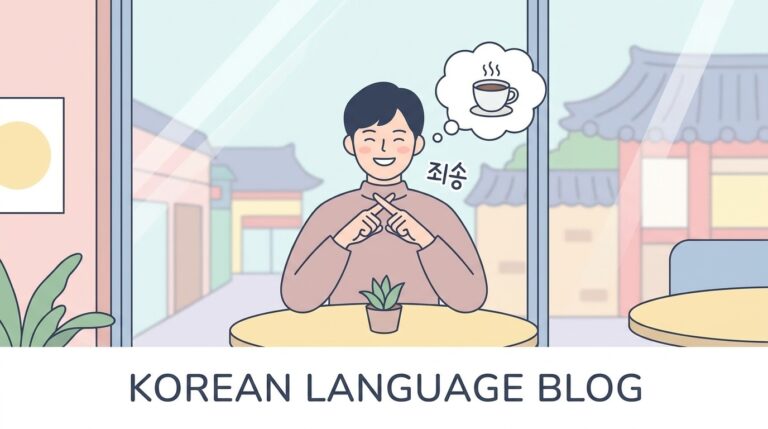
– The Apologetic Hand: When declining an offer from an older person, slightly bow your head, smile apologetically, and hold one hand up gently as if to gently block the offer, saying “아유, 괜찮습니다” (Ayu, gwaenchanseumnida – Oh, I am okay).
– Eye Contact: Do not stare piercingly into someone’s eyes while refusing them. Breaking eye contact slightly downwards shows respect and regret.
4-2. K-Drama Connection: The “Difficult” Trope
Have you ever noticed in K-Dramas, when someone confesses their love and the other person doesn’t feel the same way? They rarely say “I don’t like you.” They say, “미안해… 나는 좀 어려울 것 같아” (Sorry… I think it will be a bit difficult for me). In Korean culture, protecting the other person’s 기분 (Kibun – feelings/mood) and saving face is paramount. Directly rejecting someone is seen as unnecessarily harsh. The indirect “no” allows both parties to walk away with their dignity intact.
Phase 5: Real-Life Roleplay Scenario
Setting: Saturday afternoon at a busy cafe in Hongdae. You are exhausted from studying all week. Your Korean language exchange partner, Minsoo, suddenly brings up a huge favor.
Characters:
– YOU: An international student in Korea, currently running on zero sleep.
– Minsoo (25): Your energetic Korean friend who means well but asks for a lot.
Dialogue:
Minsoo: 아! 맞다. 너 다음 주 금요일에 시간 있어?
(A! Matda. Neo daeum ju geumyoire sigan isseo?)
[Oh! Right. Do you have time next Friday?]
YOU: 금요일? 수업 끝나고는 특별한 일 없는데… 왜?
(Geumyoil? Sueop kkeunnagoneun teukbyeolhan il eomneunde… Wae?)
[Friday? Nothing special after class… Why?]
Minsoo: 대박! 그럼 나 영어 과제하는 것 좀 도와줄 수 있어? 5페이지야! 🥺
(Daebak! Geureom na yeongeo gwajehaneun geot jom dowajul su isseo? O-peijiya!)
[Awesome! Then can you help me with my English assignment? It’s 5 pages!]
(🎭 Stage Direction: Minsoo looks at you with puppy dog eyes. You are already exhausted just thinking about it.)
🔀 YOUR TURN! How do you answer?
– A) “아니. 나 피곤해서 싫어.” (No. I’m tired, I don’t want to.)
– B) “5페이지? 아… 진짜 도와주고 싶은데, 이번 주는 내가 너무 피곤해서 좀 어려울 것 같아. 미안해!”
– C) “그래! 당연하지!” (Yes! Of course!)✅ Best Choice: B — Reason: You validate his request (“I really want to help”), give a valid reason (“I’m too tired”), and use the magic phrase (“it seems a bit difficult”).
⚠️ Choice A Analysis: This is incredibly direct and might genuinely hurt Minsoo’s feelings and damage the friendship.
⚠️ Choice C Analysis: The classic people-pleaser move! Your weekend is now ruined.
K-Culture Bonus Roleplay: The Street Vendor
(Walking through Myeongdong, a cosmetic shop employee hands you a free face mask and tries to guide you inside.)
Employee: 손님! 이거 무료예요~ 한번 보고 가세요!
(Sonnim! Igeo muryoyeyo~ Hanbeon bogo gaseyo!)
[Customer! This is free~ Come take a look!]
YOU: (Smiling politely, slightly bowing head) 아, 괜찮습니다. 많이 파세요!
(Ah, gwaenchanseumnida. Mani paseyo!)
[Ah, I’m okay. Have a good day selling!]
(Walk away smoothly. Do not stop!)
Phase 6: 10-Second Shadowing Drill
Practice making your “No” sound soft and apologetic. Pay attention to the pauses (/) and the emotion tags!
🥺 아, 어쩌죠? / 제가 오늘 / 선약이 있어서요...
(Ah, eojjeojyo? / je-ga oneul / seonyagi isseoseoyo…)
Tone: Troubled, drawing out the ‘yo’ at the end slightly.
😢 진짜 도와주고 싶은데, / 좀 / 어려울 것 같아요.
(Jinjja dowajugo sipeunde, / jom / eoryeoul geot gatayo.)
Tone: Sincere, emphasizing ‘jinjja’ (really) to show you care.
Phase 7: K-Culture Mini Dictionary
| Korean | Romanization | English | Cultural Context |
|---|---|---|---|
| 눈치 | nunchi | Social tact / awareness | The ability to read the room and understand people’s feelings without them explicitly stating it. Essential for knowing when someone is giving you a polite “no.” |
| 기분 | kibun | Mood / feelings / face | Keeping someone’s ‘kibun’ intact is why Koreans use indirect language to refuse things. |
| 선약 | seonyak | Prior engagement | The most polite and unquestionable excuse for not attending a gathering. |
| 핑계 | pinggye | Excuse | What you might need to gently invent if you just want to stay home and watch Netflix! |
| 회식 | hoesik | Company dinner | A major part of Korean work culture. Refusing these constantly can affect your relationships at work. |
Phase 8: Traveler’s Survival Kit
Even if you are just visiting Korea for a week, you will need to decline things: fliers on the street, extra spicy sauce, or plastic bags at convenience stores.
🆘 Survival Phrases TOP 3
1. “아, 괜찮아요.” (Ah, gwaenchanayo)
– 🗣️ Pronunciation: [ah, gwaen-chan-ah-yo]
– 📍 Where to use: Everywhere! When offered a receipt, a plastic bag, or a flier.
– 💡 Meaning: “I’m okay (I don’t need it).”2. “다음에 올게요.” (Daeume olgeyo)
– 🗣️ Pronunciation: [da-eum-e ol-ge-yo]
– 📍 Where to use: Clothing stores, markets, cosmetic shops.
– 💡 Meaning: “I’ll come back next time.” (The polite way to leave a store without buying anything. They know you probably won’t come back, but it’s the polite script!).3. “매운 거 잘 못 먹어요.” (Maeun geo jal mot meogeoyo)
– 🗣️ Pronunciation: [mae-un guh jal moht muh-guh-yo]
– 📍 Where to use: Restaurants.
– 💡 Meaning: “I can’t eat spicy food well.” (A polite way to refuse/ask to remove spicy ingredients without insulting the chef’s recipe).📌 Editor’s Travel Note
– Refusing Soju: If an older Korean person offers you a shot of Soju and you don’t drink, don’t just say “안 마셔요” (I don’t drink). Say “제가 술을 잘 못 해서요… 죄송합니다” (I can’t handle alcohol well… I’m sorry). They will usually understand immediately!
Phase 9: Critical Thinking Corner — “A Step Deeper”
🧠 Think Deeper: Language & Harmony (언어와 조화)
Why does the Korean language have so many complex ways to avoid saying “No”? It all ties back to the cultural emphasis on collective harmony (공동체 의식) and interpersonal relationships (정 – Jeong). In societies that prioritize the group over the individual, a flat “No” can be perceived as putting your own convenience above the relationship. By saying “It’s difficult” or “I want to, but…”, you are signaling: “I value our relationship, and I align with your goals, but external circumstances are preventing me from helping.” It’s not just language; it’s social glue.
💬 Your Turn: In your home culture, is it acceptable to give a direct “No” to a friend or boss? How do people soften their rejections where you are from? Share with us in the comments!
Phase 10: FAQ & Avoiding Misunderstandings
Q: Can I just use “싫어요” (I hate it / I don’t want to)?
A: NO! 🚫 Please be very careful with 싫어요 (sireoyo). It doesn’t just mean “No, thanks,” it means “I dislike/hate it.” If someone offers you a coffee and you say “싫어요,” you are essentially saying “I hate that.” Use “괜찮아요” (I’m okay) instead.
Q: How do I refuse an invitation from my boss?
A: Always use the formal “죄송하지만…” (I am sorry but…) instead of “미안하지만”. And always provide a brief, respectful reason, like a family matter or a prior doctor’s appointment.
❌ Common Mistake #1: Translating “I can’t” directly to “못 해요” (Mot haeyo) for favors.
✅ Do this instead: While “못 해요” technically means “I can’t,” it sounds very blunt, like “I am incapable” or “I absolutely will not.” Stick to “어려울 것 같아요” (It seems difficult).
Phase 11: Summary & Action Items
One-Liner Summary: To say “no” like a true Korean, replace the harsh “No” with “I’m sorry, but it seems a bit difficult” (미안하지만 좀 어려울 것 같아요).
Action Mission:
– 🥉 Bronze (Solo): Stand in front of a mirror, do the Korean “Sseup…” inhale, and say “아, 어쩌죠? 좀 어려울 것 같아요.” 3 times.
– 🥈 Silver (Online): Imagine your favorite K-Pop idol asked you to move to Korea tomorrow. Reply in the comments politely refusing them in Korean!
– 🥇 Gold (Real World): The next time you are at a Korean store or restaurant and they offer you a receipt (영수증 드릴까요?), politely refuse by saying “아, 괜찮습니다!”
🎬 K-Culture Mission:
Next time you watch a K-Drama, look for a scene where a character declines an offer. I guarantee you will spot them avoiding eye contact, rubbing their neck, and saying “어려울 것 같아.”
Phase 12: Interactive Quiz Challenge
1. Situational Judgment: A co-worker asks you to cover their shift this weekend, but you are going on a trip. What is the most natural Korean response?
A) 아니요. 안 돼요. (No. You can’t.)
B) 싫어요. 저는 여행을 갑니다. (I hate it. I am going on a trip.)
C) 아, 어쩌죠? 이번 주말에 선약이 있어서 좀 어려울 것 같아요. (Ah, what should I do? I have a prior engagement this weekend so it might be difficult.)
2. Fill in the Blank:
A: 이거 하나 더 드릴까요? (Shall I give you one more of this?)
B: 마음은 ________________, 괜찮습니다. (I am thankful for the thought, but I’m okay.)
3. True or False — K-Culture Edition:
If a Korean friend says “Let’s grab a meal sometime!” (언제 밥 한번 먹자!), you must immediately pull out your calendar and schedule a hard date. (T/F)
(Answers: 1. C (A & B are way too aggressive!) / 2. 감사하지만 (gamsahajiman) / 3. False. Often, this is just a polite greeting, like saying “See you around!” Wait for them to suggest a specific day before treating it as a real invitation!)
Frequently Asked Questions (FAQ)
Q: What does "미안하지만 좀 어려울 것 같아요." mean in Korean and how do you pronounce it?
A: In Korean, "미안하지만 좀 어려울 것 같아요." is pronounced [Mianhajiman jom eoryeoul geot gatayo. [mee-an-ha-jee-man johm uh-ryuh-ool gut ga-ta-yo] and means: (Literal) I'm sorry, but it seems like it will be a bit difficult. / (Real Nuance) I'm sorry, but I can't do it.
Q: What does "어쩌죠? 제가 선약이 있어서요." mean in Korean and how do you pronounce it?
A: In Korean, "어쩌죠? 제가 선약이 있어서요." is pronounced [Eojjeojyo? Jega seonyagi isseoseoyo. [uh-jjuh-jyo? je-ga sun-yah-gee is-suh-suh-yo] and means: (Literal) What should I do? I have a prior engagement. / (Real Nuance) Oh no, I really wish I could, but I already have plans.
Q: What does "마음은 감사하지만, 괜찮습니다." mean in Korean and how do you pronounce it?
A: In Korean, "마음은 감사하지만, 괜찮습니다." is pronounced [Maeumeun gamsahajiman, gwaenchanseumnida. [ma-eum-eun gam-sa-ha-jee-man, gwaen-chan-seum-nee-da] and means: (Literal) I am thankful for your heart/intent, but I am okay. / (Real Nuance) Thank you for the offer, but no thank you.






