

Phase 1: Empathy & K-Culture Cold Open
Hello! I’m your Daily Hangul Editor, your local Korean friend and culture navigator.
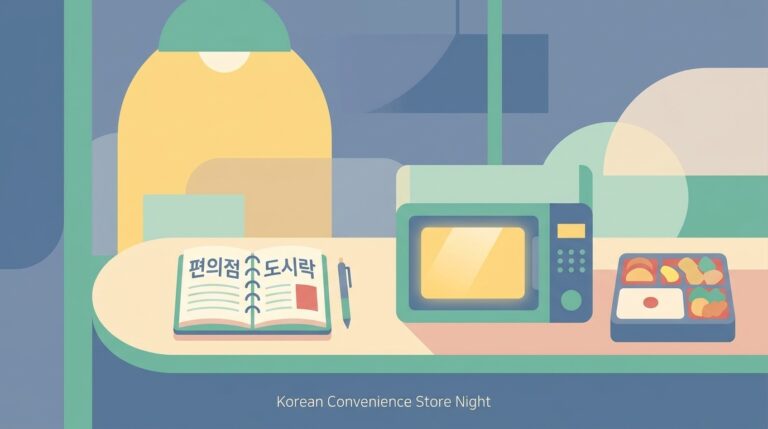
Picture this: It’s 11:30 PM. You’ve just finished a long day exploring Seoul. You walk into a brightly lit convenience store (편의점 – CVS), a scene straight out of your favorite K-Drama. You see the protagonist’s go-to comfort meal—a delicious, colorful Dosirak (도시락 – lunch box)—sitting on the shelf. Your stomach growls.
You pick it up, take it to the counter, and suddenly… panic sets in. The part-time worker (알바생) asks you something. Do you need to heat it? Do you need chopsticks? How do you say “I don’t need a plastic bag” without doing an awkward mime game?
Don’t worry! I’ve seen countless beginner students freeze in this exact situation. Today, we’re going to learn the easiest, most natural A1-level survival phrases so you can grab your K-CVS snacks like a total insider. Everything here is based on real questions from travelers just like you!
Phase 2: Core Expressions Deep Dive
Let’s master the 3 golden phrases you need for your Dosirak mission.
1. 이거 데워주세요. (Please heat this up.)
- Pronunciation: i-geo de-wo-ju-se-yo.
- i-geo sounds like “e-go” (but with a short ‘o’).
- de-wo sounds like “day-woah”.
- Meaning: Please heat this up. (Literal: This heat-up give please).
- K-Culture Moment: You’ll often see K-Drama characters eating hot ramen or Dosirak at the store’s window tables. Convenience stores in Korea have microwaves (전자레인지), and often the cashier will heat it up for you behind the counter!
- Editor’s Insight: You don’t need to know the name of the food. Just point or hold it up and say “i-geo” (this). It’s the ultimate beginner cheat code!
- Situation Spectrum:
- Convenience store staff: ✅ (Perfect)
- Restaurant staff: ✅
- Boss/Seniors: ⚠️ (A bit too direct)
- 🤔 Think About It: Why does “ju-se-yo” (please give) attach to the end of action verbs in Korean? It reflects a culture of humbly asking for a “favor” rather than making a direct command.
2. 젓가락 주세요. (Please give me chopsticks.)
- Pronunciation: jeot-ga-rak ju-se-yo.
- jeot sounds like “jut” in jut out.
- ga-rak sounds like “gah-rak”.
- Meaning: Please give me chopsticks.
- K-Culture Moment: When buying instant noodles or Dosirak, wooden chopsticks (나무젓가락) are usually free! But sometimes the cashier forgets, or they are kept behind the counter.
- Editor’s Insight: Just add “ju-se-yo” to any noun, and boom—you have a polite request!
- Situation Spectrum:
- Casual / Staff: ✅
- Formal: ✅
3. 봉투 필요 없어요. (I don’t need a bag.)
- Pronunciation: bong-tu pi-ryo eop-seo-yo.
- bong-tu sounds like “bong-too”.
- pi-ryo eop-seo-yo sounds like “pee-ryo-up-suh-yo”.
- Meaning: I don’t need a bag. (Literal: Bag necessity doesn’t exist).
- K-Culture Moment: In Korea, plastic bags are no longer free by law due to eco-friendly policies. Cashiers will always ask if you need one, and it costs about 20 to 50 won.
- Editor’s Insight: If the cashier asks a fast question right as you put your Dosirak down, 99% of the time, they are asking “Need a bag?” Say this phrase with a gentle hand wave!
- Situation Spectrum:
- Anywhere: ✅
Phase 3: Textbook vs. Real Korean
Let’s see how real life differs from your language books!
[Heating up your Dosirak]
* 📖 Textbook: 전자레인지에 데워 주시겠습니까? (Would you please heat this up in the microwave?)
* 🗣️ Real Korean: 이거 데워주세요. (Heat this please.)
* 💡 Why the difference?: Koreans value ‘Ppalli-Ppalli’ (hurry-hurry) culture. In a fast-paced CVS, short, polite, and efficient phrases win.
[Refusing a bag]
* 📖 Textbook: 저는 비닐봉투가 필요하지 않습니다. (I do not require a plastic bag.)
* 🗣️ Real Korean: (Hand waving gesture) 괜찮아요. (It’s okay / No thanks.)
* 💡 Why the difference?: “괜찮아요 (gwaen-cha-na-yo)” is the magic word in Korea. It means “I’m fine as I am, so no thank you,” saving time and syllables.
(Bottom Note: As an A1 beginner, don’t worry about long textbook sentences. Short “Noun + ju-se-yo” is your best friend!)
Phase 4: Cultural Context — K-Culture Deep Dive
4-1. Non-Verbal Nunchi (눈치)
When handing your T-money card or credit card to the CVS clerk, try using two hands, or lightly place your left hand on your right arm/elbow as you hand it over. This non-verbal gesture shows respect. Also, Nunchi (reading the room) tip: if there’s a long line behind you, step aside while your Dosirak is in the microwave!
4-2. The Convenience Store in K-Dramas & Reality
You’ve definitely seen the classic K-Drama trope: the male and female leads sit at the CVS window counter, eating ramen or Dosirak, drinking banana milk, and having a deep conversation.
Reality Check: While it is a great place for a quick, cheap meal, keep your voice down! It’s a shared space. Also, unlike the dramas where characters storm off leaving their trash, in real life, you must clean up and separate your trash (분리수거 – recycling) in the bins provided by the door.
Phase 5: Real-Life Roleplay Scenario
Setting: 11:00 PM. A CU convenience store near Hongdae. Neon lights buzzing. You grab a Bulgogi Dosirak and head to the counter.
Characters:
– YOU: A hungry traveler ready for a midnight K-Drama meal.
– Alba (알바생): The part-time cashier, looking a bit tired but friendly.
(Dialogue)
YOU: 안녕하세요. 이거 계산해 주세요.
(an-nyeong-ha-se-yo. i-geo gye-san-hae ju-se-yo.)
[Hello. Please ring this up.]
(🎭 Stage Direction: You place the Dosirak on the counter)
Alba: 안녕하세요. 포인트 적립 하시나요?
(an-nyeong-ha-se-yo. po-in-teu jeong-nip ha-si-na-yo?)
[Hello. Do you collect points?]
YOU: 아니요, 괜찮아요.
(a-ni-yo, gwaen-cha-na-yo.)
[No, it’s okay.]
Alba: 봉투 필요하세요?
(bong-tu pi-ryo-ha-se-yo?)
[Do you need a bag?]
🔀 Your Turn! How do you answer?
– A) “봉투 필요 없어요.” (I don’t need a bag.)
– B) “네, 주세요.” (Yes, please give me one.)
– C) “가방!” (Bag!)✅ Best Choice: A or B! If you have a backpack, A is eco-friendly. If you need one, B is polite.
⚠️ Choice C Analysis: Just yelling “Bag!” in Korean sounds rude. Always add “ju-se-yo” (please).
(Let’s assume you chose A)
YOU: 봉투 필요 없어요. 이거 데워주세요.
(bong-tu pi-ryo eop-seo-yo. i-geo de-wo-ju-se-yo.)
[I don’t need a bag. Please heat this up.]
Alba: 네, 1분 30초 걸립니다. 젓가락 드릴까요?
(ne, 1-bun 30-cho geol-lim-ni-da. jeot-ga-rak deu-ril-kka-yo?)
[Yes, it will take 1 min 30 secs. Shall I give you chopsticks?]
YOU: 네, 주세요.
(ne, ju-se-yo.)
[Yes, please.]
Alba: 결제 도와드릴게요.
(gyeol-je do-wa-deu-ril-ge-yo.)
[I will help you with the payment.]
YOU: 카드로 할게요.
(ka-deu-ro hal-ge-yo.)
[I’ll pay by card.]
Phase 6: 10-Second Shadowing Drill
Let’s practice the flow! Read this out loud, pausing at the slashes.
😊 “안녕하세요! / 봉투는 / 필요 없어요. / 이거 / 데워주세요~”
(an-nyeong-ha-se-yo! / bong-tu-neun / pi-ryo eop-seo-yo. / i-geo / de-wo-ju-se-yo~)
[Hello! / As for a bag / I don’t need one. / This / please heat it up~]
Phase 7: K-Culture Mini Dictionary
| Korean | Romanization | English | Context |
|---|---|---|---|
| 편의점 | pyeon-ui-jeom | Convenience Store | GS25, CU, 7-Eleven, Emart24. Open 24/7! |
| 도시락 | do-si-rak | Lunch box | Ranges from traditional rice/meat to pastas. |
| 알바(생) | al-ba(-saeng) | Part-time worker | Slang derived from the German word ‘Arbeit’. |
| 전자레인지 | jeon-ja-re-in-ji | Microwave | Often self-service in the dining area. |
| 1+1 (원플러스원) | won-peul-leo-seu-won | Buy 1 Get 1 Free | A favorite promotional event in K-CVS! |
Phase 8: Traveler Survival Kit
If you are traveling in Korea, you will visit a CVS at least once a day. Memorize these!
🆘 Survival Phrases TOP 3
1. 🇰🇷 “이거 얼마예요?” (i-geo eol-ma-ye-yo?)
– 🗣️ Sound: e-go ul-ma-yay-yo?
– 📍 Meaning: How much is this?
2. 🇰🇷 “여기서 먹어도 돼요?” (yeo-gi-seo meo-geo-do dwae-yo?)
– 🗣️ Sound: yuh-gee-suh mo-go-do dway-yo?
– 📍 Meaning: Can I eat here?
3. 🇰🇷 “티머니 돼요?” (ti-meo-ni dwae-yo?)
– 🗣️ Sound: tee-muh-nee dway-yo?
– 📍 Meaning: Can I pay with T-money (Transit card)?📌 Editor’s Travel Note
– Paying: You can use your T-money transport card to buy things at the CVS! It’s super convenient.
– Self-heating: If the cashier is busy, you might have to heat the Dosirak yourself. Look at the label: usually “1000W 1분 30초” means 1 min 30 sec in the store’s microwave.
Phase 9: Critical Thinking Corner — “One Step Deeper”
Food & Identity: The Power of ‘Bap-sim’ (밥심)
Why are Korean convenience store lunch boxes so elaborate? Unlike a simple sandwich in the West, a Korean Dosirak often contains rice, soup, Bulgogi, and 4-5 different side dishes (banchan). This is because of “Bap-sim” (밥심), which translates to “Rice Power.” In Korean culture, a meal isn’t really a meal unless there is warm rice. Even when eating a quick, cheap meal alone at 11 PM, Koreans want it to feel like a proper, warm, home-cooked meal to gain energy.
💬 Your Turn: Does your culture have a “comfort food” that everyone relies on for energy? Share it in the comments!
Phase 10: FAQ & Common Mistakes
Q: Do I need to tip the convenience store worker?
No! Korea has an absolute zero-tipping culture. Handing extra money will confuse them. Just a friendly “감사합니다” (Thank you) is the best tip!
Q: Can I drink alcohol inside the convenience store?
Technically, drinking alcohol inside a convenience store is illegal in Korea, though sitting at the tables outside the store is generally accepted. However, always check if there’s a sign that says “음주 금지” (No Drinking).
❌ Common Mistake #1: Putting the Dosirak in the microwave with the plastic lid fully sealed.
✅ Do this instead: Always remove the plastic film, and gently take off or loosen the lid before microwaving to avoid a messy explosion!
Phase 11: Summary & Action Items
- One-Liner Summary: Remember “N-oun + ju-se-yo” (Please give me [Noun]) and you can survive any K-CVS encounter!
Action Mission 3 Steps:
– 🥉 Bronze (Solo): Stand in front of a mirror holding a book (pretend it’s a Dosirak) and say “이거 데워주세요” 3 times.
– 🥈 Silver (Online): Drop a comment below using “(Food name) + 데워주세요!”
– 🥇 Gold (Real Life): Next time you visit a Korean CVS or a Korean grocery store in your country, refuse the plastic bag by saying “봉투 필요 없어요!”
🎬 K-Culture Mission: Watch an episode of a K-Drama today. I guarantee you will spot a convenience store scene. Try to spot what K-CVS snacks they are eating!
Phase 12: Quiz — Interactive Challenge
1. You are at a CVS counter. The cashier asks “봉투 필요하세요?” (Need a bag?). You want to save the turtles and use your backpack. What do you say?
A) 이거 데워주세요.
B) 젓가락 주세요.
C) 봉투 필요 없어요.
2. True or False – K-Culture Edition:
“In Korea, it is polite to leave your empty Dosirak box on the convenience store table for the staff to clean up.”
3. Fill in the blank:
To ask someone to heat up your food, you say “이거 _________.”
(Hint: day-woah-ju-say-yo)
(Answers: 1. C / 2. False! You must throw away your own trash and recycle. / 3. 데워주세요)
Frequently Asked Questions (FAQ)
Q: What does "이거 데워주세요. (Please heat this up.)" mean in Korean and how do you pronounce it?
A: In Korean, "이거 데워주세요. (Please heat this up.)" is pronounced [i-geo de-wo-ju-se-yo.] and means: a key conversational Korean expression covered in this lesson.
Q: What does "젓가락 주세요. (Please give me chopsticks.)" mean in Korean and how do you pronounce it?
A: In Korean, "젓가락 주세요. (Please give me chopsticks.)" is pronounced [jeot-ga-rak ju-se-yo.] and means: a key conversational Korean expression covered in this lesson.
Q: What does "봉투 필요 없어요. (I don't need a bag.)" mean in Korean and how do you pronounce it?
A: In Korean, "봉투 필요 없어요. (I don't need a bag.)" is pronounced [bong-tu pi-ryo eop-seo-yo.] and means: a key conversational Korean expression covered in this lesson.







