

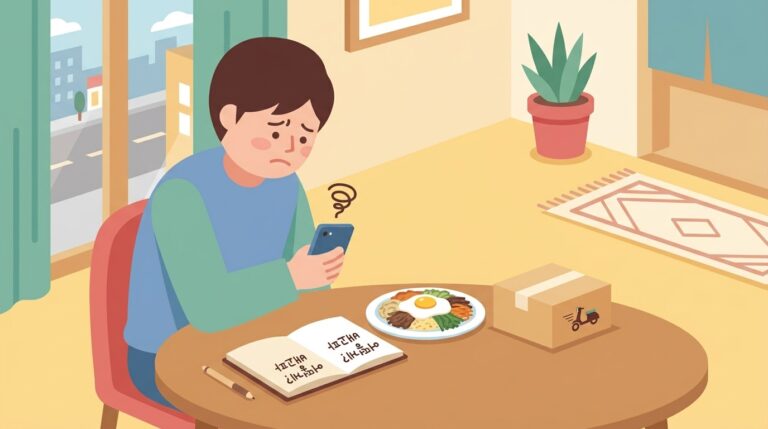
Phase 1: Empathy & Immersion
Hello! This is your Daily Hangul Editor.
Imagine this: It’s 11 PM on a Friday. You’re bundled up in your cozy blanket, binge-watching a K-Drama. Suddenly, the main characters head to a pojangmacha (포장마차, street tent) or sit in their living room to devour some mouth-watering Chimaek (Fried Chicken and Beer) or Tteokbokki. Naturally, your stomach growls. You open a Korean delivery app like Baemin (Baedal Minjok) to order just one portion of Tteokbokki for yourself.
But wait. The Tteokbokki is 8,000 KRW, yet a red warning message pops up: “Minimum order amount: 18,000 KRW.”
Welcome to the ultimate dilemma of solo-livers in Korea. You just wanted a simple late-night snack, but now you have to order three extra side dishes, a giant soda, and maybe some fried dumplings just to be allowed to pay for delivery!
If you live in or plan to visit Korea by yourself, you will inevitably face the dreaded “Minimum Order Amount” burden. Today, we’re going to learn exactly how to navigate this uniquely Korean modern struggle, the slang you need to vent your frustrations, and the cultural context behind why eating alone in Korea is a relatively new concept. Let’s dive in!
Phase 2: Deep Dive into Key Expressions
Here are the absolute must-know phrases when you’re battling the delivery apps.
1. 최소 주문 금액
- Pronunciation: choeso jumun geumaek [chwey-so joo-moon geu-maek]
(The ‘eu’ 으 in geu sounds like the disgusted sound you make when stepping in gum!)- Meaning: Minimum order amount (Literal) / The reason I’m eating leftovers for three days (Real nuance)
- K-Culture Moment: You’ll see this phrase at the very top of every restaurant page on Korean delivery apps. When a Korean friend complains, “아, 최소 주문 금액 맞추기 힘들어…” (Ah, it’s so hard to meet the minimum order amount…), you know they live alone.
- Editor’s Insight: Choeso means ‘minimum’, jumun is ‘order’, and geumaek is ‘amount’. It feels like a hurdle you have to jump over before you can even think about the delivery fee.
- Situation Spectrum:
- Casual with friends: ✅ (Complaining together)
- Semi-formal: ✅ (Stating a fact)
- Formal: 🚫 (Not typically used when speaking to elders, as it’s an app term)
- 🤔 Think About It: Why do you think restaurants set this so high? Is it because Korean meals usually come with many complimentary side dishes (banchan), making small deliveries unprofitable?
2. 배달비 / 배달 팁
- Pronunciation: baedal-bi / baedal tip [bae-dal-bee / bae-dal teep]
- Meaning: Delivery fee / Delivery tip
- K-Culture Moment: You finally meet the minimum order amount, proceed to checkout, and boom—an extra 5,000 KRW baedal-bi is added. This is the moment K-Pop idols on live streams often joke about, saying, “Delivery fees are scarier than ghosts these days!”
- Editor’s Insight: Bi (비) means ‘cost/fee’. You’ll also see Baedal Tip. Note: In Korea, a “tip” isn’t a voluntary gratuity given to the driver like in Western countries; it’s a fixed mandatory fee set by the app!
- Situation Spectrum:
- Casual: ✅
- Semi-formal: ✅
- Formal: ✅
- 🤔 Think About It: Korea has a “no tipping” culture in restaurants. How do you feel about the word “tip” being used for a mandatory delivery fee?
3. 1인분 배달
- Pronunciation: irinbun baedal [eel-een-boon bae-dal]
- Meaning: 1-person portion delivery
- K-Culture Moment: Because of the solo-living struggle, delivery apps created a specific category called “1인분 배달” (1-person delivery). Finding a good restaurant in this category feels like finding an oasis in a desert.
- Editor’s Insight: 1인 (1 person) + 분 (portion/serving). Use this magic word when searching for food, and you’ll find places with lower minimum order amounts!
- Situation Spectrum:
- Casual: ✅
- Semi-formal: ✅
- Formal: ✅
- 🤔 Think About It: Does your home country have special menus or app categories exclusively dedicated to people eating alone?
Phase 3: Textbook vs. Real Korean
Let’s see how the textbook language changes when real solo-living Koreans text each other about delivery food.
[Situation 1: Talking about eating alone]
* 📖 Textbook Korean: 저는 오늘 혼자 밥을 먹습니다. (I am eating a meal alone today.)
* 🗣️ Real Korean: 나 오늘 혼밥해. (I’m hon-bap-ing today.)
* 💡 Why is it different?: 혼밥 (Hon-bap) is a portmanteau of 혼자 (alone) and 밥 (rice/meal). Koreans love shortening words for efficiency, especially internet slang that reflects modern solo lifestyles.
[Situation 2: Complaining about the delivery fee]
* 📖 Textbook Korean: 배달 요금이 너무 비쌉니다. (The delivery fee is too expensive.)
* 🗣️ Real Korean: 와, 배달비 실화야? (Wow, is this delivery fee real life? / Delivery fee is insane.)
* 💡 Why is it different?: “실화야?” (Is it a true story/real life?) is a trendy slang used when something is shockingly good or, in this case, shockingly bad.
[Situation 3: Explaining why you ordered so much]
* 📖 Textbook Korean: 배달을 위해 더 많이 주문했습니다. (I ordered more for the delivery.)
* 🗣️ Real Korean: 최소 주문 맞추려고 다 시켰어. (I just ordered everything to meet the minimum order.)
* 💡 Why is it different?: In spoken Korean, dropping the subject (“I”) and using verbs like 맞추다 (to match/meet the target) sounds much more natural and native-like.
Bottom Note: For a B1 level, using “혼밥” (hon-bap) and “실화야?” (silhwa-ya?) will instantly make you sound like a local insider without crossing into overly heavy slang. Try dropping these in your next conversation!
Phase 4: Cultural Context — K-Culture Deep Dive
4-1. Non-Verbal Nuances: The Art of the “Review Event”
When navigating delivery apps to offset the painful baedal-bi, you must master the 리뷰 이벤트 (Review Event). Restaurants will offer free cheese balls, an extra fried egg, or a free soda if you promise to leave a 5-star review with a photo. It’s an unwritten rule: if you select the review event, you must actually leave a good review (눈치 Nunchi culture applies here too—don’t eat and run!).
4-2. Food & Society: The Evolution of “Hon-bap”
In traditional Korean culture, food is meant to be shared. Stting around a bubbling pot of Jjigae (stew) with multiple side dishes is the ultimate symbol of Jeong (정, affection/bonding). Historically, eating alone was viewed with pity—people might look at you and wonder, “Why do they have no friends to eat with?”
However, as the 1-person household (1인 가구) demographic exploded in cities like Seoul, K-Culture had to adapt. Now, not only are there “1인분” (1-person) delivery options, but there are even restaurants designed with solo booths facing a wall so you can eat your ramen in total peace without feeling self-conscious. The struggle of the minimum order amount is the growing pain of a society shifting from extreme communal living to fierce individualism.
Phase 5: Interactive Roleplay Scenario
Setting: Saturday afternoon in your cozy Seoul studio apartment. You’re hungover and desperately craving Jjamppong (spicy seafood noodle soup). You open the app, but the minimum order is 20,000 KRW, and one bowl is only 9,000 KRW. You text your Korean friend, Minsu.
Characters:
– YOU: An expat living in Seoul, struggling with app math.
– Minsu (29): Your Korean friend, a veteran solo-liver who knows all the app hacks.
Dialogue:
YOU: 민수 씨, 짬뽕 하나 먹고 싶은데 배달이 안 돼요. 😭
(Minsu ssi, jjamppong hana meokgo sipeunde baedari an dwaeyo.)
[Minsu, I want to eat one bowl of Jjamppong but it won’t deliver.]
Minsu: 왜? 아~ 최소 주문 금액 때문에?
(Wae? Ah~ choeso jumun geumaek ttaemune?)
[Why? Ah~ because of the minimum order amount?]
YOU: 네! 짬뽕은 9천 원인데, 최소 주문이 2만 원이에요.
(Ne! Jjamppongeun gu-cheon woninde, choeso jumuni i-man wonieyo.)
[Yes! The Jjamppong is 9,000 won, but the minimum order is 20,000 won.]
Minsu: 헐, 배달비도 비쌀 텐데… 그냥 탕수육 세트로 시켜!
(Heol, baedal-bido bissal tende… geunyang tangsuyuk seteuro sikyeo!)
[Omg, the delivery fee will be expensive too… just order the Sweet and Sour Pork set!]
YOU: 혼자 다 못 먹을 것 같은데요…
(Honja da mot meogeul geot gateundeyo…)
[I don’t think I can eat it all by myself…]
Minsu: 남은 건 냉장고에 넣었다가 내일 데워 먹으면 되지! 1인 가구의 지혜야. 😎
(Nameun geon naengjanggoe neoeotdaga naeil dewo meogeumyeon doeji! Iringagu-ui jihyeya.)
[Just put the leftovers in the fridge and heat it up tomorrow! That’s the wisdom of a 1-person household.]
🔀 Your Turn! How do you reply to Minsu?
– A) “아, 알겠습니다. 세트로 주문할게요!” (Ah, understood. I will order the set!)
– B) “차라리 그냥 라면 끓여 먹을래요. 배달비 실화야?” (I’d rather just boil ramen. Is this delivery fee real life?)
– C) “저한테 돈을 주세요. 제가 살게요!” (Give me money. I will buy it!)✅ Best Choice: B — Reason: Choice B uses the slang “실화야?” perfectly and expresses the highly relatable decision of giving up on delivery because of the absurd fees. It sounds incredibly native! Choice A is safe but a bit robotic.
⚠️ Choice C Analysis: Demanding money is definitely not the right Nunchi here!
Phase 6: 10-Second Shadowing Drill
Practice expressing your delivery app frustrations like a true Korean local! Pay attention to the pauses (/) and emotions.
- 😤 Annoyed: 아, / 최소 주문 금액 / 맞추기 / 너무 힘들어요.
(Ah, / choe-so ju-mun geu-maek / mat-chu-gi / neo-mu him-deu-reo-yo.)
“Ah, it’s so hard to meet the minimum order amount.” -
😲 Shocked: 와… / 배달비 / 실화야?
(Wa… / bae-dal-bi / sil-hwa-ya?)
“Wow… is this delivery fee for real?” -
😊 Proud: 이거 / 최소 주문 맞추려고 / 추가했어요!
(I-geo / choe-so ju-mun mat-chu-ryeo-go / chu-ga-haes-seo-yo!)
“I added this to meet the minimum order!”
Phase 7: K-Culture Mini Dictionary
| 한국어 (Korean) | Romanization | English | Context / Nuance |
|---|---|---|---|
| 혼밥 | hon-bap | Eating alone | A very common slang term for solo dining. You can also say 혼술 (hon-sul) for drinking alone! |
| 최소 주문 금액 | choeso jumun geumaek | Minimum order amount | The villain of every solo-liver’s late-night cravings. |
| 배달의 민족 (배민) | Baedal-ui Minjok (Baemin) | Nation of Delivery | Korea’s #1 delivery app. Often just called “Baemin.” |
| 리뷰 이벤트 | ribyu ibenteu | Review Event | Getting a free side dish by promising a 5-star photo review. |
| 1인분 | irinbun | 1 person portion | Look for this category in apps to avoid massive portions. |
Phase 8: Traveler Survival Kit
Even if you’re just visiting Korea for a week, you’ll want to experience eating fried chicken in your hotel room.
🆘 Survival Phrases for Delivery & Takeout
– 🇰🇷 “배달 되나요?” (baedal doenayo?)
– 🗣️ Meaning: “Do you offer delivery?”
– 📍 Where to use: Calling a restaurant directly or asking the front desk.
- 🇰🇷 “1인분 포장 되나요?” (irinbun pojang doenayo?)
- 🗣️ Meaning: “Can I get one portion to go?”
- 📍 Where to use: At restaurants. If you want to avoid delivery fees entirely, picking it up (pojang) is the ultimate hack!
🇰🇷 “여기로 배달해 주세요.” (yeogiro baedalhae juseyo.)
- 🗣️ Meaning: “Please deliver it here.”
- 📍 Where to use: When typing instructions or talking to the driver.
📌 Editor’s Travel Note:
– App Tip: As a tourist, using local apps like Baemin can be tough without a Korean phone number or resident card. Try using Shuttle Delivery (which has an English interface and accepts foreign cards) or ask your hotel reception to order for you!
– Takeout (Pojang) Discount: Many places offer a 1,000~2,000 KRW discount if you pick the food up yourself. Look for the sign “포장 할인” (Pojang Halin) on the storefront!
Phase 9: Critical Thinking — “One Step Deeper”
Food & Identity: Why Does Korean Food Punish the Solo Diner?
🧠 Think Deeper:
Let’s think about why the minimum order amount feels so high for just one person. Traditional Korean cuisine is based on a “Bansang” (반상) setting—rice and soup for the individual, but multiple side dishes (Banchan) and main meats shared in the center of the table.When a restaurant packs a delivery order, even for one person, they often still provide the kimchi, pickled radish, sauces, and soup. The packaging costs and the platform’s heavy commission fees make delivering a simple 8,000 KRW meal a financial loss for the owner. The “Minimum Order Amount” isn’t just corporate greed; it’s the clash between Korea’s generous communal food traditions and the modern, fast-paced solo lifestyle. It forces us to ask: How do we adapt a culture of sharing into a box meant for one?
💬 Your Turn: Does food from your home country easily translate into single-serving takeout, or is it mostly meant for sharing? Share your thoughts in the comments!
Phase 10: FAQ & Avoiding Misunderstandings
Q: If I use a delivery app, can I ask the driver to bring me cigarettes or alcohol?
No! This is highly regulated. While you can order alcohol through the app if you verify your adult age with a Korean ID, you cannot put “Please buy me a beer from the convenience store on your way” in the delivery notes.
Q: Do I need to tip the delivery driver in cash?
Absolutely not. The “Baedal Tip” (배달 팁) is already calculated and paid within the app. Trying to hand cash to the driver will only confuse them. They will usually just ring the bell, drop the food at the door, and run to their next destination!
❌ Common Mistake #1: Calling the driver to complain about the food quality.
✅ Do this instead: The driver only delivers! If there is a problem with your order, contact the restaurant directly through the app or the customer service center.
Phase 11: Summary & Action Items
One-Liner Summary: To survive solo dining in Korea, master the phrases “최소 주문 금액” (minimum order amount) and “배달비” (delivery fee), and embrace the “Hon-bap” lifestyle!
Action Mission 3 Steps:
– 🥉 Bronze (Solo): Stand in front of the mirror and confidently sigh, “와… 배달비 실화야?” (Wow… is this delivery fee for real?)
– 🥈 Silver (Online): Go to a Korean learning forum or our comment section and write what food you want to order for “hon-bap” today.
– 🥇 Gold (Action): Open a Korean map app or delivery app (like Yogiyo or Baemin), search for “1인분” (1 person portion), and see what the average minimum order amount is in a neighborhood like Gangnam!
Special K-Culture Mission:
Next time you watch a K-Drama, look closely when characters order delivery food. Notice how they rarely order just one thing—there are always multiple plastic containers spread across the table. Now you know why!
💬 Let’s chat: What is your go-to late-night delivery food? Let us know below!
Phase 12: Quiz — Interactive Challenge
Test your new solo-living survival skills!
1. Situational Judgment: You want to eat just one roll of Kimbap, but the minimum order is 15,000 KRW. What is the most natural Korean reaction to text your friend?
A) 저는 김밥을 좋아합니다. (I like Kimbap.)
B) 식당 사장님 나빠요. (Restaurant owner is bad.)
C) 아… 최소 주문 금액 맞추기 너무 힘들어. (Ah… it’s so hard to meet the minimum order amount.)
2. True or False – K-Culture Edition:
“When you pay the ‘Baedal Tip’ (배달 팁) on the app, you should also hand the driver a $5 tip in cash when they arrive.”
3. Fill in the Blank:
I don’t have anyone to eat with tonight, so I’m going to eat alone.
“나 오늘 _____해!”
👀 Click here for the answers!
1. Correct Answer: C. Complaining about the “choeso jumun geumaek” is the ultimate relatable solo-living experience.
2. False. Korea has absolutely no tipping culture. Handing cash to the driver will lead to an awkward rejection.
3. 혼밥 (hon-bap). A brilliant slang word for eating alone!
Frequently Asked Questions (FAQ)
Q: What does "최소 주문 금액" mean in Korean and how do you pronounce it?
A: In Korean, "최소 주문 금액" is pronounced [choeso jumun geumaek [chwey-so joo-moon geu-maek] and means: Minimum order amount (Literal) / The reason I'm eating leftovers for three days (Real nuance)
Q: What does "배달비 / 배달 팁" mean in Korean and how do you pronounce it?
A: In Korean, "배달비 / 배달 팁" is pronounced [baedal-bi / baedal tip [bae-dal-bee / bae-dal teep] and means: Delivery fee / Delivery tip
Q: What does "1인분 배달" mean in Korean and how do you pronounce it?
A: In Korean, "1인분 배달" is pronounced [irinbun baedal [eel-een-boon bae-dal] and means: 1-person portion delivery







