

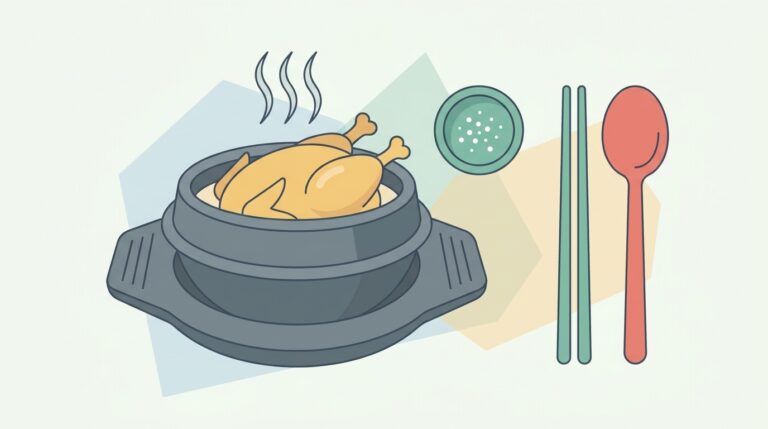
How to Eat Samgyetang Like a Local! Ultimate Korean Soup Guide
Phase 1: Empathy (Immersive Opening)
Hello! I’m the Lead Editor of Daily Hangul.
Picture this: It’s the middle of July in Seoul. The humidity is at 90%, and the sun is blazing. You step into a traditional Korean restaurant, and what does the waiter bring you? A boiling, bubbling, literal volcano of a stone pot with an entire chicken stuffed inside.
You might be thinking, “Why on earth am I eating boiling hot soup when I’m already sweating?” And more importantly… “How do I even start eating this whole chicken without making a mess?”
If you’ve ever watched a K-Drama, you’ve probably seen characters sweating over a bowl of Samgyetang (Ginseng Chicken Soup), tearing the meat apart with their chopsticks, and looking incredibly satisfied. But when you’re sitting in front of that Ttukbaegi (stone pot), the textbook won’t tell you how to debone the chicken, where to put the salt, or why your Korean friend keeps saying the boiling broth is “cool.”
Don’t worry. This guide is based on real struggles from my B2-level students who were totally baffled by their first Samgyetang experience. By the end of this post, you’ll be tackling that boiling pot like a true Seoulite!
Phase 2: Deep Dive into Core Expressions
Let’s master the essential phrases you need to survive and thrive at a Samgyetang restaurant.
1. 살을 발라내다 (Deboning the meat)
- Pronunciation: [sal-eul bal-la-nae-da] (Sal sounds like ‘sal’ in Sally, bal-la sounds like the start of ‘ballerina’, nae sounds like ‘neck’ without the ck).
- Meaning: Literal: To extract the flesh. Real nuance: To take the meat off the bone.
- K-Culture Moment: You’ll hear this a lot at Korean dinner tables. Whether it’s Samgyetang, Galbitang (Beef short rib soup), or fried chicken, someone always takes the lead to “debones” the meat for the group to share.
- Editor’s Insight: This isn’t just a physical action; it’s an act of care. If a Korean friend debones the chicken and puts the meat on your plate, that’s true love!
- Situation Spectrum:
- Close Friends (Casual): ✅ (야, 내가 살 발라줄게! – Hey, I’ll debone it for you!)
- Co-workers (Semi-formal): ✅ (제가 살을 발라낼게요. – I’ll take the meat off the bone.)
- Boss/Elders (Formal): ✅ (뼈 바르기 힘드시죠? 제가 해드릴게요. – Is it hard to debone? I’ll do it for you.)
- 🤔 Think About It: Why does Korean cuisine feature so many dishes with whole bones in them, rather than pre-cut fillets? Does your culture serve meat on the bone or off the bone?
2. 소금에 콕 찍어 먹다 (Dipping lightly in salt)
- Pronunciation: [so-geum-e kok jjik-eo meok-da] (‘Kok’ sounds like ‘coke’ but with a sharp stop).
- Meaning: Literal: To poke and dip in salt. Real nuance: To lightly dab the meat into the salt.
- K-Culture Moment: At the restaurant, you’ll be given a tiny empty plate and a jar of salt. You put a little salt on the plate, and you dip the plain chicken meat into it piece by piece.
- Editor’s Insight: The word “콕” (kok) is an onomatopoeia describing a light poking motion. It makes your Korean sound incredibly natural and cute!
- Situation Spectrum:
- Close Friends (Casual): ✅
- Co-workers (Semi-formal): ✅
- Boss/Elders (Formal): ⚠️ (Skip the “콕” and just say “소금에 찍어 드세요” to sound more mature.)
- 🤔 Think About It: Koreans love to customize their seasoning at the table. How does this compare to Western dining where the chef usually finishes the seasoning in the kitchen?
3. 국물이 시원하다! (The broth is refreshing!)
- Pronunciation: [gung-mul-i si-won-ha-da] (‘Si’ sounds like ‘she’ in sheep. ‘Won’ sounds like winning ‘one’ prize).
- Meaning: Literal: The broth is cool/cold. Real nuance: The hot broth is deeply satisfying, refreshing, and relieves fatigue.
- K-Culture Moment: Middle-aged Korean men at the spa, or drinking hot soup, often let out a deep sigh: “아~ 시원하다!” (Ah~ refreshing!). As a foreigner, this is the most confusing moment—the soup is literally 100°C!
- Editor’s Insight: When “시원하다” is applied to hot food or hot baths, it means “relieving physical tension” or “clearing the stomach.” If you use this after taking a sip of Samgyetang, the restaurant owner will immediately accept you as an honorary Korean.
- Situation Spectrum:
- Close Friends (Casual): ✅
- Co-workers (Semi-formal): ✅
- Boss/Elders (Formal): ✅
- 🤔 Think About It: Can you think of a sensation in your culture that contradicts its literal meaning?
Phase 3: Textbook vs. Real Korean
[Situation 1: Explaining how to eat]
* 📖 Textbook Korean: 닭고기를 소금과 같이 먹습니다. (I eat chicken with salt.)
* 🗣️ Real Korean: 살을 발라서 소금에 콕 찍어 드세요. (Debone the meat and give it a little dip in the salt.)
* 💡 Why different?: Real Korean heavily relies on sensory words (like 콕) and specific action verbs (바르다, 찍다) rather than generic verbs (같이 먹다).
[Situation 2: Explaining the summer food culture]
* 📖 Textbook Korean: 날씨가 더우니까 뜨거운 음식을 먹습니다. (Because the weather is hot, we eat hot food.)
* 🗣️ Real Korean: 여름엔 역시 이열치열이죠! (In summer, it’s all about fighting heat with heat!)
* 💡 Why different?: Koreans love using 4-character idioms (Saja-seongeo) derived from Chinese characters to express complex cultural habits efficiently.
Bottom Note: For B2 level learners, incorporating sensory adverbs like ‘콕’ (kok) or ‘푹’ (puk) will elevate your Korean from “I studied from a book” to “I live in Seoul!”
Phase 4: Cultural Context — K-Culture Deep Dive
4-1. Non-verbal Elements (Nunchi at the table)
When eating Samgyetang, you’ll be given an 앞접시 (apjeopsi – small personal plate). Do not eat directly from the boiling pot! Use your ladle or spoon to transfer small amounts of chicken and broth to your personal plate to let it cool.
Also, Korean Nunchi dictates that the best part of the chicken is the drumstick (닭 다리). If a Korean elder or senior gives you the drumstick, it’s the ultimate sign of affection!
4-2. K-Food Connection: The “Fight Heat with Heat” Philosophy
Why Samgyetang in summer? Korea has three specifically designated “hottest days of summer” called 복날 (Boknal). During these days, Koreans believe that sweating from the summer heat drains your internal energy. To restore it, you need to eat boiling, nutrient-rich foods like ginseng chicken soup. This is called 이열치열 (Iyeolchiyeol – fighting heat with heat). If you visit a Samgyetang restaurant on Boknal, expect a line down the block!
Phase 5: Real-Life Roleplay Scenario
Setting: A famous Samgyetang restaurant near Gyeongbokgung Palace. It’s ‘Chobok’ (the first of the three hottest days of summer). The restaurant is packed, noisy, and smells of rich ginseng. You are sweating already.
Characters:
– YOU: A B2 Korean learner, working in Korea. This is your first Boknal.
– Minho (32): Your friendly Korean co-worker who wants to show you traditional culture.
Dialogue:
Minho: 오늘 초복이잖아요! 몸보신하러 삼계탕 먹으러 왔어요. 🍲
(oneul chobogijanayo! mombosin-hareo samgyetang meogeureo wasseoyo.)
[It’s Chobok today! We came to eat Samgyetang to rejuvenate our bodies.]
(🎭 Stage Direction: Minho hands you a wet towel to wipe your hands)
YOU: 우와, 식당에 사람이 진짜 많네요. 그런데 밖에도 더운데 뜨거운 국물을 먹어요?
(uwa, sikdang-e saram-i jinjja manneyo. geureonde bakk-edo deounde tteugeoun gungmul-eul meogeoyo?)
[Wow, there are so many people here. But it’s hot outside, and we’re eating hot soup?]
Minho: 한국에선 여름에 이열치열이죠! 아, 삼계탕 나왔다.
(hangug-eseon yeoreum-e iyeolchiyeorijyo! a, samgyetang nawatda.)
[In Korea, it’s ‘fight heat with heat’ in summer! Ah, the Samgyetang is here.]
(🎭 Stage Direction: The waiter places a violently boiling stone pot in front of you. You look intimidated.)
YOU: 와, 펄펄 끓고 있어요! 이거 어떻게 먹는 거예요?
(wa, peolpeol kkeulko isseoyo! igeo eotteoke meongneun geoyeyo?)
[Wow, it’s boiling fiercely! How do I eat this?]
Minho: 먼저 닭고기 살을 발라서, 이 앞접시에 덜어 드세요. 자, 닭 다리는 OO씨 드세요!
(meonjeo dakgogi sal-eul ballaseo, i apjeopsi-e deoreo deuseyo. ja, dak dari-neun OO-ssi deuseyo!)
[First, debone the chicken meat and transfer it to this small plate. Here, you take the drumstick!]
(🎭 Stage Direction: Minho lifts a juicy drumstick and places it on your plate)
🔀 Your Turn! How do you respond?
– A) “아니요, 저는 닭 다리 안 좋아해요. 퍽퍽한 살이 좋아요.” (Honest, but a bit blunt)
– B) “에이~ 민호 씨가 선배님이신데 먼저 드세요!” (Korean-style ‘Mil-dang’ push-and-pull to show respect)
– C) “대박! 역시 민호 씨 최고! 잘 먹겠습니다!” (Very casual, great for close friends)✅ Best Choice: B — Reason: In Korean culture, politely declining the “best piece” once and offering it to the older person/senior is top-tier Nunchi. If they insist (which they will), then you say “그럼 감사히 먹겠습니다!” (I will eat it gratefully!).
(Continuing with B)
YOU: 에이~ 민호 씨가 선배님이신데 먼저 드세요!
(ei~ minho ssi-ga seonbaenim-isinde meonjeo deuseyo!)
[Hey~ You’re my senior, you eat it first!]
Minho: 괜찮아요, 저는 날개 먹으면 돼요. 고기 먼저 소금에 콕 찍어서 드셔 보세요.
(gwaenchanayo, jeo-neun nalgae meogeumyeon dwaeyo. gogi meonjeo sogeum-e kok jjigeoseo deusyeo boseyo.)
[It’s okay, I can eat the wings. Try dipping the meat lightly in the salt first.]
YOU: (Takes a bite) 음! 고기가 정말 부드러워요. 입에서 살살 녹네요.
(eum! gogi-ga jeongmal budeureowoyo. ib-eseo salsal nongneyo.)
[Mmm! The meat is so soft. It melts in my mouth.]
Minho: 국물도 한 번 드셔 보세요. 아주 진하게 우러났어요.
(gungmul-do han beon deusyeo boseyo. aju jinhage ureonasseoyo.)
[Try the broth too. It’s brewed very richly.]
YOU: (Sips the hot broth carefully) 캬~ 국물이 진짜 시원하네요!
(kya~ gungmul-i jinjja siwonhaneyo!)
[Kya~ The broth is really refreshing!]
Minho: 오~ OO씨, 이제 완전 한국 사람 다 됐네요!
(o~ OO-ssi, ije wanjeon hanguk saram da dwaenneyo!)
[Oh~ You’ve completely become Korean now!]
Phase 6: 10-Second Shadowing Drill
Master the intonation to sound like a local! Read aloud following the pauses (/) and emotions.
😊 밝게 (Brightly): 고기 살을 발라서 / 소금에 / 콕! / 찍어 드세요.
(gogi sal-eul ballaseo / sogeum-e / kok! / jjigeo deuseyo.)😤 단호하게 (Firmly): 한국의 여름은 / 역시 / 이열치열이죠!
(hangug-ui yeoreum-eun / yeoksi / iyeolchiyeorijyo!)😌 만족스럽게 (Satisfied): 캬~ / 뚝배기 국물이 / 진~~~짜 / 시원하다!
(kya~ / ttukbaegi gungmul-i / jin~~~jja / siwonhada!)
Phase 7: K-Culture Mini Dictionary
| 한국어 | Romanization | English | 맥락 설명 (Context) |
|---|---|---|---|
| 복날 | boknal | The dog days of summer | The 3 hottest days in the lunar calendar where eating nourishing food is a must. |
| 뚝배기 | ttukbaegi | Earthenware pot | A traditional Korean stone pot that keeps stews violently boiling long after leaving the stove. |
| 앞접시 | apjeopsi | Personal front plate | A small plate given to transfer hot food from a communal pot to cool it down. |
| 찹쌀 | chapssal | Sticky rice | The delicious, glutinous rice stuffed inside the Samgyetang chicken. |
| 이열치열 | iyeolchiyeol | Fight heat with heat | An ancient wisdom of overcoming the summer heat by sweating it out with hot food. |
Phase 8: Traveler’s Survival Kit
Heading to a Korean restaurant? Here are the survival phrases you must know when eating hot stews!
🆘 Survival Phrases TOP 3
– 🇰🇷 “여기 앞접시 하나만 더 주시겠어요?” (yeogi apjeopsi hanaman deo jusigesseoyo?)
– 🗣️ Meaning: Could I get one more small plate here, please?
– 📍 Context: When you need an extra plate to cool down your boiling chicken or share with a friend.
- 🇰🇷 “소금 좀 더 주시겠어요?” (sogeum jom deo jusigesseoyo?)
- 🗣️ Meaning: Could I get a little more salt, please?
- 📍 Context: If you run out of dipping salt.
🇰🇷 “김치 리필해 주세요!” (gimchi ripilhae juseyo!)
- 🗣️ Meaning: Please refill the Kimchi!
- 📍 Context: Kkakdugi (radish kimchi) is the best pairing for Samgyetang. And yes, refills are free!
📌 Editor’s Travel Note
– Ordering: Most traditional Samgyetang places have only ONE item on the menu. You just sit down and say “두 그릇 주세요” (Two bowls, please).
– Tipping: Korea has NO tipping culture. In fact, leaving money on the table will make the waiter run down the street to return it to you! Just pay at the counter near the exit.
Phase 9: Critical Thinking — A Step Deeper
Food & Identity: The Communal vs. Individual Pot
Korean food culture is famous for sharing—large pots of stew (Jjigae) bubbling in the center of the table where everyone dips their spoons. However, Samgyetang is strictly an individual dish served in a personal Ttukbaegi (stone pot). Why?
Historically, Samgyetang was considered a premium medicine, not just a meal. Providing a whole chicken stuffed with expensive ginseng to one person was the ultimate display of respect and care. It tells the guest: “Your health is so important that you get an entire pot of vitality just for yourself.” It beautifully balances Korea’s communal sharing culture with moments of intense, personalized hospitality.
💬 Your Turn: Does your culture have a specific food that is meant to restore health or vitality? Is it shared, or eaten individually? Share in the comments!
Phase 10: FAQ & Avoiding Common Mistakes
Q: “Do I eat the ginseng and dates stuffed inside the chicken?”
A: The ginseng is totally edible and very healthy, though quite bitter! As for the jujubes (dates), there’s a myth in Korea that they absorb all the bad toxins during cooking, so many Koreans leave them behind. You won’t be judged either way!
Q: “Can I pick up the stone pot to drink the broth?”
A: Absolutely NOT! The Ttukbaegi retains heat for a very long time. Touching it will burn your hands. Always use your spoon to drink the broth.
❌ Common Mistake #1: Pouring the salt directly into the soup.
✅ How to fix it: The soup usually comes lightly seasoned. You are supposed to put the salt on your small side dish and dip the chicken meat into it. If you dump it all in the soup, it might ruin the delicate ginseng flavor!
Phase 11: Summary & Action Items
One-Liner Summary: To master Samgyetang, transfer the meat to your Apjeopsi, dip it lightly (kok!) in salt, and confidently declare that the boiling broth is Siwonhada!
Action Mission:
– 🥉 Bronze (Solo): Say “아~ 국물이 시원하다!” out loud next time you drink hot coffee or tea.
– 🥈 Silver (Online): Comment below with the name of a traditional health food from your country!
– 🥇 Gold (Real Life): Visit a Korean restaurant, ask for an “앞접시” (apjeopsi), and practice deboning your food!
– 🍲 K-Culture Mission: Watch an episode of a Korean variety show (like Running Man or I Live Alone) set during summer, and spot them eating Samgyetang. Notice how they use their spoons and chopsticks together to pull the meat apart!
Phase 12: Interactive Quiz
1. Situational Judgment: You are sweating at a Samgyetang restaurant. You take a sip of the hot, rich broth. What is the most natural Korean reaction?
– A) 너무 차가워요! (It’s too cold!)
– B) 아~ 시원하다! (Ah~ It’s refreshing!)
– C) 고기 굽자! (Let’s grill meat!)
Hint: B! Remember the Korean logic of hot stews relieving physical tension.
2. Fill in the Blank:
“여름엔 뜨거운 국물을 먹으면서 더위를 이겨내야죠. 역시 한국은 _________이죠!”
(Hint: Fight heat with heat – 4 characters)
3. True or False – K-Culture Edition:
It is considered rude to ask the restaurant staff for more Kimchi because you have to pay for it. (True / False)
Answer: False! Banchan (side dishes) like Kimchi are almost always free to refill in Korea.
Great job! You are now officially ready to survive the Korean summer. See you in the next lesson!
Frequently Asked Questions (FAQ)
Q: What does "살을 발라내다 (Deboning the meat)" mean in Korean and how do you pronounce it?
A: In Korean, "살을 발라내다 (Deboning the meat)" is pronounced [sal-eul bal-la-nae-da] and means: Literal: To extract the flesh. Real nuance: To take the meat off the bone.
Q: What does "소금에 콕 찍어 먹다 (Dipping lightly in salt)" mean in Korean and how do you pronounce it?
A: In Korean, "소금에 콕 찍어 먹다 (Dipping lightly in salt)" is pronounced [so-geum-e kok jjik-eo meok-da] and means: Literal: To poke and dip in salt. Real nuance: To lightly dab the meat into the salt.
Q: What does "국물이 시원하다! (The broth is refreshing!)" mean in Korean and how do you pronounce it?
A: In Korean, "국물이 시원하다! (The broth is refreshing!)" is pronounced [gung-mul-i si-won-ha-da] and means: Literal: The broth is cool/cold. Real nuance: The hot broth is deeply satisfying, refreshing, and relieves fatigue.







