

Hello! I’m your Daily Hangul Editor. 👋
Imagine this: It’s 11 PM. You are sitting by the beautiful Han River in Seoul. The night breeze is cool, and you’re making the iconic ‘Han River Ramen’ using the convenience store’s automatic machine. You proudly bring the boiling paper bowl to your Korean friend, but they look at it, sigh, and say:
“물이 너무 한강인데? (The water is too… Han River?)”
Wait, of course we are at the Han River! What does that mean?
Welcome to Cooking Korean Food 101. In Korea, whether you’re making a quick bowl of instant ramen, cooking a bubbling Kimchi Jjigae (stew), or making a perfect bowl of rice, 90% of the success comes down to one thing: Water Control (물 조절). If you get the water wrong, your food is either a salty disaster or a bland soup!
Don’t worry. As your local culture navigator and Korean tutor, I’ve seen countless students struggle with this. Today, we’ll learn exactly how to talk about adjusting water and taste, so you can sound like a true Korean chef!
Phase 2: Core Expressions – Deep Dive
Let’s look at the absolute must-know phrases when you’re standing in front of a boiling pot.
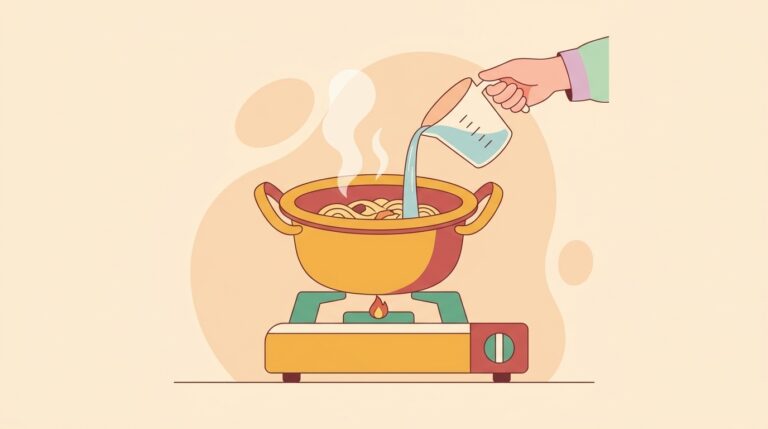
1. 물 좀 더 넣을까요?
- Pronunciation: mul jom deo neoeulkkayo? [mool / johm / duh / nuh-eul-kka-yo?]
- Meaning: Literal: Shall we put a little more water? / Real: Should I add more water?
- K-Culture Moment: You are eating Tteokbokki or Jeongol (hot pot) that is boiling on a portable stove at your table. The soup is bubbling away, getting thicker and saltier. This is the perfect moment to ask your friends this question to save the dish!
- Editor’s Insight: This phrase is incredibly polite and considerate. By adding “~까요?” (Shall we?), you are asking for the group’s opinion, which is highly valued in Korean dining culture.
- Situation Spectrum:
- 친구 사이 (Casual): ✅ (Say: 물 좀 더 넣을까?)
- 직장 동료 (Semi-formal): ✅
- 직장 상사·어른 (Formal): ⚠️ (Better to say: 물을 조금 더 넣을까요?)
- 🤔 Think About It: Why do Koreans ask for permission before adjusting the food? How does this reflect the Korean culture of sharing meals from one central pot?
2. 물이 너무 많아요 / 적어요
- Pronunciation: muri neomu manayo / jeogeoyo [moo-ree / nuh-moo / mah-nah-yo / juh-guh-yo]
- Meaning: There is too much water / too little water.
- K-Culture Moment: This is the classic judgment moment when cooking ramen. The perfect ramen requires exactly 500ml of water. If you mess it up, you’ll hear this phrase immediately!
- Editor’s Insight: “많다” means many/much, and “적다” means few/little. In Korea, ramen with too much water is considered a tragic failure.
- Situation Spectrum:
- 친구 사이 (Casual): ✅ (Say: 아, 물 너무 많아!)
- 직장 동료 (Semi-formal): ✅
- 직장 상사·어른 (Formal): ✅
- 🤔 Think About It: Have you noticed that Koreans rarely use measuring cups for everyday cooking? They rely on “눈대중” (eyeballing). How do people measure in your country?
3. 간이 안 맞아요 (너무 짜요 / 싱거워요)
- Pronunciation: gani an majayo (neomu jjayo / singgeowoyo) [gah-nee / ahn / mah-jah-yo (nuh-moo / jja-yo / sing-guh-wo-yo)]
- Meaning: The seasoning isn’t right (It’s too salty / It’s too bland).
- K-Culture Moment: When a mother is cooking soup in a K-Drama, she takes a small spoonful, tastes it, and clicks her tongue. “아휴, 너무 짜네 (Ugh, it’s too salty).” She then immediately pours in more water.
- Editor’s Insight: The word “간 (gan)” refers to the saltiness or overall seasoning of food. Controlling the water is the main way Koreans fix the “간”.
- Situation Spectrum:
- 친구 사이 (Casual): ✅
- 직장 동료 (Semi-formal): ✅
- 식당 직원에게 (To restaurant staff): 🚫 (Saying “It’s too salty” directly can be rude. See the FAQ for the better way!)
Phase 3: Textbook vs. Real Korean
Let’s see how native speakers actually talk when they are cooking together!
[Situation 1: When your ramen looks like a soup ocean]
* 📖 Textbook Korean: 물이 너무 많습니다. (There is too much water.)
* 🗣️ Real Korean: 아, 완전 한강이네! (Ah, it’s totally the Han River!)
* 💡 Why is it different?: “한강이다 (It’s the Han River)” is a popular slang term used when a dish, especially ramen, has way too much water. It playfully exaggerates that your soup looks as deep and wide as Seoul’s famous river!
[Situation 2: When the stew is boiling down and getting salty]
* 📖 Textbook Korean: 물을 추가해야 합니다. (We must add water.)
* 🗣️ Real Korean: 짜다. 물 좀 붓자. (Salty. Let’s pour some water.)
* 💡 Why is it different?: Koreans use short, punchy verbs like “붓다” (to pour) when taking quick action in the kitchen, prioritizing speed before the food burns.
(Bottom Note: For A2 learners, using “한강이다” with your close Korean friends will definitely make them laugh and treat you like a true insider!)
Phase 4: Cultural Context — K-Culture Deep Dive
4-1. The Legendary “Back of the Hand” Method (손등 물 맞추기)
When cooking rice (밥) in a rice cooker, Koreans rarely use measuring cups. Instead, there is a universally accepted non-verbal technique:
1. Wash the rice.
2. Place your hand flat on top of the rice inside the pot.
3. Add water until it exactly reaches the knuckles/back of your hand.
Every Korean mom uses this technique. If you do this in front of a Korean friend, they will be deeply impressed by your authentic “K-cooking” skills!
4-2. The Romance of K-Drama Ramen
You’ve probably seen it in K-Dramas: A couple sits at a small table, sharing one pot of ramen. The question “라면 먹고 갈래? (Do you want to come in for some ramen?)” is the ultimate romantic icebreaker. Because ramen is such a personal, comforting food, cooking it perfectly for someone (with the exact right water level) is seen as an act of care and affection.
Phase 5: Real-Life Roleplay Scenario
Setting: Friday night, 8 PM. You and your Korean coworker, Minsu (32, friendly and loves food), are at a Kimchi Jjigae restaurant. The stew has been boiling on the table stove for 15 minutes.
Characters:
– YOU: A foreigner working in Korea, trying to impress your coworker with your Korean dining etiquette.
– Minsu: Your enthusiastic Korean coworker.
Dialogue:
Minsu: 와, 찌개 냄새 진짜 좋다! 이제 먹을까요?
(wa, jjigae naemsae jinjja jota! ije meogeulkkayo?)
[Wow, the stew smells so good! Shall we eat now?]
(🎭 Stage Direction: Minsu takes a small spoonful to taste the broth.)
YOU: 네! 맛이 어때요?
(ne! masi eottaeyo?)
[Yes! How is the taste?]
Minsu: 음… 오래 끓여서 그런지 간이 좀 세네요.
(eum… orae kkeuryeoseo geureonji gani jom seneyo.)
[Hmm… Maybe because we boiled it long, the seasoning is a bit strong.]
YOU: 아, 물이 너무 적어요?
(a, muri neomu jeogeoyo?)
[Ah, is there too little water?]
Minsu: 네, 조금 짜요.
(ne, jogeum jjayo.)
[Yes, it’s a bit salty.]
🔀 Your Turn! How should you respond?
– A) “그럼 물 좀 더 넣을까요?” (geureom mul jom deo neoeulkkayo? – Then shall we add some more water?)
– B) “네, 짜요! 안 먹어요!” (ne, jjayo! an meogeoyo! – Yes, it’s salty! I won’t eat!)
– C) “물 주세요!” (mul juseyo! – Give water!)✅ Best Choice: A — It is natural, polite, and offers a practical solution using today’s expression!
⚠️ Choice C Analysis: Simply saying “Give water!” to your coworker sounds like a command. It’s too aggressive for this friendly situation.
Minsu: 네, 물 조금만 더 부어주세요.
(ne, mul jogeumman deo bueojuseyo.)
[Yes, please pour just a little more water.]
(🎭 Stage Direction: You carefully pour a glass of water into the boiling pot.)
YOU: 이 정도면 될까요?
(i jeongdomyeon doelkkayo?)
[Would this be enough?]
Minsu: 완벽해요! 역시 요리 천재네요!
(wanbyeokaeyo! yeoksi yori cheonjaeneyo!)
[Perfect! As expected, you’re a cooking genius!]
Phase 6: 10-Second Shadowing Drill
Practice speaking like a native! Follow the pauses (/) and the emotion.
😢 아앗... / 물이 / 너무 / 많아요! (aat... / mu-ri / neo-mu / ma-na-yo!)
(Emotion: Panicked, as you realize your ramen looks like a lake!)
😊 그럼 / 물을 / 조금 더 / 넣을까요? (geu-reom / mu-reul / jo-geum deo / neo-eul-kka-yo?)
(Emotion: Helpful and friendly, offering a solution to your friend.)
Phase 7: K-Culture Mini Dictionary
| 한국어 (Korean) | Romanization | English | Context/Meaning |
|---|---|---|---|
| 한강 라면 | Hangang ramyeon | Han River Ramen | 1. Ramen eaten at the Han River. 2. (Slang) Ramen with way too much water. |
| 간 | gan | Seasoning / Saltiness | The balance of salt and flavor in Korean food. “간을 맞추다” means to adjust the seasoning. |
| 눈대중 | nundaejung | Eyeballing | Measuring ingredients by eye rather than using tools. The true mark of a Korean mom! |
| 찌개 | jjigae | Stew | A thick Korean soup meant to be shared boiling in the middle of the table. |
Phase 8: Traveler Survival Kit
Even if you aren’t cooking, you will face “water control” situations in Korean restaurants! Many Korean dishes (like Dak-galbi, Tteokbokki, or Jjigae) are cooked right on your table. As they boil, they get salty.
🆘 Survival Phrases for Restaurants
– 🇰🇷 “여기, 육수 좀 더 주실 수 있나요?” (yeogi, yuksu jom deo jusil su innayo?)
– 🗣️ English Guide: Excuse me, could you give us some more broth?
– 📍 Where to use: Hot pot, stew, or Tteokbokki restaurants.
– 💡 Pro Tip: Use “육수” (broth/stock) instead of plain “물” (water) at restaurants. Adding plain water might ruin the chef’s special flavor!📌 Editor’s Travel Note
– Table Buttons: Don’t yell across the room! Look for the little call button (벨) on your table. Press it once, and when the staff arrives, ask for your extra broth.
– Self-Serve: In many casual restaurants, water (물) and side dishes (반찬) are self-serve. Look for the sign “물은 셀프입니다” (Water is self-serve).
Phase 9: Critical Thinking Corner — “A Step Deeper”
🧠 Think Deeper: Food & Identity (음식과 정체성)
In Western dining cultures, everyone gets their own plate, and if you want to add salt to your soup, you do it to your own bowl. But in Korea, dishes like Jjigae (stew) are shared from one communal pot. Adjusting the water or the “간 (seasoning)” is a group activity. You have to ask, “Is it too salty for you? Should we add more water?” This reflects the deeply rooted Korean community spirit (정 – Jeong). Eating isn’t just about feeding yourself; it’s about caring for the shared experience of the group.
💬 Your Turn: Do you have shared communal dishes in your culture? How do you adjust the seasoning if everyone’s taste is different? Share in the comments!
Phase 10: FAQ & Avoiding Common Mistakes
Q: If the restaurant food is too salty, can I say “짜요! (It’s salty!)” to the staff?
A: ⚠️ Please be careful! While technically true, saying “짜요” directly to the chef can sound like a complaint. A much softer and polite way is: “간이 조금 센 것 같아요. 육수 좀 더 주시겠어요?” (The seasoning seems a bit strong. Could I get some more broth?)
❌ Common Mistake #1: Saying “물 줘요” (Give water).
✅ Do this instead: “물 좀 더 주세요” (Please give a little more water). Adding “좀” (a little) magically makes any request sound softer and more polite in Korean!❌ Common Mistake #2: Pouring cold water into a boiling stew.
✅ Do this instead: Always ask the staff for “육수” (broth) first. If they don’t have it, then use hot water if possible to keep the food boiling beautifully.
Phase 11: Summary & Action Items
One-Liner Summary: To master Korean cooking (and eating!), remember that adjusting water is the key, and asking “물 좀 더 넣을까요?” shows great care for your dining partners!
🎯 Action Missions:
– 🥉 Bronze (Solo): Look at a cup of water, pretend it’s a pot, and say “물이 너무 많아요!” dramatically.
– 🥈 Silver (Online): Find a YouTube video of someone making Korean Ramen. Leave a comment saying “완전 한강이에요!” (Only if they actually used too much water! 😜)
– 🥇 Gold (Real World): Next time you eat at a Korean hot pot or stew restaurant, politely ask the staff: “육수 좀 더 주시겠어요?”
🍜 K-Culture Mission:
Watch one episode of any K-Drama this week. I guarantee you will spot a scene where characters are eating ramen. Look closely—did they measure the water perfectly, or is it a “Han River” situation?
Phase 12: Quiz — Interactive Challenge
Q1. You are making ramen, but you accidentally poured 800ml of water instead of 500ml. What slang expression will your Korean friend use?
1) 바다예요 (It’s the sea)
2) 수영장이에요 (It’s a swimming pool)
3) 한강이에요 (It’s the Han River)
Q2. Fill in the blank: The stew is getting too salty. You want to suggest adding water politely to your friend.
“찌개가 짜네요. 물 좀 더 _______?”
1) 넣을까요 (neoeulkkayo)
2) 많아요 (manayo)
3) 싱거워요 (singgeowoyo)
Q3. True or False: In Korea, it is considered rude to share soup from the same boiling pot in the middle of the table.
– True / False
(Answers: Q1- 3, Q2- 1, Q3- False, it is very common and a sign of closeness!)
Did you enjoy today’s lesson? Let me know in the comments if you prefer your ramen salty (간이 센 것) or bland (싱거운 것)! Until next time, happy studying!
Frequently Asked Questions (FAQ)
Q: What does "물 좀 더 넣을까요?" mean in Korean and how do you pronounce it?
A: In Korean, "물 좀 더 넣을까요?" is pronounced [mul jom deo neoeulkkayo? [mool / johm / duh / nuh-eul-kka-yo?] and means: Literal: Shall we put a little more water? / Real: Should I add more water?
Q: What does "물이 너무 많아요 / 적어요" mean in Korean and how do you pronounce it?
A: In Korean, "물이 너무 많아요 / 적어요" is pronounced [muri neomu manayo / jeogeoyo [moo-ree / nuh-moo / mah-nah-yo / juh-guh-yo] and means: There is too much water / too little water.
Q: What does "간이 안 맞아요 (너무 짜요 / 싱거워요)" mean in Korean and how do you pronounce it?
A: In Korean, "간이 안 맞아요 (너무 짜요 / 싱거워요)" is pronounced [gani an majayo (neomu jjayo / singgeowoyo] and means: The seasoning isn't right (It's too salty / It's too bland).







