

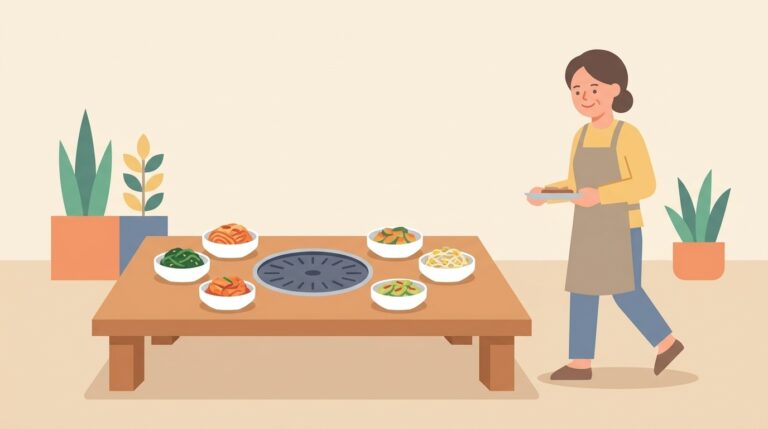
How to Ask for Banchan Refills Like a Local (Without Feeling Awkward!)
Phase 1: Empathy — Welcome to the K-BBQ Chaos!
Hello! I’m your Daily Hangul Editor, your local culture navigator and veteran Korean tutor.
Picture this: You are sitting in a bustling Korean BBQ restaurant in Seoul. The meat is sizzling on the grill, the garlic is roasting perfectly, and you’ve just taken your first bite. It’s heavenly. But wait—you’ve already finished that delicious, spicy cucumber salad (오이무침). You want more. You need more.
In K-Dramas, you always see the main characters casually raising a hand and getting endless plates of food. But in reality? The restaurant is loud, the staff is running around with hot soup, and you’re sweating, wondering: “Is it really free? Will they be mad if I ask for more? How do I even get their attention?”
If you’ve ever felt frozen holding an empty tiny plate in a Korean restaurant, you are not alone! Today, we are going to learn exactly how to ask for a banchan (side dish) refill with the confidence of a true local. By the end of this, you won’t just know the words; you’ll know the vibe. Let’s dive in!
Phase 2: Core Expressions — Let’s Break It Down
Here are the most practical ways to ask for a refill, depending on the situation.
1. 사장님, 여기 김치 좀 더 주세요. (Boss, please give us some more kimchi here.)
- Pronunciation: [sajangnim, yeogi gimchi jom deo juseyo] + [Sah-jahng-neem, yuh-gee geem-chee johm duh joo-seh-yo. ‘Jom’ sounds like ‘Rome’ but with a J.]
- Meaning: Literal: Boss, give more kimchi here please. / Real nuance: Excuse me, could I get a refill on the kimchi?
- K-Culture Moment: This is the ultimate, universally accepted restaurant phrase. You’ll hear this echoing across every pork belly (Samgyeopsal) joint on a Friday night. Calling the owner or staff ‘사장님’ (Boss) is a sign of respect and friendliness.
- Editor’s Insight: The magic word here is 좀 (jom). It literally means “a little,” but Koreans use it to soften a request. Without it, “더 주세요” sounds like a strict command. “좀 더 주세요” makes you sound polite and gentle!
- Situation Spectrum:
- Casual (Small local eateries): ✅
- Semi-formal (Family restaurants): ✅
- Formal (Fine dining/Hotel restaurants): ⚠️ (Better to use “저기요” instead of “사장님” in fine dining.)
- 🤔 Think About It: Why do Koreans call restaurant staff “Boss” (사장님) or “Auntie” (이모님) instead of “Waiter”? How does this reflect the Korean concept of treating others like extended family? What do you call servers in your country?
2. 이모님, 이거 리필 되나요? (Auntie, can this be refilled?)
- Pronunciation: [imonim, igeo ripil doenayo?] + [Ee-moh-neem, ee-guh ree-peel dweh-nah-yo?]
- Meaning: Literal: Auntie, is this refill possible? / Real nuance: Can I get some more of this side dish?
- K-Culture Moment: You’re in an old, traditional market or a cozy neighborhood restaurant. The lady running the place has been there for 30 years. Calling her ‘이모님’ (Auntie) instantly builds a bond. She might even give you extra portions!
- Editor’s Insight: The English word ‘Refill’ (리필) is completely integrated into daily Korean. It’s safe, clear, and perfectly natural to use.
- Situation Spectrum:
- Casual (Traditional diners, markets): ✅
- Semi-formal (Modern franchises): ⚠️ (Stick to 사장님 or 저기요 here)
- Formal: 🚫
- 🤔 Think About It: Calling a stranger “Auntie” might feel invasive in Western cultures, but in Korea, it signifies closeness (정 – Jeong). Would you feel comfortable calling your local cafe barista “Auntie” or “Uncle”?
3. 반찬은 셀프인가요? (Are the side dishes self-serve?)
- Pronunciation: [banchaneun selpeuingayo?] + [Bahn-chahn-eun sel-peu-in-gah-yo?]
- Meaning: Are the side dishes self-service?
- K-Culture Moment: You asked a busy worker for more radish, and they quickly point to a corner saying “셀프예요!” (It’s self-serve!). This is a very common modern K-Food scene to save labor costs.
- Editor’s Insight: Look around before you ask for a refill. If you see a sign that says “추가 반찬은 셀프입니다” (Additional side dishes are self-serve), grab a plate and help yourself!
- Situation Spectrum:
- Universal across most casual/mid-range dining: ✅
Phase 3: Textbook vs. Real Korean
Let’s see how the textbook differs from the vibrant streets of Seoul.
[Asking for more food]
* 📖 Textbook Korean: 반찬을 추가해 주시겠습니까? (Would you please add more side dishes?)
* 🗣️ Real Korean: 사장님~ 여기 깍두기 좀 더 주세요! (Boss~ a bit more radish kimchi here!)
* 💡 Why the difference?: Textbooks teach highly formal grammar (습니다/습니까), but in a noisy restaurant, you need to be quick, clear, and approachable. Using the “~주세요” (Please give) form is the golden standard for efficiency and politeness.
[When the waiter is far away]
* 📖 Textbook Korean: 실례합니다. (Excuse me.)
* 🗣️ Real Korean: 저기요! or 사장님! (Over here! / Boss!)
* 💡 Why the difference?: “실례합니다” is for apologizing when you bump into someone on the subway. To get attention in a restaurant or store, “저기요” (literally ‘Over there’) is the correct cultural cue.
(Bottom Note: For B1 learners, using “저기요” and “~좀 더 주세요” is the perfect balance—not too slangy, but incredibly natural!)
Phase 4: Cultural Context — K-Culture Deep Dive
4-1. The Non-Verbal Game: Nunchi (눈치) at the Table
Language is only half the battle. When asking for a refill, timing and body language are everything.
– The Hand Raise: Don’t just shout. Make eye contact with a staff member and raise your hand slightly (palm open, not pointing).
– Nunchi (눈치): This is the Korean art of “reading the room.” If the staff is carrying a boiling hot stone bowl of soup, do not call them. Wait until they have empty hands or are walking past your table.
– The Point: Since you probably don’t know the names of all 12 side dishes on your table, it’s perfectly fine to gently point at the empty dish and say “사장님, 이거(this) 좀 더 주세요.”
4-2. K-Food Connection: The Culture of ‘Jeong’ (정)
Why is Korean food so generous? Unlike many countries where every extra sauce or side costs money, Korean banchan is almost always infinitely refillable for free. This is rooted in Jeong (정)—the Korean concept of affection, compassion, and communal bonding. Historically, Korea was an agricultural society where sharing food with neighbors was essential for survival. A Korean meal is centered around a bowl of rice, and the banchan are shared among everyone at the table. Giving generous refills is a restaurant owner’s way of showing hospitality and Jeong to their guests.
Critical Viewpoint: While the free refill culture is beautiful, it has recently led to issues with food waste. This is why you now see signs saying “남기시면 환경부담금 3,000원” (If you leave leftovers, there is a 3,000 KRW environmental fee). Ask for a refill, but only take what you can eat!
Phase 5: Interactive Roleplay Scenario
Setting: Friday night, 7:30 PM. A lively Samgyeopsal (pork belly) restaurant near Gangnam Station. The air is thick with the smell of roasting meat. The clinking of Soju glasses can be heard all around.
Characters:
– YOU: A foreign professional working in Seoul, attending your first team dinner.
– Minsu (32): Your friendly Korean colleague who is currently taking his job as the “designated meat griller” very seriously.
Dialogue:
Minsu: 상추가 다 떨어졌네요. 고기는 흐름이 끊기면 안 되는데!
(Sangchuga da tteoreojyeonneyo. Gogineun heureumi kkeunkimyeon an doeneunde!)
[English] We’re out of lettuce. We can’t let the meat-eating flow stop!
(🎭 Stage Direction: Minsu frantically looks around for a waiter while flipping a piece of pork)
YOU: 제가 직원분 부를게요.
(Jega jigwonbun bureulgeyo.)
[English] I’ll call the staff member.
🔀 Your Turn! How should you call the busy waiter walking by?
– A) “실례합니다! 상추 추가해 주시겠습니까?”
– B) “사장님~ 여기 상추 좀 더 주세요!”
– C) “야! 상추 줘!”✅ Best Choice: B. It’s loud, polite, and completely natural.
⚠️ Choice A Analysis: It sounds like a robot or a news anchor suddenly speaking in the middle of a BBQ party.
🚫 Choice C Analysis: This is highly disrespectful informal language (Banmal). The whole restaurant will stare at you!
Minsu: 오, 한국어 진짜 자연스러운데요?
(O, hangugeo jinjja jayeonseureoundeyo?)
[English] Oh, your Korean is really natural!
Staff: 네~ 상추 많이 드렸습니다. 맛있게 드세요!
(Ne~ sangchu mani deuryeotseumnida. Masitge deuseyo!)
[English] Yes~ I gave you plenty of lettuce. Enjoy your meal!
YOU: 감사합니다. 잘 먹겠습니다!
(Gamsahamnida. Jal meokgetseumnida!)
[English] Thank you. I will eat well!
Phase 6: 10-Second Shadowing Drill
Time to practice! Follow the slashes (/) for natural pausing, and emphasize the word in bold.
😊 사장님~ / 여기 / 김치 **좀** / 더 주세요!
(sajangnim~ / yeogi / gimchi jom / deo juseyo!)
Vibe: Bright, friendly, slightly raising your voice to be heard over the restaurant noise.
Phase 7: K-Culture Mini Dictionary
| 한국어 | Romanization | English | Context/Meaning |
|---|---|---|---|
| 반찬 | banchan | Side dish | Small dishes served along with cooked rice in Korean cuisine. |
| 셀프 | selpeu | Self-service | If you see this, get your own water and side dishes! |
| 눈치 | nunchi | Social intuition | The ability to read the room; knowing when to call the waiter. |
| 인심 | insim | Generosity | Often used to describe a restaurant owner who gives huge portions (“사장님 인심이 좋아요”). |
| 리필 | ripil | Refill | A Konglish word widely used for asking for more food/drinks. |
Phase 8: Traveler Survival Kit 🧳
If you are traveling in Korea and eating your way through Seoul, keep these survival phrases in your back pocket!
🆘 Survival Phrases for K-Restaurants
– 🇰🇷 “여기 물 좀 주세요.” (yeogi mul jom juseyo) -> Please give us some water.
– 🇰🇷 “이거 많이 매워요?” (igeo mani maewoyo?) -> Is this very spicy?
– 🇰🇷 “계산이요!” (gyesaniyo!) -> Check, please! (Usually, you take the bill to the front desk to pay).📌 Editor’s Travel Note
– Call Bells (호출벨): Look at your table! Most modern Korean restaurants have a small button on the table. Just press it once (“Ding-dong!”), and the staff will come to you. You don’t even need to shout!
– Tipping Culture: There is absolutely NO tipping in South Korea. If you try to leave money on the table for the excellent banchan refills, the waiter will likely chase you down the street thinking you forgot your change!
Phase 9: Critical Thinking Corner — “One Step Deeper”
Food & Identity: The Communal Table
Why do Koreans serve food in a way that requires everyone to cross chopsticks and share side dishes? Traditional Korean culture emphasizes the collective over the individual. Eating from the same stew pot (jjigae) or sharing banchan isn’t just about feeding the stomach; it’s a ritual of bonding. They even call family members “Sikgu” (식구 – 食口), which literally translates to “mouths that eat together.” In the modern global era, some restaurants are shifting toward individual plating for hygiene, but the warm, slightly chaotic shared table remains the heart of Korean identity.
💬 Your Turn: Does your culture have a tradition of sharing food from a central plate, or is everyone’s dish strictly separated? Share your thoughts in the comments!
Phase 10: FAQ & Mistake Prevention
Q1. Are ALL side dishes free to refill?
Usually, yes! Kimchi, bean sprouts, and radish are unlimited. However, expensive side dishes (like marinated crabs – 양념게장, or rolled omelets – 계란말이) might have an extra charge on the menu. If you’re unsure, ask politely: “이거 리필 되나요?”
Q2. Can I say “이모님” (Auntie) to a young staff member?
No! If the server looks like a college student working part-time, calling them ‘Auntie’ will be incredibly awkward. For younger staff, stick to “저기요” (Excuse me) or just “직원분” (Staff).
❌ Common Mistake #1: Pointing and saying “이거 주세요” (Give me this) without a soft tone.
✅ Do this instead: Always add “좀” (a little) to soften the blow. “이거 좀 더 주세요” is the way to go.
Phase 11: Summary & Action Items
One-Liner Summary: To get more of that delicious Korean food, catch the owner’s eye and confidently say: “사장님, 이거 좀 더 주세요!”
Action Mission 3 Steps:
– 🥉 Bronze (Solo): Stand in front of your mirror and practice the “저기요!” hand-raise and phrase 3 times.
– 🥈 Silver (Online): Find a video of a Korean restaurant vlog on YouTube. Spot the moment they ask for more food or water.
– 🥇 Gold (Real Life): Visit your local Korean restaurant, find an empty banchan plate, and successfully use “이거 좀 더 주세요” with the staff!
🎬 K-Culture Mission:
Next time you watch a K-Drama featuring a K-BBQ scene, pay close attention to the table setting. Count how many small banchan plates are on the table. It’s usually more than 5!
Phase 12: Quiz — Interactive Challenge
1. Situational Judgment: You are in a fancy, quiet, upscale Korean traditional dining room (Hanjeongsik). You need more tea. What is the BEST way to get the server’s attention?
– A) Yell “이모님!!!” across the room.
– B) Press the call button, or make gentle eye contact and say “저기요.”
– C) Bang your chopsticks on the table.
Answer: B. In formal settings, “이모님” and “사장님” are too casual.
2. True or False – K-Culture Edition:
“If the restaurant gives you 4 refills of Kimchi, you must leave a 10% tip on the table before leaving.”
Answer: False! Korea is a strictly tip-free culture. A bright “잘 먹었습니다!” (I ate well!) on your way out is the best tip you can give.
Great job today! You are now fully equipped to survive and thrive in any Korean restaurant. See you in the next lesson! 👋
Frequently Asked Questions (FAQ)
Q: What does "사장님, 여기 김치 좀 더 주세요. (Boss, please give us some more kimchi here.)" mean in Korean and how do you pronounce it?
A: In Korean, "사장님, 여기 김치 좀 더 주세요. (Boss, please give us some more kimchi here.)" is pronounced [sajangnim, yeogi gimchi jom deo juseyo] and means: Literal: Boss, give more kimchi here please. / Real nuance: Excuse me, could I get a refill on the kimchi?
Q: What does "이모님, 이거 리필 되나요? (Auntie, can this be refilled?)" mean in Korean and how do you pronounce it?
A: In Korean, "이모님, 이거 리필 되나요? (Auntie, can this be refilled?)" is pronounced [imonim, igeo ripil doenayo?] and means: Literal: Auntie, is this refill possible? / Real nuance: Can I get some more of this side dish?
Q: What does "반찬은 셀프인가요? (Are the side dishes self-serve?)" mean in Korean and how do you pronounce it?
A: In Korean, "반찬은 셀프인가요? (Are the side dishes self-serve?)" is pronounced [banchaneun selpeuingayo?] and means: Are the side dishes self-service?







