

Phase 1: Empathy & Immersion (The Cold Open)
Hello! This is your editor from Daily Hangul.
Imagine this: You are watching a classic K-Drama. The mother-in-law visits her son’s house, looks at the tiny plates of food prepared by the daughter-in-law, clicks her tongue, and sighs, “Her hands are so small.” The subtitles translate it as “She’s so stingy.” Wait, what? You look closely at the screen, but her hands look perfectly average!
Or perhaps you’re at a lively Korean market, and your Korean friend whispers, “That Ahjumma has huge hands, let’s go there!” Are we judging people by their physical features now? Not at all!
When you reach the B2 (Intermediate) level in Korean, translating words perfectly isn’t enough anymore. You need to decode the idioms (사자성어와 속담), and in Korea, we love using body parts to describe personalities and habits. If you don’t know these, you might end up staring at people’s hands and feet in confusion. But once you master them? You’ll instantly sound like an absolute ‘Insider’ (인싸) who truly understands the Korean mindset. Let’s dive in!
Phase 2: Deep Dive into Core Expressions
1. 손이 크다 (To have big hands)
- Pronunciation: soni keuda [so-nee / koo-dah] (Tip: For the ‘eu’ (으) in ‘keuda’, make the disgusted sound you make when you step in chewing gum, but keep your lips stretched wide.)
- Meaning:
- Literal: Hands are big.
- Real Nuance: To be very generous, especially when making or buying food; to always prepare food in massive quantities.
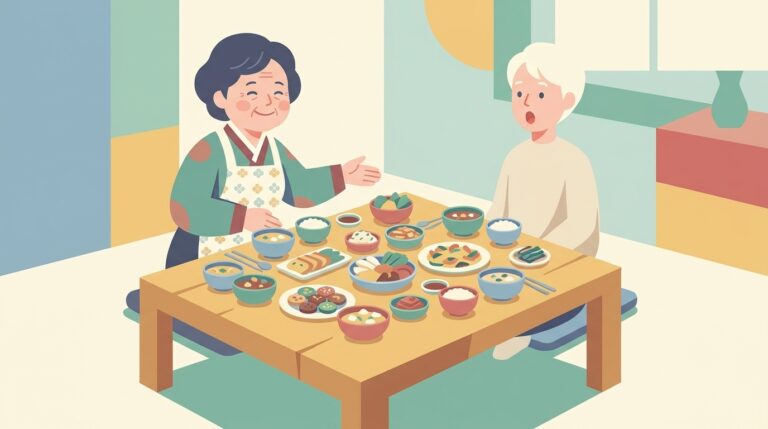
- K-Culture Moment: You visit a Korean friend’s house, and they cook a feast that could feed an entire army for just three people. In Korea, this is the ultimate compliment for a host or a restaurant owner!
- Editor’s Insight: This isn’t just about spending money. It’s heavily tied to the Korean concept of Jeong (정)—showing love through food. It feels warm, welcoming, and delightfully overwhelming.
- Situation Spectrum:
- Friends (Casual): ✅
- Co-workers (Semi-formal): ✅
- Boss/Elders (Formal): ✅ (Just add polite endings like ‘손이 크시네요’)
- 🤔 Think About It: Why is generosity measured by ‘hands’ in Korea? Historically, in an agricultural society, preparing food with your own hands for the community was the purest form of sharing. Does your culture have a body-part idiom for generosity?
2. 발이 넓다 (To have wide feet)
- Pronunciation: bari neolda [bah-ree / nul-ttah] (Tip: The ‘eol’ sounds similar to the ‘ull’ in ‘null’, but cut off sharply with a tight ‘T’ sound at the end.)
- Meaning:
- Literal: Feet are wide.
- Real Nuance: To be well-connected; to have a massive social network; to be a social butterfly.
- K-Culture Moment: This is the friend who can score sold-out K-Pop concert tickets because they “know a guy,” or the person walking through Hongdae who has to stop every five minutes to say hello to an acquaintance.
- Editor’s Insight: It emphasizes movement. To know a lot of people, you have to “walk around” a lot to meet them. It’s a very active, extroverted trait.
- Situation Spectrum:
- Friends (Casual): ✅
- Co-workers (Semi-formal): ✅
- Boss/Elders (Formal): ⚠️ (Use carefully, as it might imply they socialize instead of working, depending on context.)
- 🤔 Think About It: In English, we might say someone has “long arms” (reaching far) or is a “big mouth” (talks too much). Why did Koreans choose “feet” for networking?
3. 눈이 높다 (To have high eyes)
- Pronunciation: nuni nopda [noo-nee / nohp-ttah]
- Meaning:
- Literal: Eyes are high.
- Real Nuance: To have very high standards, to be extremely picky (especially in dating or choosing luxury items).
- K-Culture Moment: The classic K-Drama trope! The handsome, wealthy CEO refuses to go on blind dates because his “eyes are too high.”
- Editor’s Insight: This can be a slight diss or a humblebrag. If your friend has been single for 5 years despite being great, you sigh and say, “Your eyes are too high.”
- Situation Spectrum:
- Friends (Casual): ✅
- Co-workers (Semi-formal): ⚠️ (Could be seen as judging their standards)
- Boss/Elders (Formal): 🚫 (Do not tell your boss their eyes are too high!)
- 🤔 Think About It: By placing the eyes “high up,” we create a visual hierarchy of value. How does spatial language (up/down) influence our perception of quality in language?
Phase 3: Textbook vs. Real Korean
Let’s see how these idioms upgrade your Korean from a textbook robot to a trendy Seoulite.
[Describing the Ultimate Extrovert]
* 📖 Textbook Korean: 지민 씨는 아는 사람이 정말 많아요. (Jimin knows a lot of people.)
* 🗣️ Real Korean: 지민 씨 완전 마당발이에요! / 발이 진짜 넓어요. (Jimin is a total ‘yard-foot’ / Her feet are so wide!)
* 💡 Why is it different?: Using “마당발” (Madangbal – meaning a foot as wide as a front yard) adds a visual, slightly exaggerated, and highly affectionate tone that “knowing many people” lacks.
[Why Your Friend is Still Single]
* 📖 Textbook Korean: 민수 씨는 이상형의 기준이 높아요. (Min-su’s standards for his ideal type are high.)
* 🗣️ Real Korean: 민수 저 녀석은 눈이 너무 높아서 연애를 못 해. (That guy Min-su’s eyes are too high, so he can’t date.)
* 💡 Why is it different?: It shifts the blame slightly from the person’s conscious choice to their “eyes” acting independently, making the tease feel much more natural and less aggressive.
Bottom Note: For B2 (Intermediate) learners, peppering these idioms into your casual conversations will earn you massive respect. Just remember, idioms are like hot sauce—use them to add flavor, don’t drink the whole bottle!
Phase 4: Cultural Context — K-Culture Deep Dive
4-1. The Non-Verbal Language of Idioms
When using body part idioms, Koreans often use physical gestures subconsciously! If you say someone’s “eyes are too high” (눈이 높다), you might playfully raise your hand above your head. If you say a restaurant owner is “generous” (손이 크다), you might mimic holding a giant, heavy bowl. Also, applying Nunchi (눈치) is crucial here. If a friend made way too much food and looks exhausted, saying “손이 크시네요” becomes a comforting validation of their hard work.
4-2. The K-Food Connection: Why We Need Big Hands
If there is one place “손이 크다” shines, it’s the K-Food scene. Korean dining is inherently communal. We don’t order one plate for ourselves; we order stews to share and rely on endless side dishes (Banchan, 반찬).
When a restaurant owner gives you free steamed egg or an extra bottle of soda, they are practicing 서비스 (Service/Freebies). A restaurant known for having an owner with “big hands” will survive purely on word-of-mouth because, in Korea, food volume equals affection.
Critical Viewpoint: Why are Korean food portions sometimes overwhelming? It traces back to the post-war era when food was scarce. Offering an abundance of food became the ultimate symbol of success and care. Today, even in wealthy modern Seoul, that emotional connection to overflowing plates remains intact.
Phase 5: Real-Life Roleplay Scenario
Get ready to put your new knowledge to the test. You are the main character now!
- Setting: Friday, 7:00 PM. A noisy, smoke-filled Korean BBQ restaurant (삼겹살집) near Gangnam Station. Green Soju bottles line the table.
- Characters:
- YOU: A foreign expat who has been working in Seoul for a year. You understand the culture but sometimes miss the idioms.
- Min-su: (32, your witty Korean coworker who loves to grill the meat.)
[The Dialogue]
Min-su: 이번 주말에 수진 대리님 집들이 가는 거 알죠?
(ibeon jumare sujin daerinim jibdeuri ganeun geo aljyo?)
[You know we’re going to Assistant Manager Su-jin’s housewarming party this weekend, right?]
YOU: 네! 선물로 휴지 샀어요. 음식은 각자 가져가나요?
(ne! seonmullo hyuji sasseoyo. eumsigeun gakja gajeoganayo?)
[Yes! I bought toilet paper as a gift. Are we bringing our own food?]
Min-su: 에이, 아니에요. 대리님이 고기 20인분 샀대요. 우리 다섯 명 가는데.
(ei, anieyo. daerinimi gogi isibinbun satdaeyo. uri daseonmyeong ganeunde.)
[Nah, no way. She said she bought 20 portions of meat. There are only five of us going.]
(🎭 Stage Direction: Min-su flips the pork belly with tongs, looking genuinely terrified by the amount of food.)
Min-su: 진짜 수진 대리님은 완전 손이 커요. 다 먹고 죽는 거 아니야? ㅋㅋ
(jinjja sujin daerinimeun wanjeon soni keoyo. da meokgo jungneun geo aniya? kk)
[Seriously, Assistant Manager Su-jin’s hands are so big. Are we going to eat until we die? Haha.]
🔀 Your Turn! How should you respond?
– A) “대리님 손 사이즈가 그렇게 커요? 장갑 찾기 힘들겠네요.”
– B) “와, 진짜 정이 넘치시네요. 우리 배 터지겠어요!”
– C) “대리님 돈 많나 봐요. 부럽다.”✅ Best Choice: B — “Wow, she really overflows with Jeong. Our stomachs are going to burst!” You understood the idiom perfectly and matched his playful energy.
⚠️ Choice A Analysis: A literal translation fail! Min-su will definitely laugh at you (in a friendly way).
⚠️ Choice C Analysis: A bit too cynical. Generosity in Korea is praised as a character trait, not just a display of wealth.
Phase 6: 10-Second Shadowing Drill
Let’s practice the intonation to sound like a native! Follow the pauses / and match the emotion.
😲 와! / 우리 할머니는 / 정~~~말 손이 커요!
(Wa! / uri halmeonineun / jeong~~~mal soni keoyo!)
[Translation: Wow! My grandmother is sooooo generous with her food!]
Emotion Tag: Wide-eyed amazement, stretch out the “정~~~말” (realllly) for emphasis.
Phase 7: K-Culture Mini Dictionary
Here are some essential cultural keywords related to today’s topic:
| Korean | Romanization | English | Contextual Meaning |
|---|---|---|---|
| 정 | jeong | Affection/Bond | The invisible thread of emotional connection in Korea, often shown through sharing food. |
| 마당발 | madangbal | Social Butterfly | Lit. ‘Yard-foot’. Someone with a massively wide network. Super-connector. |
| 눈치 | nunchi | Social Sense | The ability to “read the room” and act accordingly. The bedrock of Korean social interaction. |
| 서비스 | seobiseu | Freebie/On the house | Free food or items given by “big-handed” business owners to build loyalty. |
Phase 8: Traveler Survival Kit
Even if you are just traveling in Korea, you will encounter the results of “Big Hands” everywhere! Here is how to navigate the overwhelming hospitality of Korean food spots.
🆘 Survival Phrases for K-Food Dining
– 🇰🇷 “이거 서비스예요?” (igeo seobiseuyeyo?)
– 🗣️ English Guide: [Is this a freebie/on the house?]
– 📍 Where to use: When the Ahjumma suddenly places a steaming bowl of egg soufflé on your table that you didn’t order.
- 🇰🇷 “조금만 주세요~” (jogeumman juseyo~)
- 🗣️ English Guide: [Please just give me a little bit.]
- 📍 Where to use: When asking for a refill, but you know the owner’s “hands are too big” and you don’t want to waste food.
- 💡 Pro Tip: In traditional markets (like Gwangjang Market), vendors are notoriously generous. If you are full, politely smile and pat your stomach while saying this!
📌 Editor’s Travel Note
– Tipping Culture: Remember, there is NO tipping in Korea. Excellent service and huge portions (손이 큰 사장님) are given out of pride and Jeong, not for a 20% tip. Giving a tip might actually confuse or offend them!
Phase 9: Critical Thinking Corner — “One Step Deeper”
Let’s look at today’s idioms through the lens of Food & Identity.
🧠 Think Deeper:
Korean food culture is fundamentally communal. Sharing one bubbling pot of stew (Jjigae) or wrapping a lettuce wrap (Ssam) and literally putting it in someone else’s mouth are acts of profound intimacy. The idiom ‘손이 크다’ (Having big hands) perfectly encapsulates this. In a society that historically endured hardship, abundance on the dining table became the ultimate symbol of love and community survival. By describing a generous person as having “big hands,” the language honors the physical, grueling labor required to feed the people you care about. It’s not just about spending money; it’s about the sweat and effort of the hands that prepared it.💬 Your Turn: Does your culture have a unique way of expressing hospitality or generosity? Do you use food, or something else entirely? Share it in the comments!
Phase 10: FAQ & Mistake Prevention
Here are some burning questions our Daily Hangul students always ask:
Q: Can I tell an elder, “할아버지, 발이 정말 넓으시네요” (Grandpa, your feet are so wide)?
A: Yes! As long as you use polite endings (으시네요), “발이 넓다” is a compliment showing admiration for their respectability and influence in the community.
Q: In English, “having a big head” means being arrogant. Is there a Korean equivalent?
A: No! Do not translate that directly. If you say “머리가 크다” in Korean, it literally just means they have a physically large head (or sometimes means a child has grown up/matured). To say someone is shameless, we say “얼굴이 두껍다” (Face is thick)!
❌ Common Mistake #1: Confusing physical descriptions with idioms.
Example: Telling a friend “눈이 크다” (Your eyes are big) is a compliment about their beauty. Telling them “눈이 높다” (Your eyes are high) means they are picky! Don’t mix up “Big” (크다) and “High” (높다)!
Phase 11: Summary & Action Items
- One-Liner Summary: Korean idioms creatively use body parts—like hands for generosity, feet for networking, and eyes for standards—to describe human personalities!
🎯 Action Mission 3 Steps:
– 🥉 Bronze (Solo): Stand in front of a mirror and practice saying “손이 크다” while mimicking carrying a heavy, giant bowl of rice.
– 🥈 Silver (Online): Go to a K-Drama YouTube clip featuring a rich, arrogant character and comment, “주인공은 진짜 눈이 높네요!” (The main character’s eyes are really high!)
– 🥇 Gold (Real-Life): Next time you visit a Korean restaurant and they give you a generous portion, tell the owner: “사장님 너무 손이 크세요! 잘 먹겠습니다!” (You are so generous! I will eat well!). Watch their face light up!
📺 K-Culture Mission:
Turn on your favorite K-Pop idol’s V-Live/Weverse stream. Idols often talk about member traits. Try to listen for “마당발” (social butterfly) or “손이 커요” when they discuss who pays for dinner or cooks in the dorms!
Phase 12: Quiz — Interactive Challenge
Let’s test your B2 instincts!
1. Situational Judgment: Your friend Min-ji just introduced you to her 50th acquaintance this week while walking down the street. What should you say to her?
– A) “민지 씨, 눈이 진짜 높네요!”
– B) “민지 씨, 발이 진짜 넓네요!”
– C) “민지 씨, 얼굴이 두껍네요!”
2. Fill in the Blank:
“이 식당 사장님은 참 ( _______ ) 커서, 항상 반찬을 산처럼 쌓아주셔!”
(This restaurant owner’s _______ are so big, they always pile the side dishes up like a mountain!)
3. True or False – K-Culture Edition:
If a Korean restaurant owner is “손이 크다” and gives you an extra plate of dumplings for free, you must leave a tip on the table to show respect. (T/F)
(Answers: 1. B, 2. 손이, 3. False! No tipping in Korea, just say a loud and polite “잘 먹겠습니다!” [I will eat well!])
Frequently Asked Questions (FAQ)
Q: What does "손이 크다 (To have big hands)" mean in Korean and how do you pronounce it?
A: In Korean, "손이 크다 (To have big hands)" is pronounced [soni keuda [so-nee / koo-dah] and means: Literal: Hands are big.
Q: What does "발이 넓다 (To have wide feet)" mean in Korean and how do you pronounce it?
A: In Korean, "발이 넓다 (To have wide feet)" is pronounced [bari neolda [bah-ree / nul-ttah] and means: Literal: Feet are wide.
Q: What does "눈이 높다 (To have high eyes)" mean in Korean and how do you pronounce it?
A: In Korean, "눈이 높다 (To have high eyes)" is pronounced [nuni nopda [noo-nee / nohp-ttah] and means: Literal: Eyes are high.







