

Phase 1: Empathy (The K-Culture Cold Open)
Hello! I’m the lead editor of Daily Hangul. Have you ever watched a K-Drama like Misaeng or Itaewon Class? You know those intense scenes where the rookie employee is standing in front of the boss, heart pounding, trying to bring up a sensitive topic while the whole office holds its breath?
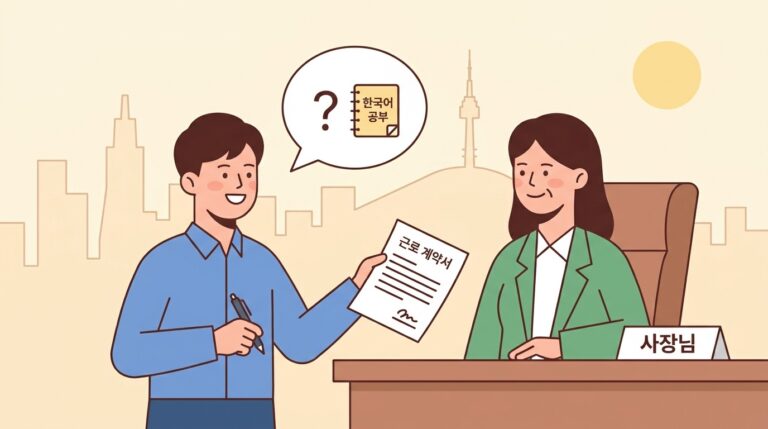
Well, for many expats working in Korea—whether as an English teacher at a hagwon (academy), a part-timer at a trendy Hongdae cafe, or a corporate worker in Gangnam—asking for your 근로 계약서 (Employment Contract) can feel exactly like that K-Drama climax.
Your boss is friendly. They buy you coffee. They say, “우리가 남이가?” (Aren’t we like family?). But two weeks have passed, and you still haven’t signed a contract. You know you need to ask, but you don’t want to ruin the vibe. How do you do it?
Today, we are tackling a critical Legal Basics topic: asking for your contract and, if necessary, knowing how to report the issue. This isn’t just about learning Korean; it’s about protecting your rights while navigating the delicate ‘Nunchi’ (reading the room) of the Korean workplace. Let’s dive in!
Phase 2: Core Expressions Deep Dive
1. 근로 계약서는 언제 작성하나요?
- Pronunciation: geunro gyeyakseoneun eonje jakseonghanayo? / [geun-ro gye-yak-seo-neun eon-je jak-seong-ha-na-yo?]
- Meaning: When do we write (sign) the employment contract?
- K-Culture Moment: You are sitting with the academy director. They are talking about how great it is to have you on the team. You sip your iced Americano, wait for a pause, and gently slide this question in. It’s polite, indirect, and doesn’t sound like an accusation.
- Editor’s Insight: Notice we use ‘작성하나요?’ (do we write) instead of ‘언제 주나요?’ (when will you give it to me). In Korean business culture, framing it as a mutual action rather than a demand softens the blow significantly.
- Situation Spectrum:
- Casual (Close coworkers): ⚠️ (Too formal, just ask ‘계약서 언제 써요?’)
- Semi-formal (HR Manager): ✅
- Formal (Boss/Director): ✅
- 🤔 Think About It: Why does Korean rely heavily on passive or mutual phrasing (like “when is it written”) when addressing superiors? How does this reflect the cultural emphasis on maintaining harmony (기분, gibun)?
2. 서면으로 받을 수 있을까요?
- Pronunciation: seomyeoneuro badeul su isseulkkayo? / [seo-myeon-eu-ro ba-deul su is-seul-kka-yo?]
- Meaning: Could I receive it in writing?
- K-Culture Moment: Your boss says, “Don’t worry, I’ll pay you 3 million won a month. Trust me!” In Korea, the concept of ‘Jeong’ (정 – emotional connection/trust) is huge. But when it comes to visas and labor laws, ‘Jeong’ won’t save you. You need this phrase.
- Editor’s Insight: The ending ‘-을까요?’ (Could I…?) is the ultimate polite request form. It gives the listener room to answer without feeling cornered, which is a masterstroke in Korean office politics.
- Situation Spectrum:
- Casual: 🚫 (Too rigid)
- Semi-formal: ✅
- Formal: ✅
- 🤔 Think About It: Does your native language have a specific grammatical ending just to make a request sound more hesitant and therefore more polite?
3. 노동청에 진정서를 제출하겠습니다.
- Pronunciation: nodongcheonge jinjeongseoreul jechulhagetseumnida. / [no-dong-cheong-e jin-jeong-seo-reul je-chul-ha-get-seum-ni-da.]
- Meaning: I will file a complaint with the Ministry of Employment and Labor.
- K-Culture Moment: This is the “nuclear option.” You only use this when the employer has ghosted you, refused to pay, and the bridge is thoroughly burned. It’s the moment the K-Drama protagonist hands in their resignation and walks out in slow motion.
- Editor’s Insight: ‘노동청’ (Labor Office) is a very scary word for employers in Korea. Using the highly formal ‘-습니다’ ending here shows you are no longer playing the ‘friendly foreigner’ role; you are taking strict legal action.
- Situation Spectrum:
- Friendly/Casual: 🚫
- Formal (Warning to a non-compliant boss): ✅
- 🤔 Think About It: Why is a sudden shift to highly formal language (존댓말) often used to signal anger or distance in Korean?
Phase 3: Textbook vs. Real Korean
[Situation 1: Asking the boss about the contract]
* 📖 Textbook Korean: 제 근로 계약서를 주십시오. (Please give me my employment contract. – Sounds like a robot demanding lunch.)
* 🗣️ Real Korean: 원장님, 혹시 계약서 작성은 언제쯤 하면 될까요? (Director, by any chance, around when should we do the contract writing?)
* 💡 Why the difference?: Adding ‘혹시’ (by any chance) and ‘언제쯤’ (around when) are the ultimate Korean workplace shock absorbers. They make the request feel like a casual inquiry rather than a legal demand.
[Situation 2: When the boss delays it repeatedly]
* 📖 Textbook Korean: 이것은 노동법 위반입니다. (This is a violation of labor law.)
* 🗣️ Real Korean: 이거 계약서 없이 일하면 나중에 문제 생기지 않나요? (Won’t there be a problem later if I work without a contract?)
* 💡 Why the difference?: Koreans avoid direct confrontation. Phrasing a warning as an innocent question (“Won’t there be a problem for us?”) saves the boss’s face while clearly drawing a line.
Bottom Note: At the
B2level, your goal isn’t just to speak accurately; it’s to speak tactfully. Using words like ‘혹시’ (by any chance) will make you sound incredibly fluent and culturally aware.
Phase 4: Cultural Context — K-Culture Deep Dive
4-1. Non-Verbal Cues: The Art of Nunchi
When asking for your contract, your body language is just as important as your words. Do not cross your arms or stare aggressively into your boss’s eyes—this is seen as a direct challenge to their authority. Instead, sit up straight, keep your tone light but steady, and make soft eye contact. If they are handing you a document, always receive it with both hands.
4-2. The “Gapjil” (갑질) Trope in K-Dramas
If you watch office dramas, you’ve definitely seen “Gapjil”—the abuse of power by someone in a higher position (the ‘Gap’ 갑). Bosses often try to blur professional lines by calling employees ‘family’ (가족 같은 회사).
While real life is rarely as dramatic as TV, this blurring of lines is exactly why foreign workers sometimes hesitate to demand their legal contracts. They fear ruining the ‘family’ vibe. Remember: A true professional relationship requires paperwork. Don’t let the warm K-Drama aesthetic trick you into working without a safety net!
Phase 5: Real-Life Roleplay Scenario
Setting: It’s Friday evening. You are in the Director’s office at a busy English academy in Gangnam. You’ve been teaching here for two weeks. The Director (Wonjang-nim) is packing his bag, looking stressed but cheerful.
Characters:
– YOU: A savvy B2-level Korean learner who knows their labor rights.
– Wonjang-nim (원장님): The academy director. Friendly, chaotic, always “forgetting” the paperwork.
Dialogue:
Wonjang-nim: 우리 선생님, 이번 주도 고생 많았어요! 주말 잘 보내요!
(uri seonsaengnim, ibeon judo gosaeng manasseoyo! jumal jal bonaeyo!)
[Our teacher, you worked hard this week! Have a great weekend!]
YOU: 네, 원장님도 수고하셨습니다. 저, 퇴근 전에 잠깐 여쭤볼 게 있는데요.
(ne, wonjangnimdo sugohasyeotseumnida. jeo, toegeun jeone jamkkan yeojjwobol ge inneundeyo.)
[Yes, you worked hard too, Director. Um, I have something to ask quickly before I leave.]
Wonjang-nim: 응? 뭔데요? 빨리 말해요. 나 약속 있어서.
(eung? mwondeyo? ppalli malhaeyo. na yaksok isseoseo.)
[Huh? What is it? Speak quickly. I have an appointment.]
YOU: 혹시 근로 계약서는 언제 작성하나요?
(hoksi geunro gyeyakseoneun eonje jakseonghanayo?)
[By any chance, when do we write the employment contract?]
Wonjang-nim: 아~ 그거? 내가 요즘 너무 바빠서. 다음 주에 해줄게요. 믿죠?
(a~ geugeo? naega yojeum neomu bappaseo. daeum jue haejulgeyo. mitjyo?)
[Ah~ that? I’ve been so busy lately. I’ll do it next week. You trust me, right?]
🔀 Your Turn! How should you respond?
– A) “아니요, 당장 주세요. 불법이잖아요!” (No, give it to me right now. It’s illegal!)
– B) “아, 네… 알겠습니다. 다음 주에 꼭 부탁드려요.” (Ah, yes… I understand. Please definitely do it next week.)
– C) “네, 이해합니다. 그래도 비자 문제 때문에 서면으로 빨리 필요해서요. 월요일에 봬도 될까요?” (Yes, I understand. But because of visa issues, I need it in writing quickly. Could we look at it on Monday?)✅ Best Choice: C — Why? It shows empathy (“I understand you are busy”), provides an undeniable external excuse (“visa issues”), and sets a hard deadline (“Monday”).
⚠️ Choice B Analysis: This is too passive. In Korea, if you keep saying “okay,” the delay might become indefinite.
Phase 6: 10-Second Shadowing Drill
Practice this until it rolls off your tongue naturally!
😊 원장님, / 혹시 / 근로 계약서는 / 언제 / 작성하나요?
(wonjangnim, / hoksi / geunro gyeyakseoneun / eonje / jakseonghanayo?)
Tone: Cheerful, slightly curious, but totally professional.
😤 노동청에 / 진정서를 / 제출하겠습니다.
(nodongcheonge / jinjeongseoreul / jechulhagetseumnida.)
Tone: Firm, low pitch, steady eye contact. No smiling.
Phase 7: K-Culture Mini Dictionary
| Korean | Romanization | English Meaning | Context |
|---|---|---|---|
| 갑질 | gapjil | Power trip / Abuse of power | When a boss uses their higher status to treat an employee poorly. A hot social issue in Korea. |
| 정 | jeong | Affection / Bond | A deep emotional connection. Sometimes used as an excuse by bad bosses to ignore formal rules. |
| 눈치 | nunchi | Reading the room | The ability to gauge the mood and respond appropriately. Crucial when asking for paperwork! |
| 노동청 | nodongcheong | Labor Board | Ministry of Employment and Labor. The place you go when ‘nunchi’ and ‘jeong’ fail you. |
Phase 8: Expat Survival Kit (Navigation & Legal Edition)
Even if you aren’t just traveling, expats need to navigate Seoul to get things done—like visiting the Labor Board!
🆘 Survival Phrases for the Labor Board / Government Offices
– 🇰🇷 “진정서를 내러 왔습니다.” (jinjeongseoreul naereo watseumnida.)
– 🗣️ Meaning: I am here to file a complaint.
– 🇰🇷 “통역사가 필요합니다.” (tongyeoksaga pillyohamnida.)
– 🗣️ Meaning: I need an interpreter.
– 🇰🇷 “외국인 등록증 여기 있습니다.” (oegugin deungnokjeung yeogi itseumnida.)
– 🗣️ Meaning: Here is my Alien Registration Card (ARC).📌 Editor’s Life Note
– Recording: In South Korea, it is currently legal to record a conversation as long as you are a participant in that conversation. If your boss refuses to give a contract and makes verbal promises, discreetly recording the meeting on your phone can serve as evidence at the Labor Board. (Always double-check current local laws!).
– Maps: Google Maps is notoriously bad for walking/driving in Korea. Always use KakaoMap or Naver Map to find the local 노동청 (Labor Office).
Phase 9: Critical Thinking Corner — “A Step Deeper”
Language & Power (언어와 권력)
In the Korean workplace, language creates an immediate hierarchy. The boss usually uses Banmal (casual language) or mid-level speech, while the employee is strictly expected to use Jondaemal (honorifics).
This linguistic power imbalance can make asserting your rights incredibly difficult. When you have to use deeply respectful grammar (like “주시겠습니까?”) to someone who is casually dismissing you, it creates a psychological barrier. It takes immense courage for a Korean—and even more for a foreigner—to firmly demand their legal rights while wrapped in the constraints of polite language.
💬 Your Turn: How does your native language handle power dynamics in the workplace? Is there a distinct “boss tone” vs. “employee tone”? Let us know in the comments!
Phase 10: FAQ & Avoiding Mistakes
- Q: “Can I just say ‘이건 불법입니다’ (This is illegal)?”
- A: Maybe, but be careful. Direct confrontation often causes the employer to become highly defensive, turning a solvable administrative delay into a massive emotional battle. Use the passive “문제가 되다” (It becomes a problem) first.
- Q: “If I haven’t signed a contract, am I working illegally?”
- A: Generally, it’s the employer’s legal duty to provide the contract. However, your visa status (like an E-2 or D-2) has strict rules about where and how you can work. Always consult immigration (Call 1345) to ensure you aren’t violating your visa terms.
❌ Common Mistake #1: Believing that KakaoTalk messages are formal enough to replace a signed, stamped contract. While they can act as evidence later, they are not a substitute for a standard labor contract (표준근로계약서).
Phase 11: Summary & Action Items
One-Liner Summary: Always secure your contract gracefully but firmly by asking, “계약서는 언제 작성하나요?” and never be afraid to set a boundary!
Action Mission:
– 🥉 Bronze (Solo): Read the 3 core expressions out loud, practicing your “polite but firm” office face in the mirror.
– 🥈 Silver (Online): Look up ‘표준근로계약서’ (Standard Labor Contract) on Naver or Google to see what the official form looks like in Korean.
– 🥇 Gold (Real World): If you are working in Korea, check your current contract! Do you have a physical/digital copy? If not, use Phase 5’s strategy tomorrow!
K-Culture Mission: Watch an episode of Misaeng (Incomplete Life) or Extraordinary Attorney Woo. Pay close attention to how employees use language when disagreeing with their bosses. Notice the hesitation, the ‘nunchi’, and the specific polite verbs they choose!
Phase 12: Interactive Challenge (Quiz)
1. Situational Judgment: Your boss says they will write your contract “later” because they are busy. What is the most culturally savvy way to push back?
* A) “I will report you to the Labor Board right now.”
* B) “Okay, take your time!”
* C) “I understand, but I really need it for my visa by Friday. Could we do it then?”
(Answer: C. It provides a face-saving external reason—the visa—while setting a hard boundary.)
2. True or False – K-Culture Edition: In Korea, if you are a participant in a conversation, it is generally legal to record it on your phone without telling the other person.
(Answer: True. It is a common practice to gather evidence for workplace disputes, though you cannot publish it publicly to defame them.)
3. Fill in the Blank:
“원장님, 혹시 근로 계약서는 언제 __________?” (Director, when do we write the contract?)
(Answer: 작성하나요?)
Great job today! Navigating legal basics in a foreign language is no joke, but you are now armed with the exact phrases and cultural insights you need. See you in the next lesson!
Frequently Asked Questions (FAQ)
Q: What does "근로 계약서는 언제 작성하나요?" mean in Korean and how do you pronounce it?
A: In Korean, "근로 계약서는 언제 작성하나요?" is pronounced [geunro gyeyakseoneun eonje jakseonghanayo? / [geun-ro gye-yak-seo-neun eon-je jak-seong-ha-na-yo?] and means: When do we write (sign) the employment contract?
Q: What does "서면으로 받을 수 있을까요?" mean in Korean and how do you pronounce it?
A: In Korean, "서면으로 받을 수 있을까요?" is pronounced [seomyeoneuro badeul su isseulkkayo? / [seo-myeon-eu-ro ba-deul su is-seul-kka-yo?] and means: Could I receive it in writing?
Q: What does "노동청에 진정서를 제출하겠습니다." mean in Korean and how do you pronounce it?
A: In Korean, "노동청에 진정서를 제출하겠습니다." is pronounced [nodongcheonge jinjeongseoreul jechulhagetseumnida. / [no-dong-cheong-e jin-jeong-seo-reul je-chul-ha-get-seum-ni-da.] and means: I will file a complaint with the Ministry of Employment and Labor.







