

Phase 1: Empathy (The K-Culture Cold Open)
Hello! I’m your Daily Hangul Editor.
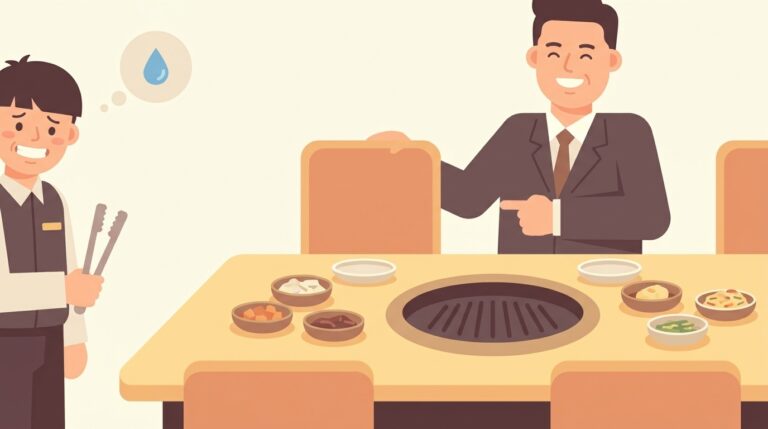
Picture this: It’s 7:00 PM on a Friday. You’re at a classic Korean pork belly (Samgyeopsal) restaurant for a Hoesik (Korean company dinner). The air is thick with savory smoke, the clinking of soju glasses, and… extreme tension. You scan the room and lock eyes with the Bujang-nim (Department Head). He’s sitting right in the middle of the table, smiling, patting the empty seat next to him.
“Come sit here! Let’s pour a drink!”
Your heart drops. In K-Dramas like Misaeng, this is the moment the protagonist either secures a promotion or gets trapped listening to their boss’s military stories from 1995 for three straight hours. How do you escape this trap without ruining your career?
If you don’t know the cultural nuances, you might accidentally offend your boss by saying a direct “No.” But if you master today’s lesson? You’ll be praised for your incredible Nunchi (social sense) and secure a fun seat with your peers.
This guide is built on the real, sweaty, panic-induced experiences of my expat students working in Korea. Let’s learn how to politely dodge the boss like a true Seoulite!
Phase 2: Core Expressions Deep Dive
Here are the ultimate survival phrases to diplomatically avoid the boss’s seat.
1. 제가 고기 굽겠습니다!
- Pronunciation: jega gogi gupgetseumnida! [jay-gah go-ghee goop-get-seum-nee-dah]
- Meaning: Literal: I will grill the meat! / Real nuance: I am volunteering as tribute to sit at the far end of the table where the grill is, safely away from you.
- K-Culture Moment: In Korea, the Mangnae (youngest or newest employee) usually grills the meat. By volunteering, you look like a hardworking, dedicated employee, all while strategically securing a seat far from the center.
- Editor’s Insight: Say this with a bright, eager smile and immediately grab the tongs. The tongs are your shield.
- Situation Spectrum:
- Friends (Casual): ✅
- Co-workers (Semi-formal): ✅
- Boss/Elders (Formal): ✅ (They will love it!)
- 🤔 Think About It: Why is serving food or pouring drinks considered a sign of respect and dedication in Korean workplace culture? Does your culture have a similar ‘rite of passage’ for junior employees?
2. 화장실 좀 다녀오겠습니다.
- Pronunciation: hwajangsil jom danyeo-ogetseumnida. [hwa-jang-shil jome dah-nyuh-oh-get-seum-nee-dah]
- Meaning: Literal: I will go to the restroom and come back. / Real nuance: I am hitting the pause button until someone else takes that empty seat.
- K-Culture Moment: The tactical retreat. You walk into the restaurant, see the boss sitting, drop your coat, and immediately announce this. By the time you return, the seat is miraculously filled.
- Editor’s Insight: Notice we use ‘다녀오겠습니다’ (I will go and come back) instead of just ‘I will go’. It shows respect to the group by confirming you are returning to the shared event.
- Situation Spectrum:
- Friends (Casual): ✅ (Though you’d say 화장실 좀 갔다 올게)
- Co-workers (Semi-formal): ✅
- Boss/Elders (Formal): ✅
- 🤔 Think About It: In Korean, we rarely just “leave” a situation abruptly. We soften it with “jom” (a little/briefly). How does this reflect the Korean value of group harmony?
3. 저쪽 테이블에 자리가 모자라서요.
- Pronunciation: jeojjok teibeure jariga mojaraseoyo. [juh-jjok tay-boo-reh jah-ree-gah moh-jah-rah-suh-yo]
- Meaning: Literal: Because there aren’t enough seats at that table. / Real nuance: I need to sit over there to ‘balance’ the seating arrangement (aka, please don’t make me sit here).
- K-Culture Moment: Used when the boss waves you over. You pretend to care deeply about the geometric balance of the restaurant tables.
- Editor’s Insight: This is an indirect rejection. You aren’t saying “I don’t want to sit by you.” You’re saying “The circumstances require me to sit elsewhere.” It saves everyone’s face (기분 – gibun).
- Situation Spectrum:
- Friends (Casual): ⚠️ (Too formal/unnecessary)
- Co-workers (Semi-formal): ✅
- Boss/Elders (Formal): ⚠️ (Use carefully with a very apologetic tone)
- 🤔 Think About It: Why do Koreans often use “circumstances” (like lack of chairs, traffic, being busy) rather than personal preference to decline an offer?
Phase 3: Textbook vs. Real Korean
[Situation 1: Volunteering to Grill to Escape]
* 📖 Textbook Korean: 제가 고기를 구울게요. (Polite, but a bit plain.)
* 🗣️ Real Korean: 부장님, 고기는 막내가 굽겠습니다! 편히 드십시오! (Boss, the youngest will grill! Please eat comfortably!)
* 💡 Why is it different?: Using your title/role (“막내” – youngest) instead of “I” (제) shows that you understand the workplace hierarchy, making your escape look like the ultimate act of loyalty.
[Situation 2: When the boss directly asks you to sit next to them]
* 📖 Textbook Korean: 아니요, 저는 저기에 앉겠습니다. (Direct “No” – Highly offensive in a formal setting!)
* 🗣️ Real Korean: 앗, 제가 불판 앞이라서요. 고기 맛있게 구워다 드리겠습니다! (Ah, I’m in front of the grill. I’ll grill it deliciously and bring it to you!)
* 💡 Why is it different?: In Korean culture, you never reject a superior directly. You reject the situation while offering them a benefit (delicious meat!).
Bottom Note: For B1 level, avoid using overly dramatic slang with your boss. Stick to polite excuses that highlight your willingness to “work” (grilling, getting side dishes) at the dinner.
Phase 4: Cultural Context — K-Culture Deep Dive
4-1. Non-verbal Elements: The Art of Nunchi
Nunchi (눈치) is your ability to read the room. When avoiding the boss’s seat, non-verbal cues are 90% of the game.
– The Quick Step: If you walk into the restaurant slowly, you will be caught. Move with purpose towards the table furthest from the entrance (where the junior staff hide).
– The Apologetic Bow: When you use an excuse like “I need to get some more kimchi from the self-bar,” bow slightly and avoid long eye contact with the boss. Look busy!
4-2. K-Drama Connection: The Seating Hierarchy
Have you ever noticed in K-Dramas that the CEO or Boss always sits in a very specific chair? In Korea, there is a concept called Sangseok (상석 – Seat of Honor). It is usually the seat facing the door, deep inside the room, giving the person a full view of everything. Conversely, the Haseok (하석 – Lowest Seat) is closest to the door, where servers bring food and where you might have to run errands.
As a junior employee, aiming for the Haseok isn’t just a way to avoid the boss; it’s actually proper business etiquette! In dramas, when a newbie accidentally sits in the Sangseok, the whole room goes dead silent.
Phase 5: Real-Life Roleplay Scenario
Setting: Friday, 7:30 PM. A lively BBQ restaurant in Gangnam. Sizzling meat, loud chatter. You are standing awkwardly with your coat.
Characters:
– YOU: An expat who has been working at a Korean firm for 3 months.
– Min-su (30s): Your friendly Korean coworker who usually helps you out.
– Bujang-nim (50s): The loud, friendly, but slightly intimidating Department Head.
[Dialogue]
Bujang-nim: 오! 우리 외국인 에이스 왔네! 여기, 내 옆에 앉아!
(O! Uri oegugin eiseu wanne! Yeogi, nae yeope anja!)
[Oh! Our expat ace is here! Here, sit next to me!]
(🎭 Stage Direction: Bujang-nim pats the empty chair next to him with a big smile.)
Min-su: (Whispering to you) 야… 빨리 핑계 대. (Ya… ppalli pinggye dae.) [Hey… make an excuse quickly.]
🔀 Your Turn! How do you reply?
– A) “아니요, 부장님 옆은 불편해요.” (No, sitting next to you is uncomfortable.)
– B) “부장님, 제가 막내니까 저쪽 불판에서 고기 굽겠습니다!” (Boss, since I’m the youngest, I’ll grill meat at that grill over there!)
– C) “아, 감사합니다!” (Ah, thank you!) [Sits down]✅ Best Choice: B — Why? You respectfully acknowledge his invitation but provide an undeniable, culturally bulletproof excuse: you must do your duty as the junior staff to grill the meat.
⚠️ Choice A Analysis: NEVER say this. This is a direct insult to the boss’s Gibun (mood/pride).
⚠️ Choice C Analysis: It’s very polite, but say goodbye to your freedom for the next 2 hours. Get ready to listen to stories about his college days!
YOU: (Choosing B) 부장님, 제가 막내니까 저쪽 불판에서 고기 굽겠습니다!
(Bujang-nim, jega mangnaenikka jeojjok bulpaneseo gogi gupgetseumnida!)
[Boss, since I’m the youngest, I’ll grill meat at that grill over there!]
Bujang-nim: 에이, 괜찮아. 고기는 다른 사람이 구울 거야. 이리 와!
(Ei, gwaenchana. Gogineun dareun sarami guul geoya. Iri wa!)
[Ah, it’s fine. Someone else will grill. Come here!]
YOU: 앗… 그럼 제가 상추랑 마늘 좀 가져오겠습니다!
(At… geureom jega sangchurang maneul jom gajyeo-ogetseumnida!)
[Ah… then I will go bring some lettuce and garlic!]
(🎭 Stage Direction: You quickly dash to the self-serve vegetable bar, buying time until Min-su takes the seat instead.)
Phase 6: 10-Second Shadowing Drill
Practice this excuse! Imagine you are holding tongs and smiling brightly.
😊 부장님! / 제가 / 고기를 / 맛있게 / 굽겠습니다!
(Bujang-nim! / jega / gogireul / masitge / gupgetseumnida!)
Tip: Hit the ‘masitge’ (deliciously) with extra enthusiasm to sound like a true team player!
Phase 7: K-Culture Mini Dictionary
| Korean | Romanization | English | Context |
|---|---|---|---|
| 회식 | hoesik | Company Dinner | A core part of Korean corporate life, designed to build team bonding. |
| 부장님 | bujang-nim | Department Head | A senior management title. The “nim” is a mandatory honorific suffix. |
| 상석 | sangseok | Seat of Honor | The best seat in the room, usually facing the entrance, reserved for VIPs/bosses. |
| 막내 | mangnae | The Youngest | The youngest or newest member of a group, who usually handles minor chores like grilling. |
| 눈치 | nunchi | Social Sense | The art of assessing a situation quickly and knowing how to act without being told. |
Phase 8: Traveler/Expat Survival Kit
Even if you aren’t working in a Korean company, you will likely eat at a Korean BBQ restaurant! Here are the top survival phrases for eating out.
🆘 Survival Phrases for K-BBQ
– 🇰🇷 “사장님, 여기 불판 좀 갈아주세요!” (Sajang-nim, yeogi bulpan jom garajuseyo!)
– Boss (Owner), please change the grill pan here!
– 🇰🇷 “반찬 좀 더 주시겠어요?” (Banchan jom deo jusigesseoyo?)
– Could we have some more side dishes?
– 🇰🇷 “앞치마 하나 주세요.” (Apchima hana juseyo.)
– Please give me one apron. (Crucial to avoid oil splatters!)📌 Editor’s Travel Note
– Scissors & Tongs: In Korea, scissors are meant for food! Don’t be shocked when someone aggressively cuts a thick piece of pork belly with them.
– Calling the Staff: Don’t just sit and make eye contact. You must press the call bell (벨) on the table or loudly say “요기요!” (Yogiyo! – Over here!).
Phase 9: Critical Thinking Corner — “A Step Deeper”
🧠 Think Deeper: Language & Power (언어와 권력)
The Korean language has a highly developed system of honorifics (존댓말) and casual speech (반말). This isn’t just about grammar; it’s a map of social power. In a Hoesik, the physical space perfectly mirrors this linguistic map. The person who uses the lowest level of speech (the boss) sits in the most powerful physical space (Sangseok). The person using the highest level of polite speech (you, the junior) sits in the most active, subservient space (by the grill or the door). Therefore, avoiding the boss’s seat isn’t just about avoiding a boring conversation; it is about navigating the physical geography of social hierarchy in Korea.
💬 Your Turn: Does your workplace culture have a specific hierarchy when it comes to seating at meetings or dinners? Share your experience in the comments!
Phase 10: FAQ & Avoiding Common Mistakes
Q: Do I really have to grill the meat just because I’m the youngest?
Yes and no. While it’s expected traditionally, modern Korean companies (especially in tech or startups) are changing. Often, seniors will grill for the juniors to show care. However, offering to do it is always seen as excellent manners.
Q: What if I don’t drink alcohol? Can I reject a drink from the boss?
Yes, but again, use an excuse! Don’t just say “I don’t drink.” Say, “제가 한약을 먹고 있어서요” (I am taking herbal medicine) or fill your Soju glass with Sprite/water and cheers with everyone else.
❌ Common Mistake #1: Saying “No” to an elder directly.
✅ Do this instead: Always pad your rejection with a “circumstance” (restroom, phone call, getting side dishes).❌ Common Mistake #2: Drinking while making direct eye contact with the boss.
✅ Do this instead: In Korea, when drinking with someone older or higher in rank, you must turn your head slightly to the side to hide your glass as you drink.
Phase 11: Summary & Action Items
One-Liner Summary: To survive a Korean company dinner and avoid the boss’s seat, never use a direct “No”—instead, become the hardest working person in the room by volunteering to grill or run errands!
Action Mission 3 Steps:
– 🥉 Bronze: Stand in front of your mirror with a fake pair of tongs and practice: “제가 고기 굽겠습니다!”
– 🥈 Silver: Leave a comment below using the word “막내” (Mangnae) in a sentence!
– 🥇 Gold: Go to a Korean BBQ restaurant this weekend and try asking for a grill change or more side dishes in Korean.
K-Culture Mission:
Turn on Netflix and watch an episode of Misaeng (미생) or Queen of Tears (눈물의 여왕). Pay close attention to the company dinner scenes. Can you spot who is sitting in the Sangseok (Seat of Honor) and who is grilling the meat?
Did you ever have a funny or awkward experience at a company dinner? Let me know in the comments!
Phase 12: Quiz — Interactive Challenge
1. Situational Judgment: The boss points at the empty seat next to him and says “Sit here!” You want to sit with your friend Min-su. What is the most culturally appropriate response?
– A) 부장님, 저는 민수랑 앉고 싶어요. (Boss, I want to sit with Min-su.)
– B) 부장님 냄새나요. (Boss, you smell.)
– C) 앗! 제가 저쪽 테이블 불판을 맡기로 해서요! (Ah! I promised to take charge of the grill at that table!)
2. True or False – K-Culture Edition:
When the boss pours you a shot of Soju, it is polite to hold your glass with one hand and make direct eye contact with him while drinking to show confidence.
(Scroll down for answers!)
.
.
.
Answers:
1. C (A is too direct and disregards hierarchy. B is… well, an immediate firing. C is the perfect strategic retreat!)
2. False (You must hold the glass with two hands when receiving, and turn your head completely to the side away from the boss while drinking it!)
Frequently Asked Questions (FAQ)
Q: What does "제가 고기 굽겠습니다!" mean in Korean and how do you pronounce it?
A: In Korean, "제가 고기 굽겠습니다!" is pronounced [jega gogi gupgetseumnida! [jay-gah go-ghee goop-get-seum-nee-dah] and means: Literal: I will grill the meat! / Real nuance: I am volunteering as tribute to sit at the far end of the table where the grill is, safely away from you.
Q: What does "화장실 좀 다녀오겠습니다." mean in Korean and how do you pronounce it?
A: In Korean, "화장실 좀 다녀오겠습니다." is pronounced [hwajangsil jom danyeo-ogetseumnida. [hwa-jang-shil jome dah-nyuh-oh-get-seum-nee-dah] and means: Literal: I will go to the restroom and come back. / Real nuance: I am hitting the pause button until someone else takes that empty seat.
Q: What does "저쪽 테이블에 자리가 모자라서요." mean in Korean and how do you pronounce it?
A: In Korean, "저쪽 테이블에 자리가 모자라서요." is pronounced [jeojjok teibeure jariga mojaraseoyo. [juh-jjok tay-boo-reh jah-ree-gah moh-jah-rah-suh-yo] and means: Literal: Because there aren't enough seats at that table. / Real nuance: I need to sit over there to 'balance' the seating arrangement (aka, please don't make me sit here).







