

Phase 1: Empathy (Immersive Open)
Hello, Advanced Korean learners! This is your Senior Editor at Daily Hangul.
Imagine this: You are watching a K-Drama where the wealthy CEO of a conglomerate (chaebol) throws a fit at a local franchise owner. Or maybe you remember that huge scandal where your favorite K-Pop idol group sued their agency over a “slave contract.” Or perhaps you were just trying to order fried chicken on a Friday night, only to find the delivery fees on the app had suddenly doubled.
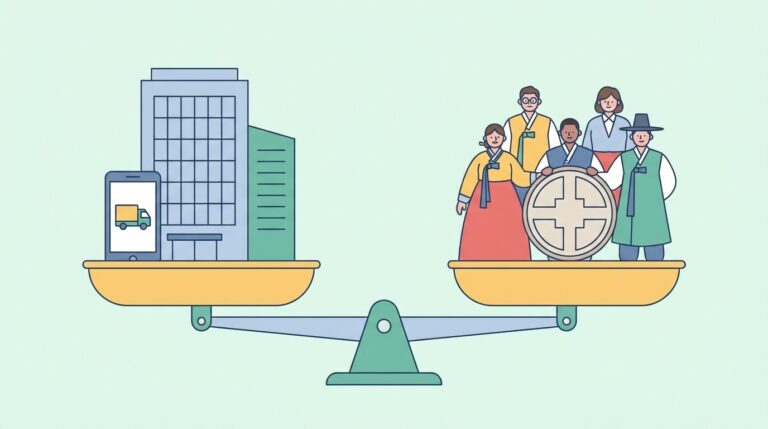
What do all these moments have in common? They are all battlegrounds for the KFTC (공정거래위원회 – Fair Trade Commission).
At a C1 level, you are no longer just ordering coffee or asking for directions. You are reading Korean news, debating societal issues with native friends, and navigating the complex socio-economic landscape of Korea. Understanding consumer rights and the role of the KFTC isn’t just about legal jargon; it’s the key to understanding a massive cultural keyword in Korea: the dynamic between the strong and the weak. Let’s dive into the words that will make your Korean friends say, “Whoa, your Korean is incredibly deep!”
Phase 2: Core Expressions Deep Dive
1. 갑질 (Gapjil)
- Pronunciation: [gap-jil] (Sounds like ‘gap’ + the ‘jeel’ in ‘congeal’)
- Meaning: (Literal) ‘Gap’ behavior / (Real nuance) Abuse of power, bossing someone around abusively.
- K-Culture Moment: This is the ultimate K-Drama trope. When a rich VIP customer forces a department store clerk to kneel to apologize, the entire nation erupts in anger over this gapjil. It’s a word you’ll hear on the news almost every week.
- Editor’s Insight: This word is visceral. It comes from the traditional naming of contract parties (Party A and Party B). Party A (갑) is usually the employer or buyer, holding the power. Adding ‘-질’ (a suffix degrading an action) turns it into a socially condemned act.
- Situation Spectrum:
- Friends (Casual): ✅ (e.g., “Stop acting like a boss!”)
- Co-workers (Semi-formal): ✅ (Discussing news or clients)
- Boss/Elders (Formal): ⚠️ (Use cautiously, as it’s a critical term)
- 🤔 Think About It: Why did a term originating from legal contracts become the most popular slang to describe human relationships in Korea? Does your language have a specific word for the abuse of social hierarchy?
2. 불공정 거래 (Bulgongjeong georae)
- Pronunciation: [bul-gong-jeong geo-rae] (Sounds like ‘bull-gong-jung guh-reh’)
- Meaning: (Literal) Unfair trade / (Real nuance) Unfair business practices (monopolies, price-fixing, unfair contracts).
- K-Culture Moment: When K-Pop fans realize that an agency is forcing idols into 10-year exclusive contracts with no breaks, they petition the KFTC reporting 불공정 거래.
- Editor’s Insight: This is the formal term you need for reading Korean newspapers (신문) or watching the 8 O’clock News. It shows you have a sophisticated grasp of societal issues.
- Situation Spectrum:
- Friends (Casual): ⚠️ (Too formal for everyday chat)
- Co-workers (Semi-formal): ✅
- Boss/Elders (Formal): ✅
- 🤔 Think About It: “Fairness” (공정) is one of the most sensitive topics for young Koreans today (the MZ generation). How does the concept of fairness differ between your home country and Korea?
3. 독과점 (Dokgwajeom)
- Pronunciation: [dok-gwa-jeom] (Sounds like ‘doke-gwa-jum’)
- Meaning: (Literal) Monopoly and oligopoly / (Real nuance) Market domination by one or a few big players.
- K-Culture Moment: Remember when the KakaoTalk server went down, and the entire country paralyzed because everyone relies on one app? That’s when the debate over 독과점 exploded.
- Editor’s Insight: It’s an economic term, but everyday people use it when complaining about delivery apps (like Baemin) raising fees because there are no other alternatives.
- Situation Spectrum:
- Friends (Casual): ✅ (When complaining about high prices)
- Co-workers (Semi-formal): ✅
- Boss/Elders (Formal): ✅
- 🤔 Think About It: Korea’s rapid economic growth was heavily reliant on mega-corporations (Chaebols). How does this history affect the current view on monopolies?
Phase 3: Textbook vs. Real Korean
[Situation 1: Complaining about an unfair idol contract]
* 📖 Textbook Korean: 이 계약은 불공정합니다. (This contract is unfair.)
* 🗣️ Real Korean: 이거 완전 노예계약 아니야? 공정위에 신고해야 돼! (Isn’t this a total slave contract? We need to report it to the KFTC!)
* 💡 Why the difference?: Fans use vivid terms like ‘노예계약’ (slave contract) to express emotional outrage and mobilize the fandom, while ‘공정위’ is the abbreviated, everyday way to say KFTC.
[Situation 2: Reacting to a crazy delivery fee]
* 📖 Textbook Korean: 독과점으로 인해 배달료가 인상되었습니다. (Delivery fees have increased due to monopoly.)
* 🗣️ Real Korean: 배달앱 지들 맘대로 다 해먹네. 배달비 선 넘었어. (These delivery apps are doing whatever they want. The delivery fee has crossed the line.)
* 💡 Why the difference?: ‘지들 맘대로 다 해먹네’ (literally: they are eating it all up however they please) is a highly native C1 idiom used to express frustration at a lack of competition.
Phase 4: Cultural Context — K-Culture Deep Dive
4-1. Non-Verbal Elements: The Frustrated ‘Tsk Tsk’
When Koreans discuss gapjil or unfair market practices, you will often hear a sharp clicking of the tongue (쯧쯧 – tsk tsk) followed by a deep sigh. It’s an expression of deep societal fatigue. When discussing these topics with locals, matching this non-verbal cue shows immense cultural empathy.
4-2. K-Food Link: The Delivery App War
If you live in Korea, you know that Bae-dal (delivery) culture is world-class. However, behind the convenience of getting spicy Tteokbokki delivered at 2 AM is a fierce battle regarding consumer rights and franchise owner protections. The KFTC frequently intervenes when delivery platforms abuse their market dominance (독과점) to squeeze high commission fees out of small restaurant owners (소상공인). Knowing this context turns a simple complaint about a 5,000 KRW delivery fee into a deep conversation about Korea’s gig economy and consumer rights.
Phase 5: Real-Life Roleplay Scenario
Setting: Friday night, 8 PM. A bustling Chimaek (Chicken & Beer) pub in Sinchon. You and your Korean friend, Minho, are having a drink after a long week.
Characters:
– YOU: An expat living in Seoul, fluent enough to read the news, but wanting to sound more like a local.
– Minho (30): Your Korean friend who loves debating social issues over beer.
Dialogue:
Minho: 아, 열받아. 방금 뉴스 봤어? 또 치킨값 오른대.
(A, yeolbada. Banggeum nyuseu bwasseo? Tto chikinkkap oreundae.)
[Ugh, I’m so mad. Did you just see the news? They say chicken prices are going up again.]
YOU: 진짜? 또? 작년에도 올렸잖아.
(Jinjja? Tto? Jangnyeonedo ollyeotjana.)
[Really? Again? They raised it last year too.]
Minho: 내 말이! 배달앱들이 수수료 엄청 떼어가니까 결국 소비자한테 떠넘기는 거지.
(Nae mari! Baedarapdeuri susuryo eomcheong tteeoganikka gyeolguk sobijahante tteoneomgineun geoji.)
[That’s what I’m saying! The delivery apps take such huge commissions, so they end up passing the cost onto the consumers.]
Minho: 이거 진짜 공정위가 나서서 제재해야 하는 거 아니야?
(Igeo jinjja gongjeongwiga naseoseo jejaehaeya haneun geo aniya?)
[Shouldn’t the KFTC really step in and sanction this?]
🔀 Your Turn! How should you respond to sound like a C1 speaker?
– A) 맞아요. 불공정 거래입니다. (Correct, but sounds like a robot reading a textbook.)
– B) 완전 독과점의 횡포지! 진짜 배달비 선 넘었어. (Perfect blend of advanced vocabulary and native slang!)
– C) 슬프네요. 치킨 못 먹겠어요. (A bit too simple for your level.)✅ Best Choice: B — Using ‘독과점의 횡포’ (tyranny of monopoly) shows you understand the economic core of the issue, while ‘선 넘었어’ (crossed the line) keeps the conversation casual and relatable.
Phase 6: 10-Second Shadowing Drill
Let’s practice the rhythm of righteous consumer anger!
😤 공정위가 / 나서서 / 이 갑질 문화를 / 뿌리 뽑아야 해요!
(Gongjeongwiga / naseoseo / i gapjil munhwareul / ppuri ppobaya haeyo!)
[The KFTC needs to step in and root out this culture of power abuse!]
Pro-tip: Put a heavy emphasis on “뿌리” (root) to sound extra determined!
Phase 7: K-Culture Mini Dictionary
| Korean | Romanization | English | Context |
|---|---|---|---|
| 공정위 | gongjeongwi | KFTC | Short for 공정거래위원회. The government body protecting consumer & fair trade rights. |
| 갑 (甲) | gap | Party A / The powerful | The party in a dominant position in a contract or relationship. |
| 을 (乙) | eul | Party B / The weaker | The party in a subordinate position. Often used to describe the struggles of the working class. |
| 꼼수 | kkomsu | Trick / Loophole | Sneaky tactics used by companies to bypass KFTC regulations. |
| 별점 테러 | byeoljeom tereo | Review bombing | When consumers weaponize app reviews (giving 1 star) to protest unfairness, though sometimes it becomes an abuse of consumer power itself. |
Phase 8: Traveler & Resident Survival Kit
Even if you aren’t debating monopolies, understanding consumer rights protects you in daily life or during travel.
🆘 Survival Expressions for Smart Consumers
– 🇰🇷 “이거 환불 규정이 어떻게 되나요?” (igeo hwanbul gyujeongi eotteoke doenayo?)
– 🗣️ Meaning: What is the refund policy for this?
– 📍 Where to use: Booking hotels, signing up for a gym, or buying electronics.
– 💡 Pro Tip: Korean law strongly protects digital and physical purchases within 7 days, but “dark patterns” (tricky UI to prevent refunds) are common. Always ask this clearly!📌 Editor’s Travel Note
– The “No Refund” trap: If a small online boutique (인스타 마켓) says “No refunds” on a defective item, that is actually illegal under KFTC regulations. Knowing your rights is power!
– Consumer Agency Help: If you get scammed, the Korea Consumer Agency (한국소비자원) provides consultation, and they have resources for foreigners too.
Phase 9: Critical Thinking Corner — “A Step Deeper”
🧠 Think Deeper: Language & Power (Gap and Eul)
The terms Gap (갑) and Eul (을) are perhaps the most fascinating examples of how modern Korean society processes its rapid capitalist evolution. Originally just a boring legal designation for ‘Contractor A’ and ‘Contractor B’, these words have transformed into profound social identifiers. In Korea, everyone is constantly evaluating whether they are the Gap or the Eul in any given interaction. When a consumer yells at a part-time worker, the consumer is the Gap. But when that same consumer goes to work and is harassed by their boss, they suddenly become the Eul. The KFTC’s role is fundamentally to level the playing field so that the Gap cannot unconditionally crush the Eul. This binary lens reflects a society highly aware of hierarchy, yet deeply passionate about justice and fairness.
💬 Your Turn: Does your language have terms to describe this ‘A vs. B’ power dynamic in everyday life? How do people in your culture react when a company abuses its power? Let us know in the comments!
Phase 10: FAQ & Mistake Prevention
Q: Can I use the word “갑질 (Gapjil)” directly to someone’s face?
A: NO! Telling your boss “지금 갑질하시는 거예요?” (Are you doing gapjil right now?) is practically declaring a war. It’s a descriptive word used to talk about a situation to a third party, not directly to the perpetrator, unless you are ready for a severe confrontation.
Q: Do I need to know these business terms if I just like K-Pop?
A: Yes, if you want to understand the industry. Disputes over album bundling (끼워팔기) or photo card monopolies are frequently investigated by the KFTC. Knowing these terms helps you understand the news about your favorite groups.
❌ Common Mistake #1: Using formal legal terms (불공정 거래) when complaining to customer service.
✅ Do this instead: When talking to staff, focus on the problem: “결제 금액이 안내된 것과 다릅니다” (The charged amount is different from what was guided.) Save the legal terms for debating the news!
Phase 11: Summary & Action Items
- One-Liner Summary: From unfair contracts to delivery app monopolies, mastering KFTC vocabulary allows you to discuss the most vital socio-economic issues in Korea like a true native.
-
Action Mission:
- 🥉 Bronze: Read the word ‘독과점’ and ‘갑질’ out loud 3 times with a frustrated sigh.
- 🥈 Silver: Leave a comment below using the phrase ‘선 넘었어’ (crossed the line) to describe something unfair you experienced recently.
- 🥇 Gold (Real-world): Go to Naver News (네이버 뉴스), search for “공정위”, and read the headline of the top article. Try to spot the vocab you learned today!
- K-Culture Mission: Watch a corporate K-Drama (like Itaewon Class or Reborn Rich) and listen carefully. I guarantee you will hear the word “갑질” at least once!
Phase 12: Quiz — Interactive Challenge
1. Fill in the blank:
“The delivery app raised its fees again because there are no competitors. It’s a classic case of _________ (Monopoly).”
Answer: 독과점 (Dokgwajeom)
2. Situational Judgment:
Your Korean friend complains that their boss made them do his personal laundry. What is the most natural C1-level response?
A) 사장님이 나쁜 사람이네요. (The boss is a bad person.)
B) 와, 그거 완전 갑질 아니야? 노동청에 신고해! (Wow, isn’t that total gapjil? Report it to the labor board!)
Answer: B. It uses the exact cultural keyword (갑질) that perfectly fits the situation.
3. True or False – K-Culture Edition:
The terms 갑 (Gap) and 을 (Eul) only exist in formal business contracts and are never used in casual conversations.
Answer: False! They have become everyday slang to describe the power dynamic in ANY relationship, including dating!
Frequently Asked Questions (FAQ)
Q: What does "갑질 (Gapjil)" mean in Korean and how do you pronounce it?
A: In Korean, "갑질 (Gapjil)" is pronounced [gap-jil] and means: (Literal) 'Gap' behavior / (Real nuance) Abuse of power, bossing someone around abusively.
Q: What does "불공정 거래 (Bulgongjeong georae)" mean in Korean and how do you pronounce it?
A: In Korean, "불공정 거래 (Bulgongjeong georae)" is pronounced [bul-gong-jeong geo-rae] and means: (Literal) Unfair trade / (Real nuance) Unfair business practices (monopolies, price-fixing, unfair contracts).
Q: What does "독과점 (Dokgwajeom)" mean in Korean and how do you pronounce it?
A: In Korean, "독과점 (Dokgwajeom)" is pronounced [dok-gwa-jeom] and means: (Literal) Monopoly and oligopoly / (Real nuance) Market domination by one or a few big players.






