

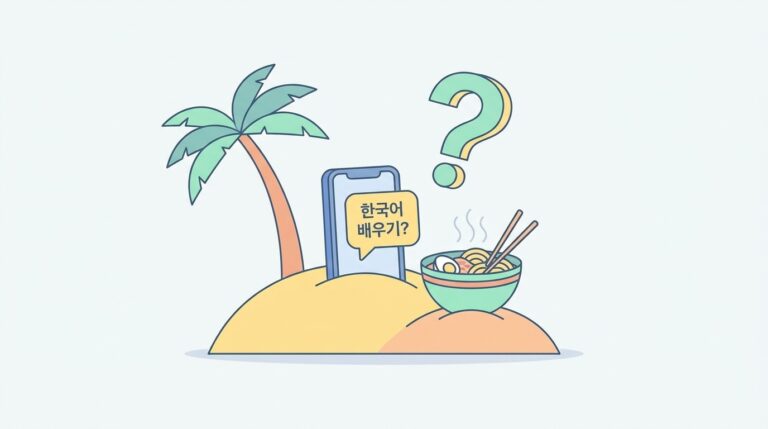
Phase 1: Empathy (The K-Culture Cold Open)
Hello! I’m your Daily Hangul Editor.
Picture this: You’re watching a live interview of your favorite K-Pop idol. The MC looks at the cue card with a mischievous smile and asks, “오빠, 무인도에 간다면 멤버 중 누구를 데려갈 거예요?” (Oppa, if you went to a deserted island, which member would you take with you?). The crowd goes wild, the idol sweats, and a hilarious debate ensues.
Or maybe you’ve watched a K-Drama where the main couple is sitting by the Han River, having a deep conversation. One asks, “If the world ended tomorrow…”
Why do Koreans love these hypothetical questions so much? From ‘Balance Games’ (밸런스 게임) to the nationwide MBTI obsession, Koreans are the undisputed champions of extreme “What if” scenarios. It’s not just a game; it’s the ultimate icebreaker. If you want to move past the awkward “Hello, my name is…” phase and instantly bond with a Korean friend, you need to master the art of the hypothetical.
Today, based on real questions from my B1 students, we are going to dive into the grammar of imagination. Let’s get you ready for the deserted island!
Phase 2: Deep Dive into Core Expressions
1. 무인도에 간다면 (If you were to go to a deserted island)
- Pronunciation: [mu-in-do-e gan-da-myeon]
- Meaning: Literal: “If you go to a deserted island” / Real nuance: “Hypothetically speaking, if you were to end up on a deserted island…”
- K-Culture Moment: This is the golden question at K-Pop fan meetings. Fans love seeing idols struggle to choose between a lighter, a smartphone, or their fellow group member.
- Editor’s Insight: You probably already know
-(으)면(if). But adding-(느)ㄴ다면adds a thick layer of imagination. It signals to the listener: “Okay, this is highly unlikely, but just play along.” It’s the Korean equivalent of “What if…?”- Situation Spectrum:
- Casual with friends: ✅ (Perfect for late-night talks)
- Semi-formal coworkers: ✅ (Great team-building icebreaker)
- Formal/Elders: ⚠️ (Might seem a bit childish to ask a CEO, unless in a playful workshop setting!)
- 🤔 Think About It: Why do you think Korean uses a completely different grammar form
(-ㄴ다면)for unlikely events compared to likely ones(-으면)? Does your native language distinguish between “if it rains tomorrow” and “if I won the lottery”?2. 딱 하나만 챙길 수 있다면 (If you could only pack exactly one thing)
- Pronunciation: [ttak ha-na-man chaeng-gil su it-da-myeon]
- Meaning: Literal: “If you can pack exactly one thing” / Real nuance: “If you were forced to choose only one item to bring”
- K-Culture Moment: You’ll hear the word
딱(exactly/just) in almost every Korean variety show when the PD gives a strict rule to the cast members. “딱 한 입만!” (Just one bite!).- Editor’s Insight: Notice the verb
챙기다(to pack/to take care of). Textbooks teach가져가다(to take), but in real life, Koreans use챙기다when talking about preparing items for a trip or an outing. It sounds much more natural and native-like.- Situation Spectrum:
- Casual with friends: ✅
- Semi-formal coworkers: ✅
- Formal/Elders: ⚠️
- 🤔 Think About It:
챙기다doesn’t just mean “to pack”; it also means “to take care of someone” (e.g., 동생을 챙기다). What does this tell you about the Korean concept of preparing for the future?3. 저는 무조건 ___ 가져갈래요 (I would unconditionally bring ___)
- Pronunciation: [jeo-neun mu-jo-geon ___ ga-jyeo-gal-lae-yo]
- Meaning: Literal: “I unconditionally want to bring ___” / Real nuance: “I would absolutely/100% bring ___”
- K-Culture Moment: When Koreans are passionate about their choices (like choosing Mint Chocolate vs. Anti-Mint Chocolate), they always throw in
무조건(unconditionally). It shows unwavering certainty.- Editor’s Insight: The ending
-ㄹ래요is a very conversational way to express your intention or desire. It sounds softer and more engaged than the robotic-겠습니다.- Situation Spectrum:
- Casual with friends: ✅ (Drop the ‘요’: 무조건 이거 가져갈래!)
- Semi-formal coworkers: ✅
- Formal/Elders: ⚠️ (Too strong and informal for a boss)
Phase 3: Textbook vs. Real Korean
[Asking the Hypothetical Question]
* 📖 Textbook: 만약 무인도에 간다면 무엇을 가지고 갈 것입니까? (If you go to a deserted island, what will you take?)
* 🗣️ Real Korean: 무인도 갈 때 딱 하나만 챙긴다면? (If you could pack just one thing for a deserted island?)
* 💡 Why the difference?: Real conversation drops the subject and particle markers for speed. Also, 챙기다 replaces 가지고 가다 for a more natural “packing” vibe.
[Answering with Certainty]
* 📖 Textbook: 저는 스마트폰을 가져가겠습니다. (I will take a smartphone.)
* 🗣️ Real Korean: 무조건 폰 챙겨야지! (I absolutely have to pack my phone!)
* 💡 Why the difference?: Using 무조건 (absolutely) and -야지 (I must/of course I should) adds emotion and personality, turning a sterile answer into a fun conversation starter.
Bottom Note: At the B1 level, try to consciously swap
가져가다with챙기다when talking about trips or your belongings. It instantly upgrades your Korean from “student” to “local”!
Phase 4: Cultural Context — K-Culture Deep Dive
4-1. Non-Verbal Cues: The Art of Thinking
When someone asks you a hypothetical question in Korea, don’t just answer immediately like a robot. Part of the fun is the performance of struggling to choose!
– Cross your arms, tilt your head slightly upward, and make a “쓰읍…” (Ss-eup – sucking in air through your teeth) sound.
– Say “아… 이거 진짜 어렵네.” (Ah… this is really hard.) before delivering your final answer. It shows you are highly engaged in their game.
4-2. The “Balance Game” (밸런스 게임) Phenomenon
The “Deserted Island” question is the grandfather of what Koreans now call the 밸런스 게임 (Balance Game – similar to “Would You Rather”). In K-Variety shows (like Running Man or YouTube shows like Halmyungsoo), celebrities are constantly forced to choose between two ridiculous extremes.
Examples of popular Korean Balance Games:
– 평생 양치 안 하기 VS 평생 샤워 안 하기 (Never brush your teeth for the rest of your life VS Never shower for the rest of your life)
– 100억 받고 폰 없이 살기 VS 그냥 살기 (Receive 10 million USD but live without a phone VS Just live as you are)
If you learn -는다면 (If…), you unlock the ability to play these games with your Korean friends. It’s the fastest way to break the ice!
Phase 5: Interactive Roleplay Scenario
Setting: It’s 9 PM on a Friday at a noisy, trendy cafe in Yeonnam-dong. You are having coffee with your Korean language exchange partner, Min-su, and his friend, Ji-eun. The conversation has paused, and Min-su suddenly leans in with a playful smirk.
Characters:
– YOU: An adventurous B1 Korean learner.
– Min-su: (28) Your outgoing Korean friend who loves asking random questions.
The Dialogue:
Min-su: 심심한데 우리 밸런스 게임 할까?
(simsimhande uri baelleonseu geim halkka?)
(영어) I’m bored, should we play a Balance Game?
YOU: 오, 좋아! 해보자.
(o, joa! haeboja.)
(영어) Oh, sounds good! Let’s do it.
Min-su: 자, 네가 내일 갑자기 무인도에 떨어졌어.
(ja, nega naeil gapjagi muindoe tteoreojyeosseo.)
(영어) Okay, you suddenly fall onto a deserted island tomorrow.
Min-su: 딱 하나만 챙길 수 있다면, 스마트폰이야, 아니면 라면 한 박스야?
(ttak hanaman chaenggil su itdamyeon, seumateuponiya, animyeon ramyeon han bakseuya?)
(영어) If you could pack exactly one thing, is it your smartphone, or a box of ramen?
🔀 Your Turn! How do you answer?
– A) “저는 스마트폰을 가져가겠습니다. 구조를 요청해야 합니다.” (Very logical and formal)
– B) “무조건 라면이지! 무인도에서 폰 배터리 없잖아!” (Passionate, logical, and casual)
– C) “아… 진짜 어렵네. (쓰읍) 폰 챙길래!” (Using the cultural “struggle” performance)✅ Best Choice: B or C!
– Why C is great: It uses the non-verbal “struggling” cue Koreans love, followed by the natural-ㄹ래ending.
– Why B is hilarious: It uses무조건(absolutely) and points out a logical flaw in the game (no chargers on a deserted island!), which usually sparks a fun debate.
– ⚠️ Choice A Analysis: Too textbook! You sound like an AI assistant. Save-겠습니다for business presentations.
Min-su: (Laughing) 야, 무인도에 와이파이 안 터져! 폰으로 뭐 할 건데?
(ya, muindoe waipai an teojyeo! poneuro mwo hal geonde?)
(영어) Hey, there’s no Wi-Fi on a deserted island! What are you gonna do with a phone?
YOU: 아, 맞다! 그럼 무조건 라면 챙겨야지!
(a, matda! geureom mujogeon ramyeon chaenggyeoyaji!)
(영어) Ah, right! Then I absolutely have to pack the ramen!
Phase 6: 10-Second Shadowing Drill
Practice this sentence until it flows perfectly. Pay attention to the pauses (/) and the intonation!
🤔 Struggling deeply
아… / 진짜 어렵네. / 무인도에 간다면… (a… / jinjja eoryeomne. / muindoe gandamyeon…)
😤 With absolute certainty
저는 / 무조~~~건! / 폰을 챙길래요! (jeoneun / mujo~~~geon! / poneul chaenggillaeyo!)
(Tip: Stretch out the ‘조’ in 무조건 to sound like a true native!)
Phase 7: K-Culture Mini Dictionary
| 한국어 | Romanization | English | Cultural Context |
|---|---|---|---|
| 무인도 | muindo | Deserted island | The default setting for Korean hypothetical survival games. |
| 밸런스 게임 | baelleonseu geim | Balance Game | The Korean “Would You Rather?” wildly popular among Gen Z and variety shows. |
| 챙기다 | chaenggida | To pack/To take care | Used universally for packing bags or looking out for someone’s well-being. |
| 무조건 | mujogeon | Unconditionally | A dramatic way to say “100% absolutely.” Koreans use this heavily in everyday debates. |
| 와이파이 터지다 | waipai teojida | Wi-Fi connects | Fun slang! 터지다 means “to explode/burst”, but here it means getting a signal. |
Phase 8: Traveler’s Survival Kit (Packing Edition)
Since we are talking about what to pack for an island, let’s adapt this to packing for your real-life trip to Korea!
🆘 Survival Expressions for Travel Preparation
– 🇰🇷 “여권 챙겼어?” (yeogwon chaenggyeosseo?) – Did you pack your passport?
– 🇰🇷 “혹시 모르니까 우산도 챙기자.” (hoksi moreunikka usando chaenggija.) – Let’s pack an umbrella, just in case.
– 🇰🇷 “이거 기내에 가지고 탈 수 있어요?” (igeo ginaee gajigo tal su isseoyo?) – Can I take this on board (the airplane)?📌 Editor’s Travel Note: What to actually “pack” for Korea
– Deodorant: Hard to find in Korean convenience stores! 무조건 챙기세요! (Absolutely pack it!)
– Cash: Korea is a cashless society, but keep some 1,000 won bills for street food like Bungeoppang (fish-shaped pastry).
– Google Maps vs. Naver Map: Google Maps doesn’t work well for walking/driving in Korea. Pack “Naver Map” or “KakaoMap” in your smartphone!
Phase 9: Critical Thinking — “Think Deeper”
🧠 Think Deeper: MBTI, Balance Games, and the Fast-Paced Korean Society (Language & Identity)
Why is modern Korean culture so obsessed with categorizing people through MBTI tests and extreme “Balance Games”? In a highly competitive, fast-paced society (빨리빨리 culture), young Koreans don’t always have the time for slow, sprawling conversations to get to know someone. Hypothetical questions act as a rapid “compatibility test.” By asking “What would you do on a deserted island?”, you instantly find out if the other person is practical (T) or emotional (F), imaginative (N) or realistic (S). It’s a playful survival mechanism for building social tribes quickly and efficiently.
💬 Your Turn: Does your culture have a similar shortcut for getting to know people quickly? Or do people prefer slow, natural conversations? Let me know in the comments!
Phase 10: FAQ & Avoiding Mistakes
Q: Can I use 무조건 (unconditionally) with my boss?
A: No. While it means “absolutely,” using it with elders or superiors can sound a bit stubborn or overly aggressive. If your boss asks what to eat for lunch, don’t say “무조건 김치찌개요!” (Absolutely Kimchi stew!). Instead, use a softer expression like “김치찌개 어떨까요?” (How about Kimchi stew?).
Q: What is the exact difference between -(으)면 and -는다면?
A:
– -(으)면 = Likely/Everyday conditions. (e.g., 내일 비가 오면… = If it rains tomorrow…)
– -는다면 = Unlikely/Hypothetical conditions. (e.g., 내가 복권에 당첨된다면… = If I were to win the lottery…)
❌ Common Mistake #1: Using
-는다면for everyday, realistic plans.
– (Awkward) 배가 고프다면 밥을 먹으세요. (If you were to theoretically be hungry, eat.)
– ✅ (Correct) 배가 고프면 밥을 먹으세요. (If you’re hungry, eat.)
Phase 11: Summary & Action Items
One-Liner Summary: Use 무인도에 간다면... to ask fun hypotheticals, and answer with 딱 하나 챙긴다면 무조건 ___! to sound like a true local.
Action Mission 3 Steps:
– 🥉 Bronze (Solo): Look at your desk right now. Say out loud in Korean: “If I went to a deserted island, I would take [Item on your desk].”
– 🥈 Silver (Online): Go to Weverse, Twitter, or Instagram and ask your favorite K-Pop idol: “오빠/언니, 무인도에 간다면 딱 하나 뭐 챙길 거예요?”
– 🥇 Gold (Real Life): Next time you meet your Korean language exchange partner, look at them seriously and initiate a “밸런스 게임”!
Phase 12: Interactive Challenge (Quiz)
Let’s test your hypothetical survival skills!
1. Fill in the blank: (You are talking to a friend about a hypothetical situation)
내가 만약 외계인을 ________, 무조건 사진부터 찍을래!
(If I were to meet an alien, I would absolutely take a picture first!)
A) 만나면
B) 만난다면
C) 만나겠습니다
2. True or False – K-Culture Edition:
If a Korean friend asks you a “Balance Game” question, you should answer immediately with a logical, serious response to show respect. (T/F)
3. Which sentence is the most natural way to say “Did you pack your phone?” before leaving the hotel?
A) 폰 챙겼어?
B) 폰 가져가겠습니다?
C) 폰 무조건이야?
Answers (Click to reveal)
1. B) 만난다면 (Meeting an alien is highly unlikely, so the hypothetical ‘-는다면’ fits best!)
2. False (Take your time, act like it’s a difficult choice, and have fun debating the ridiculous logic!)
3. A) 폰 챙겼어? (‘챙기다’ is the most natural verb for packing or checking if you have your belongings.)
Frequently Asked Questions (FAQ)
Q: What does "무인도에 간다면 (If you were to go to a deserted island)" mean in Korean and how do you pronounce it?
A: In Korean, "무인도에 간다면 (If you were to go to a deserted island)" is pronounced [mu-in-do-e gan-da-myeon] and means: Literal: "If you go to a deserted island" / Real nuance: "Hypothetically speaking, if you were to end up on a deserted island..."
Q: What does "딱 하나만 챙길 수 있다면 (If you could only pack exactly one thing)" mean in Korean and how do you pronounce it?
A: In Korean, "딱 하나만 챙길 수 있다면 (If you could only pack exactly one thing)" is pronounced [ttak ha-na-man chaeng-gil su it-da-myeon] and means: Literal: "If you can pack exactly one thing" / Real nuance: "If you were forced to choose only one item to bring"
Q: What does "저는 무조건 ___ 가져갈래요 (I would unconditionally bring ___)" mean in Korean and how do you pronounce it?
A: In Korean, "저는 무조건 ___ 가져갈래요 (I would unconditionally bring ___)" is pronounced [jeo-neun mu-jo-geon ___ ga-jyeo-gal-lae-yo] and means: Literal: "I unconditionally want to bring ___" / Real nuance: "I would absolutely/100% bring ___"







