

Phase 1: Empathy (The K-Culture Cold Open)
Hello there! I’m your Daily Hangul Editor. 😊
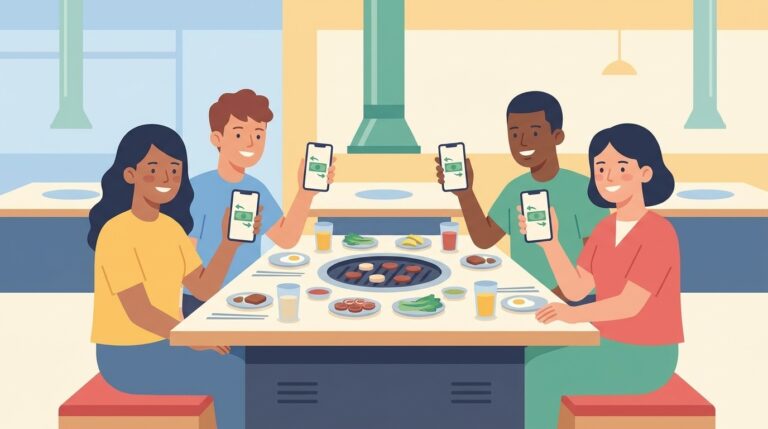
Picture this: You’ve finally joined a Korean running crew or a language exchange club in Seoul. The vibe is great, you made some friends, and after the activity, everyone heads to a local BBQ joint for a dwit-pul-i (뒷풀이, after-party). You eat, you laugh, and then the bill comes.
Suddenly, the club leader shouts something like, “I’ll calculate the N-bbang!” and everyone immediately pulls out their phones, tapping away. You’re sitting there holding your credit card, wondering, “Wait, what’s happening? Are we not paying at the counter? What is an N-bbang?!”
If you don’t know how club dues or bill-splitting works in Korea, you might end up feeling a bit awkward or accidentally getting a free meal you didn’t intend to get! But don’t worry. Knowing how to smoothly offer your share of the bill is the ultimate ‘Insider’ (인싸) move.
This guide is based on real panic moments from my tutoring students. Today, we’ll learn exactly how to handle paying dues and splitting the bill in Korea like a true local!
Phase 2: Deep Dive into Core Expressions
Here are the top three expressions you need when paying your share in a Korean club or group setting.
1. 회비 얼마예요? (How much are the dues?)
- Pronunciation: hoebi eolmayeyo? (hoe-bi sounds like ‘hway-bee’)
- Meaning: Literal: How much is the membership fee? / Real nuance: How much do I owe for the club/gathering?
- K-Culture Moment: You’ll hear this in K-Dramas when the Dongchanghoe (high school reunion) is planning a trip, or when you join a weekly tennis club. There’s always a designated ‘Treasurer’ (총무) collecting the hoebi.
- Editor’s Insight: Hoebi literally means ‘club fee’. It can be a fixed monthly fee (e.g., 20,000 KRW a month) or just the cost of that day’s after-party. It’s the most polite and standard way to ask how much you need to pay.
- Situation Spectrum:
- Casual with friends: ✅
- Semi-formal with club members: ✅
- Formal with bosses: ✅
- 🤔 Think About It: In many cultures, clubs are free, and you just pay for what you eat. Why do Koreans love creating formal “club funds” (회비) even just among close friends?
2. 계좌로 보낼게요 (I’ll send it to your account)
- Pronunciation: gyejwaro bonaelgeyo (gyejwa sounds like ‘gyeh-jwa’, bonaelgeyo sounds like ‘bo-nel-geh-yo’)
- Meaning: I will transfer the money to your bank account.
- K-Culture Moment: Think of any K-Pop idol reality show where they go grocery shopping. One person pays with their card, and the others instantly say “I’ll KakaoPay you!” Bank transfers in Korea are free and take about 2 seconds.
- Editor’s Insight: Korea is practically a cashless society. We rarely hand physical cash to each other to split a bill. We just ask for the account number (계좌번호) and transfer it on the spot.
- Situation Spectrum:
- Casual with friends: ✅
- Semi-formal with club members: ✅
- Formal with bosses: ⚠️ (Usually, the boss pays for everything! Offering to transfer them money might make them feel awkward.)
- 🤔 Think About It: How does the speed of Korean banking technology change the way people interact and share food?
3. 우리 N빵 해요 (Let’s split the bill evenly)
- Pronunciation: uri en-ppang haeyo (en-ppang sounds like the English letter ‘N’ + ‘bbang’ like a strong B sound)
- Meaning: Let’s divide the total cost by the number of people.
- K-Culture Moment: On YouTube variety shows, when celebrities lose a game, the punishment is often “N-bbang for today’s dinner!”
- Editor’s Insight: This is a very casual, slightly slangy term! ‘N’ is the mathematical variable for the number of people, and ‘bbang’ (빵) comes from a slang word meaning to divide. It’s the Korean equivalent of “going Dutch.”
- Situation Spectrum:
- Casual with friends: ✅
- Semi-formal with close club members: ✅
- Formal with bosses/elders: 🚫 (Never use this with seniors. Use “각자 낼게요” instead!)
- 🤔 Think About It: Why do Koreans prefer dividing the total bill evenly rather than calculating exactly who ate what?
Phase 3: Textbook vs. Real Korean
Let’s see how these situations look in a textbook versus on the streets of Seoul.
[Situation 1: Asking to split the bill]
* 📖 Textbook Korean: 각자 계산하겠습니다. (We will pay individually.)
* 🗣️ Real Korean: N빵 할게요. (We’ll do N-bbang.) / 따로 결제할게요. (We’ll pay separately.)
* 💡 Why the difference?: Textbooks teach formal business Korean, but younger generations use math variables (N) to create efficient, catchy slang!
[Situation 2: Sending the money]
* 📖 Textbook Korean: 돈을 송금하겠습니다. (I will remit the funds.)
* 🗣️ Real Korean: 카카오페이로 보낼게요. (I’ll send it via KakaoPay.) / 계좌 알려주세요. (Let me know your account.)
* 💡 Why the difference?: Real conversations favor specific platforms (KakaoPay, Toss) over the formal dictionary word for ‘remittance’ (송금).
Bottom Note: For A2 learners, “계좌로 보낼게요” (I’ll send it to your account) is the safest, most natural middle-ground expression you can use with almost anyone!
Phase 4: Cultural Context — K-Culture Deep Dive
4-1. Non-verbal Cues & Nunchi
In a club or group setting, Nunchi (눈치, the subtle art of reading the room) is everything. When the club leader pays the restaurant bill with their credit card, don’t just stand there waiting to be told what to do. The best Nunchi move is to immediately take out your phone, make eye contact, and ask, “회비 얼마예요? 계좌번호 알려주세요!” (How much are the dues? Please let me know your account number!). Doing this promptly shows you are a responsible and polite member.
4-2. K-Food Connection: The “One Table, One Bill” Culture
If you go to a Korean BBQ restaurant with your language exchange club, you’ll notice everyone shares the meat, the side dishes (반찬), and the stews. Because Korean food is inherently communal, asking the restaurant owner to split the bill based on “I had 3 pieces of pork and he had 5” is culturally weird and practically impossible.
That’s why one person pays the entire bill at the counter, and later, that person calculates the total, divides it by the number of people (N-bbang), and posts their bank account in the group chat room (단톡방).
Phase 5: Real-life Roleplay Scenario
Scenario A: The After-Party Checkout
- Setting: Friday night, 9:00 PM. A noisy Samgyeopsal (pork belly) restaurant near Gangnam Station. The language exchange club just finished eating.
- Characters:
- YOU: A foreign member who joined the club a month ago. You want to pay your share politely.
- Minsu (32): The friendly Korean club leader.
Dialogue:
Minsu: 자, 오늘 모임은 여기까지 할까요? 제가 먼저 계산할게요! 💳
(ja, oneul moimeun yeogikkaji halkkayo? jaega meonjeo gyesanhalkkeyo!)
[Alright, shall we wrap up today’s meetup here? I’ll pay first!]
(🎭 Stage Direction: Minsu grabs the bill from the table and walks to the counter)
YOU: 민수 씨, 오늘 정말 재밌었어요! 고기 너무 맛있었어요.
(Minsu ssi, oneul jeongmal jaemisseosseoyo! gogi neomu masisseosseoyo.)
[Minsu, today was really fun! The meat was so delicious.]
Minsu: 다행이네요! 영수증 받았으니까 이따 단톡방에 올릴게요.
(dahaengineyo! yeongsujeung badasseunikka itta dantokbange ollilgeyo.)
[I’m glad! I got the receipt, so I’ll upload it to the group chat later.]
🔀 Your Turn! How should you respond?
– A) “아, 감사합니다! 잘 먹겠습니다!” (Ah, thank you! I will eat well!)
– B) “네, 확인하고 계좌로 보낼게요!” (Yes, I’ll check and send it to your account!)
– C) “저 돈 없어요.” (I don’t have money.)✅ Best Choice: B — Reason: In this context, Minsu is not buying you a free meal; he is just paying upfront for convenience. Offering to send the money to his account is the correct etiquette.
⚠️ Choice A Analysis: If you say this, Minsu might feel awkward because he actually expects you to pay your share later! “잘 먹겠습니다” is only used when someone explicitly states they are treating you.
Minsu: 네, 좋아요. 조심히 들어가세요!
(ne, joayo. josimhi deureogaseyo!)
[Yes, sounds good. Get home safely!]
YOU: 네, 단톡방에 계좌번호 꼭 남겨주세요!
(ne, dantokbange gyejwabeonho kkok namgyeojuseyo!)
[Yes, please make sure to leave your account number in the group chat!]
Scenario B: The Travel Bonus (Splitting at a Cafe)
- Setting: A cute cafe in Jeju Island with a friend you met at the guesthouse.
- Clerk: 12,000원입니다. 같이 결제하시나요?
(man-icheon-won-imnida. gachi gyeoljehasinayo? – It’s 12,000 KRW. Are you paying together?) - YOU: 아, 따로 결제할게요.
(a, ttaro gyeoljehalgeyo. – Ah, we will pay separately.) - Clerk: 네, 각자 카드를 꽂아주세요.
(ne, gakja kadeureul kkojajuseyo. – Yes, please insert your cards individually.)
Phase 6: 10-Second Shadowing Drill
Let’s practice the most useful sentence. Pay attention to the pauses (/)!
😊 Friendly and prompt:
오늘 회비 / 얼마예요? / 계좌로 / 보낼게요!
(oneul hoebi / eolmayeyo? / gyejwaro / bonaelgeyo!)
How much are today’s dues? I’ll transfer it to your account!
Phase 7: K-Culture Mini Dictionary
| Korean | Romanization | English | Context |
|---|---|---|---|
| 눈치 | nunchi | Social awareness | The ability to read the room. Knowing when to ask for the bill is good nunchi. |
| 단톡방 | dantokbang | Group chat room | Essential for any Korean club. Where announcements and bank details are shared. |
| 회비 | hoebi | Dues / Fee | Money collected for a club or gathering. |
| 총무 | chongmu | Treasurer | The person in the club who collects the money and pays the restaurant. |
| 송금 | songgeum | Money transfer | The formal word for sending money. |
Phase 8: Traveler’s Survival Kit
Even if you’re not in a club, you’ll need to know how to handle payments in Korea. Here are your survival phrases:
🆘 Survival Phrases for Payments
– 🇰🇷 “따로 결제할게요.” (ttaro gyeoljehalgeyo) – We will pay separately.
– 🇰🇷 “영수증 버려주세요.” (yeongsujeung beoryeojuseyo) – Please throw away the receipt. (Very common to say at convenience stores!)
– 🇰🇷 “카드 되나요?” (kadeu doenayo?) – Do you accept credit cards?📍 Where to use: Cafes, restaurants, convenience stores.
📌 Editor’s Travel Note
– Cash vs. Card: Korea is a card heaven. You can buy a 1,000 KRW water bottle with a credit card. However, small street food vendors in traditional markets still prefer cash or direct bank transfers.
– Tipping Culture: There is absolutely NO tipping culture in Korea. If you leave money on the table, the staff might run out to the street to return it to you!
Phase 9: Critical Thinking Corner — “A Step Deeper”
Food & Identity: The Communal Pot
In Western cultures, it’s normal to order your own plate of food and pay only for what you ate. However, traditional Korean food is deeply communal. A massive pot of stew (찌개) boils in the center, and everyone dips their spoons into it. Sharing food from the same pot historically built a sense of Jeong (정, emotional bond and community). Because the food is shared collectively, the financial burden is also shared collectively—hence the “N-bbang” culture where everyone pays an equal slice, regardless of who ate one more piece of pork belly.
💬 Your Turn: In your culture, do people prefer ordering individual dishes or sharing everything? How do you usually split the bill with friends? Let me know in the comments!
Phase 10: FAQ & Avoiding Misunderstandings
Q: “Can I say ‘우리 N빵 해요’ to my boss at the company dinner (회식)?”
No! 🚫 In a formal company dinner, the boss or the company card pays. If it’s a lunch with slightly older colleagues, say safely: “제가 얼마 드리면 될까요?” (How much should I give you?).
Q: “Is it rude to ask for separate checks at a busy restaurant?”
Maybe. ⚠️ If it’s peak lunchtime (12 PM) and a line is out the door, the cashier might get stressed if 5 people want to pay separately. That’s why one person usually pays and friends transfer the money later.
❌ Common Mistake #1: Trying to hand physical cash to your friend in the middle of a restaurant.
✅ Do this instead: Ask for their KakaoBank or regular bank account number and transfer it via your phone. It’s much less disruptive!
Phase 11: Summary & Action Items
- One-Liner Summary: In Korea, one person pays at the counter, and you ask “회비 얼마예요? 계좌로 보낼게요” to transfer your share!
-
Action Mission:
- 🥉 Bronze (Solo): Read “계좌로 보낼게요” out loud 3 times looking at your credit card.
- 🥈 Silver (Online): Find a Korean study buddy online and roleplay asking for their account number.
- 🥇 Gold (Real Life): Next time you eat out with Korean friends, volunteer to be the one who pays the total bill, and tell them “나한테 계좌로 보내!” (Send it to my account!).
- K-Culture Mission: Watch a K-Drama today and look out for the scene where office workers fight over the bill at the counter. (It’s a classic trope where elders fight to pay the whole thing!)
Phase 12: Interactive Quiz
1. Situational Judgment: You went hiking with a new Korean club. The leader paid 100,000 KRW for 5 people’s lunch. What is the BEST thing to say?
– A) “잘 먹었습니다! 다음엔 제가 살게요.”
– B) “회비 얼마예요? 계좌번호 알려주세요.”
– C) “제 음식은 15,000원이니까 15,000원 현금으로 줄게요.”
2. True or False – K-Culture Edition:
“Korean restaurants love it when a table of 6 people asks to split the bill into 6 separate credit card transactions during busy lunch hours.”
(Scroll down for answers!)
Answers:
1. B is the most natural. (A assumes a free meal, C is too calculating for Korean communal sharing).
2. False! It slows down the line, which is why Koreans prefer ‘one payer, transfer later’ (N빵).
Frequently Asked Questions (FAQ)
Q: What does "회비 얼마예요? (How much are the dues?)" mean in Korean and how do you pronounce it?
A: In Korean, "회비 얼마예요? (How much are the dues?)" is pronounced [hoebi eolmayeyo? (hoe-bi sounds like 'hway-bee'] and means: Literal: How much is the membership fee? / Real nuance: How much do I owe for the club/gathering?
Q: What does "계좌로 보낼게요 (I'll send it to your account)" mean in Korean and how do you pronounce it?
A: In Korean, "계좌로 보낼게요 (I'll send it to your account)" is pronounced [gyejwaro bonaelgeyo (gyejwa sounds like 'gyeh-jwa', bonaelgeyo sounds like 'bo-nel-geh-yo'] and means: I will transfer the money to your bank account.
Q: What does "우리 N빵 해요 (Let's split the bill evenly)" mean in Korean and how do you pronounce it?
A: In Korean, "우리 N빵 해요 (Let's split the bill evenly)" is pronounced [uri en-ppang haeyo (en-ppang sounds like the English letter 'N' + 'bbang' like a strong B sound] and means: Let's divide the total cost by the number of people.







