

Hello! Daily Hangul Editor here.
Imagine this: You are watching a K-Drama. The female lead is getting ready for her ex-boyfriend’s wedding. She puts on killer heels, a stunning red dress, and perfect makeup. The subtitles just say, “I’ll show him,” but the Korean viewers are gasping. Why? Because wearing a flashy color to a wedding in Korea is a massive social taboo!
Or picture a K-Pop idol like EXO’s Suho or BTS’s Jin being praised by fans as having a “면접 프리패스 상” (a face that would pass any job interview). What does that even mean?
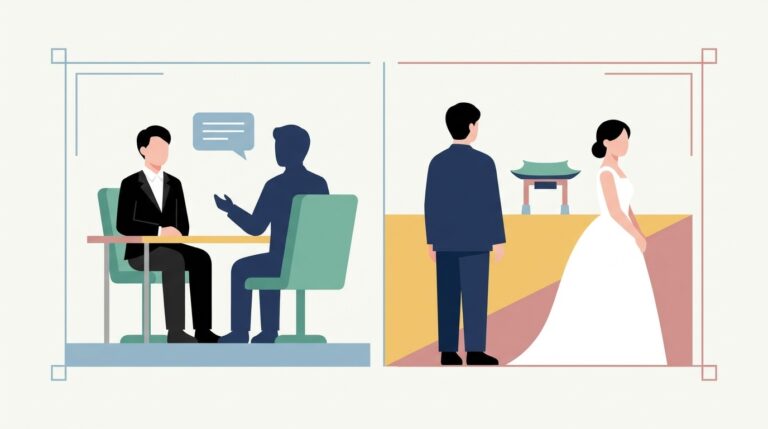
If you are living in Korea, attending a Korean friend’s wedding, or aiming to work at a Korean company, getting your fashion “TPO” (Time, Place, Occasion) right is just as important as speaking the language. Dress too loud at a wedding, and you become the villain. Dress too casually for an interview, and you are out before you even sit down.
Today, we are going to dive into the unspoken rules of Korean fashion trends, specifically for Wedding Guest Looks (하객 룩) and Interview Looks (면접 룩). I promise, knowing these expressions will save you from major fashion faux pas and give you some serious insider Nunchi (눈치).
Phase 2: Core Expressions Deep Dive
1. 민폐 하객 (Minpye Hagaek)
- Pronunciation: [min-pye ha-gaek] (‘Min-pye’ sounds like ‘mean-peh’, ‘ha-gaek’ rhymes with ‘ha-heck’ without the ‘h’ at the end)
- Meaning: Literal = Nuisance guest / Real nuance = A guest who wears white or something too flashy to a wedding.
- K-Culture Moment: You are watching a drama, and a girl shows up to a wedding in a white lace dress. The bride’s friends whisper furiously, “완전 민폐 하객이네!” (What a total nuisance guest!). In Korea, only the bride wears white so she can stand out in photos.
- Editor’s Insight: This isn’t just about fashion; it’s about stealing the spotlight. If you are called this, it means you lacked consideration for the host.
- Situation Spectrum:
- Friends (Casual): ✅ (Joking with a friend: “Don’t be a minpye hagaek!”)
- Coworkers (Semi-formal): ⚠️ (Use carefully to describe others)
- Boss/Elders (Formal): 🚫
- 🤔 Think About It: Why are Korean weddings so strict about guests not wearing white? Could it be related to the importance of group harmony over individual expression?
2. 모나미 룩 (Monami Ruk)
- Pronunciation: [mo-na-mi ruk] (‘Mo-na-mi’ sounds exactly like the French ‘mon ami’)
- Meaning: Literal = Monami Look / Real nuance = Black pants with a white shirt.
- K-Culture Moment: “Monami” is Korea’s most famous, classic ballpoint pen—it has a white barrel and black tips. Every Korean knows it. If you walk into a subway station during job interview season, you will see a sea of young people dressed exactly like this pen.
- Editor’s Insight: It’s a slightly humorous, slightly self-deprecating slang term young people use to describe the standard, ultra-safe, conservative interview outfit.
- Situation Spectrum:
- Friends (Casual): ✅
- Coworkers (Semi-formal): ✅
- Boss/Elders (Formal): 🚫 (Too slangy for an actual interview!)
- 🤔 Think About It: Does your country have a “standard uniform” for job seekers? Why do you think Korean companies prefer this “Monami” style?
3. 꾸안꾸 (Kku-an-kku)
- Pronunciation: [kku-an-kku] (‘Kku’ sounds like the sharp ‘ku’ in ‘cuckoo’)
- Meaning: Literal = Decorated but not decorated / Real nuance = Effortlessly chic.
- K-Culture Moment: This is the holy grail of modern Korean fashion. It is an abbreviation of 꾸민 듯 안 꾸민 듯 (As if decorated, as if not decorated). This is the exact vibe you want for a business casual interview or a modern wedding guest look.
- Editor’s Insight: It means you put in a lot of effort to look like you didn’t put in much effort. Think neat blazers, neutral tones, and a clean hairstyle.
- Situation Spectrum:
- Friends (Casual): ✅
- Coworkers (Semi-formal): ✅
- Boss/Elders (Formal): ⚠️ (It’s an internet/youth slang, though widely understood)
- 🤔 Think About It: Why is “trying too hard” sometimes seen as uncool or burdensome in Korean social settings?
Phase 3: Textbook vs. Real Korean
[Situation 1: Giving advice on what to wear to a wedding]
* 📖 Textbook Korean: 결혼식에 하얀 옷은 입지 마세요. (Do not wear white clothes to a wedding.)
* 🗣️ Real Korean: 하객 룩은 무조건 어두운 톤이지. 민폐 하객 되지 마! (Wedding guest looks should definitely be dark tones. Don’t be a nuisance guest!)
* 💡 Why the difference?: Koreans use specific slang (“하객 룩”, “민폐 하객”) to package complex social rules into catchy, efficient phrases.
[Situation 2: Asking a friend how their interview outfit looks]
* 📖 Textbook Korean: 제 면접 복장 단정합니까? (Is my interview attire neat?)
* 🗣️ Real Korean: 나 너무 모나미 룩 같아? (Do I look too much like a Monami pen?)
* 💡 Why the difference?: While the textbook phrase is what you’d ask a professor, young job seekers use “Monami look” to express the anxiety of blending in too much.
Bottom Note: For B2 level learners, throwing in a casual “꾸안꾸” or “모나미 룩” when talking with Korean friends will instantly make your Korean sound authentic and trend-savvy!
Phase 4: Cultural Context — K-Culture Deep Dive
4-1. Non-Verbal Elements: The Magic of “TPO”
In Korea, you will constantly hear the letters T.P.O. (Time, Place, Occasion). It’s not just about clothes; it’s about Nunchi (눈치). When you attend an interview, your hair shouldn’t cover your eyebrows (it signifies hiding something). When handing over a resume or congratulatory money (축의금, chuguigeum) at a wedding, always use two hands.
4-2. K-Culture Connection: K-Drama & K-Pop
The K-Pop “Free-pass” Face:
Have you ever heard the term 면접 프리패스 상 (Myeon-jeop Free-pass Sang)? In K-Pop fandoms, this is used to describe an idol whose face gives off such a trustworthy, neat, and diligent vibe that a Korean HR manager would hire them immediately. (Think Im Si-wan, SNSD’s Seohyun, or ASTRO’s Cha Eun-woo). It perfectly summarizes what Korean corporate culture values: neatness (단정함), trust (신뢰감), and harmony over rebellious individuality.
K-Drama Tropes vs. Reality:
In K-Dramas, you often see characters wearing incredibly fashionable, bright outfits to weddings to make an ex jealous. Do not do this in real life. Reality is a sea of navy blue, beige, and black. In fact, wearing black to a Korean wedding is perfectly fine (unlike in some Western cultures where it signifies mourning) because it helps the bride’s white dress pop!
Phase 5: Real-Life Roleplay Scenario
Setting: A cozy cafe in Gangnam, Friday afternoon. You are sipping an iced Americano with your Korean coworker, Ji-eun. Another coworker is getting married this weekend, and you are panicking about what to wear.
Characters:
– YOU: An expat working in Korea. You want to look good but don’t know the rules.
– Ji-eun (29): Your fashion-conscious Korean coworker. She speaks directly but warmly.
Dialogue:
YOU: 지은 씨, 저 이번 주 토요일 수진 대리님 결혼식 때 뭐 입을지 고민이에요.
(Ji-eun ssi, jeo ibeon ju toyoil Su-jin daerinim gyeolhonsik ttae mwo ibeulji gominnieyo.)
[Ji-eun, I’m worried about what to wear to Assistant Manager Su-jin’s wedding this Saturday.]
Ji-eun: 아, 하객 룩이요? 그냥 깔끔하게 입고 오면 돼요.
(A, hagaek rugiyo? Geunyang kkalkeumhage ipgo omyeon dwaeyo.)
[Ah, your wedding guest look? Just wear something neat.]
YOU: 저번에 산 하얀색 원피스 입어도 될까요? 진짜 예쁜데.
(Jeobeone san hayansaek wonpiseu ibeodo doelkkayo? Jinjja yeppeunde.)
[Can I wear the white dress I bought last time? It’s really pretty.]
(🎭 Stage Direction: Ji-eun’s eyes widen and she almost chokes on her coffee)
Ji-eun: 헉! 안 돼요! 하얀색은 신부의 특권이란 말이에요.
(Heok! An dwaeyo! Hayansaekeun sinbuui teukgwoniran marieyo.)
[Gasp! No! White is the bride’s privilege.]
Ji-eun: 그러다 사진 찍힐 때 민폐 하객으로 소문나요. 어두운 색 없어요?
(Geureoda sajin jjikhil ttae minpye hagaegeuro somunnayo. Eoduun saek eopseoyo?)
[You’ll get a reputation as a nuisance guest when pictures are taken. Do you have any dark colors?]
🔀 Your Turn! How do you respond?
– A) “아, 몰랐어요. 그럼 네이비색 정장 입을게요!” (Ah, I didn’t know. I’ll wear a navy suit then!)
– B) “왜요? 제 자유잖아요!” (Why? It’s my freedom!)
– C) “대박! 그럼 저 모나미 룩으로 갈까요?” (Daebak! Should I go in a Monami look then?)✅ Best Choice: A — Acknowledge the cultural rule gracefully. Navy is the ultimate safe choice for Korean weddings.
⚠️ Choice B Analysis: This will definitely make you seem like you have zero Nunchi.
⚠️ Choice C Analysis: It’s a funny response! But “Monami look” is usually reserved for job interviews, not weddings. For weddings, “꾸안꾸” (effortlessly chic) is better.
Phase 6: 10-Second Shadowing Drill
Practice your tone and intonation! Follow the slash (/) for pauses.
- 😳 (Shocked) 야! / 너 그렇게 입고 가면 / 완전 민폐 하객이야!
(Ya! / neo geureoke ipgo gamyeon / wanjeon minpye hagaegiya!)
[Hey! / If you go dressed like that / you are a total nuisance guest!] -
😎 (Confident) 오늘 면접은 / 무난하게 / 모나미 룩으로 정했다!
(Oneul myeonjeobeun / munan-hage / monami rugeuro jeonghaetda!)
[For today’s interview / I decided to safely go with / the Monami look!]
Phase 7: K-Culture Mini Dictionary
| Korean | Romanization | English | Context |
|---|---|---|---|
| TPO (티피오) | Ti-pi-o | Time, Place, Occasion | The golden rule of Korean fashion and social etiquette. |
| 축의금 | Chuguigeum | Congratulatory Money | Given in a white envelope at weddings. Usually 50k, 100k, or 150k KRW depending on closeness. |
| 정장 | Jeongjang | Formal suit | Usually refers to a full matching suit, required for traditional corporate interviews. |
| 비즈니스 캐주얼 | Bijeuniseu kaejueol | Business Casual | Becoming popular in tech/startups. Means slacks and a shirt, but absolutely no jeans. |
Phase 8: Traveler Survival Kit (Shopping for Outfits)
If you find out about an interview or wedding last minute, you might need to run to an underground shopping mall in Gangnam or Hongdae!
🆘 Survival Phrases for Clothes Shopping
– 🇰🇷 “이거 입어봐도 돼요?” (Igeo ibeobwado dwaeyo?)
– 🗣️ Meaning: Can I try this on?
– 📍 Where to use: Zara, SPAO, or street shops.
– 💡 Pro Tip: In small street boutiques or underground malls, you often cannot try on white shirts or knitwear because of makeup stains. Always ask first!
- 🇰🇷 “한 사이즈 큰 거/작은 거 있어요?” (Han saijeu keun geo/jageun geo isseoyo?)
- 🗣️ Meaning: Do you have a size bigger/smaller?
📌 Editor’s Travel Note
– Free Size (프리사이즈): Many Korean street brands sell “Free Size.” Don’t let the name fool you; it usually translates to a standard Women’s Small/Medium or Men’s Medium.
– Face Covers: If they let you try on a top, they will hand you a white tissue-like hood (페이스 커버). Wear it over your head so your makeup doesn’t stain the collar!
Phase 9: Critical Thinking Corner — “One Step Deeper”
Conformity vs. Individuality in Korean Fashion
When foreigners see the “Monami Look” at interviews or the sea of navy blue at weddings, they often wonder, “Why does everyone dress exactly the same?” In Western cultures, an interview might be a chance to show your unique personality through a pop of color. But in Korea, blending in is often seen as a sign of respect for the collective. Wearing the “Monami Look” or sticking to strict TPO isn’t necessarily about suppressing who you are; it’s a non-verbal way of saying, “I respect the gravity of this occasion and the people here more than my desire to stand out.”
🧠 Think Deeper:
As Korean startups adopt Silicon Valley culture, the “Monami Look” is slowly fading in favor of “Business Casual.” However, the underlying desire to read the room (Nunchi) remains.💬 Your Turn: Does your culture value standing out or blending in during formal events like weddings and interviews? Share in the comments!
Phase 10: FAQ & Avoiding Mistakes
Q: “Can I wear black to a Korean wedding? I heard it’s for funerals!”
A: Yes, you absolutely can! Black, navy, and dark gray are actually the most preferred colors for wedding guests in Korea. It serves the purpose of making the bride’s white dress look even brighter.
Q: “My Korean company says the dress code is ‘Casual’. Can I wear a hoodie?”
A: Proceed with caution! In Korean corporate culture, “Casual” usually means “Business Casual” (꾸안꾸 vibe). Think a neat collared shirt, slacks, and loafers. Save the hoodie until you see your manager wearing one.
❌ Common Mistake: Giving congratulatory money (축의금) in an unsealed, colorful envelope.
✅ Do This Instead: Use the white envelopes provided at the wedding hall. Write your name vertically on the back left side.
Phase 11: Summary & Action Items
One-Liner Summary: In Korean formal settings, blending in stylishly (꾸안꾸) is your best weapon—never be the “minpye hagaek” in a white dress, and embrace the “Monami look” for classic interviews!
Action Mission 3 Steps:
– 🥉 Bronze: Say “저 모나미 룩 어때요?” (How is my Monami look?) in front of the mirror.
– 🥈 Silver: Search the hashtag #하객룩 (Wedding Guest Look) on Instagram to see the actual color palette Koreans wear.
– 🥇 Gold: The next time you dress up for a formal event, ask your Korean friend, “저 오늘 꾸안꾸 스타일이에요?” (Is my style effortlessly chic today?)
🎬 K-Culture Mission:
Watch a corporate K-Drama (like Misaeng or Start-Up). Can you spot the difference between the traditional “Monami look” and the startup “Business Casual”?
Phase 12: Quiz — Interactive Challenge
1. Situational Judgment: You are invited to your Korean boss’s wedding. Which outfit should you choose?
– A) A bright red dress to look festive.
– B) A pure white suit to look formal.
– C) A navy blue dress or suit.
2. True or False – K-Culture Edition:
“If a Korean friend calls your outfit ‘꾸안꾸’, they are insulting you for looking messy.”
3. Fill in the Blank:
To avoid being a nuisance guest at a wedding, don’t become a ( _______ ) 하객!
(Answers: 1. C / 2. False! It’s a high compliment meaning effortlessly chic. / 3. 민폐)
Frequently Asked Questions (FAQ)
Q: What does "민폐 하객 (Minpye Hagaek)" mean in Korean and how do you pronounce it?
A: In Korean, "민폐 하객 (Minpye Hagaek)" is pronounced [min-pye ha-gaek] and means: Literal = Nuisance guest / Real nuance = A guest who wears white or something too flashy to a wedding.
Q: What does "모나미 룩 (Monami Ruk)" mean in Korean and how do you pronounce it?
A: In Korean, "모나미 룩 (Monami Ruk)" is pronounced [mo-na-mi ruk] and means: Literal = Monami Look / Real nuance = Black pants with a white shirt.
Q: What does "꾸안꾸 (Kku-an-kku)" mean in Korean and how do you pronounce it?
A: In Korean, "꾸안꾸 (Kku-an-kku)" is pronounced [kku-an-kku] and means: Literal = Decorated but not decorated / Real nuance = Effortlessly chic.







