

Phase 1: Empathy (Immersive Cold Open)
Hello! Daily Hangul Editor here.
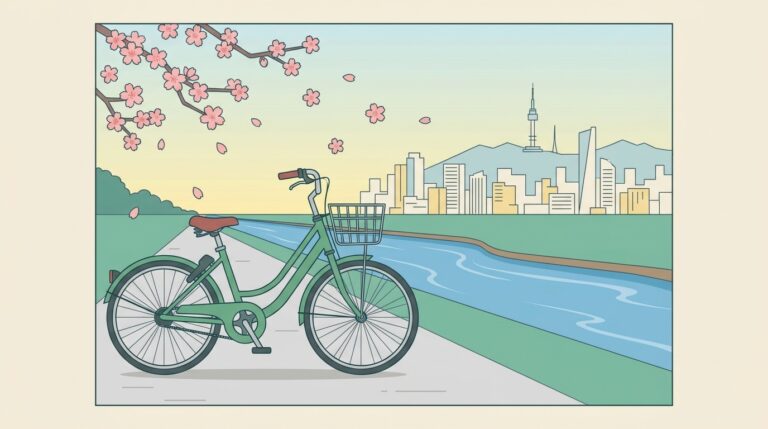
Imagine this: It’s a breezy Friday evening at Yeouido Hangang Park. The golden hour hits perfectly, and the sunset reflects off the Han River. You see groups of locals breezing past you on identical green bicycles. It looks straight out of a K-Drama—maybe a scene from Extraordinary Attorney Woo or Crash Landing on You.
You decide to join the vibe. You walk up to a row of these green bikes, known as ‘Ttareungi’ (따릉이), Seoul’s pride and joy of public transportation. You download the app, tap a few buttons, and suddenly… nothing happens. The bike won’t unlock. The app flashes a Korean error message. People are waiting behind you, and panic sets in.
Don’t worry! This is a rite of passage for every expat and traveler in Seoul. Today, we’re going to master the C1-level nuances of renting a Ttareungi, dealing with tech glitches in Korean, and embracing the Han River cycling culture. Everything here is based on the real ‘pain points’ my advanced students face when trying to navigate Seoul’s public tech infrastructure.
Phase 2: Core Expressions Deep Dive
To master Seoul’s bike-sharing system, you need more than just “I want to ride a bike.” You need the administrative and tech-troubleshooting vocabulary that Koreans use daily.
1. 앱이 먹통이에요.
- Pronunciation: aebi meoktong-ieyo [aeb-i meok-tong-ee-eh-yo] (‘meok’ sounds like the ‘muck’ in muckraker)
- Meaning: The app is unresponsive / The app is frozen.
- K-Culture Moment: You’re standing at the bike rack scanning the QR code, but the loading wheel just keeps spinning. You look at your friend and say this. It’s the ultimate native-sounding complaint for any tech failure.
- Editor’s Insight: Forget the textbook phrase “작동하지 않습니다” (does not operate). ‘먹통’ (meoktong) originally meant an ink-line box used by carpenters, but in modern slang, it means a piece of technology has become totally unresponsive—like a brick.
- Situation Spectrum:
- Friends (Casual): ✅ (앱 먹통이야!)
- Coworkers (Semi-formal): ✅ (앱이 먹통이네요.)
- Customer Service (Formal): ⚠️ (Better to say: 앱이 멈췄어요 / 작동을 안 해요)
- 🤔 Think About It: Why do Koreans use physical, tangible words like ‘먹통’ (ink block) or ‘다운되다’ (to go down) for digital errors? Does your native language also use physical metaphors for software crashes?
2. 잠금장치가 안 풀려요.
- Pronunciation: jamgeumjangchi-ga an pullyeoyo [jam-geum-jang-chee-ga ahn pool-lyeo-yo]
- Meaning: (Literal) The locking device isn’t being unfastened. / (Real Nuance) The lock won’t open.
- K-Culture Moment: You rented the bike, heard the ding, but the physical lock on the back wheel is stuck.
- Editor’s Insight: Notice the C1-level grammar here. We don’t say “내가 못 열어요” (I can’t open it). We use the passive voice (피동형) ‘풀리다’ (to be unfastened). In Korean, when things don’t work as they should, we subtly shift the blame to the object itself. It’s less confrontational and sounds 100% natural.
- Situation Spectrum:
- Friends (Casual): ✅
- Coworkers (Semi-formal): ✅
- Customer Service (Formal): ✅
- 🤔 Think About It: Shifting the subject from ‘I’ to ‘the lock’ changes the tone from personal failure to an objective observation. How does this reflect the Korean preference for indirectness in problem-solving?
3. 반납 처리가 안 됐어요.
- Pronunciation: bannap cheori-ga an dwaesseoyo [bahn-nahp cheo-ree-ga ahn dwae-sseo-yo]
- Meaning: (Literal) The return processing didn’t happen. / (Real Nuance) The return didn’t go through / It didn’t register my return.
- K-Culture Moment: You pushed the lock down to return the bike, walking away to grab some fried chicken (Chimaek!), but your phone doesn’t give you the standard “Return complete” KakaoTalk message. If you ignore this, you’ll be charged extra!
- Editor’s Insight: The word ‘처리’ (processing/handling) is the backbone of Korean adulting. Whether you are dealing with a refund, a bike return, or a bank transfer, things aren’t just ‘done’ in Korea—they are ‘processed’ (처리되다). Master this word, and your Korean instantly jumps to an advanced level.
- Situation Spectrum:
- Friends (Casual): ✅
- Coworkers (Semi-formal): ✅
- Customer Service (Formal): ✅
Phase 3: Textbook vs. Real Korean
[Situation 1: Asking if someone is using a parked bike]
* 📖 Textbook Korean: 이 자전거는 사용 중입니까? (Is this bicycle currently in use?)
* 🗣️ Real Korean: 이거 쓰시는 거예요? (Are you using this?)
* 💡 Why the difference?: Koreans prioritize the person over the object. Using the honorific ‘-시-‘ for the other person’s action is much softer and more polite than stiffly asking about the bicycle’s ‘status’.
[Situation 2: Telling your friend you’ll lock the bike temporarily to go into a convenience store]
* 📖 Textbook Korean: 저는 자전거를 잠시 잠그겠습니다. (I will lock the bicycle briefly.)
* 🗣️ Real Korean: 나 잠깐 임시 잠금 해둘게. (I’ll put it on temp lock for a sec.)
* 💡 Why the difference?: Ttareungi has a specific feature called ‘임시 잠금’ (temporary lock). Adding ‘-아/어 두다’ (to do something in advance/maintain a state) is crucial for showing that you intend to come back to it.
Bottom Note: At the
C1 (Upper-Intermediate/Advanced)level, mastering compound verbs like ‘-아/어 두다’ (해두다, 잠가 두다) and administrative nouns (처리, 임시) is the secret to sounding like a true Seoulite.
Phase 4: Cultural Context — K-Culture Deep Dive
4-1. Non-Verbal Nunchi at the Ttareungi Station
In Korea, leaving your personal belongings (like a laptop or a bag) on a cafe table is perfectly safe. But public goods? That’s a different story. If there is only one Ttareungi left at a station, and someone is walking toward it, it’s a silent race. However, if they are already standing next to it wrestling with their app, Nunchi (눈치) dictates that you do not scan the QR code before them. You politely wait or ask, “혹시 이거 타실 거예요?” (Are you planning to ride this?).
4-2. The Han River & K-Drama Connection
Riding a bike along the Han River is almost a mandatory K-Drama trope. Think of the refreshing breeze, the protagonist reflecting on their life choices, or a sweet romantic date. But here is the reality check: K-Drama characters never seem to sweat, and they certainly never struggle with the Ttareungi app!
Furthermore, the ultimate reward for your Ttareungi ride is Chimaek (치맥 – Chicken & Maekju/Beer). The cultural ritual is: Ride from Mapo to Yeouido, get completely exhausted, return the bike properly (반납 처리 완료!), and immediately undo all your healthy exercise by eating crispy fried chicken on a picnic mat.
Phase 5: Interactive Roleplay Scenario
Setting: Friday evening, 6:30 PM. Yeouido Hangang Park. You and your Korean coworker, Min-su, just got off work. You both agreed to ride Ttareungi to a famous Chimaek spot down the river. The weather is perfect, but the Ttareungi station only has two bikes left.
Characters:
– YOU: An expat working in Seoul, proud of your C1 Korean skills.
– Min-su (32): Your friendly, slightly impatient coworker who loves food more than exercise.
Dialogue:
Min-su: 아, 다행이다. 딱 두 대 남았네요! 얼른 빌리죠. 🚲
(A, dahaengida. Ttak du dae namatneyo! Eolleun billijo.)
[Ah, thank god. Exactly two left! Let’s rent them quickly.]
(🎭 Stage Direction: Min-su rushes over and starts scanning the QR code on his phone)
YOU: 과장님, 저는 벌써 대여 성공했어요. (Click!)
(Gwajangnim, jeoneun beolsseo daeyeo seonggonghaesseoyo.)
[Min-su, I already succeeded in renting mine.]
Min-su: 어? 잠시만요. 왜 안 되지? 아… 앱이 또 먹통이에요.
(Eo? Jamsimanyo. Wae an doeji? A… aebi tto meoktong-ieyo.)
[Huh? Wait a second. Why isn’t it working? Ah… the app is frozen again.]
(🎭 Stage Direction: Min-su frantically taps his screen, sighing)
Min-su: 아예 화면이 안 넘어가네요. 제 폰이 이상한가?
(Aye hwamyeoni an neomeoganeyo. Je poni isanghanga?)
[The screen isn’t turning over at all. Is my phone acting weird?]
🔀 Your Turn! How do you respond?
– A) “그럼 그냥 걸어갈까요? 배고픈데…” (Shall we just walk then? I’m hungry…)
– B) “제 폰으로 한 대 더 대여해 볼게요. (선물하기 기능)” (I’ll try renting one more with my phone using the gift feature.)
– C) “빨리 고객센터에 전화해서 따지세요!” (Call customer service quickly and complain!)✅ Best Choice: B — Ttareungi actually has a feature where you can rent for someone else (선물하기) or you can suggest a practical tech workaround. It shows deep familiarity with Korean app culture!
⚠️ Choice C Analysis: Telling a coworker to ‘complain’ (따지다) aggressively is way too intense for a relaxing Friday evening. Plus, calling customer service over a frozen app isn’t the “Palli-Palli” (hurry up) way—restarting the app is!
YOU: 앱 한 번 껐다가 다시 켜보세요. 결제 오류일 수도 있어요.
(Aep han beon kkeotdaga dasi kyeoboseyo. Gyeolje oryu-il sudo isseoyo.)
[Try closing the app and turning it on again. It might be a payment error.]
Min-su: 오, 다시 켰더니 되네요! 자, 잠금장치 풀렸습니다. 출발할까요?
(O, dasi kyeotdeoni doeneyo! Ja, jamgeumjangchi pullyeotseumnida. Chulbalhalkkayo?)
[Oh, it works after I restarted it! Alright, the lock is released. Shall we head out?]
YOU: 치맥이 우리를 기다립니다. 가시죠! 🍗🍻
(Chimaegi urireul gidarimnida. Gasijo!)
[Chimaek is waiting for us. Let’s go!]
Phase 6: 10-Second Shadowing Drill
Let’s practice the rhythm of complaining about a tech glitch like a native. Notice how we drag out the ‘아’ for frustration, and slightly raise the end to soften the complaint.
😅 아... / 반납 처리가 / 안 된 것 / 같은데요? ⤴️
(Ah... / bannap cheori-ga / an doen geot / gateundeyo?)
Director’s Note: Sound slightly confused rather than angry. Tilting your head a little while saying this will make you look 100% local!
Phase 7: K-Culture Mini Dictionary
| 한국어 | Romanization | English | Context |
|---|---|---|---|
| 따릉이 | ttareungi | Seoul Public Bike | The official name sounds like a bike bell ringing (“Ring-ring”). |
| 먹통 | meoktong | Frozen/Unresponsive | Used for phones, apps, or even people who aren’t paying attention! |
| 임시 잠금 | imsi jamgeum | Temporary Lock | Essential feature if you need to run into a bathroom or store without ending your rental. |
| 반납 처리 | bannap cheori | Return Processing | The holy grail phrase of Korean admin. Always wait for the KakaoTalk notification confirming this! |
| 치맥 | chimaek | Chicken & Beer | The ultimate post-Han River bike ride reward. |
Phase 8: Traveler’s Survival Kit
If you are visiting Seoul and want to ride a Ttareungi, knowing the app is only half the battle. Here are your essential survival phrases:
🆘 Survival Phrase #1: Finding a bike
– 🇰🇷 “근처에 따릉이 대여소 어디 있어요?”
– 🗣️ (geuncheo-e ttareungi daeyeoso eodi isseoyo?)
– 📍 Use this when: Google Maps is confusing you and you need a local’s help.🆘 Survival Phrase #2: Reporting an issue
– 🇰🇷 “이거 고장 난 것 같아요. 체인이 빠졌어요.”
– 🗣️ (igeo gojang nan geot gatayo. chein-i ppajyeosseoyo.)
– 📍 Use this when: You want to warn someone trying to rent a broken bike. (Koreans often turn the seat backward to signal a broken Ttareungi!)🆘 Survival Phrase #3: Payment Troubles
– 🇰🇷 “결제 오류가 자꾸 나는데, 비회원으로도 되나요?”
– 🗣️ (gyeolje oryu-ga jakku naneunde, bihoewon-eurodo doenayo?)
– 📍 Use this when: Asking a friend or tourist info desk if you can rent as a non-member.📌 Editor’s Travel Note
– App Tip: The English version of the Ttareungi app can be notoriously buggy with foreign credit cards. Purchasing a pass via the ‘Discover Seoul Pass’ or using a physical T-money card sometimes bypasses these headaches!
– Secret Code: If you see a Ttareungi parked with its seat completely turned backward, do not rent it. This is the universal street sign among Seoulites that the bike is broken (고장 났다).
Phase 9: Critical Thinking — “One Step Deeper”
Public Tech Language & The ‘Palli-Palli’ Bureaucracy
Have you noticed how formal the language on Korean apps is? Words like 결제 (payment), 해제 (release/cancellation), 처리 (processing), and 승인 (approval) are deeply rooted in Sino-Korean (Hanja) administrative vocabulary. While an English app might simply say “You’re all set!” or “Unlock,” Korean apps use terminology that sounds like you are filing paperwork at a government office.
This reflects Korea’s hyper-efficient, highly organized digital infrastructure. In a society where everything is automated and moves at ‘Palli-Palli’ (hurry up) speed, precision and clear administrative states (Processed vs. Unprocessed) are valued over casual user-friendliness. The language guarantees trust: if it says ‘처리 완료’ (Processing Complete), you know you won’t be charged extra.
💬 Your Turn: Does your country’s public transportation apps use casual, friendly language, or strict administrative terms? Let us know in the comments!
Phase 10: FAQ & Avoiding Mistakes
Q: Can I just leave the Ttareungi anywhere when I’m done?
No! This is a huge misconception. Unlike dockless scooters, Ttareungi must be returned to a designated ‘대여소’ (Rental Station). If you leave it randomly on the street, you’ll be hit with an extra fee, and you might even face a penalty.
Q: What if I have to go to the bathroom during my ride?
Use the ‘임시 잠금’ (Temporary Lock) feature. Just push down the lever on the back tire. But remember, your rental time is still ticking!
❌ Common Mistake: Forgetting to check KakaoTalk for the return confirmation.
✅ Do this instead: Always listen for the voice prompt saying “반납되었습니다” (It has been returned) from the bike’s speaker, AND check your phone for the confirmation message. If you don’t hear it, the lock might not be fully engaged!
Phase 11: Summary & Action Items
One-Liner Summary: To survive Seoul’s Ttareungi system, master the passive voice for broken parts (안 풀려요), use administrative nouns for the app (처리, 오류), and always lock it properly!
Action Mission 3 Steps:
– 🥉 Bronze (Solo): Say “아, 앱이 먹통이에요” out loud 3 times next time your phone freezes.
– 🥈 Silver (Online): Comment below with your favorite place to ride a bike in your city, using Korean!
– 🥇 Gold (Real World): Rent a Ttareungi in Seoul, use ‘임시 잠금’ to grab a coffee, and successfully complete your ‘반납 처리’!
K-Culture Mission:
Find a Han River bike riding scene in a K-Drama (like Crash Course in Romance or Doona!). Do they show the character struggling with the app? (Spoiler: They never do!).
Phase 12: Quiz — Interactive Challenge
1. Situational Judgment: You want to run into a CU convenience store for 5 minutes, but you want to keep riding your Ttareungi afterward. What should you do?
– A) 반납 처리 (Return processing)
– B) 임시 잠금 (Temporary lock)
– C) 고객센터 문의 (Customer service inquiry)
(Answer: B. If you do A, someone else might rent it while you’re buying snacks!)
2. Fill in the Blank:
“The QR code isn’t scanning. I think my app is frozen.”
“QR 스캔이 안 되네요. 제 앱이 [ ________ ]인가 봐요.”
(Answer: 먹통)
3. True or False — K-Culture Edition:
If a Ttareungi’s seat is turned 180 degrees backward at a station, it means the bike is reserved for someone else. (T/F)
(Answer: False. It is a social cue that the bike is broken/고장 났다. Don’t rent it!)
Frequently Asked Questions (FAQ)
Q: What does "앱이 먹통이에요." mean in Korean and how do you pronounce it?
A: In Korean, "앱이 먹통이에요." is pronounced [aebi meoktong-ieyo [aeb-i meok-tong-ee-eh-yo] and means: The app is unresponsive / The app is frozen.
Q: What does "잠금장치가 안 풀려요." mean in Korean and how do you pronounce it?
A: In Korean, "잠금장치가 안 풀려요." is pronounced [jamgeumjangchi-ga an pullyeoyo [jam-geum-jang-chee-ga ahn pool-lyeo-yo] and means: (Literal) The locking device isn't being unfastened. / (Real Nuance) The lock won't open.
Q: What does "반납 처리가 안 됐어요." mean in Korean and how do you pronounce it?
A: In Korean, "반납 처리가 안 됐어요." is pronounced [bannap cheori-ga an dwaesseoyo [bahn-nahp cheo-ree-ga ahn dwae-sseo-yo] and means: (Literal) The return processing didn't happen. / (Real Nuance) The return didn't go through / It didn't register my return.







