

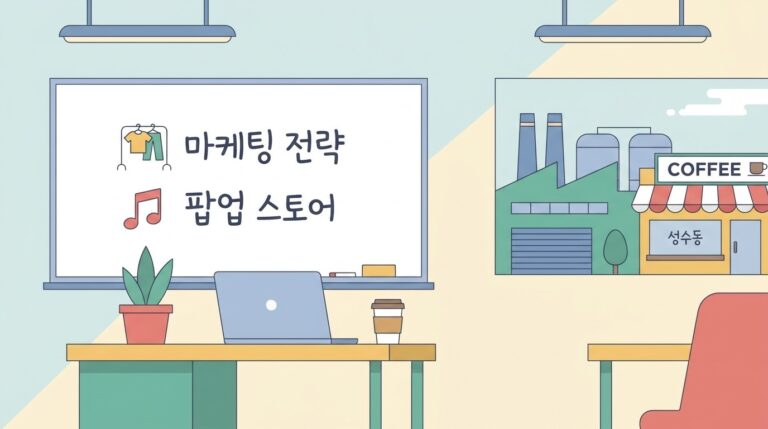
Phase 1: Empathy & K-Culture Cold Open
Hello there! It’s your lead editor from Daily Hangul.
Picture this: You are watching an incredibly tense K-Drama. The lead detective has finally cornered the serial killer. The music swells, the rain pours down, and suddenly… the detective pauses, pulls out a bright red pouch of red ginseng extract, says “Ah, I need to recharge my energy for this,” and slurps it while staring directly into the camera.
Did your immersion just shatter into a million pieces? Welcome to the infamous world of forced K-Drama PPL (Product Placement).
As advanced (C2) Korean learners and professionals, you already know how to talk about business. But how do you eloquently critique why a marketing campaign succeeded brilliantly or failed miserably in Korea? How do you explain why Gen Z consumers in Seoul will wait three hours in the freezing cold for a quirky pop-up store, but absolutely boycott a multi-million-dollar ad campaign because it felt “fake”?
Today, we aren’t just learning business vocabulary. We are diving into the psychology of K-Marketing and Storytelling. These are the exact phrases I hear at high-end marketing agencies in Seongsu-dong when dissecting what makes Korean consumers tick. Let’s upgrade your professional fluency!
Phase 2: Core Expressions Deep Dive
1. 억지 감동을 쥐어짜다 (To squeeze out forced emotion)
- Pronunciation: [eokji gamdong-eul jwieojjada] — ‘eok’ sounds like the grunt you make when someone bumps into you.
- Meaning: Literal: To squeeze out forced emotion. / Real nuance: Relying on cheap, overly melodramatic tropes to force the audience to cry or feel moved.
- K-Culture Moment: In the Korean film and ad industry, there is a term called ‘Shinpa’ (신파). It refers to forced, tear-jerking melodrama. When a brand tries to tell a “sad but inspiring” story about a struggling family just to sell life insurance, and it feels completely inauthentic, Korean viewers will immediately call this out.
- Editor’s Insight: This is a fantastic, highly visual expression for critique. 쥐어짜다 means to wring something out (like a wet towel). It implies the emotion isn’t flowing naturally; the brand is aggressively wringing it out of the audience.
- Situation Spectrum:
- Casual with friends/colleagues: ✅
- Semi-formal (Brainstorming meeting): ✅
- Highly Formal (Client presentation): ⚠️ (A bit too aggressive; use “작위적이다” – contrived – instead)
- 🤔 Think About It: Why are Korean consumers so sensitive to ‘forced emotion’? Historically, Korean media heavily utilized Han (deep sorrow) to connect with audiences. But as the society modernized, younger generations began to value wit, irony, and authenticity over traditional tear-jerkers. Does your culture have a similar term for “milking” emotions?
2. 세계관에 과몰입하다 (To become hyper-immersed in the universe/lore)
- Pronunciation: [segyegwan-e gwamoripada] — ‘gwa’ sounds like the start of ‘guacamole’.
- Meaning: Literal: To over-immerse in a worldview. / Real nuance: To enthusiastically buy into and play along with a brand or idol group’s fictional universe.
- K-Culture Moment: Think of K-Pop groups like EXO (who came from exoplanets with superpowers) or aespa (with their AI avatars). But this isn’t just for K-Pop! Binggrae (a classic Korean dairy brand) created “Binggraeus,” an anime-style prince heir to the Binggrae Kingdom on Instagram. Consumers loved it and acted like his loyal subjects in the comments. That is 과몰입.
- Editor’s Insight: 과 (Over/Hyper) + 몰입 (Immersion). In marketing, this is the holy grail. You don’t just want customers; you want fans who are 과몰입 in your brand’s storytelling.
- Situation Spectrum:
- Casual with friends: ✅
- Semi-formal (Marketing meeting): ✅
- Highly Formal: ✅ (Widely accepted as a legitimate marketing term now)
- 🤔 Think About It: Why does ‘playful immersion’ work so well in modern Korean marketing? It provides a collective playground. In a highly competitive society, playing pretend in a brand’s whimsical universe offers shared, stress-free escapism.
3. 진정성이 결여되다 / 돋보이다 (To lack / stand out in authenticity)
- Pronunciation: [jinjeongseong-i gyeoryeodoeda / dotboida]
- Meaning: To lack authenticity / To have outstanding authenticity.
- K-Culture Moment: When a beauty brand claims to be “eco-friendly” but wraps its products in layers of unrecyclable plastic, Korean netizens will flood the comments saying, “진정성이 전혀 안 느껴지네요” (I don’t feel any authenticity). On the flip side, when a CEO genuinely apologizes and shows concrete steps for change, their 진정성 is praised.
- Editor’s Insight: 진정성 (Authenticity) is the absolute core metric of modern Korean branding. It’s a sophisticated, C2-level vocabulary word that will make you sound like a true industry expert.
- Situation Spectrum:
- Casual with friends: ⚠️ (A bit too academic for a pub chat)
- Semi-formal: ✅
- Highly Formal (Presentations, reports): ✅
- 🤔 Think About It: In an era of infinite choices and AI-generated content, 진정성 acts as the ultimate filter for trust. How do brands in your home country prove their “진정성”?
Phase 3: Textbook vs. Real Korean
Let’s see how a C2 professional elevates their critique from textbook statements to native-level industry insights.
[Critiquing a Failed Campaign]
* 📖 Textbook Korean: 이 광고는 슬픈 이야기를 써서 효과가 없습니다. (This ad uses a sad story so it is not effective.)
* 🗣️ Real Korean: 완전 억지 신파라서 오히려 역효과가 났네요. (It’s such forced melodrama that it actually backfired.)
* 💡 Why the difference?: Using words like 신파 (melodrama) and 역효과 (backfire/adverse effect) demonstrates a deep understanding of market reactions rather than just stating a fact.
[Praising a Successful Brand Persona]
* 📖 Textbook Korean: 고객들이 이 브랜드의 이야기를 아주 좋아합니다. (Customers really like this brand’s story.)
* 🗣️ Real Korean: 타겟층이 브랜드 세계관에 완벽하게 과몰입했네요. (The target audience is perfectly hyper-immersed in the brand’s universe.)
* 💡 Why the difference?: 세계관 (universe) and 과몰입 (hyper-immersion) are the exact buzzwords dominating Korean marketing strategies right now.
[Evaluating Greenwashing or Fake Marketing]
* 📖 Textbook Korean: 이 회사는 거짓말을 해서 이미지가 나빠졌습니다. (This company lied, so its image got bad.)
* 🗣️ Real Korean: 메시지에 진정성이 결여되어서 소비자들의 외면을 받은 거죠. (The message lacked authenticity, which is why consumers turned their backs on it.)
* 💡 Why the difference?: 진정성의 결여 (lack of authenticity) and 외면을 받다 (to be ignored/turned away from) are highly refined, formal expressions perfect for critical business analysis.
Bottom Note: At the C2 level, your goal is precision. Choosing words like 역효과 instead of just 안 좋다 instantly establishes your professional credibility in Korea.
Phase 4: Cultural Context — K-Culture Deep Dive
4-1. The Non-Verbal Nuance of Critique
When critiquing a campaign in a Korean office setting, Nunchi (눈치) is crucial. Even if an idea is terrible, you rarely attack it directly right away. A native professional will often tilt their head slightly, suck in a little breath through their teeth (the classic ‘쓰으읍…’ sound), and say, “스토리텔링은 좋은데… 진정성 면에서는 조금 리스크가 있지 않을까요?” (The storytelling is good, but… wouldn’t there be a bit of a risk regarding authenticity?). Softening the blow while maintaining a sharp critique is an art form.
4-2. The “Universe” (세계관) Phenomenon in K-Culture
If you want to understand modern Korean storytelling marketing, look at K-Pop.
The concept of a 세계관 (Lore/Universe) started with idol groups creating intricate sci-fi or fantasy storylines for their albums. Fans didn’t just listen to the music; they decoded music videos and wrote theories.
Marketers realized this interactive, puzzle-solving approach creates fiercely loyal consumers. Now, Korean convenience stores (like CU or GS25) create animated characters with complex backstories. Pop-up stores in Seongsu-dong aren’t just selling products; they require you to “enter a secret laboratory” or “solve a mystery” to get a sample. In Korea, if your brand doesn’t have a 세계관, you are just a commodity. If you have a 세계관, you are an experience.
Phase 5: Real-World Roleplay Scenario
Setting: A chic, minimalist meeting room in a Seongsu-dong marketing agency. Iced Americanos are sweating on the glass table. You are leading a post-mortem meeting on a competitor’s recent, highly controversial ad campaign.
Characters:
* YOU: Senior Marketer. Sharp, observant, but collaborative.
* Jimin (29): Your Art Director. Trendy, heavily invested in internet culture, speaks in a mix of professional jargon and Gen Z slang.
Dialogue:
지민: 팀장님, A사 이번 캠페인 보셨어요? 유튜브 댓글 창 완전 난리 났던데요.
(Timjangnim, A-sa ibeon kaempein bosyeosseoyo? Yutyubeu daetgeul chang wanjeon nalli natdeondeyo.)
[Team Leader, did you see Company A’s campaign this time? The YouTube comment section is an absolute mess.]
(🎭 Stage Direction: Jimin aggressively scrolls through her iPad and slides it across the table to you)
YOU: 봤어요. 인플루언서들 앞세워서 감성 마케팅하려고 한 것 같던데.
(Bwasseoyo. Inpeullueonseodeul apsewoseo gamseong maketingharyeogo han geot gatdeonde.)
[I saw it. Seems like they tried to do emotional marketing by putting influencers at the forefront.]
지민: 맞아요. 근데 스토리가 너무 작위적이지 않아요?
(Majayo. Geunde seutorigaa neomu jagwijeogiji anayo?)
[Exactly. But isn’t the story too contrived?]
YOU: 그러니까요. 갑자기 환경 보호를 운운하는 게 진정성이 너무 결여되어 보이더라고요.
(Geureonilkkayo. Gapjagi hwangyeong bohoreul ununhaneun ge jinjeongseongi neomu gyeoryeodoeeo boideoragoyo.)
[Exactly. Suddenly bringing up environmental protection made it look like it completely lacked authenticity.]
지민: 네, 네! 소비자들도 바보가 아닌데 말이죠. 차라리 처음부터 유쾌한 세계관으로 갔으면 어땠을까요?
(Ne, ne! Sobijadeuldo baboga aninde marijo. Charari cheoeumbuteo yukaehan segyegwaneuro gasseumyeon eottaesseulkkayo?)
[Yes, yes! Consumers aren’t stupid, you know. What if they had just gone with a fun ‘universe/lore’ concept from the start?]
YOU: 제 생각도 그래요. 억지 감동을 쥐어짜려다가 오히려 역효과만 났어요.
(Je saenggakdo geuraeyo. Eokji gamdongeul jwieojjaryeodaga ohiryeo yeokhyokwaman nasseoyo.)
[I think so too. They tried to wring out forced emotion, but it just backfired.]
지민: 그럼 우리는 다음 달 B브랜드 팝업 기획할 때 어떤 방향으로 가는 게 좋을까요?
(Geureom urineun daeum dal B beuraendeu pabeop gihoekhal ttae eotteon banghyangeuro ganeun ge joeulkkayo?)
[So, which direction should we take when planning Brand B’s pop-up next month?]
🔀 Your Turn! How do you respond as the savvy Senior Marketer?
– A) “그냥 예쁘게 꾸미고 샘플이나 많이 나눠줍시다.” (Let’s just decorate it nicely and give out lots of samples.)
– B) “타겟층이 자발적으로 과몰입할 수 있는 디테일한 세계관을 기획해 봅시다.” (Let’s plan a detailed universe that the target audience can voluntarily hyper-immerse themselves in.)
– C) “우리도 무조건 슬픈 스토리로 대박을 터뜨려 봅시다.” (Let’s also hit the jackpot with an unconditionally sad story.)✅ Best Choice: B — Reason: You are directly applying the lessons from the failed campaign. By suggesting a detailed 세계관 (universe) that encourages 과몰입 (hyper-immersion), you are speaking the exact language of top-tier Korean marketers today.
⚠️ Choice A Analysis: This is considered “lazy marketing” in Korea today. Consumers want experiences, not just freebies.
Phase 6: 10-Second Shadowing Drill
Let’s perfect that C2-level professional cadence. Speak this aloud, paying attention to the pauses (/) and the intonation!
😤 억지 감동을 / 쥐어짜는 스토리텔링은 / 이제 소비자들에게 / 외면받기 쉽습니다.
(eokji gamdong-eul / jwieojjaneun seutoritelling-eun / ije sobijadeul-ege / oemyeonbatgi swipseumnida.)
[Storytelling that wrings out forced emotion / is now easy for consumers / to turn away from.]
Tip: Keep your voice steady and authoritative. Drop your pitch slightly at the end of “쉽습니다” to sound like an absolute expert.
Phase 7: K-Culture Mini Dictionary
Here are some indispensable terms for analyzing Korean marketing and consumer behavior:
| 한국어 (Korean) | Romanization | English | 맥락 설명 (Context) |
|---|---|---|---|
| 세계관 | segyegwan | Brand Universe / Lore | Originally a philosophical term, now refers to the fictional narrative or universe a brand/idol creates. |
| 과몰입 | gwamorip | Hyper-immersion | The act of heavily investing emotionally and playfully into a brand’s universe or a TV show. |
| 신파 | sinpa | Forced Melodrama | Over-the-top, tear-jerking storytelling. Highly criticized by modern Korean audiences. |
| 돈쭐내다 | donjjullaeda | To “scold” with money | A slang term where consumers collectively buy out a store to reward an owner for a good deed or authentic behavior. |
| 어그로를 끌다 | eogeuro-reul kkeulda | To clickbait / provoke | Using provocative, sensational methods to grab attention. Often ruins brand authenticity. |
Phase 8: Traveler Survival Kit (Pop-Up Edition)
If you want to witness Korean storytelling marketing in action, you MUST visit the pop-up stores in Seongsu-dong or The Hyundai Seoul. It is the ultimate battlefield of brand universes. Here is your survival kit for navigating these experiences.
🆘 Survival Phrases for Pop-Up Stores
🇰🇷 1. “웨이팅 등록은 어디서 하나요?” (weiting deungnogeun eodiseo hanayo?)
– 🗣️ Meaning: Where do I register for the waiting list?
– 📍 Context: Korean pop-ups almost never let you just walk in. You must register your phone number on a tablet (CatchTable / Tabling).🇰🇷 2. “이거 팝업 한정 굿즈인가요?” (igeo pabeop hanjeong gutjeuingayo?)
– 🗣️ Meaning: Is this merchandise exclusive to the pop-up?
– 📍 Context: Brands love ‘limited edition’ (한정판) storytelling.🇰🇷 3. “스탬프 미션 다 모았는데, 어디로 가면 되나요?” (seutaempeu misyeon da moanneunde, eodiro gamyeon doenayo?)
– 🗣️ Meaning: I collected all the mission stamps, where should I go?
– 📍 Context: To enforce 과몰입 (immersion), brands make you complete ‘missions’ (post on IG, play a game) to get a stamp.
📌 Editor’s Travel Note:
– The Waiting Culture: If a pop-up in Seongsu is famous, people will do an “Open Run” (오픈런) — lining up before the store opens.
– The CatchTable Dilemma: Many tablet waitlist systems require a Korean phone number. Don’t panic! Politely find a staff member and ask: “제가 외국 번호밖에 없는데, 현장 대기 되나요?” (I only have a foreign number, can I wait in person?). They usually have a manual workaround!
Phase 9: Critical Thinking — “One Step Deeper”
🧠 Think Deeper: Corporate Personas and the 반말 (Casual Language) Controversy
In the quest for “authenticity” and “intimacy,” many Korean brands have adopted a highly informal, conversational tone on social media, often using 반말 (casual speech) to speak to consumers as if they are close friends. While this can successfully build a fun, engaging 세계관 (universe), it frequently sparks controversy regarding Language & Power in Korea.
Korean is a language deeply rooted in respect and hierarchy. When a massive corporation uses 반말 to a consumer, is it breaking down barriers, or is it an arrogant overstep? Several brands have faced fierce backlash for “crossing the line” (선을 넘다) and lacking basic manners in the name of trendy marketing. It proves that in Korea, true authenticity isn’t just about sounding cool—it’s about understanding the subtle boundaries of respect (Nunchi).
💬 Your Turn: Have brands in your country changed the way they speak to consumers online? Do you prefer a professional brand voice, or one that sounds like a sassy teenager? Share your thoughts below!
Phase 10: FAQ & Common Mistakes
Q: “Can I say ‘진정성’ when talking about a person, not just a brand?”
Absolutely! You can say “그 사람의 사과에는 진정성이 느껴졌어요” (I could feel the authenticity in his apology). It is a highly respected trait in Korean interpersonal relationships.
Q: “Is ‘신파’ always a bad thing?”
Historically, no. It was a beloved genre. But in modern marketing and film criticism, saying something is “신파적이다” (Shinpa-esque) is almost always a negative critique of laziness.
❌ Common Mistake #1: Confusing 비판하다 (to critique/constructively criticize) with 비난하다 (to condemn/blame).
✅ How to fix it: In a meeting, you are providing 비판 (criticism of the strategy), not 비난 (attacking the person). E.g., “이 캠페인에 대해 비판적인 시각을 가져보자면…” (If we take a critical view of this campaign…)❌ Common Mistake #2: Using ‘과몰입’ in a highly rigid, traditional corporate environment (like a bank’s board meeting) to describe board members.
✅ How to fix it: ‘과몰입’ is slightly informal and trendy. Use it to describe consumer behavior or pop culture, not your CEO’s dedication to a financial spreadsheet.
Phase 11: Summary & Action Items
- One-Liner Summary: To critique Korean marketing like a pro, look beyond the surface and analyze if a brand’s 세계관 (universe) inspires genuine 과몰입 (immersion), or if it just wrings out forced 신파 (melodrama) without 진정성 (authenticity).
🔥 Action Mission 3-Steps:
* 🥉 Bronze (Solo): Look at a recent ad from your favorite brand and describe its 진정성 out loud in Korean using today’s phrases.
* 🥈 Silver (Online): Find a Korean TV commercial on YouTube and leave a C2-level comment: “스토리텔링이 훌륭해서 과몰입하게 되네요!”
* 🥇 Gold (Real World): Visit a pop-up store (or watch a Seongsu-dong vlog) and analyze the brand’s 세계관 in a short Korean diary entry.
🎬 K-Culture Mission:
Next time you watch a K-Drama and a sudden, awkward PPL appears, shout at the screen: “아, 진짜 억지스럽네! 몰입 깨진다!” (Ah, that’s so forced! It breaks my immersion!)
Phase 12: Interactive Quiz
1. Situational Judgment:
You are evaluating a competitor’s campaign where they lied about donating profits to charity to boost sales. What is the most sophisticated C2-level critique?
* A) 진짜 나쁜 회사네요. (They are a really bad company.)
* B) 스토리텔링에 진정성이 완전히 결여되었습니다. (Their storytelling completely lacks authenticity.)
* C) 너무 세계관에 과몰입했어요. (They hyper-immersed too much in their universe.)
2. True or False – K-Culture Edition:
In modern Korean pop-up stores, the ultimate goal is usually just to make you buy the product as quickly as possible and leave. (T/F)
3. Fill in the Blank:
요즘 Z세대 소비자들은 브랜드가 만든 재미있는 [ ________ ]에 기꺼이 동참하며 놀이를 즐깁니다.
(These days, Gen Z consumers willingly participate and play along in the fun [ ________ ] created by brands.)
👀 Click here for answers!
1. B (Perfect use of high-level vocabulary to point out the fake marketing.)
2. False (The goal is ‘과몰입’ — keeping you in their ‘universe’ playing games and taking photos so you organically share it on Instagram.)
3. 세계관 (Universe/Lore. It provides the playground for the consumers!)
Did you enjoy today’s deep dive into Korean marketing psychology? Which brand do you think has the best ‘세계관’? Drop a comment below!
Frequently Asked Questions (FAQ)
Q: What does "억지 감동을 쥐어짜다 (To squeeze out forced emotion)" mean in Korean and how do you pronounce it?
A: In Korean, "억지 감동을 쥐어짜다 (To squeeze out forced emotion)" is pronounced [eokji gamdong-eul jwieojjada] and means: Literal: To squeeze out forced emotion. / Real nuance: Relying on cheap, overly melodramatic tropes to force the audience to cry or feel moved.
Q: What does "세계관에 과몰입하다 (To become hyper-immersed in the universe/lore)" mean in Korean and how do you pronounce it?
A: In Korean, "세계관에 과몰입하다 (To become hyper-immersed in the universe/lore)" is pronounced [segyegwan-e gwamoripada] and means: Literal: To over-immerse in a worldview. / Real nuance: To enthusiastically buy into and play along with a brand or idol group's fictional universe.
Q: What does "진정성이 결여되다 / 돋보이다 (To lack / stand out in authenticity)" mean in Korean and how do you pronounce it?
A: In Korean, "진정성이 결여되다 / 돋보이다 (To lack / stand out in authenticity)" is pronounced [jinjeongseong-i gyeoryeodoeda / dotboida] and means: To lack authenticity / To have outstanding authenticity.







